Seoul · Palace Quarter (Jongno)
Gwanghwamun Square 광화문광장
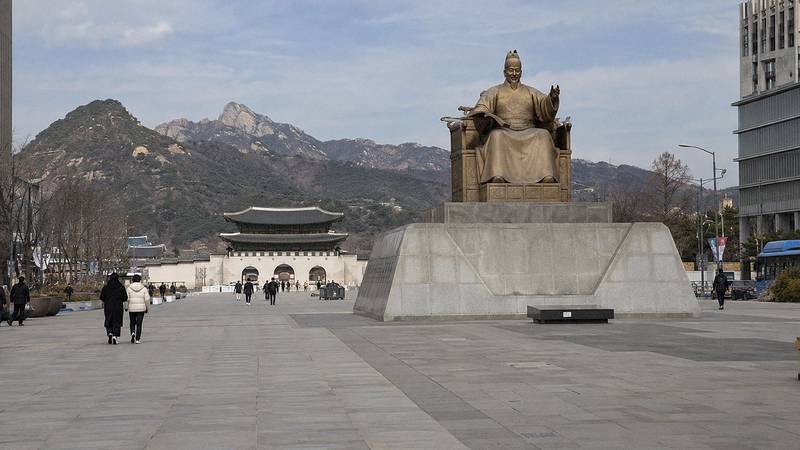
The broad plaza in front of Gyeongbokgung's main gate, with statues of King Sejong and Admiral Yi Sun-sin and the mountains beyond.
Updated
Essentials
- Hours
- Square: open 24 hours, every day
- Sejong Story and Chungmugong Story (underground exhibition): 10:00–18:30, last entry 18:00; until 30 November 2026 open to 21:00 (last entry 20:30) on Tuesdays, Wednesdays, Fridays, Saturdays and Sundays
- Gate guard ritual (파수의식) in front of Gwanghwamun: 11:00 and 13:00, about 10 minutes
- Haechi Madang media wall: 08:00–22:00 daily
- Light of Gratitude light show: 20:00–23:00 (19:00–22:00 in winter), 10 minutes every 30 minutes
- Closed
- The square never closes. Sejong Story and Chungmugong Story close on Mondays (if a Monday is a public holiday they open and close the next day instead).
- Admission
- Free: the square, the underground exhibition and the guard rituals
- Freedom Hall (Garden of Gratitude): self-guided viewing needs no booking
- Getting there
- Subway Line 5, Gwanghwamun Station: Exit 7, or the underground passage straight into Haechi Madang
- Subway Line 3, Gyeongbokgung Station, Exit 6, walking towards the Government Complex and Gwanghwamun Gate
- Airport bus 6002 and many city buses stop along Sejong-daero
- Address
- 172 Sejong-daero, Jongno-gu, Seoul
서울 종로구 세종대로 172 - Website
- gwanghwamun.seoul.go.kr/ghm-eng/main.do
Book your trip
Gwanghwamun Square is free and open 24 hours. It runs south from the main gate of Gyeongbokgung, past the statues of King Sejong and Admiral Yi Sun-sin. Come at 11:00 or 13:00 for the guard ritual at the gate. After dark, beams of light rise from the new Garden of Gratitude. Allow 30 minutes, or 1–1½ hours with the free exhibition under the Sejong statue.
The square sits on the old Yukjo-geori, the “street of six ministries”, where the Joseon government had its offices in front of the palace. It is still Korea’s main civic stage, used for national celebrations, concerts and rallies. Seoul rebuilt it with more trees and fountains and reopened it in August 2022; the royal stone terrace (woldae) in front of the gate has since been restored. For a first visit it works best as the approach to Gyeongbokgung, or as an evening walk after the palace has closed.
When to go
Your plan for the day decides the best time to come, so start here.
| Time | What happens | Good for |
|---|---|---|
| 10:00 or 14:00 | Full Royal Guard Changing Ceremony inside the palace’s first courtyard (20 min) | Pairing with a palace ticket |
| 11:00 or 13:00 | Short guard ritual at Gwanghwamun Gate itself (10 min), free from the square | Seeing the guards without a ticket |
| Sunday 15:00–16:00, spring and autumn | Guard patrol procession from the gate terrace to Insadong (Mar–May, Sep–Nov) | Photos with the guards |
| Tuesday–Sunday daytime | Sejong Story and Chungmugong Story open underground (closed Mondays) | Rainy or very hot days, families |
| After dark | Light of Gratitude beams (from 20:00, or 19:00 in winter) and the Haechi Madang media wall (to 22:00) | Evening walk, night photos |
Times from the Korea Heritage Agency’s guard programme, the Gwanghwamun Square site and Seoul city notices, checked 28 October 2026.
The simplest first-visit plan: walk up the square in the morning, watch the 11:00 ritual at the gate and go into the palace. Gyeongbokgung is closed on Tuesdays, but the underground exhibition is open. On Mondays it is the other way round: the palace is open and the exhibition is closed.
What to see, from the gate southwards
- Gwanghwamun Gate and its terrace. The palace’s main gate, rebuilt on its original site in 2008. The raised stone terrace in front of it is where the guard ritual takes place. See Gyeongbokgung for the palace itself.
- Haechi Madang. An underground lounge below the square, connected by passage to Gwanghwamun Station. A 53-metre media wall shows video art from 08:00 to 22:00 every day.
- King Sejong statue. The large seated bronze of the king who created the Korean alphabet, Hangeul. Models of the sundial, rain gauge and armillary sphere made in his reign stand beside it.
- Sejong Story and Chungmugong Story. Stairs behind the Sejong statue lead to two connected free exhibition halls two floors down. One covers Hangeul and Sejong’s science. The other covers Admiral Yi’s naval battles and has a turtle ship model at 55 percent of full size that you can climb into. You can try on royal or admiral costumes for photos.
- Garden of Gratitude. Opened in May 2026 as a memorial to the countries that fought for South Korea in the Korean War. Its 23 stone pillars, each 6.25 m tall for 25 June 1950, are lined up north to south in the order the countries joined. The United States is at the south end and Korea at the north. Each pillar has the country’s flag and a QR code, so visitors from the US, UK, Australia, Canada, the Philippines and other participating nations can find their own. Freedom Hall, underneath, is a media exhibition about the war and the countries that took part.
- Admiral Yi Sun-sin statue. The standing statue of the admiral at the south end of the square. The Myeongnyang fountain plays around its base in summer.
Hours and admission
| Part | Hours | Notes |
|---|---|---|
| Square | 24 hours, all year | Free |
| Sejong Story / Chungmugong Story | 10:00–18:30 (last entry 18:00) | Closed Mondays; to 21:00 five evenings a week until 30 Nov 2026 |
| Gate guard ritual | 11:00 and 13:00 | About 10 minutes |
| Haechi Madang media wall | 08:00–22:00 daily | – |
| Light of Gratitude | 20:00–23:00 (19:00–22:00 in winter) | 10-minute show every 30 minutes, six a night |
Hours from the Gwanghwamun Square site, the Korea Heritage Agency and Seoul city articles of 12 May, 29 September and 13 October 2026, checked 28 October 2026. The square, the Sejong and Chungmugong exhibition and the guard rituals are free.
Freedom Hall runs guided tours Tuesday to Sunday between 10:00 and 20:00, twelve a day for up to 20 people each. English tours are available, booked on the Seoul Public Service Reservation site. You can also walk through on your own without booking.
Getting there
- Line 5, Gwanghwamun Station. Take Exit 7 towards the square’s forest garden, or follow the underground passage straight into Haechi Madang.
- Line 3, Gyeongbokgung Station. Take Exit 6 and walk towards the Government Complex and Gwanghwamun Gate. This is the better choice if you are starting with the palace.
- By bus. Airport bus 6002 and dozens of city buses stop along Sejong-daero.
The south end of the square meets the start of Cheonggyecheon stream. Walk on south along Sejong-daero for Seoul Plaza and Deoksugung; Jogyesa and Insadong are to the east.
Tips
- Combine it with the palace. The square is the natural approach to Gyeongbokgung and the National Palace Museum. Seoul’s other palaces are covered in palaces of Seoul.
- Weekend events. The square hosts festivals, concerts and markets on many weekends and public holidays, and large gatherings can fill parts of it. The official site’s event calendar lists what is on.
- Rain or heat. Sejong Story, Chungmugong Story, Haechi Madang and Freedom Hall are all underground, so the square still works on a bad-weather day.
- Night photos. Come after the palace has closed for the Light of Gratitude beams and the media wall; the square itself never closes.
- Families. Children can climb into the turtle ship model and, in summer, play in the Hangeul and Myeongnyang fountains.
Nearby
Gyeongbokgung Palace
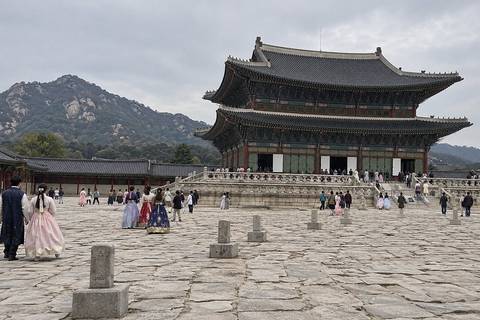
The largest and grandest of Seoul's five Joseon palaces, with the throne hall, a lotus-pond pavilion and the changing of the guard.
National Palace Museum of Korea
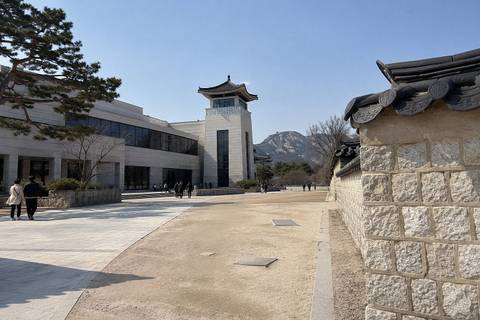
Royal artifacts of the Joseon court and Korean Empire, from thrones and seals to carriages, right beside Gyeongbokgung.
Cheonggyecheon Stream
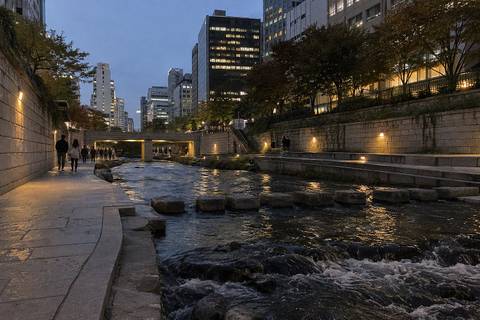
A restored urban stream with walking paths below street level, running east from Gwanghwamun; pleasant on summer evenings.
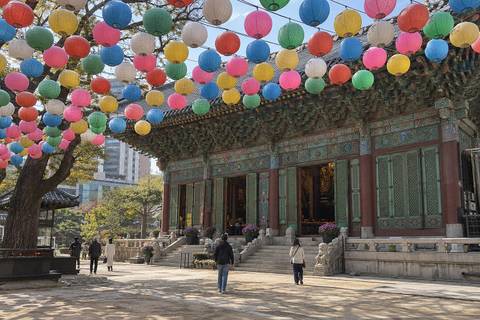
Jogyesa Temple
The head temple of Korea's largest Buddhist order, right in the city center and decked with thousands of lanterns before Buddha's Birthday.
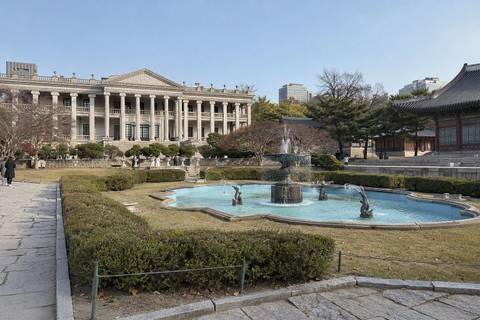
Deoksugung Palace
A compact palace by City Hall mixing Korean halls with early 1900s Western-style stone buildings; its stone-wall road is a classic stroll.
Frequently asked questions
Is Gwanghwamun Square free?
Yes. The square is a public space open 24 hours a day, and the Sejong Story and Chungmugong Story exhibition under the King Sejong statue is free too, as is watching the guard ritual at Gwanghwamun Gate.
What time is the changing of the guard at Gwanghwamun?
At the gate itself, a short guard ritual takes place at 11:00 and 13:00 and lasts about 10 minutes. The full Royal Guard Changing Ceremony, about 20 minutes, is at 10:00 and 14:00 inside the first courtyard of Gyeongbokgung.
Where is the entrance to Sejong Story?
Stairs behind the seated statue of King Sejong lead down to the exhibition, two floors below the square. You can also enter from the basement of the Sejong Center. Sejong Story connects directly to Chungmugong Story, which has a walk-in turtle ship model.
What is the Garden of Gratitude at Gwanghwamun?
A memorial to the countries that fought for South Korea in the Korean War, opened in May 2026. It has 23 stone pillars, 6.25 m high, that send up beams of light at night, and an underground media hall called Freedom Hall. Each pillar carries a country's flag and a QR code.
How long do you need at Gwanghwamun Square?
About 30 minutes to walk the square from the gate to the Admiral Yi statue, or 1–1½ hours if you go down into the Sejong and Chungmugong exhibition. Most visitors combine it with Gyeongbokgung, at the square's north end.
Sources
Facts on this page were checked against these sources on 28 October 2026. Prices, hours and rules change — confirm with the operator before you go.
- Gwanghwamun Square (Seoul Metropolitan Government) – Directions, open 24 hours · official
- 광화문광장 – 오시는 길 (세종대로 172, 연중 24시간 개방) (Korean) · official
- Gwanghwamun Square – Introduction (history and the 2022 reopening) · official
- Gwanghwamun Square – Haechi Lounge Media Window (2026 3rd exhibition, 1 Sep–30 Nov; daily 08:00–22:00) · official
- 광화문광장 – 해치마당 영상창 (2026 세 번째 전시, 매일 08:00~22:00) (Korean) · official
- Gwanghwamun Square – Garden of Gratitude: participating nations, Light of Gratitude, Freedom Hall · official
- 광화문광장 공지사항 – 수경시설 운영시간 조정 안내 (2026-08-03) (Korean) · official
- 광화문광장 행사 – 소상공인과 함께하는 광화문 가을마켓 (~11월 5일, 11:00~22:00) (Korean) · official
- 내 손안에 서울 – 광화문광장 지하 '세종·충무공이야기' (운영시간·휴관일·야간 연장, 2026-09-29) (Korean) · official
- 내 손안에 서울 – 광화문에서 만난 세종대왕과 충무공 이야기 (무료, 월요일 휴관, 2026-10-13) (Korean) · official
- 내 손안에 서울 – 광화문광장 '감사의 정원' 개장 (감사의 빛 23·프리덤 홀·전시해설, 2026-05-12) (Korean) · official
- 내 손안에 서울 – 광화문~서울광장 '세종대로' 산책 코스 (분수, 거북선 모형, 감사의 정원, 2026-07-21) (Korean) · official
- Korea Heritage Agency – Royal Guard Changing Ceremony programme (수문장 교대의식 프로그램 안내) (Korean) · official
- OpenStreetMap – Gwanghwamun Square (coordinates)