Pyeongchang 평창
Pyeongchang is worth one or two nights for snow, skiing and Odaesan's temples. KTX trains reach Jinbu (for Mona Yongpyong and Woljeongsa) in about 1 h 15 min from Cheongnyangni. Mona Yongpyong opens on 22 November 2026, with 2026–27 lift prices not yet posted; Odaesan's high trails close 15 November–15 December 2026.
Updated
Is Pyeongchang worth a night or two?
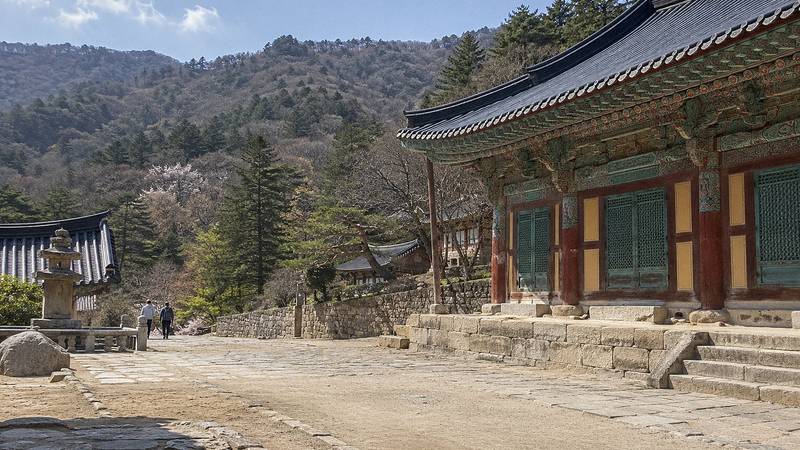
Pyeongchang is a large, thinly populated county of about 40,000 people high in the Gangwon mountains, about 1 h 15 min from Seoul by KTX. It hosted the 2018 Winter Olympics. Come in winter for Korea’s most reliable snow and its biggest ski resorts, or in any season for the fir forest and temples of Odaesan and the highland sheep farms. The sights sit in three separate areas, so the first decision is which one you are going to.
| Your situation | Do this |
|---|---|
| First ski trip, December to February | KTX to Jinbu, taxi to Mona Yongpyong; stay at the resort |
| Want snow scenery, not skiing | Balwangsan cable car at Mona Yongpyong, then the Woljeongsa fir avenue |
| Temples and forest walks | KTX to Jinbu, bus 226 to Sangwonsa, walk down towards Woljeongsa |
| Sheep farm with children | Intercity bus to Hoenggye, taxi to the Daegwallyeong Sheep Farm |
| Snowboarding or the buckwheat village | KTX to Pyeongchang Station for Phoenix and Bongpyeong |
| Hiking 15 November–15 December 2026 | Odaesan’s high trails are closed; stay on the valley paths |
| Here on a Monday | The Olympic Memorial Hall and Lee Hyo-seok’s village are closed |
Facts checked 2 November 2026. For the rest of the province, see the Gangwon guide; for snow elsewhere, Korea in winter.
Ski resorts: which one, and when they open
Pyeongchang’s resorts sit on and around the Daegwallyeong plateau, one of the snowiest areas in Korea. None had published 2026–27 lift prices on 17 November 2026; Mona Yongpyong has fixed its opening day.
| Resort | Slopes | 2025–26 season | 2026–27 | Nearest KTX |
|---|---|---|---|---|
| Mona Yongpyong | 28 slopes, 14 lifts | Opened 21 November 2025 | Opens 22 November 2026 (Pink slope first) | Jinbu, about 20 min by taxi |
| Alpensia | 6 slopes | 4 December – 2 March | Not announced | None nearby; bus to Hoenggye |
| Phoenix Pyeongchang | Not stated | Opened 21 November 2025 | Not announced | Pyeongchang Station |
From the resorts’ Korean pages and Korean press, checked 2 November 2026; Mona Yongpyong updated 17 November 2026. Mona Yongpyong is the biggest and the usual choice for a first trip. Alpensia is small and quieter, and Phoenix is popular with snowboarders. Resorts open a few slopes first and the rest through December. Yongpyong’s rental page says 2026–27 prices will be announced later. This season it sells 4-, 6- and 8-hour lift tickets, with day skiing 08:30–16:30 and night skiing 18:00–22:00; the Mona Yongpyong page has the details and the ski buses.
Mona Yongpyong also runs the Balwangsan Cable Car, which climbs 3.7 km in about 18 minutes to the 1,458 m summit of Balwangsan. It runs 09:00–17:00 (last car down 18:00). A return ticket costs ₩27,000 for adults and ₩23,000 for children, or ₩23,000 and ₩19,000 one way. It is closed on the second and fourth Monday of each month and in strong wind or lightning.
Odaesan National Park: Woljeongsa and Sangwonsa
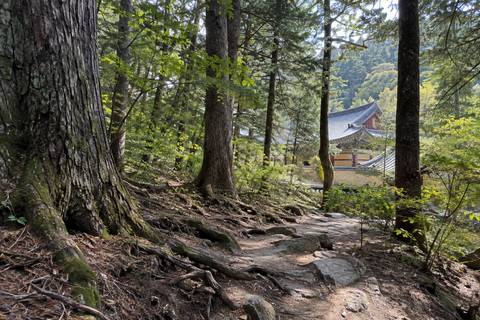
Odaesan, north of Jinbu, is a gentle, heavily forested mountain park and one of Korea’s great Buddhist centres. Its main peak is Birobong (1,563 m); Gyebangsan (1,577 m), on the western edge, is the highest in the park.
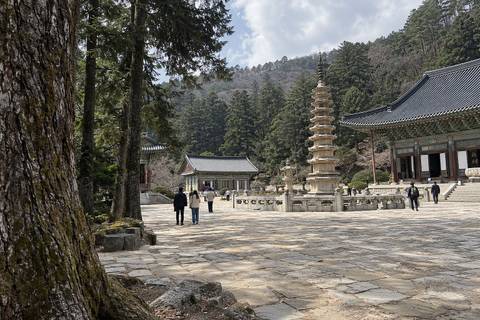
Woljeongsa was founded in 643 by the monk Jajang. The approach is the reason to come: a straight avenue of about 1,700 old fir trees runs for about 1 km from the One-Pillar Gate to the temple. In the courtyard stands an octagonal nine-storey stone pagoda of the early Goryeo period, a National Treasure. There has been no admission fee since May 2023, when temples with state-designated heritage stopped charging one.
Sangwonsa, higher up the valley, keeps Korea’s oldest surviving bronze bell, cast in 725 and also a National Treasure. From here a path climbs about 2 km to Jeokmyeol Bogung, a shrine that holds relics of the Buddha. The Seonjae-gil, a riverside path of about 9 km, links the two temples.
| Odaesan trails | |
|---|---|
| Autumn closure | High trails closed 15 November – 15 December 2026 for the wildfire season |
| Open during the closure | Seonjae-gil (Woljeongsa–Sangwonsa), Sangwonsa–Jeokmyeol Bogung, Sangwonsa–Saja-am, Mureung valley–Guryong Falls |
| Entry hours to Birobong (Sangwonsa side) | November–March 05:00–15:00, April–October 04:00–16:00; earlier cut-offs at Jingogae and Sogeumgang |
From the Korea National Park Service and Korean press, checked 2 November 2026. Guryong Falls and the Sogeumgang valley are on the eastern side of the park, reached from Gangneung. Trails, entry hours and buses for the whole park are on the Odaesan National Park page. The park service’s closure page is in Korean only. More parks are covered on the national parks page, and temple etiquette on Korean temples.
Daegwallyeong: sheep farms, ranches and the Olympics
The plateau around Hoenggye, below the 832 m Daegwallyeong pass, is open grassland and wind farms. Three ranches welcome visitors, and all of them are windy and cold in winter.
| Adult / child | November–March hours | Closed | |
|---|---|---|---|
| Daegwallyeong Sheep Farm | ₩9,000 / ₩7,000 | From 09:00; tickets to 16:00, gate closes 17:00 (from 1 November 2026) | None listed |
| Samyang Roundhill | ₩12,000 / ₩10,000 | From 09:00; tickets to 16:30, closes 17:30 | Open every day |
| Sky Ranch | ₩8,000 / ₩6,000 | 09:00–17:30; tickets to 16:30 | Open all year |
From each farm’s own site, checked 2 November 2026. The Daegwallyeong Sheep Farm is the easiest for families: a loop path over the pasture and hay feeding in the barn. In 2026 the sheep graze outdoors until 8 November and stay in the barn and feeding area after that. Samyang Roundhill is the largest, from 850 to 1,470 m, with wind turbines and an East Sea viewpoint on its ridge. From November to April its shuttle bus does not run and visitors drive their own cars through the ranch, so without a car it is better from May to October. Sky Ranch next door offers a tractor-wagon ride (₩10,000 adults, ₩8,000 children), which stops in snow, rain or high wind.
Alpensia was the main resort of the 2018 Games, with the Olympic ski jump. In Hoenggye, the free PyeongChang Olympic Memorial Hall tells the story of the Games. It is open 10:00–18:00 (last entry 17:30) and closed on Mondays, 1 January and the days of Seollal and Chuseok.
Jinbu in winter: the trout festival
The Pyeongchang Trout Festival fills the frozen Odaecheon stream in Jinbu with ice-fishing holes. It ran from 9 January to 9 February in 2026, when indoor fishing cost ₩20,000. The 2027 dates had not been announced by 2 November 2026. Like all ice festivals, it depends on the ice being thick enough. See the festival calendar.
Bongpyeong: buckwheat and Lee Hyo-seok
Bongpyeong is the setting of When the Buckwheat Flowers Bloom, a famous short story by Lee Hyo-seok. The Lee Hyo-seok Culture Village combines a museum and Moonlight Hill, a small themed village.
| Lee Hyo-seok Culture Village | |
|---|---|
| Hours | October–April 09:00–17:30, May–September 09:00–18:30; combined ticket sold until 16:00 |
| Closed | Mondays (Tuesday if Monday is a holiday), 1 January, Seollal, Chuseok |
| Fee | Museum ₩2,000, Moonlight Hill ₩3,000, combined ₩4,500; under 6 and 65+ free |
From the museum, checked 2 November 2026. The buckwheat fields flower in early September, when the Hyoseok Culture Festival is held (4–13 September in 2026), with a free shuttle from Pyeongchang Station. Phoenix Pyeongchang ski resort is nearby.
Getting there and around
From Seoul, KTX trains on the Gangneung Line leave Cheongnyangni and Seoul Station. Jinbu (Odaesan) is 1 h 13 min – 1 h 32 min from Cheongnyangni, about 14 trains a day. Pyeongchang Station is 1 h 12 min – 1 h 24 min away, about 16 a day. Not every train stops at both, so check the stop when you book; see the KTX guide.
Intercity buses from Dong Seoul stop at Jangpyeong, Jinbu and Hoenggye on the way to Gangneung, eight times a day. They are the simplest way to reach Hoenggye.
| Dong Seoul to | Time | Adult fare |
|---|---|---|
| Jangpyeong | about 1 h 50 min | ₩17,800 |
| Jinbu | about 2 h 10 min | ₩20,400 |
| Hoenggye (Daegwallyeong) | about 2 h 30 min | ₩22,900 |
T-money Bus timetable for 5 November 2026, checked 2 November 2026. Ski-season weekends are often slower.
County buses cost a flat ₩1,000. From Jinbu bus terminal, buses 225 and 226 serve Woljeongsa and Sangwonsa about ten times a day. Jinbu KTX Station has only a few buses into town, so a taxi is usual. Mona Yongpyong is about 20 minutes from Jinbu Station by taxi and lists a guests-only shuttle from the station twice a day, with times that change with the trains. Without a car, base yourself in the area you came for. See the transportation guide.
When to go
Ski season runs from late November or December to March, and January is the coldest month. The trout festival fills January and early February. Odaesan’s autumn colour peaks in mid-October, among the earliest in Korea; see autumn leaves. Early September brings the buckwheat flowers to Bongpyeong. The ranches are greenest from May to October. For the coast, combine Pyeongchang with Gangneung, the next stops along the KTX line, or Sokcho for Seoraksan.
Book your trip
Top attractions in Pyeongchang
Daegwallyeong and Hoenggye
The high plateau around the town of Hoenggye, below the 832 m Daegwallyeong pass: the Mona Yongpyong and Alpensia ski resorts, the 2018 Olympic sites, the sheep farms and ranches, and hwangtae dried pollack.
Mona Yongpyong
Korea's best-known ski resort: 28 slopes, 14 lifts; opens 22 November 2026. KTX to Jinbu, then about 20 min by taxi.
Balwangsan Cable Car
A 3.7 km gondola from Mona Yongpyong to the 1,458 m top of Balwangsan, with a skywalk and yew trail; ₩27,000 return.
Alpensia
The 2018 Winter Olympics resort near Hoenggye, with six ski slopes and the Olympic ski jump; its 2025–26 season ran 4 December to 2 March.
PyeongChang Olympic Memorial Hall
A free museum of the 2018 Winter Olympics and Paralympics in Hoenggye, open 10:00–18:00 and closed on Mondays.
Daegwallyeong Sheep Farm
A hillside sheep farm on the old Daegwallyeong pass: 1.2 km pasture loop, hay feeding, ₩9,000. Sheep graze outside until 15 Nov 2026.
Samyang Roundhill (Samyang Ranch)
A huge highland ranch at 850–1,470 m, with wind turbines on the ridge and an East Sea viewpoint; ₩12,000, open every day.
Daegwallyeong Sky Ranch
A smaller ranch next to Samyang, with walking trails, hay feeding and a tractor-wagon ride to the ridge; ₩8,000, open all year.
Jinbu and Odaesan
The market town of Jinbu with its KTX station, and Odaesan National Park to the north with the fir forest of Woljeongsa and the mountain temple of Sangwonsa; the trout festival is held on the stream in town.
Odaesan National Park
Five peaks led by Birobong (1,563 m), old fir forest and the temples of Woljeongsa and Sangwonsa; autumn colour peaks in mid-October.
Woljeongsa Temple
A great Odaesan temple founded in 643, approached through a 1 km avenue of old firs; free entry, with a nine-storey stone pagoda.
Sangwonsa Temple
A small mountain temple deep in Odaesan, home to Korea's oldest bronze bell (725), and the start of the walk to Jeokmyeol Bogung.
Pyeongchang Trout Festival
Ice and indoor trout fishing on the Odaecheon stream in Jinbu; it ran 9 January–9 February in 2026, with 2027 dates not yet announced.
Bongpyeong and Jangpyeong
The western side of the county near Pyeongchang KTX Station: Phoenix Pyeongchang ski resort and Bongpyeong, the buckwheat village of the writer Lee Hyo-seok.
Phoenix Pyeongchang
A large ski and snowboard resort in Bongpyeong, popular with snowboarders; its nearest KTX stop is Pyeongchang Station.
Lee Hyo-seok Culture Village
Museum and hillside village of Lee Hyo-seok, author of When the Buckwheat Flowers Bloom; ₩4,500 combined, closed Mondays.
Pyeongchang by interest
Getting to Pyeongchang
| From | How | Time | Notes |
|---|---|---|---|
| Cheongnyangni (Seoul) | KTX to Jinbu (Odaesan) Station | about 1 h 13 min – 1 h 32 min | 14 trains a day, 06:00–22:34; from Seoul Station, 9 a day in 1 h 33 min – 1 h 53 min. Book on Korail; see the KTX guide. |
| Cheongnyangni (Seoul) | KTX to Pyeongchang Station | about 1 h 12 min – 1 h 24 min | 16 trains a day, 05:27–21:52; from Seoul Station, 12 a day in 1 h 33 min – 1 h 47 min. The stop for Phoenix and Bongpyeong. |
| Dong Seoul Bus Terminal | Intercity bus to Jinbu, Hoenggye or Jangpyeong | about 1 h 50 min – 2 h 30 min | 8 premium buses a day, 06:40–20:20: Jangpyeong ₩17,800, Jinbu ₩20,400, Hoenggye ₩22,900. Book on T-money Bus; see long-distance buses. |
| Seoul Nambu Terminal | Intercity bus to Jinbu | about 2 h 15 min | 3 buses a day (07:40, 11:00, 17:40); ₩21,600. |
There are two KTX stations on the Gangneung Line, and not every train stops at both: Jinbu (Odaesan) for Mona Yongpyong, Woljeongsa and Sangwonsa, and Pyeongchang for Phoenix and Bongpyeong. Hoenggye, the town for Alpensia and the ranches, has no station. Train times are for 5 November 2026; bus times and fares are from the T-money Bus booking system for 5 November 2026, checked 2 November 2026. Scheduled bus times; holiday and ski-season traffic can add more. No KTX fare is given because no current official fare table could be checked.
Getting around
Pyeongchang's county buses charge a flat ₩1,000 for adults (₩500 for students and children), with one free transfer within 60 minutes. From Jinbu bus terminal, buses 225 and 226 run up the Odaesan valley past Woljeongsa to Sangwonsa about ten times a day (first 07:50, last 17:30 under the county's March 2025 timetable). Jinbu KTX Station is outside the town, with only a few buses (route 224) a day, so most visitors take a taxi: Mona Yongpyong is about 16 km and 20 minutes away. From Hoenggye bus terminal, bus 443 goes to Samyang Roundhill twice a day (09:40 and 14:30, turning straight back). Distances between the three areas are long, so a car or taxis make a short stay much easier.
Long-distance trains: see KORAIL PASS and transportation in Korea.
Itineraries
Two days of snow from Seoul
Take a morning KTX to Jinbu and a taxi to Mona Yongpyong. Ski or ride the Balwangsan cable car on day one, then spend day two at Woljeongsa's fir forest (bus or taxi from Jinbu) before the KTX back. In January and early February, add the trout festival in Jinbu town.
Odaesan temples in a day
From Jinbu bus terminal, ride bus 226 to Sangwonsa and walk on to Jeokmyeol Bogung (about 2 km), then ride back down the valley to Woljeongsa and walk the fir avenue. The Seonjae-gil riverside path links the two temples (about 9 km) if you prefer to walk.
Ranches and Olympic sites
Base in Hoenggye. Visit the Daegwallyeong Sheep Farm in the morning (bus 440 from Hoenggye) and the Olympic Memorial Hall after lunch, with a hwangtae soup in town. Samyang Roundhill is best from May to October, when its shuttle runs to the ridge.
Where to stay in Pyeongchang
Mona Yongpyong and Alpensia resorts
Ski-in hotels and condos at the foot of the slopes, with restaurants and rental on site; a taxi ride from Jinbu Station.
Best for: Skiers, families, one-stop stays
See hotels in Mona Yongpyong and Alpensia resortsHoenggye (Daegwallyeong)
The highland town between the two big resorts, with the bus terminal, hwangtae and beef restaurants, and the sheep farm close by.
Best for: Budget, ranches, food
See hotels in Hoenggye (Daegwallyeong)Jinbu
The town nearest Woljeongsa and Sangwonsa, with the bus terminal for the Odaesan buses and the KTX station a short taxi ride away.
Best for: Odaesan temples, KTX, trout festival
See hotels in JinbuPhoenix Pyeongchang and Bongpyeong
A large resort complex on the western side, near Pyeongchang KTX Station and Lee Hyo-seok's village.
Best for: Snowboarders, buckwheat country
See hotels in Phoenix Pyeongchang and Bongpyeong
Some links on this page are affiliate links: if you book through them we may earn a commission at no extra cost to you. It never decides what we recommend. Affiliate disclosure.
Food and restaurants in Pyeongchang
Pyeongchang's food follows its altitude and its mountains. Hoenggye, on the Daegwallyeong plateau, is the classic place where pollack is hung outdoors to freeze and thaw through the winter into hwangtae, and the town also sells Daegwallyeong hanwoo beef. Bongpyeong is buckwheat country, and the road up to Woljeongsa is lined with restaurants serving mountain-vegetable set meals.
What to eat
| Hwangtae soup and grilled hwangtae 황태해장국 · 황태구이 | Pollack freeze-dried on outdoor racks through the winter, cooked in a mild, milky soup or grilled with a sweet chilli glaze. |
|---|---|
| Buckwheat noodles and pancakes 메밀막국수 · 메밀전병 | Cold buckwheat noodles, thin buckwheat pancakes and rolled pancakes filled with kimchi, the dishes of Bongpyeong. |
| Mountain-vegetable set meal 산채정식 | Rice, soup and a spread of seasoned wild greens and herbs from the Odaesan hills, served in Jinbu and near Woljeongsa. |
| Daegwallyeong hanwoo 대관령한우 | Korean beef from the highland farms, grilled at the table in Hoenggye's beef restaurants. |
Where to eat
- Hoenggye town — Hwangtae restaurants and the hanwoo beef town on the main road; see Korean food.
- Jinbu and the Woljeongsa road — Mountain-vegetable set meals before or after the temples.
- Bongpyeong — Buckwheat noodle shops around the town and Lee Hyo-seok's village.
Experiences and tours in Pyeongchang
Ski day trips from Seoul
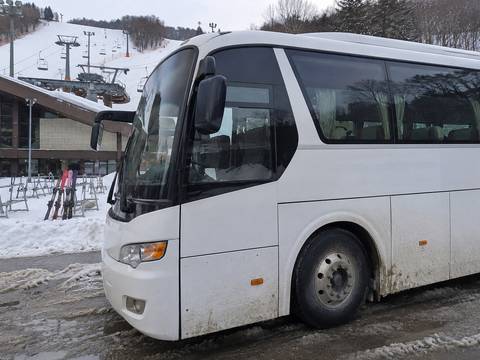
Day trips by coach from central Seoul to a Pyeongchang ski resort, usually with lift and rental packages; good for first-time skiers.
Check on Klook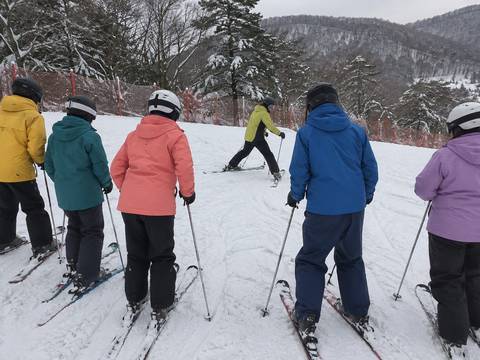
Ski and snowboard lessons
Beginner lessons with English-speaking instructors at the Pyeongchang resorts, often bundled with equipment and clothing rental.
Check on Klook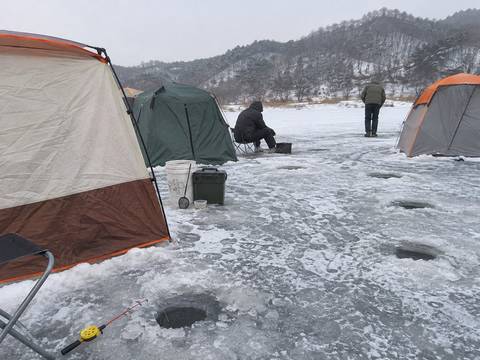
Trout festival tours
Winter day trips from Seoul to the ice-fishing festival in Jinbu, sometimes combined with a sheep farm or ranch.
Check on Klook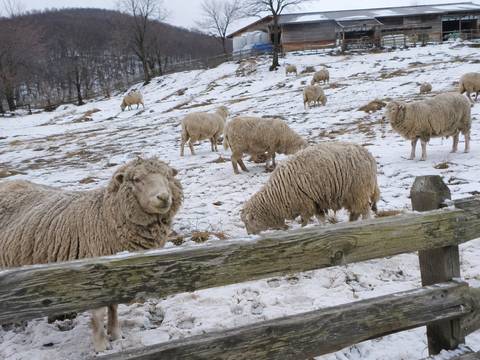
Sheep farm and ranch tours
Day tours from Seoul to the Daegwallyeong ranches, often paired with Woljeongsa or the Gangneung coast.
Check on Klook
Some links on this page are affiliate links: if you book through them we may earn a commission at no extra cost to you. It never decides what we recommend. Affiliate disclosure.
Frequently asked questions
Is Pyeongchang worth visiting?
Yes, if you want snow, skiing or quiet mountain temples. It has Korea's best-known ski resorts, the Woljeongsa fir forest and the Daegwallyeong sheep farms, all about 1 h 15 min from Seoul by KTX. Spend one or two nights; the sights are spread across a large county, so a day trip covers only one area.
Which KTX station should I use for Pyeongchang?
Jinbu (Odaesan) Station for Mona Yongpyong, Woljeongsa and Sangwonsa, and Pyeongchang Station for Phoenix Pyeongchang and Bongpyeong. Alpensia and the sheep farms are around Hoenggye, which has no station: take an intercity bus from Dong Seoul (about 2 h 30 min, ₩22,900) or a taxi from Jinbu.
When do the Pyeongchang ski resorts open for 2026–27?
Mona Yongpyong opens on Sunday 22 November 2026 at 11:00, starting with one slope (₩10,000 lift ticket that day only); last season it opened on 21 November. Alpensia opened on 4 December last season. Lift prices for 2026–27 had not been published on 17 November 2026, so check the resorts' own sites.
Is Woljeongsa free to visit?
Yes. No admission fee is charged: the cultural-heritage fee at temples with state-designated heritage, Woljeongsa among them, was dropped in May 2023. The fir avenue runs about 1 km from the One-Pillar Gate to the temple.
Can I hike Odaesan in November or December?
Only on the lower trails between 15 November and 15 December 2026, when the park service closes the high routes for the wildfire season. The Seonjae-gil path between Woljeongsa and Sangwonsa, and the walks from Sangwonsa to Jeokmyeol Bogung and Saja-am, stay open.
Sources
Facts on this page were checked against these sources on 17 November 2026. Prices, hours and rules change — confirm with the operator before you go.
- 모나용평 – 공지: 모나용평 스키장 26/27 Winter Season OPEN! (2026.11.22(일) 11:00 개장, 핑크 슬로프, 2026-11-17) (Korean) · official
- 모나용평 – 스키장 소개 (슬로프 28면·리프트 14기) (Korean) · official
- 모나용평 – 렌탈 요금 (26/27시즌 추후 공지) (Korean) · official
- 모나용평 – 발왕산 관광케이블카 (Korean) · official
- 모나용평 – 오시는 길: KTX 진부역 (택시 약 20분, 16 km) (Korean) · official
- 이뉴스투데이 – 모나용평, 2026~2027 시즌 11월 말 개장 목표 제설 시작 (2026.10.22) (Korean)
- 아시아경제 – 용평·휘닉스 21일 개장 (2025.11.19) (Korean)
- 알펜시아 스키700 – 스키장 소개 (6면 슬로프) (Korean) · official
- 파이낸셜뉴스 – 알펜시아, 12월 4일 스키장 개장 (2025.11.25) (Korean)
- 휘닉스 평창 – 교통 안내 (KTX 평창역) (Korean) · official
- 대관령양떼목장 – 이용요금 (Korean) · official
- 대관령양떼목장 – 공지사항 (11월 매표 시간, 방목 종료 11.8) (Korean) · official
- 삼양라운드힐 – 이용안내 (요금·운영시간) (Korean) · official
- 삼양라운드힐 – 오시는 길 (443번 버스, 화이트시즌 셔틀 미운영) (Korean) · official
- 대관령 하늘목장 – 이용요금 및 운영시간 (Korean) · official
- 평창군 관광 – 평창올림픽기념관 (Korean) · official
- 2018평창기념재단 – 올림픽기념관 관람안내 (Korean) · official
- 이효석문학관 – 관람안내 (운영시간·휴관일) (Korean) · official
- 이효석문학관 – 관람료 (Korean) · official
- VisitKorea – Pyeongchang Hyoseok Culture Festival 2026 · official
- 평창송어축제 – 공식 홈페이지 (Korean) · official
- 국가유산청 – 평창 월정사 팔각 구층석탑 (국보) (Korean) · official
- 국가유산청 – 평창 상원사 동종 (국보, 725년) (Korean) · official
- K-TRIP TIPS – 월정사·월정사 전나무숲 (입장료 무료, 2026.06.19 수정) (Korean)
- 매일신문 – 국가지정문화재 보유 사찰 65곳 관람료 면제 (2023.05.04) (Korean)
- 국립공원공단 – 오대산 입산시간지정제 (Korean) · official
- 국립공원공단 – 탐방로 통제 정보 (Korean) · official
- 강원신문 – 오대산국립공원 가을철 산불조심기간 탐방로 통제 (11.15~12.15) (Korean)
- 평창군 – 농어촌버스 운행시간표 (2025.03.01 시행) (Korean) · official
- 평창군 버스정보 – 노선 검색 (225·226·224번) (Korean) · official
- 시외버스 통합예매 – 동서울·서울남부→진부·횡계·장평 배차조회 (2026.11.05) (Korean) · official
- 코레일 열차시간표 (info.koreacharts) – 청량리·서울→진부·평창 (2026.11.05) (Korean)
- 대한민국 구석구석 – 평창 황태·메밀·대관령한우·산채정식 (Korean) · official
- 평창군 – 인구 및 세대현황 (2026년 9월) (Korean) · official