Ulsan 울산
Ulsan is worth a day from Busan or Gyeongju: walk the free Taehwagang National Garden and its bamboo forest, then cross the free 303 m suspension bridge at Daewangam Park on the coast. Add the UNESCO-listed Bangucheon petroglyphs if you have a second half-day. KTX trains stop at Ulsan Station, far west of town; from Busan, take the Donghae line to Taehwagang Station downtown. Museums close on Mondays.
Updated
Is Ulsan worth it?
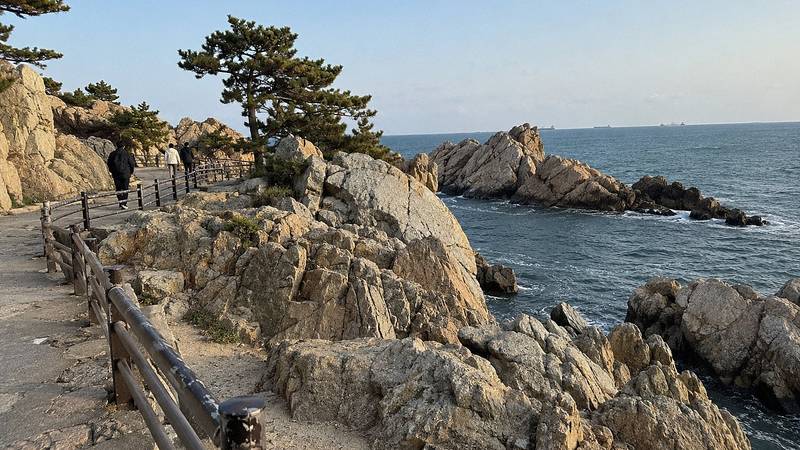
Ulsan is Korea’s big industrial city on the south-east coast, home to shipyards, car plants and refineries, but it has three sights that rank with the country’s best: a riverside bamboo forest in the middle of town, the red sea cliffs of Daewangam Park, and prehistoric whale carvings in a valley to the west. All three are free. The city lies between Busan and Gyeongju, so most visitors come for a day.
| Your situation | Do this |
|---|---|
| Based in Busan, one free day | Donghae line to Taehwagang Station, the National Garden and bamboo forest, then Daewangam Park in the afternoon |
| Based in Gyeongju | Intercity bus (about 50 min) to Ulsan terminal; same day as above |
| On the KTX from Seoul | Get off at Ulsan Station for the petroglyphs (bus 383 or taxi), then limousine 5001 or 5003 into town |
| Here on a Monday | The petroglyph museum and the Jangsaengpo whale district are closed; do the garden and Daewangam |
| Here on the 2nd Tuesday of the month | The Daewangam suspension bridge is closed; the park and rock footbridges stay open |
| Want to see whales | The Jangsaengpo cruise runs April to October only; in winter, visit the whale museum instead |
| Sight | Adult | Hours | Closed |
|---|---|---|---|
| Taehwagang National Garden | Free | Open at all hours; bamboo night path sunset–23:00 | — |
| Daewangam suspension bridge | Free | 09:00–18:00, last entry 17:40 | 2nd Tuesday of the month; Seollal and Chuseok days; rain, fog or strong wind |
| Ulsan Bridge Observatory | Free | 09:00–21:00 | 2nd and 4th Monday; Seollal and Chuseok days |
| Ulsan Petroglyph Museum | Free | 09:00–18:00, last entry 17:30 | Mondays (Tuesday if Monday is a holiday); 1 January |
| Jangsaengpo whale district | Museum ₩2,000; village ₩3,000; pass ₩9,100; monorail ₩11,000 | 09:00–18:00, tickets to 17:30; weekends to 19:00 in November | Mondays; Seollal and Chuseok days |
| Ganjeolgot | Free | Open all year; lighthouse hall 09:00–17:00 Oct–Mar, 09:00–18:00 Apr–Sep | Lighthouse hall on Mondays |
From each site’s official page, checked 3 November 2026. A day covers the garden and Daewangam comfortably; the petroglyphs need another half-day because they are far out in the west of the city.
Taehwagang National Garden and the bamboo forest
The Taehwagang National Garden follows the Taehwa river through the middle of the city: 835,452 m² of riverside gardens in two sections, Taehwa on the north bank and Samho on the south. It was named Korea’s second national garden and has more than 20 themed gardens. Entry is free and the garden is open at all hours; the visitor centre opens 09:00–18:00.
Its showpiece is the Simni Bamboo Forest (Simnidaesup), a band of some 500,000 bamboo running about 10 ri, or 4 km, along the bank; an 18th-century gazetteer already recorded bamboo here. Walk at least the central section, where earth paths cut through the grove. A 600 m stretch called Eunhasu-gil is lit after dark, from sunset to 23:00.
The garden’s bus stop is Taehwagang National Garden / Donggang Hospital. Buses 523, 713, 763, 1115 and 1733 stop there from Taehwagang Station; 523 and 1733 also link it with Ulsan Station. City tour bus 9001 uses its own stop at Osan Plaza, and limousine 5003 from Ulsan Station stops at Taehwa-dong (태화동), about 550 m from the visitor centre. In the south of the centre, the much larger Ulsan Grand Park is a family park with a rose garden (rose festival around May), a small zoo, an insect hall and picnic lawns, open all year; facilities such as the Aquasis pool close on Mondays.
Daewangam Park and the Dong-gu coast
Daewangam Park covers the headland that juts furthest into the East Sea on Korea’s south-east corner. A 600 m path under century-old pines leads from the entrance to Ulgi lighthouse, then opens onto cliffs and heaps of reddish rock; the city likens Daewangam, the rock at the tip, to a dragon struggling out of the sea. Entry is free and the park is open all year. It is not the Daewangam underwater tomb off Gyeongju.
The suspension bridge (출렁다리) spans a rocky cove for 303 m and is free. It opens 09:00–18:00, with last entry at 17:40, and closes on the second Tuesday of each month, on Seollal and Chuseok days, and in rain, fog or strong wind. At the end of the headland, iron footbridges set on the rocks take you out onto Daewangam itself, where you can stand above the sea. Parking is charged after a free first period (longer on weekdays). Bus 1411 runs from Taehwagang Station and the bus terminal to the park with no change.
Next to the park, Ilsan beach curves round a small bay with hotels behind it. On a hill to the south-west, the Ulsan Bridge Observatory looks down on the Ulsan Bridge and the harbour; it is free, open 09:00–21:00, and closed on the second and fourth Mondays of the month. Come after dark, when the bridge and the industrial plants are lit.
The Bangucheon petroglyphs
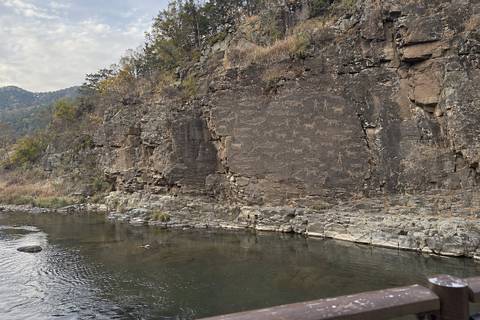
In July 2025 the Petroglyphs along the Bangucheon Stream became Korea’s 17th World Heritage Site. There are two cliffs. At Daegok-ri (Bangudae), around 300 figures were carved, probably in the Neolithic: more than 50 whales of at least seven species, deer, tigers, hunters, and boats with harpoons, floats and nets in scenes of whale hunting. About 2.3 km upstream, the Cheonjeon-ri rock, a National Treasure since 1973, adds animals, diamond and circle patterns and fine-line Silla drawings of people, boats and dragons, plus inscriptions; one records a visit in 525 by a brother of King Beopheung.
You see the carvings from a viewing deck across the water, not up close. The light matters: Bangudae shows best between about 15:00 and 17:00 from March to October, and Cheonjeon-ri between about 09:00 and 12:00 from March to November. The Bangudae panel sits by the Sayeon reservoir and can be partly under water when it is high; the museum posts how to check the level.
The free Ulsan Petroglyph Museum has full-size replicas and explains what the figures show. It is open 09:00–18:00 (last entry 17:30) and closed on Mondays and 1 January; if Monday is a holiday, it opens and closes the next weekday instead. A free shuttle bus loops between the public car park, the museum and both carving sites; in 2026 it runs Wednesday to Sunday. Bus and shuttle times, the best light and the free close-up guided walk are on the Bangudae petroglyphs page.
Jangsaengpo, the whaling port
Jangsaengpo was the centre of Korean whaling until the International Whaling Commission’s moratorium of 1986; at its late-1970s peak some 20 whaling boats were based here. Today the Whale Culture Special Zone tells that story. The Whale Museum (₩2,000) has skeletons and the tools of the trade; the Whale Culture Village (₩3,000, with the Whales Fantasium media-art hall) rebuilds the old whaling village’s streets; the Whale Life Experience Hall (₩5,000) keeps dolphins in an aquarium; and a monorail (₩11,000 adults, ₩7,000 children) loops above the district. Visitors aged 65 and over enter the museums free, and adults save with the ₩9,100 Happy Tourism Card. Bus 716 runs here from Taehwagang Station; see the Jangsaengpo whale district page for tickets, bus times and the dolphins.
The zone opens 09:00–18:00, with tickets sold until 17:30, and stays open to 19:00 on March, November and December weekends (20:00 April–October). It closes on Mondays and on Seollal and Chuseok days. Payment is by card only.
The whale-watching cruise (고래바다여행선) sails from Jangsaengpo from April to October: three hours, ₩20,000 for adults and ₩10,000 for children. Sightings are not guaranteed. In November only a Saturday evening coastal cruise is scheduled. Book on the zone’s website and bring photo ID.
Ganjeolgot
Ganjeolgot is a cape on the city’s southern coast with a lighthouse dating from the colonial era, pine woods and a giant “wish postbox”: postcards, free from the nearby county shop, really are delivered. It is Korea’s best-known New Year sunrise spot; the city says the sun rises here a minute before Homigot and five before Jeongdongjin, and a free festival with shuttle buses is held on New Year’s Eve and Day. Jinha beach is next door. It is free and open all year. Bus 1715 runs there from Taehwagang Station in 23 stops; from Seosaeng station on the Donghae line, take bus 735 or 울주10. See the Ganjeolgot guide for the 2027 sunrise time, the festival and the buses. See beaches for other spots on the coast.
Getting there and around
From Seoul, about 36 KTX trains a day run from Seoul Station to Ulsan Station in 2 h 10 – 2 h 30. The station is in Eonyang, well west of the city. Limousine buses link it to the centre: 5001 goes along the river to City Hall and Taehwagang Station, 5003 runs past Taehwaru to the old town, and 5005 goes to the airport. All cost ₩3,900 with a card or ₩4,000 in cash. See KTX and trains.
From Busan, the Donghae line commuter trains run from Bujeon via Centum, Haeundae and Gijang to Taehwagang Station in central Ulsan, about 1 h 15 min from Bujeon; tap a T-money card. Since 30 December 2025 a few KTX-Eum trains between Busan, Gyeongju, Pohang and Gangneung also stop at Taehwagang.
Express buses leave the Gyeongbu side of Seoul Express Bus Terminal nine times a day (5 November 2026), from ₩41,700. Intercity buses from Haeundae take about an hour and from Gyeongju about 50 minutes. See long-distance buses. Ulsan Airport has three flights a day each way to Gimpo and to Jeju.
In town, city buses cost ₩1,500 with a transit card (₩1,600 cash), with free transfers within 40 minutes. The sights are spread out, so taxis save a lot of time. The rest of the region is in the Gyeongsang guide.
Book your trip
Top attractions in Ulsan
Taehwagang and downtown
The city centre along the Taehwa river: the National Garden and its bamboo forest on both banks, Taehwagang Station and the shopping streets of Samsan and the old town.
Taehwagang National Garden
Korea's second national garden: 83 ha of themed gardens on both banks of the Taehwa river; free and open at all hours.
Simni Bamboo Forest
A grove of some 500,000 bamboo along about 4 km of the river, inside the garden; a 600 m section is lit from sunset to 23:00.
Ulsan Grand Park
A large family park in Nam-gu with a rose garden, a small zoo, an insect hall and picnic lawns; open all year.
Dong-gu coast
The shipbuilding district on the eastern headland, with Daewangam Park, Ilsan beach and the observatory above the Ulsan Bridge.
Daewangam Park
Pine headland of red rocks with a free 303 m suspension bridge (closed 2nd Tuesday) and a footbridge out to Daewangam rock.
Ulsan Bridge Observatory
Free tower on a hill in Dong-gu looking over the Ulsan Bridge, the harbour and the city; open to 21:00 for the night view.
Jangsaengpo
A former whaling port in Nam-gu, on the harbour south of the centre, now a whale museum district with a monorail and whale-watching cruises.
Jangsaengpo Whale Culture Special Zone
Old whaling port turned whale district: whale museum ₩2,000, 1970s village set ₩3,000, monorail ₩11,000; closed Mondays.
Jangsaengpo whale-watching cruise
A 3-hour whale-watching cruise from Jangsaengpo, April to October (₩20,000); sightings are not guaranteed.
Ulju county
The rural west and south of the city: the UNESCO petroglyphs near the KTX station, and the Ganjeolgot sunrise cape on the south coast.
Petroglyphs along the Bangucheon Stream
Prehistoric carvings of whales and hunters on stream cliffs, a UNESCO World Heritage Site since 2025; free, with a free shuttle.
Ulsan Petroglyph Museum
Free museum at the petroglyph valley with full-size replicas of the carved panels; closed Mondays.
Ganjeolgot
Free south-coast cape with a 1920 lighthouse and a working giant postbox; sunrise about 07:31 on 1 Jan 2027; bus 1715.
Ulsan by interest
Getting to Ulsan
| From | How | Time | Notes |
|---|---|---|---|
| Seoul Station | KTX (Gyeongbu line) to Ulsan Station | about 2 h 10 min – 2 h 30 min | About 36 trains a day, roughly 05:10 to 22:30; a few slower ones take about 3 h. Ulsan Station (울산역, also signed Tongdosa) is in Eonyang, far west of the centre. Book on Korail. |
| Busan (Bujeon, Centum, Haeundae) | Donghae line electric train to Taehwagang Station | about 1 h 15 min from Bujeon | Korail's commuter line along the coast from Bujeon to Taehwagang, 23 stations; pay with a Korean transit card. Taehwagang Station is downtown, near the garden. |
| Seoul Express Bus Terminal (Gyeongbu side) | Express bus to Ulsan | about 4 h 10 min | Nine buses on 5 November 2026, 06:30 to a 22:00 night bus. Standard fares: premium (우등) ₩41,700, Premium class ₩54,200 (₩46,100 with the online discount), night ₩50,000. Book on Kobus. |
| Haeundae (Busan) | Intercity bus to Ulsan terminal | about 1 h | About 20 buses a day, 06:00 to 23:00. |
| Gyeongju | Intercity bus to Ulsan terminal | about 50 min | About 15 buses a day, 07:30 to 21:40. |
| Gimpo Airport (Seoul) or Jeju | Flight to Ulsan Airport | about 1 h | Three flights a day each way from Gimpo and from Jeju on the November 2026 schedule (Korean Air, Jin Air, Air Busan). Limousine bus 5005 links the airport with Ulsan Station. |
Ulsan has two rail stations that matter. KTX trains from Seoul use Ulsan Station in Eonyang, well west of the city; Taehwagang Station is downtown and is served by the Donghae line from Busan and by some KTX-Eum trains on the east-coast and Jungang lines. KTX times and counts are from a timetable mirror of Korail data for 5 November 2026; Seoul bus times and fares are from Kobus for 5 November 2026; Haeundae and Gyeongju bus counts are from a timetable mirror of intercity bus data (late October 2026). Donghae line time is Korail's figure from the line's opening.
Getting around
Ulsan is spread out: the garden, the coast, Jangsaengpo and the petroglyphs are each 20–60 minutes apart, so plan on city buses or taxis. Regular city buses cost ₩1,500 with a transit card (₩1,600 cash), and transfers within 40 minutes are free. From Ulsan Station, limousine buses 5001 (to the river, City Hall and Taehwagang Station) and 5003 (via Taehwaru to the old town) run into the city for ₩3,900 by card; buses 523 and 1733 also go to the National Garden. Naver Map and KakaoMap show current routes.
Long-distance trains: see KORAIL PASS and transportation in Korea.
Itineraries
A day trip from Busan
Take the Donghae line to Taehwagang Station and walk or bus to the National Garden and the bamboo forest. After lunch, take bus 1114 or a taxi east to Daewangam Park for the suspension bridge and the rocks, and stay for sunset or the night view at the Ulsan Bridge Observatory (not on its 2nd and 4th Monday closures).
A KTX stop with the petroglyphs
Arrive at Ulsan Station in the morning, take bus 383 or a taxi to the Ulsan Petroglyph Museum, and use the free shuttle to the Bangudae and Cheonjeon-ri carvings (Wednesday to Sunday). In the afternoon ride limousine 5001 or 5003 into the city for the garden, then sleep downtown or go on to Busan.
Two days on the Gyeongsang coast
Combine Ulsan with Gyeongju (about 50 minutes by intercity bus) and Busan: one day for the garden and Daewangam, a morning in Jangsaengpo, and the petroglyphs on the way to or from the KTX.
Where to stay in Ulsan
Samsan and Taehwagang Station
Business hotels and department stores around Samsan, near the bus terminal and a short ride from the river, the garden and Taehwagang Station.
Best for: First-timers, rail travellers
See hotels in Samsan and Taehwagang StationSeongnam-dong and the old town
The old centre on the north bank of the river, with smaller hotels, eating streets and the bamboo forest within walking distance.
Best for: Walking to the garden, food streets
See hotels in Seongnam-dong and the old townIlsan beach and Daewangam
Hotels and guesthouses facing the beach next to Daewangam Park in Dong-gu, quiet at night and further from the trains.
Best for: Sea views, an early walk on the coast
See hotels in Ilsan beach and DaewangamNear Ulsan Station (Eonyang)
A few hotels around the KTX station and Eonyang, the closest base for the petroglyph valley but a long way from the coast.
Best for: Early KTX, the petroglyphs
See hotels in Near Ulsan Station (Eonyang)
Some links on this page are affiliate links: if you book through them we may earn a commission at no extra cost to you. It never decides what we recommend. Affiliate disclosure.
Food and restaurants in Ulsan
Ulsan's best-known local dish is Eonyang bulgogi from the town by the KTX station, and Jangsaengpo still serves the whale dishes of its whaling past. The fish markets and restaurants at Bangeojin port in Dong-gu are the place for raw fish.
What to eat
| Eonyang bulgogi 언양불고기 | Thin slices of seasoned beef pressed flat and grilled over charcoal, a speciality of Eonyang near Ulsan Station. |
|---|---|
| Hoe 회 | Sliced raw fish, eaten at the harbour restaurants of Bangeojin and along the Dong-gu coast. |
| Gorae-gogi 고래고기 | Whale meat, served boiled or raw in Jangsaengpo's restaurants; a local tradition that many visitors choose to skip. |
| Mulhoe 물회 | Raw fish in an icy, spicy broth with vegetables, a summer favourite on the east coast. |
Where to eat
- Eonyang bulgogi street — Restaurants grilling Eonyang bulgogi near the old Eonyang town centre, a short ride from Ulsan Station and on the way to the petroglyphs.
- Bangeojin port — Fish restaurants around the harbour south of Daewangam; see Korean food.
- Jangsaengpo — Whale restaurants and cafes around the whale museum district.
Experiences and tours in Ulsan
KTX and rail passes
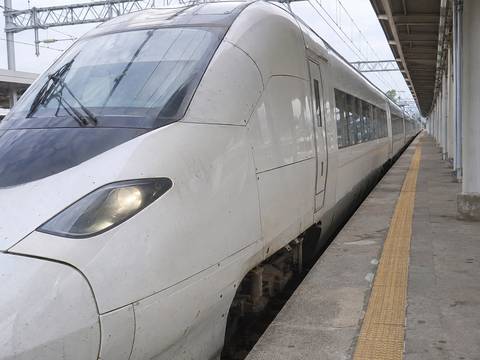
Rail passes for foreign visitors, for a Seoul–Ulsan–Gyeongju–Busan trip.
Check on Klook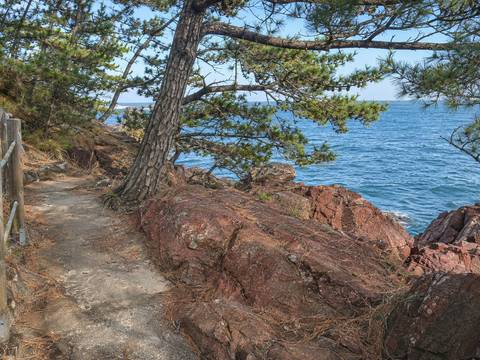
Ulsan day tours from Busan
Guided day trips that link Daewangam, the bamboo forest and the whale district without changing buses.
Check on GetYourGuide
Private car with driver
A driver for the day joins the petroglyphs, the garden and the coast, which are far apart by city bus.
Check on Klook
Jangsaengpo whale-watching cruise
Cruise tickets from Jangsaengpo harbour in the April–October season, if a partner sells them.
Check on Klook
Some links on this page are affiliate links: if you book through them we may earn a commission at no extra cost to you. It never decides what we recommend. Affiliate disclosure.
Frequently asked questions
Is Ulsan worth visiting?
Yes, for a day, especially from Busan or Gyeongju. Daewangam Park's sea cliffs and suspension bridge and the bamboo forest in the Taehwagang National Garden are both free and among the best city nature sights in Korea. Add the UNESCO petroglyphs if you are interested in prehistory. Ulsan is an industrial city, so most visitors do not stay more than a night.
How do I get from Busan to Ulsan?
Take the Donghae line electric train from Bujeon, Centum, Haeundae or Gijang to Taehwagang Station in central Ulsan, about 1 h 15 min from Bujeon, paying with a transit card. Intercity buses from Haeundae take about an hour, about 20 a day.
Which station should I use in Ulsan?
KTX trains from Seoul stop at Ulsan Station in Eonyang, far west of the city; take limousine bus 5001 or 5003 (₩3,900) into town. Trains from Busan on the Donghae line, and some KTX-Eum trains, use Taehwagang Station, which is downtown near the garden.
Is the Daewangam suspension bridge free?
Yes. The 303 m bridge and Daewangam Park are free. The bridge is open 09:00–18:00, with last entry at 17:40, and closes on the second Tuesday of each month, on Seollal and Chuseok days, and in rain, fog or strong wind. Parking is charged after a free first period.
Can you see the Bangudae petroglyphs?
Yes, from a viewing deck across the stream, not up close; telescopes help. The carvings show best in the afternoon light (about 15:00–17:00 from March to October), and the panel can be under water when the reservoir is high. A free shuttle links the car park, museum and both carving sites.
Sources
Facts on this page were checked against these sources on 13 November 2026. Prices, hours and rules change — confirm with the operator before you go.
- 태화강 국가정원 – 국가정원 개요 (835,452 ㎡, 무료 입장) (Korean) · official
- 태화강 국가정원 – 자주 묻는 질문 (상시 개방, 십리대숲, 은하수길 일몰–23시) (Korean) · official
- 태화강 국가정원 – 오시는 길 (버스 노선) (Korean) · official
- 울산관광 – 대왕암공원 (연중무휴, 매월 둘째 화요일 출렁다리 휴장) (Korean) · official
- 대왕암공원 – 자주하는 질문 (출렁다리 09:00–18:00, 17:40 입장 마감, 휴장, 주차 요금) (Korean) · official
- VisitKorea – Daewangam Park (suspension bridge 303 m, free) · official
- 한국관광공사 무장애여행 – 대왕암공원 (출렁다리 이용시간, 주차요금) (Korean) · official
- 울산관광 – 울산대교 전망대 (무료, 09:00–21:00, 둘째·넷째 월요일 휴관) (Korean) · official
- 울산관광 – 울산대공원 (Korean) · official
- 울산관광 – 간절곶 (연중무휴) (Korean) · official
- 한국관광공사 축제 – 간절곶 해맞이 축제 (Korean) · official
- 울산암각화박물관 – 자주하는 질문 (관람시간, 입장료 없음, 월요일 휴관) (Korean) · official
- 울산암각화박물관 – 찾아오시는 길 (383번 버스) (Korean) · official
- 울산암각화박물관 – 대형버스 주차 불가 및 공영주차장 무료 셔틀버스 안내 (2026-05-06) (Korean) · official
- 울산암각화박물관 – 암각화 현장 문양 관찰 가능 시간 안내 (Korean) · official
- 울산암각화박물관 – 대곡리 반구대 암각화 (2025년 7월 세계유산 등재) (Korean) · official
- Petroglyphs along the Bangucheon Stream inscribed on the UNESCO World Heritage List (Ministry of Foreign Affairs) · official
- 서울신문 – 반구천 암각화 무료 순환버스·XR 망원경 (2026-07-16) (Korean)
- 장생포고래문화특구 – 장생포고래의 역사 (1986 IWC 상업포경 금지) (Korean) · official
- 울산암각화박물관 – 천전리 명문과 암각화 (국보, 525년 명문) (Korean) · official
- 장생포고래문화특구 – 운영시간 (09:00–18:00, 매주 월요일 휴관) (Korean) · official
- 장생포고래문화특구 – 이용요금 (고래박물관, 고래생태체험관, 고래문화마을, 모노레일) (Korean) · official
- 장생포고래문화특구 – 고래바다여행선 운항 일정·요금 (Korean) · official
- 코레일 – 동해선 광역전철 (부전–태화강 63.8 km, 23개 역) (Korean) · official
- 코레일 보도자료 – 동해선 부전–태화강 광역전철 개통 (76분) (Korean) · official
- 코레일 보도자료 – 동해선 KTX-이음 운행 (강릉–포항–경주–태화강–부전, 2025-12-30) (Korean) · official
- 울산광역시 – 버스 요금 (일반 1,500원, 리무진 3,900원, 40분 내 무료 환승) (Korean) · official
- Ulsan Metropolitan City – Transportation (bus fares) · official
- 울산 ITS – 리무진 버스 노선 (5001–5005) (Korean) · official
- 한국공항공사 울산공항 – 운항 시간표 (2026.11.05) (Korean) · official
- 고속버스통합예매 – 서울경부→울산 배차조회 (2026.11.05) (Korean) · official
- 기차 시간표 – 서울역→울산역 KTX (2026.11.05, data.go.kr 기반) (Korean)
- 시외버스 시간표 – 해운대→울산 (asamaru) (Korean)
- 시외버스 시간표 – 경주→울산 (asamaru) (Korean)