Accommodation
Hanok Stays in Korea
Updated
Book your trip
Book one or two nights in a registered hanok stay, not your whole trip. Seoul is easiest for a first visit: use the city’s official Seoul Stay list, where you can filter for hanok stays. Before you pay, check three things: bed or floor bedding, a private or shared bathroom, and whether the house sits in Bukchon’s red zone, where tourist visits are barred 17:00–10:00. This page reflects the rules in force on 17 October 2026.
| Your situation | What to book |
|---|---|
| First trip, one traditional night in Seoul | A hanok stay from the official Seoul Stay list in Seochon, Ikseon-dong or Bukchon outside the red zone |
| You want a whole hanok village around you | Jeonju Hanok Village, which has about 160 hanok stays |
| You are already visiting Gyeongju’s tombs and temples | A hanok guesthouse near Hwangnidan-gil or Gyochon in the central district |
| You want a family home in a UNESCO village | A homestay in Hahoe Folk Village, Andong (book by phone, often in Korean) |
| Bad knees, back trouble or you need an en-suite | Filter for rooms with a bed and a private bathroom, or stay in a hotel and visit hanok areas by day |
For most first trips, one night in Seoul is enough to try floor heating and a courtyard. Pick Jeonju or Hahoe if the village itself is the reason for the trip.
What a hanok stay is
A hanok stay (한옥체험업, “hanok experience business”) is a registered tourism business that lets visitors sleep in a traditional Korean house, or take part in traditional games and crafts there. It is registered with the city or district office under the Tourism Promotion Act.
- Open to everyone. Korean and foreign guests can both stay. City homestays, by contrast, may take foreign guests only.
- No host needs to live there. The law requires a manager on site during business hours, not a resident owner.
- Small by design. Guest space must be under 230 m², unless the house is a listed heritage building, a registered architectural asset or a village hanok covered by a local ordinance.
- Not graded. Only hotels get official stars, so a hanok stay without stars is normal. See the hotel grades guide for how stars work.
What the law requires
The registration rules set a minimum for every hanok stay that offers overnight lodging.
| Requirement | What it means for you |
|---|---|
| A real hanok | The house must meet the national hanok building standard, or be a listed heritage hanok |
| Bathroom or shower | Guests must have one, but it can be shared |
| Fire safety | At least one fire extinguisher in or near the room, a smoke detector in every room, and a carbon monoxide alarm where rooms have their own heating |
| Clean rooms | Rooms and bathrooms cleaned regularly, bedding washed regularly, disinfection at least once a month |
| Water and air | Safe drinking water, and ventilation unless the room has a window |
| Staff | A manager present during business hours |
| Posted prices | A rate table at the front desk and on every website or app the stay sells through, and those rates honoured |
The posted-price rule was added on 4 August 2026 to stop overcharging. Existing hanok stays had one month to comply, so every registered one should now show its rates. If you are charged more than the posted rate, keep the receipt and contact the Tourist Complaint Center on +82-2-1330.
Hanok stays can also apply for Korea Quality (한국관광 품질인증), the government quality mark that the Korea Tourism Organization awards on the culture ministry’s behalf. To pass, rooms, bedding, bathrooms and any kitchen must meet at least the middle of a five-level cleanliness scale. The mark is optional, so its absence does not mean a stay is unlicensed.
What to expect inside
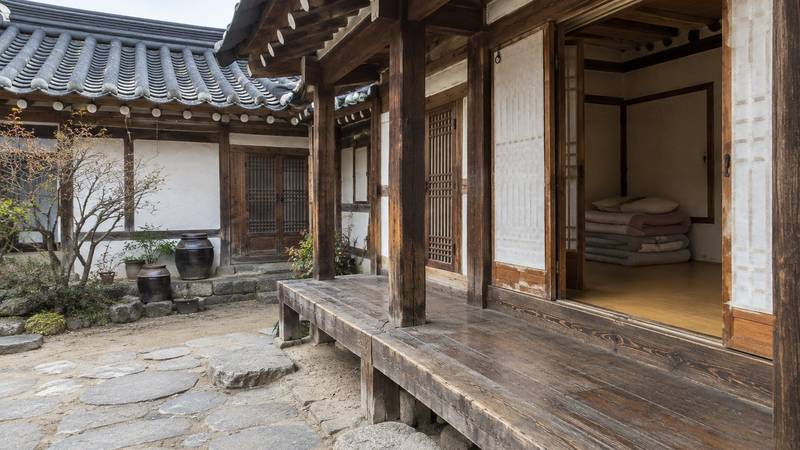
A hanok is built around a courtyard, with rooms opening onto a wooden veranda. Expect a different kind of comfort from a hotel.
- Floor bedding. Many rooms use a yo, a padded mattress laid on the floor and folded away by day. Some stays offer bed frames; check the photos.
- Heated floors. Ondol underfloor heating keeps rooms warm in winter. The floor can feel hot, so ask how to adjust it.
- Shoes off. You take your shoes off before stepping onto the veranda or into the room.
- Thin walls and paper doors. Paper-screen doors let in light and sound. Pack earplugs if you sleep lightly.
- Small rooms, low doorways. Mind your head on the lintels, and expect limited space for large suitcases.
- Shared bathrooms are common. In a small house the bathroom may be across the courtyard. Bring a pair of slippers.
Where to stay in a hanok
Seoul
Seoul’s hanok stays cluster in the old centre between the palaces: Bukchon, Seochon west of Gyeongbokgung, and Ikseon-dong. The Seoul city guide covers the area, and where to stay in Seoul compares bases.
The Seoul Tourism Organization’s Seoul Stay site lists only hanok stays and urban homestays that have registered with their district. You can filter by “Hanok Stay”, by area and by accessible facilities. Each year the city also picks a small number as Excellent Seoul Stay, after a document review and an on-site inspection; the filter shows them by year.
Bukchon’s red zone
Bukchon is a lived-in neighbourhood. In the red zone around Bukchon-ro 11-gil, about 34,000 m², tourist visits are banned from 17:00 to 10:00. A breach can bring a 100,000-won fine, enforced since 1 March 2025.
Jongno-gu’s notice does not publish an exception for people staying overnight. If a listing’s address is on or near Bukchon-ro 11-gil, ask the host in writing how check-in and evening returns work before you pay. Otherwise choose Seochon or Ikseon-dong. The Bukchon Hanok Village guide has more on the zone and on visiting politely.
Jeonju
Jeonju Hanok Village, in North Jeolla, is a whole neighbourhood of tiled-roof houses. The city’s official site says the village has about 160 hanok stays. It points to a Korean-language vacancy search (jeonjuhanokroom.kr) and the village tourist information line, 063-282-1330. See the Jeonju guide for the sights, food and getting there.
Gyeongju
Gyeongju’s hanok guesthouses sit in the flat central district, within walking distance of the royal tombs, Cheomseongdae and Wolji Pond. Hwangnidan-gil has the most cafes and evening life. Gyochon Hanok Village, by the Woljeonggyo bridge, is quieter. The Gyeongju guide lists the best base areas.
Hahoe Folk Village, Andong
Hahoe, a UNESCO-listed clan village outside Andong in the Gyeongsang region, lets you sleep in a family home inside the village. The village’s official site lists over 30 homestays (민박) with room counts, capacity and phone numbers. Most are booked by phone, and a few take bookings through Naver. Some serve dinner or breakfast. Expect to need Korean, or help from your hotel or a translation app.
How to book
- Pick the area first. Choose Seoul, Jeonju, Gyeongju or Hahoe from the table above, then search within it.
- Check it is registered. In Seoul, look for it on the Seoul Stay list. Listing there is optional, so a stay that is missing may still be legal: ask for its tourism business registration (관광사업등록증), as you would elsewhere, or look for the Korea Quality mark.
- Read the room details. Look for “bed” or “floor bedding (yo)”, a private or shared bathroom, and how many guests share the house.
- Compare the posted rate. The price on the listing should match the rate table the stay must display.
- Confirm arrival. Small hanok stays may not have a 24-hour desk. Agree a check-in time, and in Bukchon ask about the red zone hours.
Common mistakes
- Booking an unregistered “hanok Airbnb”. Airbnb has blocked Korean listings without a business registration since 1 January 2026. The accommodation guide explains the rules.
- Expecting a hotel bed. Many rooms use floor bedding. Check before you book.
- Assuming an en-suite. Shared bathrooms are common and legal.
- Arriving in Bukchon’s red zone after 17:00 without a plan. Confirm with the host first.
- Being loud in the lanes. Hanok areas are residential. The etiquette guide covers quiet hours and local rules.
- Packing a giant suitcase. Rooms and doorways are small. Leave big bags at your hotel or a station locker for a one-night stay.
Where to next
- Where to stay in Korea: all lodging types, Airbnb rules and the hotel VAT refund
- Hotels in Korea: star grades and how to check them
- Hanok villages: which village to visit, from Bukchon and Namsangol to Jeonju, Hahoe and Yangdong
- Seoul in 3 days: a first-timer’s route through the palace and hanok districts
- Korean etiquette for tourists
City guides
Frequently asked questions
Can foreigners stay in a hanok in Korea?
Yes. A registered hanok stay (한옥체험업) is a tourism business open to all visitors, Korean or foreign. Unlike city homestays, it is not limited to foreign guests and the owner does not have to live there, but a manager must be on site during business hours.
Do hanok stays have beds?
Many rooms use traditional floor bedding: a padded mattress (yo) laid on a heated ondol floor and folded away in the day. Some hanok stays also offer rooms with a bed frame. The listing photos and room description usually show which type you get, so check before you book.
Do hanok stays have private bathrooms?
Not always. The law requires a bathroom or shower facility for guests, but not one inside every room. Small hanok stays often have a shared bathroom across the courtyard, so filter for an en-suite or private bathroom if that matters to you.
Can I stay in a hanok in Bukchon after 17:00?
Bukchon's red zone around Bukchon-ro 11-gil bars tourist visits from 17:00 to 10:00, with a 100,000-won fine. Jongno-gu's notice does not publish an exception for overnight guests, so if your hanok stay is in that zone, ask the host in writing how check-in and evening returns work before you pay.
How do I know a hanok stay is legal?
In Seoul, look it up on the city's official Seoul Stay site, which lists only hanok stays and homestays registered with their district; listing is optional, so not every legal stay appears. Otherwise ask for the tourism business registration (관광사업등록증), check that rates are posted on the listing, or look for the Korea Quality mark.
Sources
Facts on this page were checked against these sources on 17 October 2026. Prices, hours and rules change — confirm with the operator before you go.
- 국가법령정보센터 – 관광진흥법 시행령 (대통령령 제36554호, 2026-08-04 시행): 제2조 (한옥체험업 정의), 제65조 (품질인증 업무 한국관광공사 위탁), 별표 1 제4호 사목 (등록기준), 부칙 제2조 (Korean) · official
- 국가법령정보센터 – 관광진흥법 시행령 제41조의11 (한국관광 품질인증의 대상) (Korean) · official
- 국가법령정보센터 – 관광진흥법 시행규칙 (한국관광 품질인증 기준: 한옥체험업 청결 수준) (Korean) · official
- Seoul Tourism Organization – Seoul Stay (registered Urban Stay and Hanok Stay listings) · official
- 서울관광재단 – 서울스테이 (외국인관광 도시민박업·한옥체험업, 우수 서울스테이) (Korean) · official
- 서울특별시 – 2026 우수 서울스테이 선정 참가업체 모집 공고(연장) (Korean) · official
- 종로구청 – 특별관리지역 (북촌 레드존 관광객 방문시간 제한) (Korean) · official
- 서울특별시 – 북촌 특별관리지역 관광객 방문시간 제한 안내 (Korean) · official
- 전주한옥마을 (전주시) – 한옥숙박체험 (Korean) · official
- 안동하회마을 – 민박 안내 (Korean) · official