Accommodation
Hotels in Korea
Updated
Book your trip
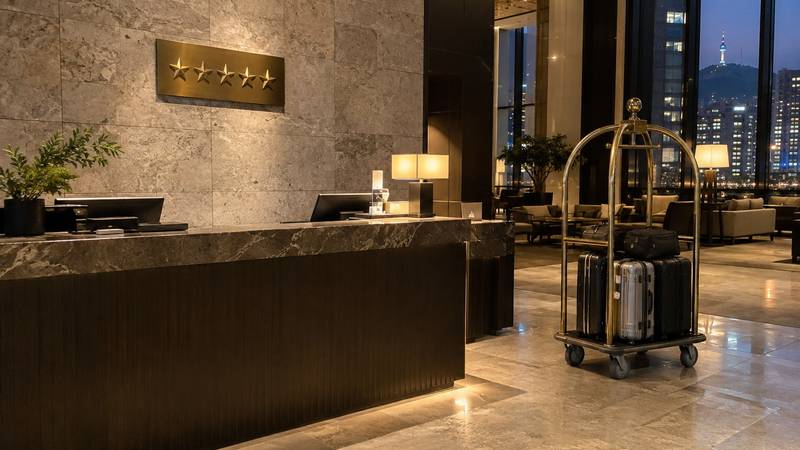
Korea’s hotel stars are official government grades, not marketing. A 3-star hotel is a solid, clean base for most first trips. Pick 4 or 5 stars if you want a pool or gym, several restaurants and English-speaking concierge help. Before you pay, check the grade on the official lookup at hotelrating.or.kr. A booking site’s star count can differ from it. This page reflects the grading rules in force on 16 October 2026. For hostels, hanok stays, Airbnb and templestays, see the accommodation hub.
| Your situation | What to book |
|---|---|
| First trip, mostly out sightseeing, mid budget | A 2 or 3-star hotel near a subway or train station |
| You want restaurants, a pool or gym and concierge help | A 4 or 5-star hotel |
| Family with small children who want to cook | A family hotel (가족호텔), which must have cooking facilities |
| You want a traditional-style stay with hotel service | A traditional Korean hotel (한국전통호텔) |
| Staying 30 days or less and want the VAT back | A hotel on the government’s VAT-refund list |
What the star grades mean
Every tourist hotel, small hotel, family hotel, traditional Korean hotel, floating hotel and medical-tourism hotel registered under the Tourism Promotion Act must apply for a grade. The culture ministry has handed the grading to the Korea Tourism Association. Inspectors score each hotel on service, rooms and facilities, and on whether it complies with safety laws. The current rules took effect on 1 July 2026.
| Grade | Score needed | What the hotel must have (selected) |
|---|---|---|
| 5 stars | 90% or more | At least 3 food and beverage outlets including breakfast; duty manager, doorman or bell service and concierge |
| 4 stars | 80% or more | At least 2 food and beverage outlets including breakfast |
| 3 stars | 65% or more | At least 1 food and beverage outlet including breakfast; a property management system |
| 2 stars | 50% or more | A breakfast space and breakfast service |
| 1 star | 40% or more | A breakfast space and breakfast service |
4 and 5-star hotels must also have:
- front-desk staff who speak a foreign language;
- at least one guest facility such as a gym, pool, sauna or lounge;
- a banquet hall for 50 or more people, and meeting rooms.
At 1 to 3 stars, foreign-language service at the front desk can come from staff or from digital translation tools. Every graded hotel needs CCTV security, an emergency guide and evacuation map in the room, heating and cooling, and a way for guests to complain, such as a complaint card or a satisfaction survey. Room service earns points but is not compulsory at any grade.
How grading works
- The grade lasts 3 years. Hotels must re-apply before it expires, and new hotels must apply within 60 days of registering.
- Inspections are partly secret. Hotels applying for 4 or 5 stars get an anonymous overnight stay by an inspector. Lower grades get an unannounced same-day visit.
- Top hotels get spot checks. A 4 or 5-star hotel must have at least one interim check while its grade is valid.
- Complaints cost points. Each overcharging complaint filed with the Korea Tourism Organization or the Korea Consumer Agency in the last 3 years takes 30 points off the score. False star advertising, including on booking sites, takes off 20.
- Results are public. The ministry publishes grading results every quarter. On 16 October 2026 the lookup listed 846 graded hotels: 72 at 5 stars, 129 at 4 stars, 231 at 3 stars, 327 at 2 stars and 87 at 1 star. Seoul had 300 of them.
How to check a hotel’s grade
- Search the official lookup. Enter the hotel’s name at hotelrating.or.kr/hotel. The site is in Korean, so a browser’s translate option helps. The result shows the grade and its validity dates.
- Look for the plaque. Graded hotels must display an official star plaque. The mark is shaped like a tiled roofline: indigo blue for 1 to 4 stars and brown for 5 stars.
- Report a fake. If a hotel shows stars it does not hold, report it on the grading body’s false star sign page.
Jeju is different. Under the Jeju Special Self-Governing Province Act, the Jeju governor grades hotels on the island, not the culture ministry. Jeju hotels therefore do not appear in the national lookup. Ask the hotel for its grade, or look for the plaque on site.
Hotel types you will see
The type is set when the hotel registers, and it tells you what to expect beyond the stars.
| Type (Korean) | What it means for you |
|---|---|
| Tourist hotel (관광호텔) | The standard hotel. At least 30 rooms, each with a bath or shower, and set up to serve foreign guests |
| Small hotel (소형호텔) | 20 to 29 rooms, breakfast service, foreign-language staff and at least 2 kinds of guest facility |
| Family hotel (가족호텔) | At least 30 rooms, with cooking facilities in each room or on each floor; rooms of 19 m² or more |
| Traditional Korean hotel (한국전통호텔) | A hotel built in traditional Korean style with full hotel services |
| Medical-tourism hotel (의료관광호텔) | At least 20 rooms, aimed at patients and their families visiting for treatment |
Business hotels and “boutique hotels” are marketing names, not legal types. Some budget places that call themselves hotels are registered as general lodging (일반숙박업, usually motels) under the Public Health Control Act, and these are not graded.
Toiletries: bring your own
Lodging businesses with 50 or more rooms may not give out free disposable toothbrushes, toothpaste, razors, shampoo or conditioner. Most mid-size and large hotels are covered. The ban covers free giveaways only, so a hotel may sell these items. Smaller hotels may still provide them, but pack a small kit to be safe.
VAT refund on your hotel bill
Foreign tourists can get the VAT back on stays of 30 days or less, but only at hotels on the culture ministry’s quarterly list. The accommodation hub explains who qualifies and how to claim.
Overcharging and complaints
If you are charged more than the agreed rate or face a problem the hotel will not fix, contact the Korea Tourism Organization’s Tourist Complaint Center by calling +82-2-1330 or emailing tourcom@knto.or.kr. Keep your booking confirmation and receipt. Complaints filed there count against the hotel when its grade is next decided.
Where to stay
The city guides list the best areas for a first stay:
- Seoul: Myeongdong, Jongno, Hongdae, Gangnam or Seoul Station.
- Busan: Haeundae, Seomyeon or Nampo.
- Jeju
- Gyeongju
Stay within a short walk of a subway or train station. It matters more than an extra star.
Common mistakes
- Trusting booking-site stars. Booking sites set their own star ratings. Check the official grade.
- Assuming breakfast is included. The hotel must serve breakfast, but your rate may not cover it.
- Expecting free toiletries. Hotels with 50 or more rooms cannot hand them out free.
- Booking a “hotel” that is really a motel. Ungraded lodging can be fine, but it has no official checks behind it.
- Missing the VAT refund. Ask whether the hotel is on the current list when you book.
Where to next
- Accommodation in Korea: all lodging types, Airbnb rules and templestays
- Money in Korea: cards, cash and tax refunds
- Getting around Korea
- Korea in 7 days
City guides
Busan
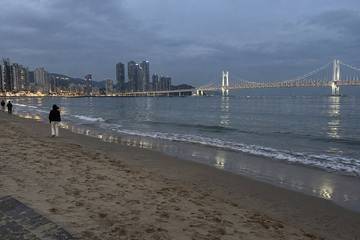
Korea's second city and busiest port, wrapped around beaches, hillside villages, fish markets and a temple on the rocks.
Gyeongju
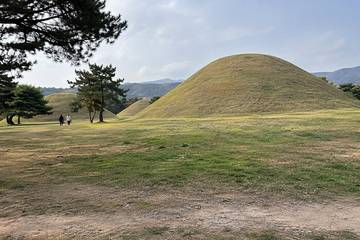
The former Silla capital, an open-air museum of grassy royal tombs, ancient temples and stone Buddhas in the southeast.

Jeju Island
Korea's volcanic holiday island, with the country's highest peak, UNESCO-listed craters and lava tubes, black-sand coves and waterfalls.
Seoul
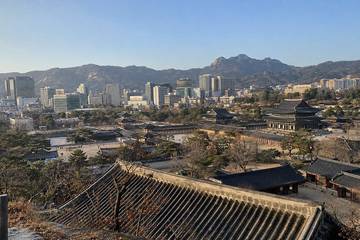
Korea's capital: Joseon palaces and hanok lanes beside skyscrapers, night markets, Han River parks and granite peaks inside the city limits.
Frequently asked questions
Are Korean hotel star ratings official?
Yes. Tourist hotels, small hotels, family hotels, traditional Korean hotels and medical-tourism hotels must be graded 1 to 5 stars under the Tourism Promotion Act. The culture ministry has delegated the grading to the Korea Tourism Association, which publishes the results. Booking-site stars are not the same thing unless the hotel holds the official grade.
How can I check a hotel's real star grade?
Search the hotel's name on the official lookup at hotelrating.or.kr/hotel, which lists every currently valid grade outside Jeju. In the hotel, look for the official star plaque on display: indigo blue for 1 to 4 stars and brown for 5 stars.
What does a 5-star hotel in Korea have to offer?
At least three food and beverage outlets including breakfast, a duty manager, doorman or bell service and a concierge, foreign-language front-desk staff, a gym, pool, sauna or lounge, a banquet hall for 50 or more people and meeting rooms. It must also score at least 90 percent, including an anonymous overnight stay by an inspector.
Why are hotels in Jeju missing from the national lookup?
Under the Jeju Special Self-Governing Province Act, the power to grade hotels in Jeju belongs to the Jeju governor rather than the culture ministry. Jeju hotels are graded under the province's own arrangements, so ask the hotel for its grade certificate or look for the plaque.
Do Korean hotels give out free toothbrushes and shampoo?
Not at larger hotels. Lodging with 50 or more rooms may not hand out free disposable toothbrushes, toothpaste, razors, shampoo or conditioner. The ban covers free giveaways only, so a hotel may sell them, but it is easier to pack your own.
Sources
Facts on this page were checked against these sources on 16 October 2026. Prices, hours and rules change — confirm with the operator before you go.
- 관광진흥법 제19조 (관광숙박업 등의 등급) (Korean) · official
- 관광진흥법 시행령 제22조 (호텔업의 등급결정) 및 별표1 (등록기준) (Korean) · official
- 관광진흥법 시행규칙 제25조, 제25조의3 (등급결정 신청, 유효기간 3년, 결과 공표) (Korean) · official
- 문화체육관광부 고시 제2026-28호: 호텔업 등급결정업무 위탁 및 등급결정에 관한 요령 (2026-07-01 시행) (Korean) · official
- 한국관광협회중앙회 호텔업 등급결정: 등급호텔 조회 (Korean) · official
- 한국관광협회중앙회 호텔업 등급결정: 등급표지 허위·미부착 신고 (Korean) · official
- 제주특별자치도 설치 및 국제자유도시 조성을 위한 특별법 제240조 (관광숙박업의 등급 지정에 관한 특례) (Korean) · official
- 자원의 절약과 재활용촉진에 관한 법률 시행규칙 (숙박업 1회용품 무상제공 금지) (Korean) · official
- Korea Tourism Organization: Tourist Complaint Center · official