Transportation
T-money and Transit Cards in Korea
Updated
Book your trip
Buy a T-money card for ₩3,000 at a convenience store, load it with cash and tap it on every subway gate and bus: a Seoul subway ride then costs ₩1,550 and transfers within 30 minutes are discounted. Foreign Visa and Mastercard cards cannot be tapped on Seoul’s gates or buses yet, so almost every visitor needs a transport card. Fares and card rules were checked against T-money’s and the Seoul city government’s English and Korean pages on 6 October 2026.
| Your situation | What to do |
|---|---|
| First trip, a few rides a day, travelling beyond Seoul | Buy a basic T-money card and top it up with ₩20,000–30,000 in cash |
| Many rides every day, staying inside Seoul | Compare a Climate Card short-term pass (₩5,000 for 1 day to ₩20,000 for 7 days) |
| You have an iPhone and no Korean cash | Use the T-money app and top up with Apple Pay (Mastercard, Amex, UnionPay or JCB, not Visa) |
| Travelling with children aged 6 to 18 | Register each child’s card with their date of birth when you buy it |
| Leaving Korea with money on the card | Get the balance back at a convenience store before you fly (₩500 fee) |
What a T-money card is and what it costs
T-money is Korea’s most common rechargeable transport card. You load money onto it and touch it on a reader to pay; it is not a pass, so each ride takes the normal card fare from your balance. One card works on public transport across the country.
- Card: ₩3,000 for a basic card at 7-Eleven, emart24, GS25, CU and Tmoney Town; ₩5,000 for the design sold at airport railroad (AREX) stations. The card price is not refundable.
- Balance: top up in steps of ₩1,000, from ₩1,000 to ₩90,000 at a time, up to a maximum balance of ₩500,000.
- Payment: Korean won cash at convenience stores and station machines.
- Discount: a card ride is about ₩100 cheaper than a single-journey ticket in Seoul and unlocks transfer discounts.
No passport or ID is needed to buy a basic adult card.
How to buy and top up a T-money card
- Get some won in cash. Exchange money or use an ATM at the airport; see money in Korea for which ATMs take foreign cards.
- Buy the card at a convenience store counter (CU, GS25, 7-Eleven, emart24) or at the staffed information centre of a Seoul subway station on lines 1 to 8. Ticket machines in stations do not sell T-money cards.
- Ask for a top-up at the same counter: hand over the card and the cash, and say the amount. Staff put the card on a reader and give it back loaded.
- Top up again later at the ticket and top-up machines in subway stations: put the card on the reader, select the amount and insert won notes. The machine screen shows the balance.
Arriving at Incheon Airport, buy the card before you take the AREX airport railway or a bus into Seoul: T-money’s tourist card is sold at the airport’s convenience stores and bus ticket offices.
How to ride with T-money: tapping, transfers and fares
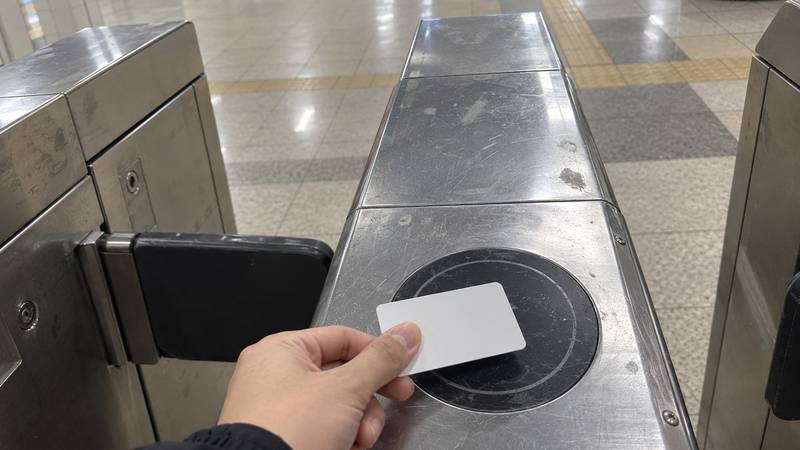
Touch the card on the reader when you enter the subway gate and again when you leave (the Seoul subway guide covers lines, last trains and exits). On buses, tap when you board and tap again on a reader by the door when you get off. The tap out matters: the system uses it to calculate distance and transfers.
Seoul city fares for adults paying by card, checked on 6 October 2026:
| Ride | Card fare | Without a card |
|---|---|---|
| Subway, first 10 km | ₩1,550 | ₩1,650 single-journey ticket, plus a ₩500 deposit |
| Subway, early-bird (before 06:30) | ₩1,240 | Card only |
| City bus (blue and green) | ₩1,500 | ₩1,500 cash on routes that still take it |
| Village bus | ₩1,200 | – |
| Red wide-area bus | ₩3,000 | – |
| Late-night bus | ₩2,500 | – |
On the subway, every 5 km beyond the first 10 km adds ₩100, and beyond 50 km the surcharge drops to ₩100 per 8 km. Seoul raised the subway fare from ₩1,400 on 28 June 2025; older guides still quote the old price. Single-journey tickets return their ₩500 deposit at the deposit refund machine after the ride, which is one more reason to carry a card.
Transfer discounts
In Seoul, Incheon and Gyeonggi Province, a card ride is charged by total distance rather than per vehicle when you change between subway and bus. The conditions:
- Board the next bus or train within 30 minutes of tapping out (60 minutes between 21:00 and 07:00).
- Up to 4 transfers, so 5 rides in total, count as one journey.
- One card per person, and no discount for changing to the same bus route.
- If you forget to tap out of a bus, the chain breaks and the next ride is charged a full fare.
Travelling as a group, each person needs their own card. Bus drivers can charge several people on one card, but the transfer discount then stops at the subway.
Using T-money outside Seoul
T-money works on public transport nationwide. Its official coverage list includes the subways of Busan, Daegu, Daejeon, Gwangju and Incheon, city and intercity buses across the country, airport buses and buses on Jeju. Many taxis accept it too, but T-money notes that some regions limit taxi payments, so carry cash or a card as a backup.
In Busan, fares are set by Busan Transportation Corporation: a card ride on the metro costs ₩1,600 in zone 1 and ₩1,800 in zone 2 for adults, and children ride free. In Gyeongju and on Jeju, where there is no subway, T-money pays for local buses.
KTX and other long-distance trains need a separate train ticket; see how to book KTX trains. Intercity bus tickets booked online cannot be paid with T-money.
Other visitor cards and mobile options
T-money is the safe default, but four alternatives matter for visitors. Korea Field Notes compares them in detail in T-money vs WOWPASS vs Climate Card.
| Card | Price | Best for | Limits |
|---|---|---|---|
| Climate Card short-term pass | ₩5,000 (1 day), ₩8,000 (2), ₩10,000 (3), ₩15,000 (5), ₩20,000 (7) plus a ₩3,000 card | Many rides a day inside Seoul | Seoul subway and Seoul buses only |
| Tmoney Travel Card | ₩4,000 | Visitors who want a tourist design with the same T-money functions | Sold at convenience stores and Incheon Airport bus ticket offices |
| WOWPASS | Card fee varies by card type; passport needed | Visitors who also want a prepaid payment card loaded with foreign cash | The T-money balance is topped up separately from the payment balance |
| Mobile T-money (iPhone) | Free app | iPhone users without won cash | Top-ups by Apple Pay with Mastercard, Amex, UnionPay or JCB; Visa not supported |
A Climate Card short-term pass runs from the day you load it, so it cannot be preloaded for a later date. Since 17 March 2026 the new ticket machines in Seoul Metro stations on lines 1 to 8 sell it with foreign credit and debit cards. It covers the Seoul subway (you may also ride to Incheon Airport but not board there) and buses licensed by Seoul, but not the Shinbundang line, GTX, red wide-area buses, airport buses or the Seoul public bikes. The 30-day Climate Card ended on 1 October 2026; its replacement is for Seoul residents only.
The Korea Tour Card has been discontinued. Seoul plans to accept foreign contactless cards on city buses first and on subway lines 1 to 8 from 2027, and the plan’s final stage runs to 2030; until then, a transport card is required.
Getting your balance back before you leave
Leftover money on a plastic T-money card can be returned in cash, minus a ₩500 fee. The card price itself is not refunded.
| Where | How much | Notes |
|---|---|---|
| GS25 | Balances under ₩20,000 | ₩500 fee |
| 7-Eleven and independent stores | Up to ₩20,000 | ₩500 fee |
| CU and emart24 | Up to ₩30,000 | ₩500 fee |
| Seoul subway information centres | Partial refunds of ₩10,000–50,000 in ₩10,000 steps | Plastic cards only |
| Tmoney Town, Seoul City Tower 1F (near Seoul Station) | Over ₩50,000 | The only place for large balances |
The easiest plan is to stop topping up in the last day or two and spend the rest at a convenience store, where T-money also pays for snacks. Balances on mobile T-money are refunded only to a Korean bank account, so load small amounts on the app.
What can go wrong
Where to next
Most first trips start in Seoul, where a T-money card covers the subway, buses and many taxis. For long-distance travel, read the transportation overview and how to book KTX trains; for cards, cash and tax refunds, see money in Korea. Keeping mobile data on helps with route apps: compare SIM cards and eSIMs.
City guides
Busan
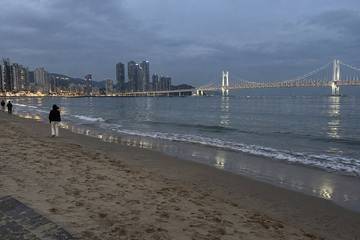
Korea's second city and busiest port, wrapped around beaches, hillside villages, fish markets and a temple on the rocks.
Gyeongju
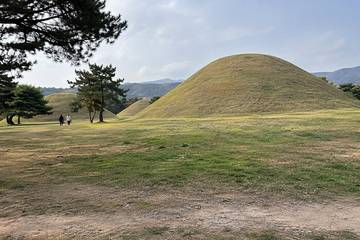
The former Silla capital, an open-air museum of grassy royal tombs, ancient temples and stone Buddhas in the southeast.
Jeju Island
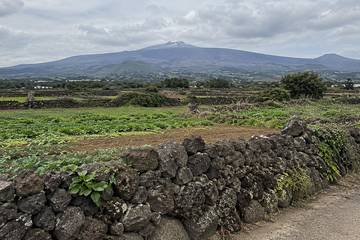
Korea's volcanic holiday island, with the country's highest peak, UNESCO-listed craters and lava tubes, black-sand coves and waterfalls.
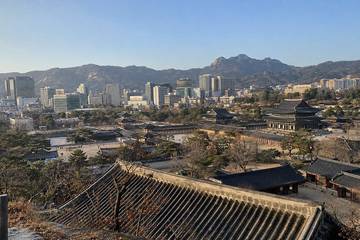
Seoul
Korea's capital: Joseon palaces and hanok lanes beside skyscrapers, night markets, Han River parks and granite peaks inside the city limits.
Frequently asked questions
Where can I buy a T-money card?
At convenience stores such as CU, GS25, 7-Eleven and emart24, and at the staffed information centres in Seoul subway stations on lines 1 to 8. A basic card costs ₩3,000; designs sold at airport railroad stations cost ₩5,000. Station machines top cards up but do not sell them.
Can I top up T-money with a credit card?
Not with a foreign card in most places. Convenience stores and station machines take Korean won cash. The exception is the T-money app on an iPhone, which since 2026 accepts non-Korean Mastercard, American Express, UnionPay and JCB cards through Apple Pay; Visa is not yet included.
Can I tap my Visa or Mastercard on the Seoul subway?
No, not yet. Seoul's plan installs international contactless payment on city buses first and replaces subway gates for lines 1 to 8 in 2027. Until then you need a transport card such as T-money or a Climate Card.
Does T-money work in Busan and Jeju?
Yes. T-money works on public transport nationwide, including the Busan, Daegu, Daejeon, Gwangju and Incheon subways and buses in Jeju. Many taxis also accept it, although T-money warns that some regions restrict taxi payments.
How do I get my T-money balance back before leaving Korea?
Ask at a convenience store: GS25 refunds balances under ₩20,000, 7-Eleven up to ₩20,000, CU and emart24 up to ₩30,000, all for a ₩500 fee. Larger balances go to Tmoney Town near Seoul Station. The ₩3,000 card price is never refunded.
Do children need a special T-money card?
Children aged 6 to 12 and youths aged 13 to 18 pay lower fares only if the card is registered with their date of birth. Do this at the convenience store or subway information centre when you buy the card. Unregistered cards are charged the adult fare.
Sources
Facts on this page were checked against these sources on 6 October 2026. Prices, hours and rules change — confirm with the operator before you go.
- Tmoney – Guide for foreigners (top-up, refund, transfer discount) · official
- Tmoney – Tourist cards (Tmoney Travel Card, Korea Tour Card discontinued) · official
- VISITKOREA – Transportation cards (T-money, WOWPASS, Climate Card; updated August 2026) · official
- Tmoney app on the App Store (version notes: international users, Apple Pay top-up) · official
- 티머니 – 일반 티머니 카드 (가격·판매처) (Korean) · official
- 티머니 – 이용 안내 (구매처, 충전, 환불, 할인 등록, 사용처) (Korean) · official
- 서울특별시 – 교통 요금 안내 (지하철 2025.6.28., 버스 2023.8.12. 조정) (Korean) · official
- 서울특별시 – 수도권 통합환승할인제도 (Korean) · official
- 서울특별시 – 1회용 교통카드 보증금 환급 (Korean) · official
- 서울특별시 – 기후동행카드(단기권) FAQ (Korean) · official
- 서울특별시 – 기후동행카드(30일권) 운영종료 FAQ (Korean) · official
- 서울특별시 보도자료 – 외국인 관광객 오픈루프 교통결제 단계적 도입 (2025-10-16) (Korean) · official
- 부산교통공사 – 운임 안내 (Korean) · official
- 이투데이 – 서울 지하철 기본요금 28일부터 1550원 (2025-06) (Korean)
- SBS Biz – 모바일티머니, 해외 발행 카드로 충전 가능 (2026-03-19) (Korean)
- 경향신문 – 기후동행카드 30일권 운영 종료 (2026-08) (Korean)