Andong 안동
Andong is worth one night if you want Hahoe, Korea's best-known lived-in clan village, and two UNESCO Confucian academies; KTX-Eum trains from Cheongnyangni take about 2 hours. Hahoe costs ₩5,000 including the shuttle and mask museum, and Busan-bound trains make Andong an easy stop on the way south.
Updated
Is Andong worth it?
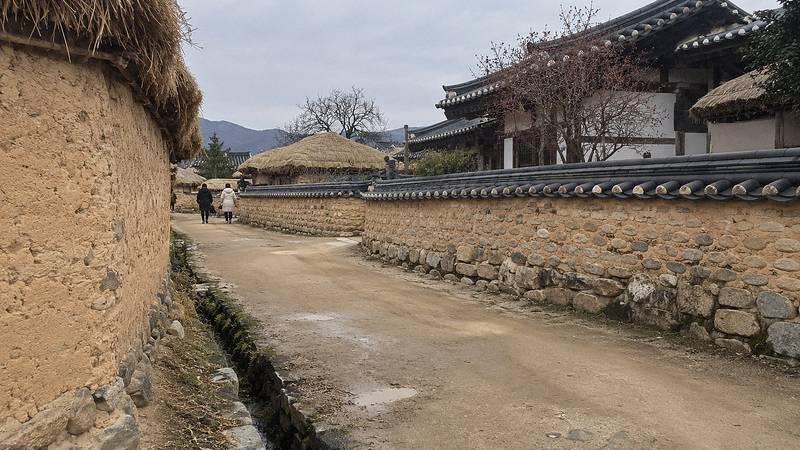
Andong, in the hills of North Gyeongsang, calls itself the capital of Korean spiritual culture. It earns the claim through its Confucian clan villages and academies, which survive here better than anywhere else in Korea. Most visitors come for one place: Hahoe Folk Village, a riverside clan village where about 150 households still live among 127 old houses.
| Your situation | Do this |
|---|---|
| One night between Seoul and Busan | Hahoe and the mask dance by day, jjimdak and Woryeonggyo at night, then on to Busan by KTX-Eum |
| Only a day from Seoul | Hahoe only, timed for the 14:00 mask dance; book both trains first |
| Interested in Confucian Korea | Add Byeongsanseowon (free) and Dosanseowon (₩2,000) |
| No car | Bus to Hahoe is easy; for Byeongsanseowon, Dosan or Bongjeongsa, use a taxi or the day tour |
| Arriving on a Monday | Fine for Hahoe and the museums, but no mask dance that day |
Facts checked 24 October 2026. A day trip from Seoul is long. One night lets you see Hahoe without rushing and catch the town in the evening.
Hahoe Folk Village: what to see and how long
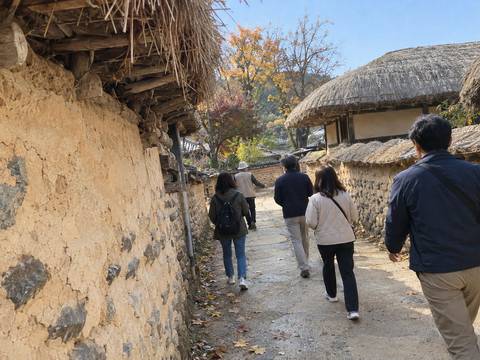
Hahoe was listed by UNESCO in 2010, together with Gyeongju’s Yangdong, as one of the Historic Villages of Korea. The Nakdong River loops almost all the way round it, which gives the village its name (ha-hoe, “river turning”). The Ryu clan houses Yangjindang and Chunghyodang are the grandest buildings. The old zelkova at the Samsindang shrine stands in the middle of the lanes, and the Mansongjeong pine forest runs along the sandy bank.
Allow 2–4 hours for the village, and longer with the mask dance. Buy your ticket at the office by the car park and take the free shuttle to the village entrance. There are no restaurants inside the village, so eat near the car park. Families live in many of the houses, so keep out of closed gates and courtyards.
| Sight | Adult fee | Hours |
|---|---|---|
| Hahoe Folk Village (shuttle and Mask Museum included) | ₩5,000 | From 09:00; last entry 17:30 Apr–Sep, 16:30 Oct–Mar |
| Mask dance (Byeolsingut Talnori) | Free | 14:00 Tue–Sun Mar–Dec; Sat–Sun Jan–Feb |
| Hahoe World Mask Museum | Free | 09:30–18:00 |
| Byeongsanseowon | Free | 09:00–18:00 summer, 09:00–17:00 winter |
| Dosanseowon | ₩2,000 | 09:00–18:00 Feb–Oct, 09:00–17:00 Nov–Jan; last entry 30 min before |
From the Hahoe Village, Byeongsanseowon and Andong tourism sites, checked 24 October 2026. Hahoe youths (13–18) pay ₩2,500 and children (7–12) ₩1,500. The mask dance hall was being renovated from June 2025, with shows moved to a temporary hall, so ask at the ticket office where the 14:00 show is held.
The Hahoe Byeolsingut Talnori is a masked dance-drama that once formed part of a village shamanic rite. Its characters mock aristocrats and monks, and the wooden Hahoe masks used in it are national treasures. It is part of the Korean mask dance (talchum) tradition that UNESCO added to its intangible heritage list in 2022. Across the river, Buyongdae cliff gives the view over the whole loop; it is reached by road via Gwangdeok Bridge. On a few evenings a year the village holds Seonyu Julbul, a fire show of burning rope lines and floating lanterns, with tickets sold in advance only.
The Gyeongbuk wildfires of March 2025 came within about 10 km of Hahoe. News reports the next day confirmed that neither Hahoe nor Byeongsanseowon was damaged.
The Confucian academies: Byeongsanseowon and Dosanseowon
Seowon were private Confucian academies where scholars taught and honoured a revered teacher. Nine were inscribed together by UNESCO in 2019, and two of them are in Andong. Visit one if you have a spare half day. Visit both only if Joseon history is the point of your trip.
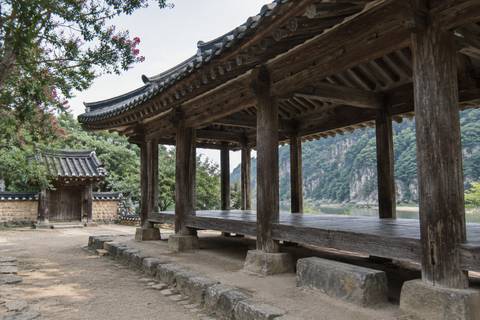
Byeongsanseowon, down the river from Hahoe, is the more striking of the two. Its long open pavilion, Mandaeru, looks straight across the water to a cliff, and the academy is free. City bus 210 reaches it only a few times a day. Most people take a taxi from Hahoe, or join the private day tour. The access road was paved in spring 2026.
Dosanseowon, north of the city above the Andong Lake, grew out of the school of Toegye Yi Hwang, the 16th-century scholar on Korea’s ₩1,000 note. Toegye built his study here in 1561, and his disciples completed the academy after his death. Take bus Express 3 from the station and terminal.
Andong in town: Woryeonggyo, museums and jjimdak
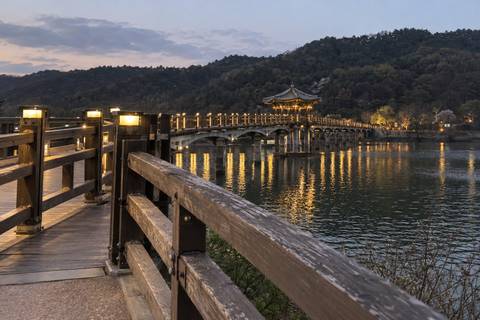
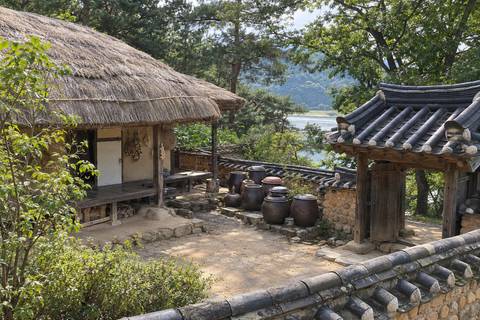
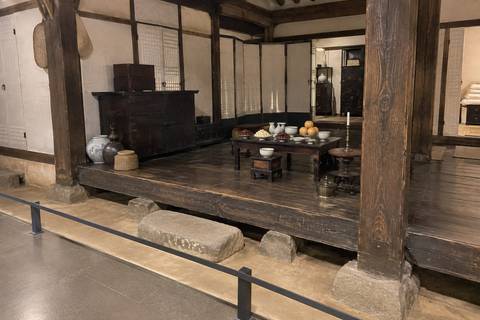
In the evening, head to the city. Woryeonggyo, a 387 m wooden footbridge below the Andong Dam, is free, lit at night and has a pavilion halfway across. Next to it, the Andong Folk Village holds houses moved from the land flooded by the dam. The Andong Folk Museum nearby is free and open on Mondays, 09:00–18:00 with last entry at 17:30.
Dinner means jjimdak in the jjimdak alley of the old market, Gu-sijang, where about 30 restaurants serve braised chicken by the platter for two or more. Near Woryeonggyo, restaurants serve heotjesabap; salted mackerel set meals are on menus across the city. Andong soju is a clear distilled spirit of around 45 percent, far stronger than ordinary soju. The free Soju and Traditional Food Museum explains it, and it also shows the 73rd birthday table prepared for Queen Elizabeth II during her 1999 visit to Andong. The city lists the museum as closed on Mondays. For more on regional dishes, see the Korean food guide.
Bongjeongsa, a small temple in the hills north of the city, is free to enter. Its Geungnakjeon hall is the oldest wooden building in Korea, and the temple is one of the seven mountain monasteries on the UNESCO list. Take bus Express 2 or 310. See the temples guide for the other six.
Getting there and around without a car
The fastest way from Seoul is the KTX-Eum from Cheongnyangni, at about 1 h 50 min to 2 h 5 min. The same line continues south to Busan’s Bujeon Station in about 2 hours, so Andong fits between Seoul and Busan without backtracking. Express buses from Seoul take about 2 h 40 min from the Express Bus Terminal, or about 3 hours from Dong Seoul.
Andong Station and the bus terminal stand side by side west of the city, and buses to Hahoe leave from there. Bus Express 2 or 210 goes to Hahoe. A taxi is the practical way to reach Byeongsanseowon from Hahoe, or to see Dosanseowon and Bongjeongsa in a morning. Ask the driver to wait, as taxis are scarce at the outlying sites. If you have a rail pass, see the Korail Pass guide.
When to go
Spring and autumn are the best seasons for walking Hahoe and the academies. The Andong Maskdance Festival fills the city and Hahoe for about 11 days around the turn of September and October; in 2026 it ran from 24 September to 4 October. The 2027 dates have not been announced. For the other big events through the year, see the festival calendar for Korea.
Summer is hot inland and there is little shade in Hahoe’s lanes. Winter is cold and quiet, and the mask dance drops to weekends in January and February. For the rest of the region, including Gyeongju, Daegu and Haeinsa, see the Gyeongsang guide. For another traditional town, compare Jeonju.
Book your trip
Top attractions in Andong
Hahoe and Pungcheon (west)
The UNESCO clan village of Hahoe, the Buyongdae cliff opposite and Byeongsanseowon down the river, west of the city. This is the reason most visitors come.
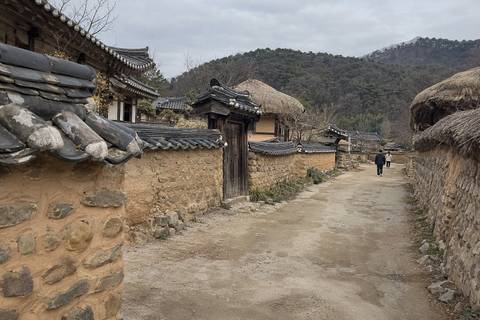
Hahoe Folk Village
A Pungsan Ryu clan village of tiled and thatched houses in a river bend, still lived in; UNESCO-listed with Yangdong in 2010.
Hahoe Byeolsingut Talnori performance
The village's satirical masked dance-drama, performed free at 14:00 Tuesday to Sunday from March to December, weekends only in winter.
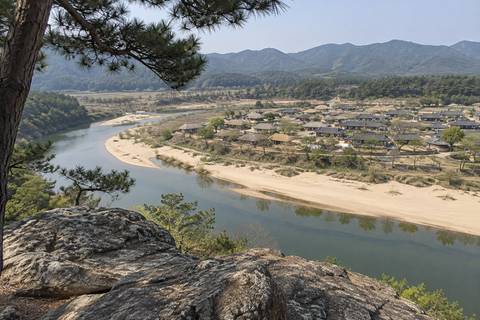
Buyongdae Cliff
The cliff across the river from Hahoe, with the classic view down over the whole village; reached by road via Gwangdeok Bridge.
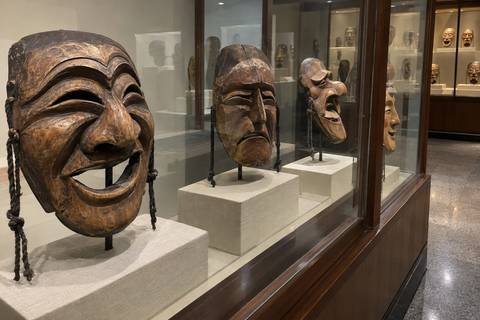
Hahoe World Mask Museum
Masks from Korea and around the world beside the Hahoe ticket office; free, 09:30–18:00.
Byeongsanseowon
A Confucian academy facing a cliff and river, its open Mandaeru pavilion framing the view; UNESCO 2019, free.
City centre and Woryeonggyo
The old market and its jjimdak alley, the long wooden Woryeonggyo footbridge by the Andong Dam, and the folk village and museums beside it. The KTX station and bus terminal are on the western edge of the city.
Woryeonggyo Bridge
A 387 m wooden footbridge over the river below the Andong Dam, with a pavilion halfway; free, open at all hours and lit at night.
Andong Folk Village
Old houses moved here from land flooded by the Andong Dam, laid out on a hillside by the river; free and open at all hours.
Andong Folk Museum
The city museum of local customs, from ancestral rites to farming life, next to the folk village; free, open Mondays.
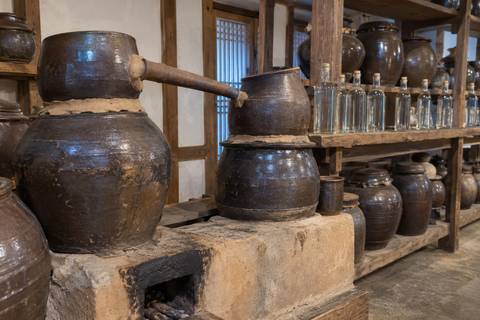
Andong Soju and Traditional Food Museum
A small free museum about Andong's distilled soju and local food, with tastings; the city lists it as closed on Mondays.
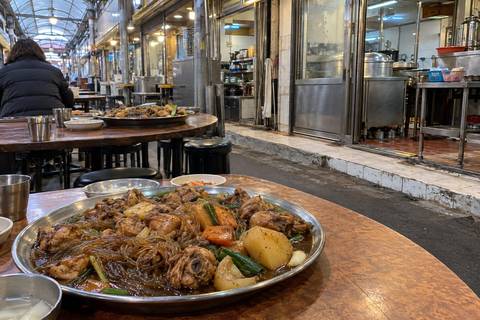
Andong Gu-sijang and Jjimdak Alley
The old market's covered alley of about 30 restaurants serving Andong jjimdak, braised chicken with glass noodles, for sharing.
Dosan and Bongjeongsa (north)
Two more UNESCO sites in the hills north of the city: Dosanseowon, the academy of the scholar Toegye, and the mountain temple of Bongjeongsa. Each is a separate bus or taxi trip.
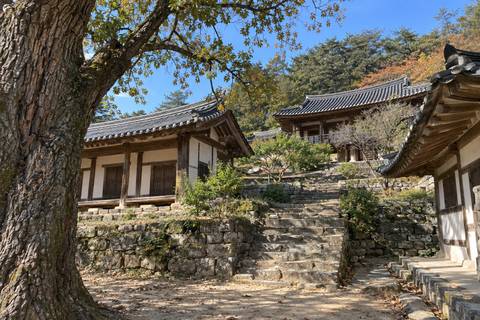
Dosanseowon
The academy built around the study of Toegye Yi Hwang, the scholar on the ₩1,000 note, above the Andong Lake; UNESCO 2019.
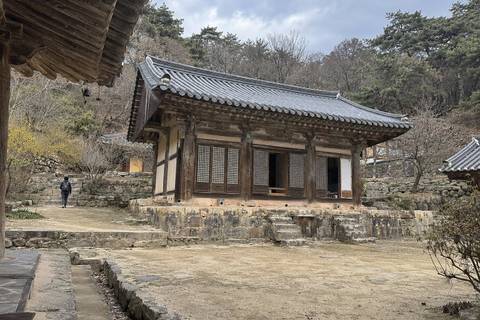
Bongjeongsa Temple
A small mountain temple whose Geungnakjeon hall is Korea's oldest surviving wooden building; one of the UNESCO Sansa, free.
Andong by interest
Getting to Andong
| From | How | Time | Notes |
|---|---|---|---|
| Cheongnyangni (Seoul) | KTX-Eum to Andong Station | about 1 h 50 min – 2 h 5 min | Some trains start at Seoul Station and take longer. Book on the Korail app or website; see how to book KTX tickets. |
| Busan (Bujeon Station) | KTX-Eum to Andong Station | about 2 h | The Jungang Line trains from Cheongnyangni continue south to Bujeon, so Andong works as a stop between Seoul and Busan. The city lists nine Andong–Bujeon trains a day. |
| Seoul Express Bus Terminal or Dong Seoul | Express bus to Andong Bus Terminal | about 2 h 40 min (Express Bus Terminal) / about 3 h (Dong Seoul) | Fares rose on 1 October 2026, so check the current price on Kobus or T-money Bus. See long-distance buses. |
| Incheon Airport | Direct airport bus to Andong Bus Terminal | about 3 h 30 min – 4 h 30 min | Only a few buses run a day, so check the times before you land. If you miss the last one, take the AREX into Seoul and a KTX-Eum from Cheongnyangni. |
Andong Station moved in December 2020 from the old city centre to Songhyeon-dong on the western edge of the city. The bus terminal is next to it, so trains and long-distance buses share one arrival point. Hahoe is further west, and the city centre, market and Woryeonggyo are a bus or taxi ride east.
Getting around
City buses cost ₩1,500 with a transport card, with a free transfer within an hour if you tap the reader when you get off. From the station and terminal, take bus Express 2 (급행2) or 210 to Hahoe; 210 continues to Byeongsanseowon a few times a day. Express 3 (급행3) runs to Dosanseowon, Express 2 or 310 to Bongjeongsa, and 112 to Woryeonggyo from the old station stop. Buses to the outlying sites are infrequent, so check the times on Naver Map or the city's bus information site (bus.andong.go.kr) and note the last bus back. A private day tour linked from the city tourism site covers Hahoe, the mask dance and Byeongsanseowon from Tuesday to Sunday (minimum five people), for ₩30,000 including admissions, with pick-ups at the station and in the old town. See T-money.
Long-distance trains: see KORAIL PASS and transportation in Korea.
Itineraries
Andong in one night
Take a morning KTX-Eum from Cheongnyangni and a bus straight to Hahoe. Walk the village, see the 14:00 mask dance, then go up Buyongdae or on to Byeongsanseowon by taxi. In the evening eat jjimdak at the old market and walk across Woryeonggyo when it is lit. Next morning, visit Dosanseowon or Bongjeongsa before the train on.
Seoul to Busan via Andong
Leave Seoul on an early KTX-Eum, leave your bag in a station locker and spend the day at Hahoe and Byeongsanseowon. Return to the station by late afternoon and take an evening KTX-Eum to Busan's Bujeon Station, about 2 hours. Check the last train before you set out.
Day trip from Seoul
Possible but rushed: the round trip is about 4 hours by train plus the bus to Hahoe. Go to Hahoe only, see the 14:00 mask dance and come back. If you also want an academy or Woryeonggyo, stay the night.
Where to stay in Andong
Hahoe Village homestays
Over 30 family homes inside the village take guests in traditional rooms, some with meals; booking is mostly by phone in Korean. See hanok stays.
Best for: Couples, culture lovers, one night
See hotels in Hahoe Village homestaysGurume Resort and the Andong Dam area
Old houses moved from the dam area and turned into rooms, near the folk village and a short walk from Woryeonggyo.
Best for: Couples, hanok with comfort
See hotels in Gurume Resort and the Andong Dam areaOld city centre
Ordinary hotels and motels near the old market and jjimdak alley, where most of the restaurants are.
Best for: Food, evenings, budget
See hotels in Old city centreStation and bus terminal area
Practical for an early KTX-Eum or bus, and buses to Hahoe leave from here, but it is a ride from the market and restaurants.
Best for: Early trains, short stays
See hotels in Station and bus terminal area
Some links on this page are affiliate links: if you book through them we may earn a commission at no extra cost to you. It never decides what we recommend. Affiliate disclosure.
Food and restaurants in Andong
Andong food comes from an inland region far from the sea and from the household rites of its old clans. Jjimdak, braised chicken with glass noodles, is the dish everyone orders, and the city is also known for salted mackerel, rite-style bibimbap and its strong distilled soju.
What to eat
| Andong jjimdak 안동찜닭 | Chicken braised in a soy-based sauce with glass noodles, potatoes and chilli, served on a large platter for two or more. |
|---|---|
| Salted mackerel 안동간고등어 | Mackerel salted to last the journey inland in the days before refrigeration, grilled and served as a set meal with rice and side dishes. |
| Heotjesabap 헛제사밥 | Literally 'fake ancestral-rite rice': the namul, fish and jeon of a memorial table served as a meal on ordinary days. |
| Andong soju 안동소주 | A clear spirit distilled from grain at around 45 percent alcohol, unlike the diluted green-bottle soju sold everywhere. |
Where to eat
- Gu-sijang jjimdak alley — The old market's alley of jjimdak restaurants in the city centre; see markets in Korea.
- Woryeonggyo — Heotjesabap restaurants on the road by the bridge and the dam.
- Hahoe car park area — Restaurants by the ticket office and car park; there are none inside the village itself.
Experiences and tours in Andong
Andong and Hahoe day tour from Seoul
A guided day trip with transport, worth considering because the outlying sites are hard to combine by city bus.
Check on KlookHahoe tour from Busan
A guided day from Busan for travellers basing themselves on the south coast.
Check on KlookKTX train tickets to Andong
Book the KTX-Eum in English with a foreign card; the official Korail site also takes foreign cards.
Check on KlookKorea Rail Pass
Covers the KTX-Eum to Andong and on to Busan if you are making several long train trips; see the Korail Pass guide.
Check on Klook
Some links on this page are affiliate links: if you book through them we may earn a commission at no extra cost to you. It never decides what we recommend. Affiliate disclosure.
Frequently asked questions
Is Andong worth visiting?
Yes, for traditional Korea. Hahoe is a clan village where about 150 households still live, and Byeongsanseowon and Dosanseowon are two of the nine UNESCO-listed Confucian academies. One night is enough. If you only want hanok streets with cafés, Jeonju is easier.
How do I get from Seoul to Andong?
Take the KTX-Eum from Cheongnyangni, about 1 h 50 min to 2 h 5 min, or an express bus from the Seoul Express Bus Terminal, about 2 h 40 min. Both arrive at the same place, as Andong Station and the bus terminal are side by side west of the city.
How much is Hahoe Village?
₩5,000 for adults, ₩2,500 for youths (13–18) and ₩1,500 for children (7–12). The ticket includes the shuttle from the ticket office to the village, the car park and the Hahoe World Mask Museum. Last entry is 17:30 from April to September and 16:30 from October to March.
When is the Hahoe mask dance performance?
At 14:00 from Tuesday to Sunday between March and December, and on Saturdays and Sundays only in January and February. It lasts about an hour and is free. The schedule can change, so check at the ticket office.
Can you get to Byeongsanseowon by bus?
Only a few times a day: city bus 210 continues past Hahoe to Byeongsanseowon. Most visitors take a taxi from Hahoe and ask the driver to wait, or join a day tour. Entry to the academy is free.
Sources
Facts on this page were checked against these sources on 24 October 2026. Prices, hours and rules change — confirm with the operator before you go.
- 안동하회마을 – 관람안내 (관람료·입장시간·셔틀버스·버스 시간표) (Korean) · official
- 안동하회마을 – 2026 하회별신굿탈놀이 상설공연 일정 (2026-01-02) (Korean) · official
- 안동하회마을 – 세계유산 등재 (한국의 역사마을, 2010) (Korean) · official
- 안동하회마을 – 마을 현황 (Korean) · official
- 안동하회마을 – 민박 안내 (Korean) · official
- 안동하회마을 – 공지사항 (선유줄불놀이 2026) (Korean) · official
- 하회별신굿탈놀이보존회 – 상설공연 안내 (Korean) · official
- 하회세계탈박물관 – 관람안내 (Korean) · official
- 병산서원 – 관람안내 (관람료·관람시간) (Korean) · official
- 병산서원 – 오시는 길 (210번 버스) (Korean) · official
- 병산서원 – 병산서원 가는길 포장공사 안내 (2026-04-02) (Korean) · official
- 안동관광 – 병산서원 (Korean) · official
- 안동관광 – 안동 오시는길 (KTX-이음·고속버스·공항버스) (Korean) · official
- 안동관광 – 관광지 가시는길 (시내버스 노선·요금·환승) (Korean) · official
- 안동관광 – 관광지 관람료 (Korean) · official
- 안동관광 – 관광지 관람시간 (Korean) · official
- 안동관광 – 도산서원 (Korean) · official
- 안동관광 – 월영교 (Korean) · official
- 안동관광 – 안동찜닭골목 (Korean) · official
- 안동관광 – 안동의 맛 (헛제사밥·간고등어) (Korean) · official
- 안동관광 – 안동소주·전통음식박물관 (Korean) · official
- 안동관광 – 숙박 (구름에 리조트) (Korean) · official
- 안동시립민속박물관 – 관람안내 (Korean) · official
- 안동시 – 한국정신문화의 수도 안동 (Korean) · official
- 안동국제탈춤페스티벌 – 2026 축제 (9.24–10.4) (Korean) · official
- GBTOUR – 안동 시티투어 (지역투어 코스·요금) (Korean) · official
- VisitKorea – Bongjeongsa Temple [UNESCO World Heritage] · official
- VisitKorea – Andong Folk Village · official
- VisitKorea – Andong Soju · official
- 경북매일 – 안동역 송현동 신역사로 이전 (2020-12-14) (Korean)
- 한국경제 – 안동 산불, 하회마을·병산서원 피해 없어 (2025-03-26) (Korean)