Accommodation
Guesthouses and Hostels in Korea
Updated
Book your trip
In Korea, “guesthouse” is a marketing name, not a licence: the place you book is legally a hostel, a city homestay, a rural homestay or a hanok stay, and each has different rules. City homestays take foreign guests only and the host must live there; hostels take everyone and have shared showers and a kitchen. Before you pay, check that the listing is registered and posts its rates, and whether the bathroom is shared. Rules as in force on 27 October 2026.
| Your situation | What to book |
|---|---|
| Solo on a budget, want to meet other travellers | A registered hostel (dorm bed or private room) near a subway line |
| You want to stay in a Korean family home in Seoul or Busan | A foreign-tourist urban homestay, ideally from the official Seoul Stay list in Seoul |
| Someone in your group holds a Korean passport | A hostel, hanok stay or hotel; ask before booking a city homestay |
| Villages, the coast or countryside, including rural Jeju | A rural homestay (농어촌민박), often with breakfast in the rate |
| One traditional night in an old house | A hanok stay |
| You need an en-suite, a lift or 24-hour reception | A small hotel; see hotels in Korea |
For most first trips a hostel in a busy area such as Hongdae or Seoul Station is the simplest choice. A homestay suits travellers who want a quieter neighbourhood and a host, and can live with house rules.
Which kind of guesthouse is it?
The listing will rarely tell you the legal category. The table shows what each one means for you.
| Category (Korean name) | Who can stay | Host lives there? | Typical set-up | Where you find it |
|---|---|---|---|---|
| Hostel (호스텔업) | Everyone | No | Dorms and private rooms, shared showers, guest kitchen, lounge | Cities, near stations and nightlife areas |
| Urban homestay (외국인관광 도시민박업) | Foreign tourists only | Yes | A few rooms in the host’s house or apartment | Seoul, Busan and other cities |
| Rural homestay (농어촌민박) | Everyone | Yes, and owns the house | Rooms in a detached house, breakfast allowed | Villages, islands, coast, rural Jeju |
| Hanok stay (한옥체험업) | Everyone | No, a manager on site | Rooms around a courtyard, often floor bedding | Bukchon, Jeonju, Gyeongju, Andong |
| General inn or motel (숙박업) | Everyone | No | Private rooms, often en-suite | Everywhere |
Categories from the Tourism Promotion Act Enforcement Decree and the Rural Community Act, versions in force on 27 October 2026. If a “guesthouse” sits in a city apartment block and the host does not live there, it fits none of the homestay rules, so ask how it is registered.
Hostels: dorm beds and shared kitchens
A registered hostel is defined in law as lodging suited to backpackers and other independent travellers. It must provide shared facilities such as showers and a kitchen, plus a space for cultural and information exchange between foreign and Korean guests.
- Dorm or private room. Hostels sell both. Check the number of beds per dorm and whether it is mixed or women-only.
- Shared bathrooms are the norm. Bring flip-flops and a small towel unless the listing says towels are included.
- No stars. Only hotels are graded, so a hostel with no star rating is normal.
- Everyone can stay. Unlike a city homestay, a hostel takes Korean and foreign guests alike.
Hostels make sense near the transport you will use most. The city guides list the best bases: Seoul, Busan and Jeju.
City homestays: a room in a local home
An Airbnb-style room in a city home needs a foreign-tourist urban homestay licence (외국인관광 도시민박업). The licence exists so foreign visitors can experience Korean home life, and the rules follow from that.
- The host must live there. The home must be a detached house, a multi-unit house, an apartment or a low-rise flat where the host actually lives.
- Foreign guests only. Korean guests are allowed only in a narrow exception for village enterprises inside urban regeneration areas.
- Help in your language, or by app. Hosts must be able to look after foreign guests. Since October 2025 the culture ministry also accepts a host who guides guests through a translation app, so do not expect fluent English.
- Posted prices. Since 4 August 2026, an urban homestay must post its rate table at the home and on every website or app it sells through, and charge those rates.
House rules matter more here than in a hostel: shoes off at the door, quiet hours in apartment blocks, and recycling sorted the Korean way. The etiquette guide covers the basics.
Rural homestays: minbak in villages and on Jeju
In rural and semi-rural areas, a small guesthouse in the owner’s home is a rural homestay (농어촌민박) under the Rural Community Act. This is the category for village, island and countryside homes, including in rural Jeju.
- Owner-run. The operator must be a local resident who owns and lives in the detached house used for guests, after at least six months in the area; long-term tenants are a narrow exception.
- Breakfast allowed. A rural homestay may serve breakfast, and its cost must be included in the room rate.
- Posted prices. The operator must display the registration certificate and the rate table where guests can see them; breaking this rule can bring a fine of up to 1,000,000 won.
- Everyone can stay. There is no foreign-guests-only rule.
Rural homestays often need a car or taxi for the last stretch. Check the distance to the nearest bus stop before booking, especially on Jeju.
How to check that a guesthouse is registered
Registered places carry fire-safety, cleaning and price rules; unregistered ones do not, and they may be closed or cancel at short notice.
- In Seoul, search the official Seoul Stay site. The Seoul Tourism Organization lists urban homestays and hanok stays registered with their district. Listing is optional, so a legal place may be missing.
- Look for posted rates. Since August 2026 urban homestays and hanok stays must post their rates on site and on any website or app they sell through; rural homestays must post them on site.
- Look for the Korea Quality mark. The government quality mark (한국관광 품질인증), run by the Korea Tourism Organization, covers urban homestays, hanok stays and general inns. It is optional, so its absence proves nothing.
- Ask for the registration. A host can tell you the category and show the registration or report certificate (등록증 or 신고증). A refusal is a warning sign.
If you are overcharged or something goes wrong, call the Korea Travel Hotline on 1330 (from abroad +82-2-1330), which also handles tourist complaints.
Airbnb in Korea: what changed
Airbnb Korea now asks every Korean host for proof of registration. The platform says Korean law did not require this; it chose to do it.
- 2 October 2024: new listings had to submit their business registration details and certificate.
- 16 October 2025: existing listings that still had not submitted them stopped taking bookings for stays from 1 January 2026. Hosts who submit later can take bookings again from that point.
Booking a 2026 or 2027 stay on Airbnb therefore means booking a listing that has submitted a registration. Read the listing’s house rules and check-in method; many city homestays use door keypads and send codes by message.
What to check before you book
- Bathroom: shared or private. Shared is standard in hostels and many homestays.
- Bed or floor: some homestays and all hanok stays may use floor bedding (yo) on a heated floor.
- Check-in: many small places have no 24-hour desk. Confirm how a late arrival works if your flight lands in the evening.
- Luggage: stairs without a lift are common in older low-rise buildings and hillside lanes, especially in Busan.
- Location: time to the nearest subway station matters more than the room. See the subway guide.
- Cancellation: check the policy, especially for peak dates such as cherry blossom season and Korean holidays.
For a comparison with hotels, hanok stays and temple stays, see the accommodation overview.
City guides
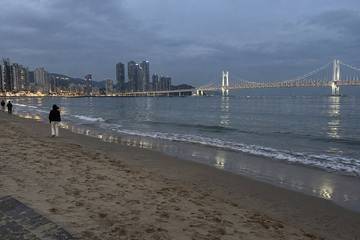
Busan
Korea's second city and busiest port, wrapped around beaches, hillside villages, fish markets and a temple on the rocks.
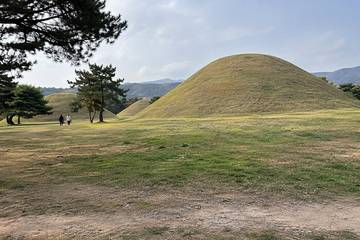
Gyeongju
The former Silla capital, an open-air museum of grassy royal tombs, ancient temples and stone Buddhas in the southeast.

Jeju Island
Korea's volcanic holiday island, with the country's highest peak, UNESCO-listed craters and lava tubes, black-sand coves and waterfalls.
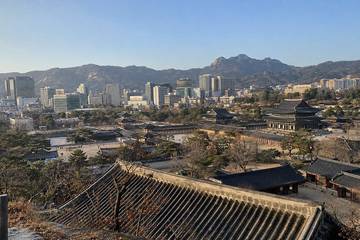
Seoul
Korea's capital: Joseon palaces and hanok lanes beside skyscrapers, night markets, Han River parks and granite peaks inside the city limits.
Frequently asked questions
Is a guesthouse the same as a hostel in Korea?
Not legally. A hostel (호스텔업) is a registered tourism business built for independent travellers, with shared showers, a kitchen and a common area. "Guesthouse" is only a name; the place may be a hostel, a city homestay, a rural homestay, a hanok stay or a small inn.
Can Korean citizens stay in a guesthouse or Airbnb in Seoul?
In a registered foreign-tourist urban homestay (외국인관광 도시민박업), guests must be foreign tourists; the only exception is a village enterprise inside an urban regeneration area. Hostels, hanok stays and rural homestays take everyone. If someone in your group holds a Korean passport, ask the host before you book.
Are Airbnb listings legal in Korea?
Only if the host has registered the home with the local authority. Airbnb Korea has required new listings to submit their business registration since 2 October 2024. Existing listings that had not done so by 16 October 2025 could not take bookings for stays from 1 January 2026.
Do Korean guesthouse hosts speak English?
Not always. Urban homestays must offer service to foreign guests, but since October 2025 the culture ministry accepts a host who guides guests with a translation app instead of fluent English. Keep a translation app and messaging app on your phone for check-in.
Do Korean guesthouses serve breakfast?
Many do. Rural homestays may legally serve breakfast to guests, and the cost must be included in the room rate. In cities, check the listing; a self-service breakfast of toast and coffee is common but not required by law.
Sources
Facts on this page were checked against these sources on 27 October 2026. Prices, hours and rules change — confirm with the operator before you go.
- 국가법령정보센터 – 관광진흥법 시행령 (대통령령 제36554호, 2026-08-04 시행): 제2조 (호스텔업, 외국인관광 도시민박업 정의), 제41조의11 (한국관광 품질인증 대상), 별표 1 제4호 바목 (요금표 게시) (Korean) · official
- 국가법령정보센터 – 농어촌정비법 (법률 제21433호, 2026-09-11 시행): 제2조 제16호 라목 (농어촌민박사업), 제86조 (신고 요건), 제86조의2 (요금표 게시, 조식 제공) (Korean) · official
- 대한민국 정책브리핑 – 30년 이상 주택도 '외국인관광 도시민박업' 등록 가능 (문화체육관광부, 2025-10-10) (Korean) · official
- 강동구청 – 2026년 외국인관광 도시민박업 신규 등록 신청방법 안내 (2026-09-30) (Korean) · official
- Seoul Tourism Organization – Seoul Stay (registered Urban Stay and Hanok Stay listings) · official
- Korea Tourism Organization – Korea Quality (한국관광 품질인증) (Korean) · official
- 에어비앤비 뉴스룸 – 10월 16일부터 영업신고 의무화 조치 전면 시행 (2025-08-18) (Korean) · official