Transportation
Seoul Subway Guide
Updated · First published
Book your trip
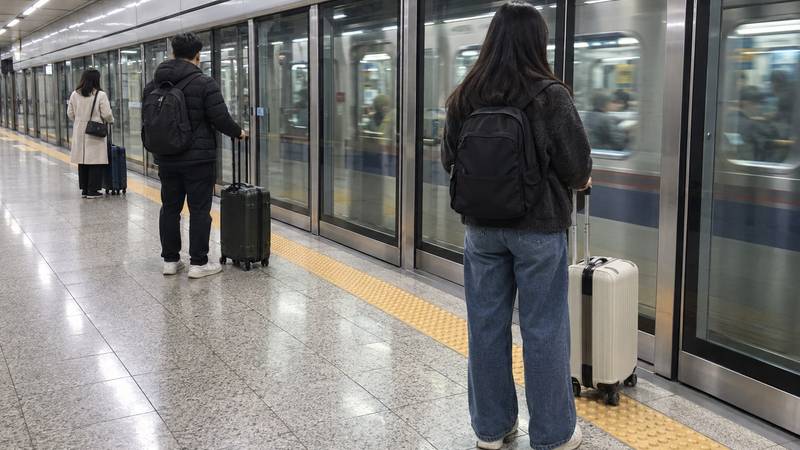
Buy a T-money card, tap it at the gate and follow the line colour and station number: a Seoul subway ride costs ₩1,550 and trains run from about 05:30. The catch is the last train. On weekdays Line 2 runs until about 01:00, but on Saturdays, Sundays and holidays it stops before midnight. Times and fares were checked against Seoul Metro’s English and Korean pages and Seoul’s official timetable data on 6 October 2026.
| Your situation | What to do |
|---|---|
| First day in Seoul, riding several times a day | Buy a T-money card at a convenience store and load ₩20,000–30,000 in cash |
| You only need one ride and have no card | Buy a single-journey ticket at the station machine (English mode) |
| Out late on a Saturday or holiday | Plan to be on your last train by about 23:30, or budget for a taxi |
| Carrying large suitcases | Avoid 07:00–09:00 and drop bags at a T-luggage counter, or have them sent to the airport |
| Not sure which exit to use | Check the exit number for your destination before you tap out |
How to ride the Seoul subway, step by step
- Find your route in a map app. Naver Map has English menus and gives subway routes with transfers and journey times.
- Note three things: the line number and colour, the direction (the name of the last station on the line), and the exit number at your destination.
- Tap your card on the reader at the gate. The screen shows the fare and your remaining balance.
- Follow the signs for your line and direction to the platform. Signs, platform screens and announcements are in Korean and English.
- Change lines by following the transfer signs in the line colour you want. You do not tap out between subway lines.
- Tap out at your destination. The system needs the tap to work out the fare, so always tap out.
- Leave by the right exit. Large stations have more than ten numbered exits that come up in different streets.
Every station has a number as well as a name; the first digit usually tells you the line. City Hall on Line 2, for example, is station 201. Station numbers are useful at ticket machines, which let you search a destination by number.
Paying: transport card or single-journey ticket
A rechargeable transport card is cheaper and quicker than buying a ticket every ride. Seoul Metro’s adult fares, checked on 6 October 2026:
| Ticket | First 10 km | Notes |
|---|---|---|
| Transport card (T-money and similar) | ₩1,550 | +₩100 per 5 km up to 50 km; 20% early-bird discount before 06:30 |
| Single-journey ticket | ₩1,650 | Plus a ₩500 deposit, refunded at your destination; no bus transfers |
| Climate Card short-term pass | Unlimited rides | ₩5,000 for 1 day up to ₩20,000 for 7 days, plus a ₩3,000 card; Seoul subway and Seoul buses only |
Pick a T-money card unless you will ride only once or twice. It also gives transfer discounts with buses and works in other Korean cities; see T-money and transit cards for where to buy one, top-ups, children’s fares and refunds.
Buying a single-journey ticket
- At the ticket machine, select English at the bottom of the screen.
- Select Single-Journey.
- Choose your destination by station name, or search by station number.
- Choose the number of tickets and insert cash for the fare plus the ₩500 deposit.
- At the end of the trip, put the card into the Deposit Refund Device to get the ₩500 back.
Foreign Visa and Mastercard cards cannot be tapped at the gates yet. Seoul plans to fit contactless-card gates on lines 1 to 8 in 2027.
Reading the Seoul subway map: lines, operators and express trains
Lines are numbered 1 to 9 and colour-coded, and named lines such as the Airport Railroad (AREX), the Gyeongui–Jungang Line and the Shinbundang Line join them. Different companies run them, but one fare system covers the whole capital-area network, and one card works on all of them.
- Lines 1 to 8 are run by Seoul Metro. Korail trains also run on lines 1, 3 and 4, so a Line 1 train may continue well beyond Seoul.
- Line 9 has express trains as well as all-stop local trains. Express trains stop only at major stations, including Gimpo International Airport, Yeouido and the Express Bus Terminal, and cost the same. Check the train type on the platform screen before boarding.
- Branch lines: Line 2 is a loop with two short branches, and Line 5 splits in the east. Read the destination on the train front or platform screen.
Trains on lines 1 to 8 come every 2.5 to 4.5 minutes in the morning rush and about every 5 to 8.5 minutes at other times, according to Seoul Metro’s operating figures.
First and last trains: Seoul subway hours
First trains leave around 05:20–05:45, depending on the station. The last train is the time that matters, and it changes with the day of the week. Line 2 times from Seoul’s official timetable data, checked on 6 October 2026:
| Day | First trains | Last trains |
|---|---|---|
| Monday to Friday | About 05:20–05:45 | About 00:45–01:00 |
| Saturday, Sunday and public holidays | About 05:20–05:45 | About 23:45–23:58 |
Two things catch visitors out. Late trains often end their run partway along the line, so the last train from your station may not reach your stop. And lines run by other operators keep their own hours. Check the last train to your destination in a map app before a late dinner.
Service can also stop early for engineering work. In May 2026, Seoul Metro ended trains between Hongik Univ. and Euljiro 1-ga at midnight for one night instead of the usual 01:00.
Stations for Seoul’s main sights
Most sights are a few minutes’ walk from a numbered exit. Use these stations and exits:
| Sight | Station (line) | Exit |
|---|---|---|
| Gyeongbokgung Palace | Gyeongbokgung (Line 3) | Exit 5 |
| Changdeokgung Palace | Anguk (Line 3) | Exit 3 |
| Bukchon Hanok Village | Anguk (Line 3) | Exit 3 |
| Insadong | Anguk (Line 3) | Exit 6 |
| Myeongdong | Myeongdong (Line 4) | Exits 5–10 |
| Gwangjang Market | Jongno 5-ga (Line 1) | Exit 8 |
| Dongdaemun Design Plaza | Dongdaemun History & Culture Park (Lines 2, 4, 5) | Exit 1 |
| N Seoul Tower | Chungmuro (Lines 3, 4), then Namsan bus 01A or 01B | Exit 2 |
| Lotte World Tower | Jamsil (Line 2 or 8) | Exits 1–2 (Line 2) |
| National Museum of Korea | Ichon (Line 4 or Gyeongui–Jungang) | Exit 2 |
Anguk Station on Line 3 is the stop for the palace and hanok quarter. One trip there covers Changdeokgung, Bukchon and Insadong on foot.
Seats, etiquette and rush hour
- Priority seats at both ends of each car are for older people, disabled passengers and others who need them. Leave them free even when the train is empty.
- Pink seats in the middle of the car, two per car on lines 1 to 8, are kept for pregnant women.
- Stand aside at the doors and let passengers off first.
- Keep calls short and music in headphones.
- Don’t smoke near the entrances. The 10 m around every Seoul subway entrance is a no-smoking area. More rules and manners are on the Korean etiquette page.
- Avoid the morning rush (roughly 07:00–09:00) with luggage or a pushchair, when trains run most often but are fullest.
Luggage: T-luggage storage and airport delivery
Seoul Metro runs staffed T-luggage counters in six stations. They store bags for the day or deliver them to another station or to Incheon Airport, which saves dragging suitcases through transfer corridors on your last day.
| Size | Storage, first 4 hours (weekday / weekend) | Delivery to Incheon Airport (weekday / weekend) |
|---|---|---|
| S (up to 20 in) | ₩3,000 / ₩4,000 | ₩20,000 / ₩29,000 (S–M) |
| M (20–23 in) | ₩4,000 / ₩6,000 | ₩20,000 / ₩29,000 (S–M) |
| L (23–27 in) | ₩6,000 / ₩9,000 | ₩26,000 / ₩38,000 |
| XL (over 27 in) | ₩9,000 / ₩13,000 | ₩31,000 / ₩45,000 |
Storage costs ₩1,000 for each extra hour. Counters open 09:00–22:00 every day at Seoul Station (Line 1, B1 near Exit 1), Hongik Univ. (Line 2, Exits 3–4), Jamsil (Line 2, Exits 3–4), Myeongdong (Line 4, Exits 9–10), Gimpo International Airport (Line 5) and Jongno 3-ga (Line 5, Exit 6). Book ahead at tluggage.co.kr or walk in.
What can go wrong on the subway
Where to next
The subway reaches almost every sight in Seoul; our three-day Seoul itinerary shows how to string them together. For the card itself, read T-money and transit cards. To leave the city, see the transportation overview and how to book KTX trains. Route apps need data, so compare SIM cards and eSIMs before you fly.
City guides
Seoul
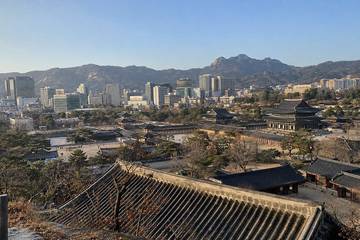
Korea's capital: Joseon palaces and hanok lanes beside skyscrapers, night markets, Han River parks and granite peaks inside the city limits.
Frequently asked questions
What time does the Seoul subway stop running?
On weekdays the last trains on Line 2 run until about 00:45–01:00; on Saturdays, Sundays and public holidays they finish around 23:45–23:58. Many late trains end their run partway along the line, so check the last train to your station, not just from it.
How much is a Seoul subway ride?
₩1,550 for the first 10 km with a transport card such as T-money, plus ₩100 for every further 5 km. A single-journey ticket costs ₩100 more and needs a ₩500 deposit, which you get back from the deposit refund machine at your destination.
Can I tap my Visa or Mastercard at Seoul subway gates?
Not yet. Seoul plans to replace the gates on lines 1 to 8 with contactless-card gates in 2027. Until then you need a transport card such as T-money or a Climate Card, or a single-journey ticket.
Is the Seoul subway in English?
Yes. Station signs, maps, platform screens and announcements are in Korean and English, and every station has a number (City Hall on Line 2 is 201). Ticket machines have an English mode, and Naver Map offers route search in English.
Can I take big suitcases on the Seoul subway?
You can, but rush hours and long transfer corridors make it hard work. Seoul Metro's T-luggage counters at Seoul Station, Myeongdong, Hongik Univ. and three other stations store bags from ₩3,000 for 4 hours and deliver them to Incheon Airport the same day.
What do I do if I leave something on a Seoul subway train?
Tell station staff at once with the time, the train's direction and the car or door number. Found items are registered on the police LOST112 portal and held at a Seoul Metro lost-and-found centre for up to 7 days, open weekdays 09:00–18:00.
Sources
Facts on this page were checked against these sources on 7 October 2026. Prices, hours and rules change — confirm with the operator before you go.
- Seoul Metro – Single-journey ticket (how to buy and use) · official
- Seoul Metro – T-luggage (storage and delivery fees) · official
- VISITKOREA – Helpful apps and resources (map apps; updated August 2026) · official
- Seoul Metropolitan Government – Introduction of the rapid urban railway system: Line 9 (express trains) · official
- Asia Economy – Line 2 Hongdae to Euljiro 1-ga: last train one hour earlier (2026-05-28)
- 서울교통공사 – 운임안내 (기본운임 1,550원, 1회권, 조조할인) (Korean) · official
- 서울교통공사 – 운행현황 (호선별 운행 시격, 코레일 열차) (Korean) · official
- 서울교통공사 – 또타러기지(T-luggage) 보관·배송 요금 (Korean) · official
- 서울교통공사 – 유실물센터 이용안내 (위치, 운영시간, 처리절차) (Korean) · official
- 서울 열린데이터광장 – 서울교통공사 지하철 호선별 첫차와 막차 정보 (Korean) · official
- 서울특별시 – 9호선 급행열차 확대 (김포공항~올림픽공원) (Korean) · official
- 서울특별시 – 지하철 임산부 배려석 운영 (Korean) · official
- 서울특별시 – 기후동행카드(단기권) FAQ (Korean) · official
- 서울특별시 보도자료 – 외국인 관광객 오픈루프 교통결제 단계적 도입 (2025-10-16) (Korean) · official
- 헤럴드경제 – 서교공 "해당 구간, 막차 1시간 앞당겨서 28일 밤 12시 종료" (2026-05-28) (Korean)