History & Religion
Fortresses
Updated
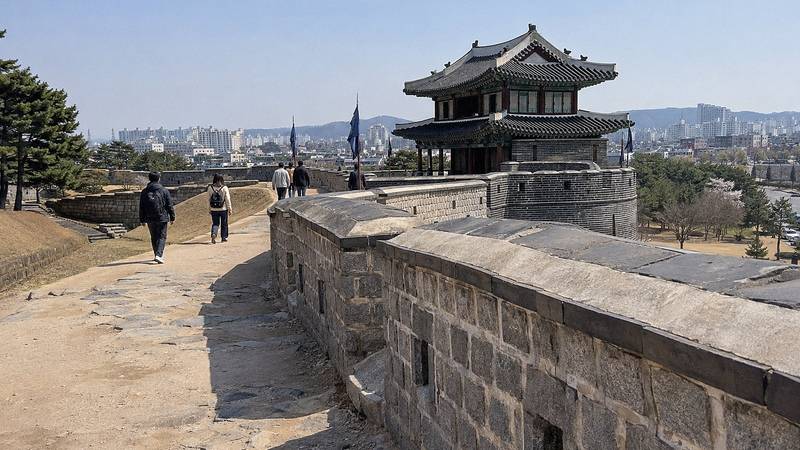
For one fortress on a Seoul-based trip, go to Hwaseong in Suwon: the 5.74 km UNESCO-listed wall is free, open at all hours and 30–40 minutes from Seoul by train. For a greener, quieter ridge walk choose Namhansanseong (free, UNESCO 2014); with only two hours in Seoul, walk the Naksan section of the Seoul City Wall. Palaces inside fortresses charge separately, and Namhansanseong’s palace closes on Mondays.
Korea is full of fortresses: its kingdoms fought over the peninsula for some two thousand years. Three kinds are worth knowing: sanseong (mountain fortresses, such as Namhansanseong), eupseong (walled county towns on flat ground, such as Naganeupseong), and the capital walls of Seoul and Suwon. Many were rebuilt or extended after the Japanese invasions of the 1590s, the Imjin War.
Which fortress fits your trip
| Your situation | Do this |
|---|---|
| One day out of Seoul, first trip | Hwaseong in Suwon: walk the wall, see the Haenggung palace, eat galbi or fried chicken |
| You want a forest walk, not a town | Namhansanseong: Line 8 to Sanseong Station, bus 9 or 52, then a 1–3 h wall course |
| Two or three hours in Seoul | Seoul City Wall, Naksan section (3.2 km, about 1 h 30 min, free, good at dusk) |
| You are hiking Bukhansan anyway | Take the western route through the Bukhansanseong gates — see Bukhansan |
| On the way to Jeonju, Gwangju or Busan | Gongju and Buyeo (Baekje walls), Naganeupseong near Suncheon or Jinjuseong in Jinju |
If you see only one, make it Hwaseong: it is the most complete, the easiest to reach, and its walls still ring a lively city centre. Namhansanseong is the one to add if you liked it.
Fees and hours near Seoul in 2026
| Fortress | Wall | Fee | Open | Getting there |
|---|---|---|---|---|
| Hwaseong, Suwon | 5.74 km loop | Wall free; Haenggung palace ₩2,000 | Wall at all hours; palace daily 09:00–18:00 | Train to Suwon Station (30–40 min), then city bus |
| Namhansanseong, Gwangju-si | About 12 km on a ridge | Fortress free; Haenggung ₩2,000 (youth ₩1,000) | Haenggung 10:00–18:00 Apr–Oct, 10:00–17:00 Nov–Mar; closed Mondays | Line 8 Sanseong Station, bus 9 or 52 to the Namhansanseong terminus |
| Seoul City Wall | 18.6 km in 4 sections | Free | Bugaksan section open 24 h; the official site suggests daylight hours (to 17:00 in winter) | Hyehwa (Line 4), Dongdaemun (Lines 1 and 4) or Changuimun gate |
| Ganghwa forts, Incheon | Coastal forts | Chojijin and Deokjinjin free; Gwangseongbo ₩1,500 | Deokjinjin 09:00–18:00 | Bus to Ganghwa — see Incheon |
Fees for adults, from the Suwon Cultural Foundation, the Gyeonggi Namhansanseong World Heritage Center, Seoul’s city-wall site and Ganghwa County, checked 25 October 2026. Namhansanseong’s palace is free for anyone wearing hanbok, and for visitors 65 and over. The walls themselves cost nothing at all three sites near Seoul, so you only pay for palaces and museums.
Hwaseong Fortress, Suwon
King Jeongjo built Hwaseong in the 1790s around a new town that was meant to become a second capital. Its walls, gates, watchtowers and water gate survive almost complete, and it was inscribed by UNESCO in 1997. Climb Paldalsan to Seojangdae for the view, then follow the wall north to the Hwahongmun water gate and Banghwasuryujeong pavilion, best at dusk. At Yeonmudae you can shoot traditional arrows or ride the Hwaseong Trolley.
The Suwon guide covers trains, buses, the palace’s night openings and where to stay, and day trips from Seoul has the one-day plan.
Namhansanseong
Namhansanseong sits about 25 km south-east of central Seoul, on mountains averaging over 480 m, with about 12 km of wall around a basin wide enough for a village. Built on a Silla-era site and greatly extended under King Injo in 1626, it was the royal refuge in wartime, and the court sheltered here during the Qing invasion of 1636–37. The fortress was inscribed by UNESCO in 2014 and has been free to enter since 2007. Inside, the rebuilt Haenggung was the king’s retreat palace.
The heritage centre publishes five wall courses, most starting at the Rotary in the village:
- Course 2, 3 km, about 1 h: the shortest, past the Sueojangdae command post and the West Gate.
- Course 1 or 4, 3.8 km, about 1 h 20 min: half the circuit, via the North and West gates or the South and East gates.
- Course 5, 7.7 km, about 3 h 20 min: the whole circuit.
From Jamsil, Line 8 reaches Sanseong Station in about 19 minutes; buses 9 and 52 then climb to the Namhansanseong terminus. The heritage centre advises public transport on public holidays, when the road up and the car parks are very crowded.
Seoul City Wall (Hanyangdoseong)
The wall of Joseon Seoul was begun in 1396 along the four inner hills, Bugaksan, Naksan, Namsan and Inwangsan. About 70 percent of its 18.6 km survives or has been rebuilt, and a marked path follows it all the way round.
| Section | From → to | Length | Time |
|---|---|---|---|
| Baegak (Bugaksan) | Changuimun → Hyehwamun | 4.7 km | About 3 h |
| Naksan | Hyehwamun → Gwanghuimun (via Dongdaemun) | 3.2 km | About 1 h 30 min |
| Namsan | Gwanghuimun → Donuimun site | 6.7 km | About 3 h 30 min |
| Inwangsan | Donuimun site → Changuimun | 4 km | About 2 h 30 min |
Official course lengths and walking times from the Seoul City Wall site, checked 25 October 2026. Naksan is the easy, low section; Baegak and Inwangsan are real hill climbs with long stairs. The free Hanyangdoseong Museum near Dongdaemun (09:00–18:00, closed Mondays and 1 January) explains the wall before you walk it, and the Namsan section climbs past N Seoul Tower.
Fortresses beyond Seoul
- Gongju and Buyeo (Chungcheong). The walls of the Baekje kingdom’s last two capitals. Gongsanseong in Gongju (₩3,000; 09:00–18:00 Mar–Oct, to 17:00 Nov–Feb) follows a hill above the Geumgang River; a ₩6,000 combined ticket adds the Muryeong royal tomb and the Seokjang-ri Museum. Busosanseong in Buyeo (₩2,000, free from 12:00 to 13:00) is a wooded hill with paths to the Nakhwaam cliff. Both belong to the UNESCO Baekje Historic Areas. Buses from Seoul take about 1 h 30 min to Gongju and about 2 h to Buyeo.
- Haemieupseong (Seosan, Chungcheong). A walled garrison town about 1.8 km round, free, open 05:00–21:00 from March to October and 06:00–19:00 from November to February.
- Naganeupseong (Suncheon, Jeolla). The most lived-in of the walled towns: about 230 residents in some 290 thatched houses inside a 1.41 km wall. ₩4,000; tickets are sold until 17:30 to 18:30 depending on the month.
- Gochang Eupseong (Gochang, Jeolla). A town wall on a pine slope, ₩3,000. At the Moyangseong festival each October (15–19 October in 2026) people walk the ramparts carrying a stone on their head.
- Jinjuseong (Jinju, Gyeongsang). The fortress where a Joseon garrison beat back a Japanese siege in 1592 and fell to a second in 1593. ₩2,000 from 09:00 to 18:00; the grounds stay open 05:00–23:00 from March to October and to 22:00 in winter. The Jinju National Museum inside is closed on Mondays. Each October the Namgang Yudeung festival floats lanterns on the river below (3–18 October in 2026).
- Smaller stops on city trips. Jeonju’s Pungnammun is the last gate of its city wall, next to the Hanok Village. Yeosu’s Jinnamgwan is the vast hall of the Joseon navy’s headquarters. On Ganghwa Island, Jeondeungsa temple stands inside an old mountain fortress.
For temples inside fortress walls, see temples; for every listed site, see World Heritage sites; for the palaces of Seoul, see palaces. Mountain fortresses make good half-day hikes, and the hiking guide covers the trails around Seoul.
Practical tips
- Shoes and daylight. Ramparts are uneven stone with steep steps. On Bugaksan, Inwangsan and Namhansanseong, start at least three hours before sunset.
- Mondays. Fortress walls are open every day, but many palaces and museums inside them close on Mondays, including Namhansanseong’s Haenggung, the Hanyangdoseong Museum and the Jinju National Museum.
- Hanbok helps. Wearing hanbok gets you into Namhansanseong’s palace free, as at Seoul’s palaces.
- Autumn is the season. Mid-October to early November brings red maples along the walls of Suwon and Namhansanseong and the big fortress festivals; see the autumn leaves report.
Book your trip
Best fortresses in Korea
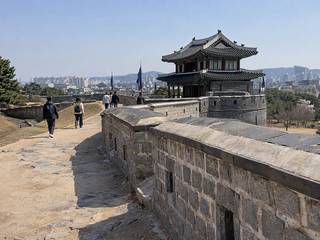
Hwaseong Fortress walls 수원 화성
King Jeongjo's 1790s fortress loop of gates, towers and ramparts, 5.74 km long; UNESCO-listed in 1997, free and open at all hours.
Suwon · Gyeonggi & Incheon ·
Namhansanseong 남한산성
UNESCO-listed (2014) mountain fortress south-east of Seoul rebuilt in 1626 as the Joseon court's wartime refuge; about 12 km of wall on a forested ridge, free to enter, with a rebuilt royal retreat palace (₩2,000, closed Mondays).
Gwangju (Gyeonggi) · Gyeonggi & Incheon ·
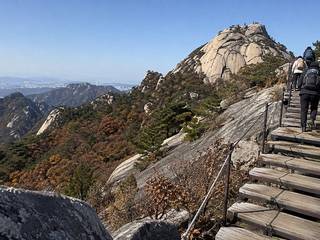
Bukhansan National Park 북한산국립공원
Granite peaks on the northern city edge with trails to Baegundae summit, an old mountain fortress and hillside temples.
Seoul · Seoul ·
Seoul City Wall 한양도성
The 18.6 km Joseon capital wall over Seoul's four inner hills, begun in 1396; free, and the Bugaksan section is open around the clock. The short Naksan stretch takes about 1 h 30 min.
Seoul · Seoul ·
Jeondeungsa Temple 전등사
A hillside temple inside an old mountain fortress wall in southern Ganghwa; free to enter since May 2023.
Incheon · Gyeonggi & Incheon ·
Hwahongmun and Banghwasuryujeong 화홍문 방화수류정
The north water gate over the Suwoncheon stream and the pavilion on the wall beside it; the classic Suwon view, best at dusk.
Suwon · Gyeonggi & Incheon ·
Paldalsan and Seojangdae 팔달산 서장대
The western command post on top of Paldalsan hill, a short steep climb from the palace with the widest view over the walled town.
Suwon · Gyeonggi & Incheon ·
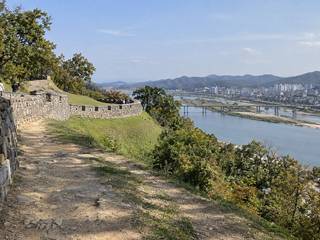
Gongsanseong 공산성
Hilltop wall above the Geumgang River guarding Baekje's capital of 475–538, part of the UNESCO Baekje Historic Areas; ₩3,000, or ₩6,000 with the Muryeong royal tomb.
Gongju · Chungcheong ·
Jinnamgwan Hall 진남관
A huge single-storey wooden hall of the Joseon navy's headquarters, a National Treasure reopened in 2025 after a ten-year restoration.
Yeosu · Jeolla ·
Naganeupseong Folk Village 낙안읍성
A complete walled Joseon county town with a 1.41 km wall around some 290 thatched houses where about 230 people still live; ₩4,000.
Suncheon · Jeolla ·
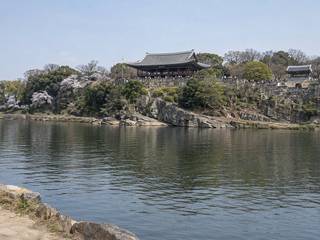
Jinjuseong Fortress 진주성
Riverside fortress besieged twice in the Imjin War (1592 and 1593), with the Chokseongnu pavilion over the Namgang and the Jinju National Museum inside; ₩2,000, open until 22:00 or 23:00.
Jinju · Gyeongsang ·
Gwangseongbo and the Ganghwa forts 광성보 초지진 덕진진
Coastal forts on the strait where Korean troops fought French and US warships in 1866 and 1871; two of the three are free.
Incheon · Gyeonggi & Incheon ·
Yeonmudae, trolley and archery 연무대 화성어차 국궁체험
The eastern command post, where the Hwaseong Trolley loop starts (closed Mondays) and visitors can shoot 10 arrows for ₩3,000.
Suwon · Gyeonggi & Incheon ·
Busosanseong 부소산성
Wooded fortress hill of Baekje's last capital, with paths to the Nakhwaam cliff and the small Goransa temple above the river; ₩2,000, part of the UNESCO Baekje Historic Areas.
Buyeo · Chungcheong ·
Haemieupseong 해미읍성
A walled Joseon garrison town on flat ground, about 1.8 km round, with gates, lawns and a few rebuilt buildings inside; free, open from early morning to evening all year.
Seosan · Chungcheong ·
Pungnammun Gate 풍남문
The south gate and only survivor of the four gates of Jeonju's old city wall, between the Hanok Village and Nambu Market; free.
Jeonju · Jeolla ·
Gochang Eupseong 고창읍성
Also called Moyangseong: a Joseon town wall on a pine-covered slope, where people walk the ramparts with a stone on their head at the October festival; ₩3,000.
Gochang · Jeolla ·
Frequently asked questions
Which fortress is the best day trip from Seoul?
Hwaseong in Suwon. Trains reach Suwon Station in about 30–40 minutes, the 5.74 km wall is free and open at all hours, and the palace, markets and cafés are inside the walls. Namhansanseong is the quieter, greener alternative: Line 8 to Sanseong Station, then bus 9 or 52.
Can you walk the whole Seoul City Wall in a day?
Fit walkers can: the four official sections add up to 18.6 km and about 10½ hours of walking, with steep stairs on Bugaksan and Inwangsan. Most visitors walk one section; Naksan (3.2 km, about 1 h 30 min, from Hyehwamun past Dongdaemun to Gwanghuimun) is the easiest.
Are Korean fortresses free?
Many are. The walls of Hwaseong, Namhansanseong and the Seoul City Wall cost nothing, and so does Haemieupseong. Gongsanseong (₩3,000), Jinjuseong (₩2,000), Busosanseong (₩2,000) and Naganeupseong (₩4,000) charge adult admission, and palaces inside fortresses charge separately.
Is the Seoul City Wall a UNESCO World Heritage site?
Not yet. In January 2026 Korea submitted the 'Capital Fortifications of Hanyang' (the Seoul City Wall with Bukhansanseong and Tangchundaeseong) to UNESCO; a decision is expected in 2027. Hwaseong (1997), Namhansanseong (2014) and the Baekje fortresses of Gongju and Buyeo are already listed.
What should I wear to walk a fortress wall?
Proper walking shoes. The ramparts are stone paths with steep steps, and mountain fortresses such as Namhansanseong and Bugaksan climb several hundred metres. Carry water, and start mountain sections well before dark.
Sources
Facts on this page were checked against these sources on 25 October 2026. Prices, hours and rules change — confirm with the operator before you go.
- 수원문화재단 – 수원화성 관람안내 (화성·화성행궁 관람료) (Korean) · official
- 수원문화재단 – 수원화성 소개 (축성, 시설물) (Korean) · official
- 경기도 남한산성세계유산센터 – 세계유산 등재 (2014, 성벽 12.4 km) (Korean) · official
- 경기도 남한산성세계유산센터 – 관람안내 (입장료 폐지, 행궁 관람료·시간·휴궁일) (Korean) · official
- 경기도 남한산성세계유산센터 – 탐방코스 (Korean) · official
- 경기도 남한산성세계유산센터 – 찾아오시는 길 (산성역 9·52번) (Korean) · official
- 서울 한양도성 – 한양도성 소개 (18.6 km) (Korean) · official
- 서울 한양도성 – 순성길 코스 (백악·낙산·남산·인왕산) (Korean) · official
- 서울시 – 한양도성박물관 이용안내 (2026-03-20) (Korean) · official
- 국가유산청 보도자료 – 「한양의 수도성곽」 세계유산 등재신청서 제출 (2026-01-30) (Korean) · official
- 아시아투데이 – 한양의 수도성곽 유네스코 등재신청서 제출, 2027년 결정 (2026-01-30) (Korean)
- 공주시 문화관광 – 공산성 (관람시간·관람료) (Korean) · official
- 공주시 문화관광 – 관람료 안내 (통합권) (Korean) · official
- 공주시 – 교통안내 (서울고속버스터미널–공주 1시간 30분) (Korean) · official
- 부여군 문화관광 – 부소산성 (관람시간) (Korean) · official
- 부여군 – 교통안내 (서울남부터미널–부여 약 2시간) (Korean) · official
- 부여군 문화관광 – 관람료 안내 (부소산성, 점심시간 무료) (Korean) · official
- VisitKorea – Haemieupseong Fortress · official
- 한국관광공사 열린관광 – 해미읍성 (이용시간, 2026-10-21) (Korean) · official
- 진주시 – 진주성 관람안내 (관람료·개방시간) (Korean) · official
- 국립진주박물관 – 관람안내 (Korean) · official
- 진주남강유등축제 (2026년 10월 3–18일) (Korean) · official
- 순천 낙안읍성 – 관람요금·관람시간 (Korean) · official
- 순천 낙안읍성 – 낙안읍성 소개 (주민, 초가) (Korean) · official
- 고창군 문화관광 – 고창읍성 관람료 (Korean) · official
- 고창군 문화관광 – 고창모양성제 (Korean) · official
- 강화군 문화관광 – 관광지 입장료 안내 (광성보·초지진·덕진진) (Korean) · official