Accommodation
Templestay in Korea
Updated
Book your trip
A templestay is one night in a working Buddhist temple, or a two-hour taster, booked on the official Templestay site. In October 2026, one-night English programs at well-known temples cost ₩80,000–130,000 per adult with meals, and short day programs start at ₩10,000. Expect shared rooms, men and women apart, vegetarian meals and a 04:00 wake-up. Refund rules differ by temple, so read them before you pay. Prices were checked on 17 October 2026.
| Your situation | What to book |
|---|---|
| Curious, but short on time in Seoul | A day program at Jogyesa in central Seoul, from ₩10,000 |
| First time, want the full routine | A one-night experience program, such as Jogyesa or Bongeunsa in Seoul, or Beomeosa in Busan |
| You want rest more than activities | A rest (relaxation) program, such as Geumsunsa in Seoul or Woljeongsa in Gangwon |
| You are touring Gyeongju | Golgulsa, which teaches Seonmudo, a Buddhist martial art |
| Travelling as a couple and want one room | Book a temple that offers a private room for an extra fee, or skip the overnight |
For most first trips, one night is enough. A city temple in Seoul is the easiest to reach, and a mountain temple such as Beomeosa, Haeinsa or Woljeongsa feels quieter.
What a templestay is
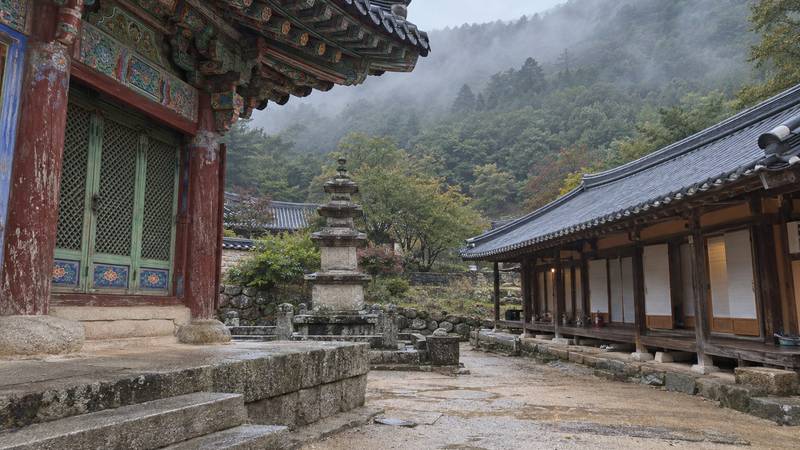
A templestay lets you sleep inside a Buddhist temple and follow part of the monks’ day. The programs are run by individual temples and listed on one official site, operated by the Cultural Corps of Korean Buddhism. That site is the place to book; the English version is eng.templestay.com.
You do not need to be Buddhist. The official FAQ says anyone can join, whatever their religion, nationality or age, and that most participants follow other religions. Every activity is optional. If 108 bows go against your beliefs, you can sit quietly.
Which type of program to choose
The official site sorts programs into three types.
| Type | How long | What happens | Best for |
|---|---|---|---|
| Day (one-day) | About 2–3 hours | Temple tour, meditation, tea with a monk or a craft such as a paper lotus lantern | Short trips, families, a first look |
| Experience | 1 night, 2 days, often at weekends | Evening and dawn ceremonies, 108 bows, a temple meal, meditation, tea with a monk | First-timers who want the full routine |
| Rest (relaxation) | 1 night or more | Only the core ceremonies, or none; the rest is free time | Quiet, a break from sightseeing |
The Korean FAQ recommends the experience type for a first stay. You can stay longer by combining experience and rest programs. The English FAQ says the limit varies by temple but is usually about ten days.
How much it costs
Each temple sets its own fee, and it covers the program, bedding and meals. These are the prices listed on the official English site.
| Temple and program | Where | Adult | Child |
|---|---|---|---|
| Jogyesa, Always Templestay (day) | Central Seoul | ₩10,000 | ₩10,000 |
| Jogyesa, Regular Templestay (1 night) | Central Seoul | ₩80,000 | ₩80,000 |
| Geumsunsa, Relaxational Templestay (1 night) | Northern Seoul, Bukhansan | ₩80,000 | ₩60,000 |
| Myogaksa, 2 days 1 night | Eastern central Seoul | ₩95,000 | ₩95,000 |
| Bongeunsa, Regular Templestay (Sat–Sun) | Gangnam, Seoul | ₩120,000 | ₩120,000 |
| Beomeosa, Experiential Templestay (weekends) | Busan | ₩100,000 | ₩80,000 |
| Golgulsa, Seonmudo program (1 night) | Gyeongju | ₩120,000 | ₩120,000 |
| Woljeongsa, Relaxing Templestay (1 Oct–1 Dec 2026) | Odaesan, Gangwon | ₩100,000 | ₩70,000 |
| Haeinsa, Tripitaka Koreana Pilgrimage (weekends) | Hapcheon | ₩100,000–130,000 by room | ₩90,000–120,000 |
Per person, from each temple’s program page on templestay.com, checked 17 October 2026. Teen prices match one of the two columns or sit between them. Golgulsa and Woljeongsa also list pre-school prices, ₩60,000 and ₩50,000.
Many temples charge the same for children as for adults. Programs have set run dates, so check that yours runs on your travel dates.
The government sometimes subsidises templestays. From 1 to 30 September 2026, for example, a special program for foreign visitors cost ₩30,000 for one night at temples around the country. Offers like this are announced in the Notice & Event section of the official site, so check it before you book.
How to book
- Pick a program. On the official site, open Reservation and filter for temples that run programs for foreigners.
- Read the program page. It shows the price, schedule, what to bring, the refund policy and how far ahead you must book. Jogyesa’s one-night program closes 3 days ahead, Beomeosa’s 2 days and Bongeunsa’s 1 day.
- Choose a date and the number of guests. The calendar asks for adults, teenagers, children and pre-school children separately.
- Book with an account or as a guest. Guest bookings are looked up later by email and password.
- Pay the way the temple asks. Payment is set by each temple. Jogyesa takes card payment online or a bank deposit, not card on arrival, and cancels unpaid bookings after a set time. Geumsunsa and Golgulsa take card or cash on arrival; Myogaksa takes cash at the temple or a deposit. The site does not say whether foreign-issued cards work at online checkout. If yours is declined, choose a temple that takes payment on arrival.
- Keep the email. You do not need to print a confirmation. Some temples do not send one; if yours does not, email support@templestay.com.
Some programs need an email first. Jogyesa’s day program for groups, for example, asks you to email before booking.
A typical night at a temple
Schedules vary by temple. Jogyesa’s one-night program in Seoul is typical:
| Time | What happens |
|---|---|
| 13:30 | Check in, change into the temple clothes, etiquette briefing |
| Afternoon | Lotus lantern craft, tea or sutra copying, temple tour |
| 16:30 | Evening temple meal |
| 17:55 | Evening ceremony (optional) |
| 19:00 | 108 bows (optional) |
| 21:00 | Lights out |
| 04:00 | Wake up; dawn ceremony at 04:25 (optional) |
| 07:00 | Breakfast |
| 10:00 | Check out |
The Korean FAQ describes a standard one-night program the same way. You arrive around 14:00–15:00. The day ends with lunch, and you leave between 12:00 and 13:00, a little later than at Jogyesa. Golgulsa wakes at 05:00, and Beomeosa from 03:30.
Rooms, food and rules
- Shared rooms, men and women apart. Couples sleep in separate rooms. Rooms range from large halls for 15 or more people to rooms for 4–8. Same-sex friends and families are placed together where possible. Some temples offer a private or small room for an extra fee.
- Shared bathrooms are the norm. Some rooms have their own toilet.
- Clothes are provided. You get a temple vest and trousers at check-in. Most temples supply only soap and toothpaste.
- Vegetarian meals. No meat, eggs or instant food. Some temples serve the formal monastic bowl meal, barugongyang.
- No alcohol and no smoking. Jogyesa also asks you not to wear sleeveless tops or flip-flops. Bongeunsa asks you not to go barefoot in the halls.
- Safe for solo travellers. Rooms lock, outsiders cannot come in after 22:00, and templestay staff live at the temple.
What to bring: towel, shampoo, toothbrush, cleanser, hair dryer, socks and spare clothes. Mountain temples are cold in the morning and evening except in midsummer, so pack a warm layer.
Templestay Information Center in Seoul
The official information centre sits across the street from Jogyesa, in the Templestay Center at 56 Ujeongguk-ro, Jongno-gu. It is open 09:00–18:00 every day except New Year’s Day, Lunar New Year and Chuseok. Phone +82-2-2031-2000. From Jonggak Station (Line 1) exit 2, or Anguk Station (Line 3) exit 6, it is about a 5-minute walk.
Jogyesa is in the palace quarter, a short walk from Insadong.
Common mistakes
- Booking on an unofficial reseller. Book on templestay.com, where each temple’s own price and refund rules apply.
- Missing the refund deadline. Jogyesa refunds in full only 7 or more days ahead and nothing after that; Bongeunsa refunds in full 14 days ahead. Most others refund in full 3–4 days ahead.
- Expecting a hotel room. You will likely share a floor-mattress room and a bathroom.
- Assuming couples can share. They cannot, unless a temple offers a private room.
- Arriving late. Programs start at a fixed time, and mountain temples can be an hour or more from the nearest station.
- Not checking the minimum group size. Some programs are cancelled if too few people book. Myogaksa, for example, cancels if 5 or fewer people have signed up 4 days before.
Where to next
- Where to stay in Korea: all lodging types, Airbnb rules and the hotel VAT refund
- Korea’s Buddhist temples: the main temples, ranked by region
- Hanok stays: another traditional night, with more privacy
- Korean etiquette for tourists: temple manners and local rules
City guides
Busan
Korea's second city and busiest port, wrapped around beaches, hillside villages, fish markets and a temple on the rocks.
Gyeongju
The former Silla capital, an open-air museum of grassy royal tombs, ancient temples and stone Buddhas in the southeast.
Seoul
Korea's capital: Joseon palaces and hanok lanes beside skyscrapers, night markets, Han River parks and granite peaks inside the city limits.
Frequently asked questions
How much does a templestay cost in Korea?
Each temple sets its own fee. On the official site in October 2026, one-night English programs at well-known temples cost ₩80,000–130,000 per adult, including meals. Short day programs start at ₩10,000 at Jogyesa in central Seoul.
Do I have to be Buddhist to do a templestay?
No. The official site says anyone can join regardless of religion, nationality or age, and that most participants follow other religions. Every activity, including the dawn ceremony and the 108 bows, is optional; you can sit quietly instead.
Can couples share a room at a templestay?
No. Men and women are housed separately, even couples. Rooms are usually shared with other guests, though friends or family of the same sex are placed together where possible, and some temples offer a private room for an extra fee.
What time do you wake up at a templestay?
Usually around 04:00. Lights out is about 21:00, and the dawn ceremony (yebul) follows straight after waking. At Jogyesa and Bongeunsa in Seoul the wake-up is 04:00; Beomeosa in Busan starts from 03:30.
Can I cancel a templestay booking?
Yes, but the refund depends on the temple. Jogyesa refunds in full only 7 or more days before; Bongeunsa from 14 days; most other temples between 3 and 4 days. Cancel through the temple or support@templestay.com, and read the Refund Policy on the program page before you pay.
Sources
Facts on this page were checked against these sources on 17 October 2026. Prices, hours and rules change — confirm with the operator before you go.
- Templestay (Cultural Corps of Korean Buddhism) – What is Templestay: types of Templestay · official
- Templestay – FAQ (English) · official
- 템플스테이 (한국불교문화사업단) – 자주 묻는 질문 (체험형·휴식형·당일형, 숙소, 공양, 일정, 아이 동반) (Korean) · official
- 템플스테이 – 홍보관 (템플스테이 통합정보센터 운영시간·위치) (Korean) · official
- Templestay – Information Center and How to get there · official
- Templestay – Jogyesa: Regular Templestay program (1 night 2 days), price, schedule and refund policy · official
- Templestay – Jogyesa: Always Templestay (Daily) · official
- Templestay – Bongeunsa: Regular Templestay [Sat–Sun] · official
- Templestay – Geumsunsa: Relaxational Templestay (2 days 1 night) · official
- Templestay – Myogaksa: 2 days 1 night program · official
- Templestay – Beomeosa: Experiential Templestay (Weekends) · official
- Templestay – Golgulsa: Moving Seon – Seonmudo (two days one night) · official
- Templestay – Woljeongsa: Relaxing Templestay · official
- Templestay – Haeinsa: Tripitaka Koreana Pilgrimage (weekend program) · official
- 템플스테이 – 공지사항: 2026년 외국인 특별 템플스테이 (2026년 9월 1일~30일, 1박 2일 30,000원) (Korean) · official