Gyeongju · Namsan and the Outskirts
Underwater Tomb of King Munmu 경주 문무대왕릉
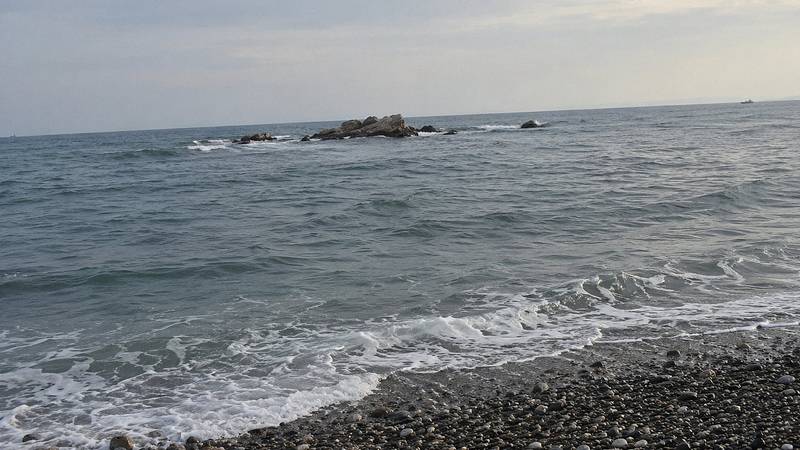
A rocky islet just off the east coast, said to hold the remains of the Silla king who united the peninsula's three kingdoms.
Updated
Essentials
- Hours
- Tomb, beach, Gameunsa site and Igyeondae: no fixed hours, open all year
- King Munmu Maritime History Museum: 10:00–18:00 March–October, 10:00–17:00 November–February
- Closed
- The tomb and beach never close. The museum closes on Mondays, 1 January and Seollal and Chuseok days
- Admission
- Tomb, beach, Gameunsa site and Igyeondae: free
- Museum: adults ₩3,000, youth and conscripts ₩2,000, children ₩1,000; the museum says entry is free until 31 December 2026
- Getting there
- Bus 1150 from Gyeongju Station (KTX) via the bus terminal, Gyeongju World and Bulguksa to 문무왕릉.봉길해수욕장, 9th stop; 08:00–17:50, every 3–4 hours
- Bus 150 from the express/intercity bus terminal via Bomun to 문무왕릉.봉길해수욕장, 52nd stop; 06:30–21:00, every 50–60 min (150-1: 08:40–17:30)
- Same buses: 탑마을.감은사지 for Gameunsa (49th stop on the 150); 대종교입구 for the museum and Igyeondae
- Address
- 26 Bonggil-ri, Munmudaewang-myeon, Gyeongju, Gyeongsangbuk-do
경상북도 경주시 문무대왕면 봉길리 26 - Website
- gyeongju.go.kr/tour/page.do?code_uid=1016&mnu_uid=4718&area_uid=152&cmd=2
Book your trip
The Underwater Tomb of King Munmu is a rocky islet about 200 m off Bonggil beach, 32 km east of central Gyeongju, where the Silla king who unified the Korean peninsula’s three kingdoms is said to lie. You see it from the shore, for free, at any hour. It is worth the trip only as a half-day coast loop with the Gameunsa pagodas, Igyeondae and the new museum. Bus 1150 runs direct from the KTX station every 3–4 hours; bus 150 leaves the bus terminal about hourly.
| Your situation | Do this |
|---|---|
| One day in Gyeongju | Skip it; do Bulguksa, Seokguram and the tomb parks in town |
| A second day, and you like history or the sea | Bus to 탑마을.감은사지, walk to the tomb, then Igyeondae and the museum; half a day |
| Arriving by KTX with a few hours | Bus 1150 from Gyeongju Station, but check the next return first: it runs only every 3–4 hours |
| Want a sunrise | Come by car or taxi; the first bus is too late for winter sunrise |
| Visiting on a Monday | The tomb, beach and Gameunsa are open; the museum is closed |
| Driving the east coast | Add the Yangnam columnar joints, 7 stops further south on bus 150 |
Is the Underwater Tomb of King Munmu worth it?
On its own, not really: it is a low granite outcrop in the surf, and 15 minutes on the beach is enough. What makes the trip worthwhile is the story, which you follow across three sites within about a kilometre of each other. King Munmu asked to be cremated and buried in the East Sea so that he could become a dragon and guard Silla against raiders from Japan. His son built a temple facing the sea for the dragon to visit and a pavilion from which to watch for it.
If you have a second day in Gyeongju and like either history or the sea, the coast loop is a good half day out of town. If you have only one day, the temples and tomb parks of central Gyeongju come first.
| Entry | Free (tomb, beach, Gameunsa, Igyeondae) |
| Hours | None; open all year, day and night |
| Time needed | 15 min at the tomb; half a day for the coast loop |
| Bus from KTX | 1150, 9 stops, every 3–4 hours |
| Bus from the terminal | 150, 52 stops, about hourly |
| Parking | Free, at Bonggil-ri 846-4 |
Opening and fee details from Gyeongju City’s tourism pages; bus data from Gyeongju’s live bus system; checked 1 November 2026.
What you see
The Korea Heritage Service describes the tomb as a natural rock about 200 m from the shore, showing about 35 by 36 m above the water and 5.3 m high. Channels were cut through it from north, south, east and west. Water comes in from the east and leaves to the west, so the pool in the middle stays calm. Under the surface lies a flat stone 3.7 m long, oriented north–south, under which the king’s remains are believed to rest. It has been a Historic Site since 1967.
King Munmu reigned from 661 to 681. He completed the conquest of Goguryeo begun by his father, King Muyeol, held off Tang China and laid down much of the unified Silla state. According to the Samguk Sagi, he asked for a Buddhist cremation and a burial in the East Sea so that he could protect the country as a dragon.
From the beach you see the rock with waves breaking around it; from the hill at Igyeondae, a short walk north, you look down on it and can make out its shape. Gyeongju City’s magazine notes that in recent years some have argued that another rock about 500 m away is the real tomb; the heritage listing remains this one.
Bonggil Daewangam Beach (봉길대왕암해변), in front of the tomb, is a 500 m strip of sand at the mouth of the Daejong-cheon stream. It is open all year and free, with shared showers and toilets.
Gameunsa temple site, Igyeondae and the museum
These three sites turn a quick look at a rock into a half day.
- Gameunsa temple site (감은사지). Munmu began the temple to protect the coast, and his son King Sinmun completed it in 682, naming it “Gratitude Temple”. Only the platforms and two three-storey stone pagodas remain; they are a National Treasure, among the largest stone pagodas in Korea, and the model for many later ones. Under the main hall’s foundations is a stone-lined space that the Samguk Yusa links to a channel for the dragon king to come and go. Free, no fixed hours; Gyeongju City lists culture guides on site from 10:10 to 16:30 (to 17:00 in peak season). Bus stop 탑마을.감은사지; the site is about 1 km inland from the beach.
- Igyeondae (이견대). A pavilion on the hill north of the beach, on the spot where King Sinmun, in 681, is said to have seen the dragon and then received the manpasikjeok, a bamboo flute that calmed the waves and the country’s troubles. The present building was rebuilt after excavation. Free, no fixed hours; it is the best viewpoint over the tomb.
- King Munmu Maritime History Museum (문무대왕 해양역사관). Opened on 15 May 2026 in a hanok-style building on the site of a former primary school, above Igyeondae. Media rooms tell the story of the unification wars and Silla’s sea trade; an immersive film runs three times an hour (on the hour, :20 and :40). There is a café with sea views and an outdoor terrace looking out to the tomb.
| King Munmu Maritime History Museum | |
|---|---|
| Hours | 10:00–18:00 March–October, 10:00–17:00 November–February |
| Closed | Mondays, 1 January, Seollal and Chuseok days |
| Fee | Adults ₩3,000, youth and conscripts ₩2,000, children ₩1,000; free under 7 |
| 2026 | The museum’s site says entry is free until 31 December 2026 |
| Bus | 대종교입구 stop, then about 10 minutes on foot |
From the museum’s official site and Gyeongju City’s tourism page, checked 1 November 2026. The free period appears only on the museum’s own site; Gyeongju City’s page lists the standard fees.
Getting there by bus
The coast is about 35 minutes by car from Hwangnidan-gil, according to the museum. By bus there are two options, both run by Gyeongju City.
| Bus | From | To 문무왕릉.봉길해수욕장 | Departures |
|---|---|---|---|
| 1150 | Gyeongju Station (KTX), then the bus terminal, Gyeongju World, Bulguksa | 9th stop | 08:00–17:50, every 3–4 hours |
| 150 | Express/intercity bus terminal, via Bomun Lake | 52nd stop | 06:30–21:00, every 50–60 min |
| 150-1 | Express/intercity bus terminal, a different route | 59th stop | 08:40–17:30, every 50–60 min |
Stop order, first and last departures and gaps from Gyeongju City’s live bus system, checked 1 November 2026. Times are departures from the first stop.
- Which stop? On bus 150, 탑마을.감은사지 (49th) is closest to Gameunsa, 대종교입구 (50th) to the museum and Igyeondae, and 문무왕릉.봉길해수욕장 (52nd) to the beach and tomb. Bus 1150 skips Gameunsa: it stops at 대종교입구 (7th) and the tomb (9th).
- A simple loop. Get off at 탑마을.감은사지, walk down to the coast for Igyeondae, the museum and the beach, and catch the bus back from the tomb stop.
- Back to town. Bus 150 heading back leaves Yangnam (the end of the line) between 06:30 and 21:00 and stops at the tomb (14th stop) and 감은사지 (17th) on the way to the bus terminal. Bus 1150 leaves Yangnam between 09:50 and 19:40 and goes back via Bulguksa to Gyeongju Station. With gaps of 3–4 hours on the 1150, note the time of the next return before you set off.
- Further south. Seven stops past the tomb on bus 150, the 주상절리 stop serves the Yangnam columnar joints, a natural monument with a 1.7 km coastal boardwalk (free, no fixed hours).
- By car. The free car park for the tomb and beach is at Bonggil-ri 846-4; Gameunsa has its own free car park.
Tips
- Sunrise. The beach faces east across the open sea. For sunrise, especially on New Year’s Day when crowds gather, you need a car or taxi: the first bus leaves the terminal at 06:30.
- Mondays. The museum is closed, but the tomb, beach, Gameunsa and Igyeondae are all open.
- The sea. Outside the summer beach season, treat Bonggil as a place to walk, not swim; see beaches in Korea for how the season works.
- Food. Gampo port, about 15 minutes by car north of the museum, is the coast’s biggest harbour, known for raw fish and flounder; the museum has a café.
- Not Ulsan. Daewangam Park in Ulsan, further south, is a different place with a similar name.
Around the Underwater Tomb of King Munmu
The tomb is on Gyeongju’s coast, in the outskirts east of the city; bus 1150 links it with Bulguksa and bus 150 with Bomun Lake. For hotels, trains and the rest of the city, see the Gyeongju guide and the Gyeongsang region page. For other places to see the sea, see beaches in Korea.
Nearby
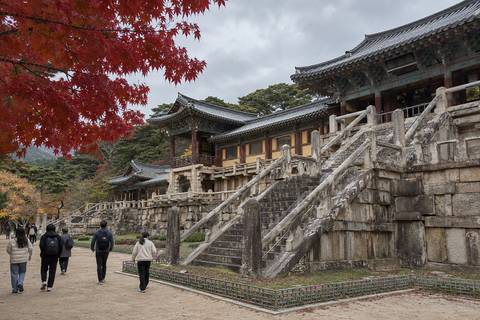
Bulguksa Temple
Korea's most celebrated temple, with Silla-era stone stairways, bridges and the twin pagodas Dabotap and Seokgatap.
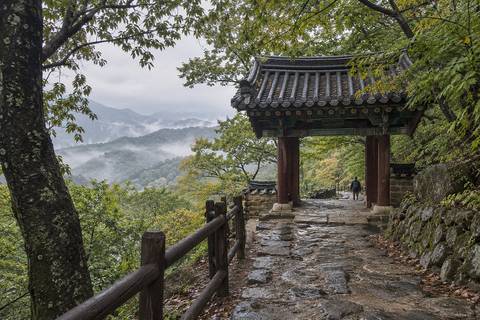
Seokguram Grotto
A granite Buddha in an artificial cave grotto high on Tohamsan, viewed through glass; reach it by bus or a mountain trail.
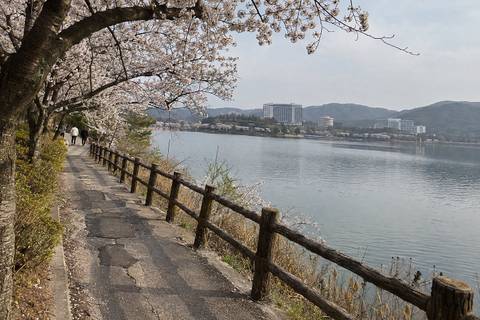
Bomun Lake
A resort lake with an 8 km lakeside walking path, open around the clock and famous for cherry blossoms in early April.
Frequently asked questions
Can you visit the Underwater Tomb of King Munmu?
You see it from the shore. The tomb is a natural rock about 200 m off Bonggil beach, in the sea east of Gyeongju, and the beach in front of it is open all year and free. For a view from above, walk up to the Igyeondae pavilion or the terrace of the King Munmu Maritime History Museum just to the north.
Is the Underwater Tomb of King Munmu worth the trip?
Only if you make a half-day coast trip of it. The tomb itself takes 15 minutes to see. Combined with the twin pagodas at the Gameunsa temple site, the Igyeondae pavilion and the new museum, it tells the story of the king who wanted to become a sea dragon. With one day in Gyeongju, spend it on Bulguksa and the tomb parks in town instead.
How do I get to the Underwater Tomb of King Munmu by bus?
Bus 1150 runs from Gyeongju Station (KTX) via the bus terminal and Bulguksa to the 문무왕릉.봉길해수욕장 stop, but only every three to four hours, from 08:00 to 17:50. Bus 150 leaves the express/intercity bus terminal about every hour from 06:30 to 21:00 and reaches the same stop after 52 stops, via Bomun Lake.
Is the Underwater Tomb of King Munmu free?
Yes. The tomb, Bonggil beach, the Gameunsa temple site and Igyeondae have no ticket and no fixed hours, and the car parks at the tomb and Gameunsa are free. Only the King Munmu Maritime History Museum has a fee (₩3,000 for adults), and the museum says entry is free until 31 December 2026.
Is it a good place for sunrise?
Yes. The beach faces east across the open sea, and Gyeongju City notes that crowds gather here on New Year's Day to watch the first sunrise behind the rock. Bus 150's first run leaves the terminal at 06:30, too late for a winter sunrise, so you need a car or taxi at dawn.
Sources
Facts on this page were checked against these sources on 1 November 2026. Prices, hours and rules change — confirm with the operator before you go.
- 경주시 문화관광 – 문무대왕릉 (관람시간 정해진 시간 없음, 관람료 무료, 문무대왕릉 주차장 봉길리 846-4 무료; 봉길리 26) (Korean) · official
- 국가유산청 – 경주 문무대왕릉 (사적, 1967.7.24 지정; 신라 30대 문무왕 재위 661~681; 해안에서 200m; 노출부 동서 35m·남북 36m·높이 5.3m; 사방 수로, 길이 3.7m 넓적한 돌) (Korean) · official
- 국가유산청 – 경주 감은사지 (사적; 신문왕 682년 완성; 금당 아래 배수시설 전설) (Korean) · official
- 국가유산청 – 경주 감은사지 동·서 삼층석탑 (국보, 1962.12.20 지정; 682년; 1960년 해체 수리 때 서탑에서 사리기 발견) (Korean) · official
- 국가유산청 – 경주 이견대 (사적; 신문왕 681년; 만파식적 설화; 발굴 후 복원) (Korean) · official
- 경주시 문화관광 – 경주 감은사지 (관람시간 정해진 시간 없음, 무료, 문화관광해설 10:10~16:30, 주차장 용당리 52-3 무료) (Korean) · official
- 경주시 문화관광 – 경주 이견대 (정해진 관람시간 없음, 무료; 동해안로 1480-12) (Korean) · official
- 경주시 문화관광 – 봉길대왕암해변 (연중무휴, 무료, 백사장 500m·폭 40m, 경주시에서 동쪽 32km, 샤워장·화장실) (Korean) · official
- 경주시 문화관광 – 경주 양남 주상절리 (천연기념물; 읍천항~하서항 1.7km 해안데크길; 정해진 이용시간 없음, 무료) (Korean) · official
- 문무대왕 해양역사관 – 관람안내 (하절기 3~10월 10:00~18:00, 동절기 11~2월 10:00~17:00; 월요일·1월 1일·설·추석 당일 휴관; 성인 3,000원 등; 2026년 12월 31일까지 한시적 무료) (Korean) · official
- 문무대왕 해양역사관 – 오시는 길 (동해안로 1473; 150번·150-1·1150번 대종교 정류장 하차 후 도보 10분; 문무대왕릉·감은사지까지 차로 5분, 황리단길에서 35분) (Korean) · official
- 경주시 문화관광 – 문무대왕해양역사관 (관람시간·휴관일·관람료; 옛 대본초 부지, 역사 전시실 실감영상 매시 정각·20분·40분) (Korean) · official
- 경주시 실시간 버스정보 – 150·150-1·1150번 노선 정류소 순서 (문무왕릉.봉길해수욕장, 탑마을.감은사지, 대종교입구), 첫차·막차, 배차간격 (Korean) · official
- 아름다운 경주이야기 (경주시 웹진) vol.166 – 문무대왕릉으로 떠나는 해맞이 여행 (새해 첫날 일출 인파; 가미새바위 주장; 감은사지·이견대) (Korean) · official
- 노컷뉴스 – 경주 문무대왕 해양역사관 개관…신라 역사·문화 체험 공간 (2026-05-15) (Korean)