Gyeongju · Central Gyeongju
Gyochon Hanok Village 교촌한옥마을
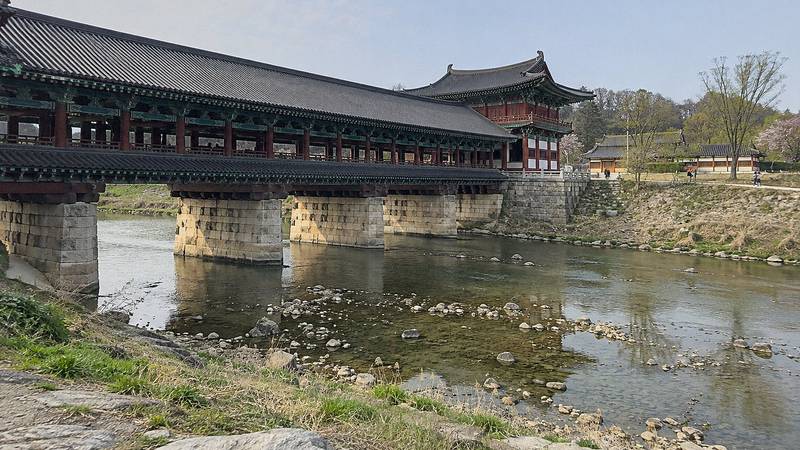
A small hanok village around the historic Choi family house, next to the rebuilt covered bridge of Woljeonggyo.
Updated
Essentials
- Hours
- Village lanes: no gate and no fixed hours
- Choi family house: 09:00–18:00 (17:00 in winter)
- Gyeongju Hyanggyo: 09:00–18:00
- Woljeonggyo Bridge: 09:00–22:00
- Admission
- Free: the village, the Choi family house, Gyeongju Hyanggyo and Woljeonggyo Bridge
- Workshops, hanbok rental, shops and cafes charge separately
- Getting there
- City bus 60 or 61 from Gyeongju Station (KTX) to the 천마총 (Cheonmachong) stop, the 21st stop, then about 350 m south on foot
- Wolseong loop buses 월정1, 월정2 and 월정3 stop at 교촌한옥마을 (Gyochon Hanok Village) and 월정교 (Woljeonggyo)
- About 500 m on foot from Cheomseongdae through Gyerim forest
- By car: free Woljeonggyo public car park (153-5 Gyo-dong) or the paid roadside spaces at 2 Gyochon-gil
- Address
- 39-2 Gyochon-gil, Gyeongju, Gyeongsangbuk-do
경상북도 경주시 교촌길 39-2 (교동) - Website
- gyeongju.go.kr/gyochon/index.do
Book your trip
Gyochon Hanok Village is a free, gateless cluster of tiled-roof houses in central Gyeongju, about 500 m south of Cheomseongdae. It holds the house of the Choi family, famous for staying rich and generous for 12 generations, and a Confucian school on the site of Silla’s royal academy. At its edge stands Woljeonggyo, a rebuilt Silla bridge open and lit until 22:00. Allow 1–1.5 hours. Come in the late afternoon and stay for the bridge after dark.
| Your situation | Do this |
|---|---|
| One afternoon and evening in central Gyeongju | Cheomseongdae → Gyerim forest → Gyochon → Woljeonggyo at dusk → bus or taxi to Wolji Pond |
| You want to see inside the Choi house | Arrive before 17:00; it closes at 18:00, or 17:00 in winter |
| Arriving at Gyeongju Station (KTX) | Bus 60 or 61 to the 천마총 (Cheonmachong) stop, the 21st, then walk about 350 m south |
| Driving | Free Woljeonggyo public car park, then walk to the village |
| You want hanbok photos | Rent in the village and walk to the bridge and the Hyanggyo |
Is Gyochon worth it?
Yes, if you are already walking between Cheomseongdae and the national museum. It adds little extra distance, costs nothing and is far calmer than Hwangnidan-gil. Most of Gyeongju’s sights are Silla tombs and ruins. Gyochon is the place to see a Joseon-era family house and school, still standing on Silla ground.
It is less of a draw if you have seen a large hanok village such as Jeonju or Hahoe. Many buildings here are recent rebuilds that house workshops and cafes. The highlights are the Choi house, the Hyanggyo and the bridge.
| Entry | Free; no gate |
| Hours | Village: none fixed. Choi house 09:00–18:00 (17:00 in winter). Hyanggyo 09:00–18:00. Woljeonggyo 09:00–22:00 |
| Time needed | 1–1.5 hours, more with a workshop |
| Nearest bus stop | 교촌한옥마을 (loop buses 월정1/2/3); 천마총 (bus 60/61), about 350 m |
| Best time | Late afternoon, then the bridge after dark |
Hours, fees and parking from Gyeongju City’s tourism pages; checked 31 October 2026.
What to see in Gyochon
The name means “school village”. Gyeongju City says King Sinmun founded Silla’s royal academy, the Gukhak, here in 682. It became a local school under Goryeo and a hyanggyo, a state Confucian school, under Joseon. The lanes and nearby sites also tie into Silla stories. The palace of Princess Yoseok, wife of the monk Wonhyo, is said to have stood here.
The Choi family house (경주 최부자댁)
The head house of the Gyeongju Choi clan, known in Korea as the “Choi rich family”. The family held great wealth for 12 generations and produced nine jinsa, scholars who passed the state exam. Its house rules are still quoted. Take no office above jinsa, hold no more than 10,000 seok of rice, treat travellers well, and let no one within 100 ri starve. Gyeongju City notes that the family funded the independence movement and founded schools; the 12th head, Choi Jun, was an independence activist.
- The house. It dates from around 1700 and was designated National Folklore Heritage on 27 May 1971. The Korea Heritage Service record says the men’s quarters and a separate pavilion burned in November 1970; Gyeongju City’s page lists a large men’s quarters, the women’s quarters, the tall gate and a storehouse among the buildings standing today.
- Built low on purpose. Gyeongju City says the site was cut lower than the school next door so as not to rise above it. The tall gate is plain and low for a house of this rank.
- Hours. 09:00–18:00 (17:00 in winter), free.
Gyeongju Hyanggyo (경주향교)
The Confucian school stands right beside the Choi house. It burned in the Imjin War of the 1590s. The shrine hall was rebuilt in 1600 and the lecture hall in 1614. Both are now Treasures: the shrine hall, Daeseongjeon, since 2011, and the lecture hall, Myeongnyundang, since 2020. The heritage record calls the lecture hall the largest of its kind in Korea, and names the school, with Naju Hyanggyo, a model hyanggyo layout: shrine in front, school behind. Open 09:00–18:00, free. Spring and autumn rites to Confucius are still held here.
Gyochon Gyodong beopju (경주교동법주)
The Choi family’s rice liquor has been National Intangible Heritage since 1986. The heritage record says it is brewed from glutinous rice with water from the family well and takes about 100 days to make. It is a clear, pale-yellow drink of 16–18% alcohol.
Woljeonggyo Bridge (월정교)
According to the Samguk Sagi, King Gyeongdeok built two bridges over the Muncheon stream south of the palace in 760. The excavated site of Woljeonggyo shows a bridge of about 60 m with a roofed deck. It has been a Historic Site since 2004. After about a decade of research, the bridge was finished in 2013, and the gate towers at each end followed in April 2018. Gyeongju City calls it Korea’s largest wooden bridge.
- Open 09:00–22:00, free. It is lit after dark.
- The best view. Gyeongju City points to the stepping stones in the river in front of the bridge.
- Small exhibition. The second floor of the gate tower has a video on the rebuild and finds from the site.
Hanbok and workshops
The village has a row of small workshops. Each has its own hours, prices and closing days, so check the village website before you go.
- Hanbok rental. In October 2026 the village site lists the 교촌의상실 shop at 10,000 won for 1 hour, 15,000 won for 2 hours and 25,000 won for 4 hours. It is open 10:00–18:00 and closed on Tuesdays.
- Pottery, rice cakes and noodles. Other workshops offer pottery painting, pounding rice cakes and making noodles. Several close on Mondays and Tuesdays or midweek, and some need booking.
- Weekend shows. In spring the village square has had free traditional shows on some Saturdays. The 2026 run ended in May.
Getting to Gyochon
| From | How | Get off / walk |
|---|---|---|
| Gyeongju Station (KTX) | City bus 60 or 61 | 천마총 (Cheonmachong), the 21st stop; about 350 m south |
| Hwangnidan-gil public car park | Loop bus 월정1 or 월정3 | 교촌한옥마을, the 3rd stop |
| Express and intercity bus terminals | Loop bus 월정2 | 교촌한옥마을, near the end of the loop |
| Cheomseongdae | On foot through Gyerim forest | About 500 m |
| Daereungwon / Hwangnidan-gil | On foot | About 0.8–0.9 km |
Stop order, times and stop coordinates from Gyeongju City’s live bus system; distances are straight-line, checked 31 October 2026.
- Check the sign on the bus. Runs marked 천마총미경유 (60 and 61) and 선덕여고경유 (61) skip the Cheonmachong stop.
- Bus times. From the station, the first 60 leaves at 06:00 and the last at 19:40. The 61 runs 06:35–19:20. Gaps range from 20 minutes to 2 hours.
- Loop buses. 월정1 runs 08:30–22:00, 월정2 08:10–21:30 and 월정3 10:00–20:30, with gaps of 60–90 minutes. They also stop at Woljeonggyo, the national museum and Wolji Pond.
- Going back to the station. Buses 60 and 61 run a one-way loop. Walk to the bus terminal stop and take a 60 or 61 there, or take a taxi.
- Fares. A city bus ride is 1,500 won, or 50 won less with a transport card.
By car, Gyeongju City points to the free Woljeonggyo public car park (153-5 Gyo-dong) and the paid roadside spaces at 2 Gyochon-gil.
Tips
- Do it in this order. Walk from Cheomseongdae through Gyerim forest, see the Choi house and Hyanggyo before they close, then cross Woljeonggyo as the lights come on.
- Then go east for night views. Wolji Pond is about 1 km away and sells tickets until 21:30. The Gyeongju National Museum is across the stream.
- Lunch or coffee. For a busy cafe street, walk north to Hwangnidan-gil. Gyochon has a few restaurants and a traditional tea house of its own.
- Stay overnight. The village and nearby lanes have hanok guesthouses. See hanok stays in Korea and where to stay in Gyeongju.
Around Gyochon
Gyochon is part of central Gyeongju, south of Daereungwon and Cheomseongdae. For a day that fits it between Bulguksa and Wolji Pond, see Gyeongju in one day. For other traditional villages, see the hanok page. For trains and hotels, see the Gyeongju guide and the Gyeongsang region page.
Nearby
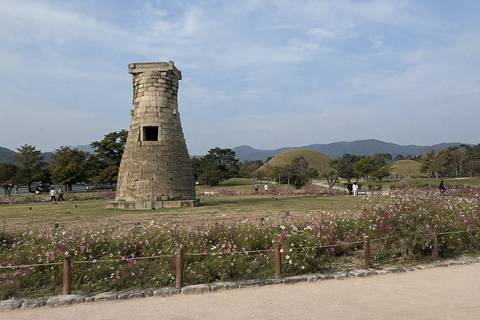
Cheomseongdae Observatory
A bottle-shaped stone tower from the 7th century, often called East Asia's oldest surviving observatory, set in open fields.
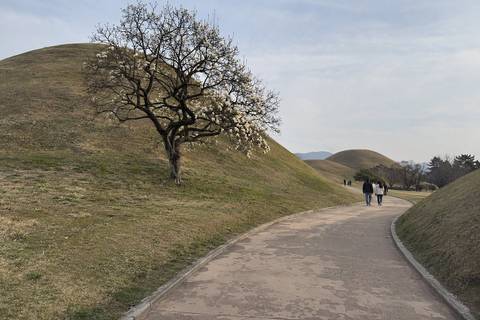
Daereungwon Tomb Complex
A park of huge grassy Silla burial mounds; inside Cheonmachong you can see how a royal tomb was built and what it held.
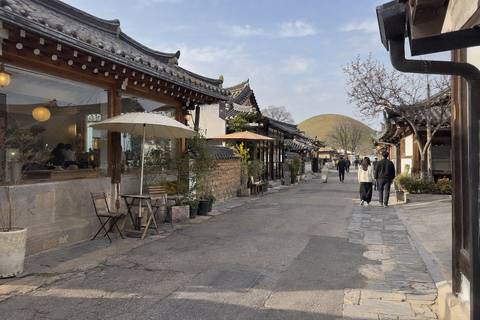
Hwangnidan-gil
A street of hanok cafes, bakeries and small shops beside the tomb park, the liveliest part of town in the evening.
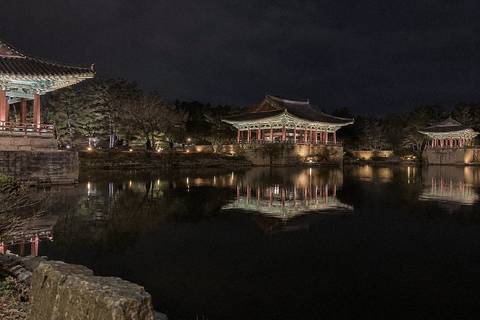
Donggung Palace and Wolji Pond
Reconstructed pavilions of a Silla crown prince's palace beside a landscaped pond, most popular after dark when they are lit up.
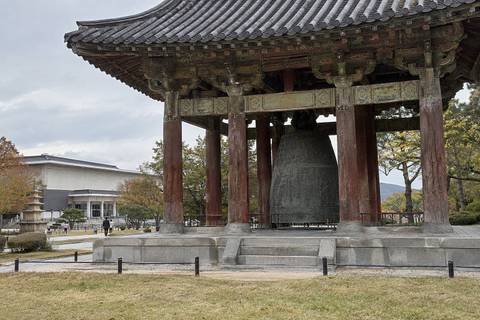
Gyeongju National Museum
Silla gold crowns, Buddhist sculpture and the great bronze Divine Bell of King Seongdeok; the best introduction to the city.
Frequently asked questions
Is Gyochon Hanok Village free?
Yes. Gyeongju City and VisitKorea both list the village as free, with no gate. The Choi family house, Gyeongju Hyanggyo and Woljeonggyo Bridge are free too. You pay only for workshops, hanbok rental, food and drink.
What are the opening hours of Gyochon Hanok Village?
The lanes have no fixed hours. The Choi family house is open 09:00–18:00 (17:00 in winter) and the Hyanggyo 09:00–18:00. Woljeonggyo Bridge is open 09:00–22:00 and lit after dark. Shops and workshops set their own hours and closing days.
What is the difference between Gyochon and Hwangnidan-gil?
Hwangnidan-gil, beside the tomb park, is a busy street of cafes and shops. Gyochon, about 900 m south, is a quieter restored village built around a historic family house and a Confucian school, with the Woljeonggyo bridge at its edge.
How do I get to Gyochon Hanok Village from Gyeongju Station?
Take city bus 60 or 61 to the 천마총 (Cheonmachong) stop, the 21st stop, and walk about 350 m south. Avoid runs marked 천마총미경유 and the 61 marked 선덕여고경유, which skip that stop. A taxi is faster if you have bags.
Is Woljeonggyo Bridge worth seeing at night?
Yes, if you are in central Gyeongju after dark. The rebuilt bridge is open until 22:00 and lit at night. Gyeongju City suggests the stepping stones in the river in front of it for the best view. It is a short walk from the village.
Sources
Facts on this page were checked against these sources on 31 October 2026. Prices, hours and rules change — confirm with the operator before you go.
- 경주문화관광 – 교촌마을 (교촌길 39-2; 정해진 관람시간 없음; 관람료 무료; 주차: 교촌길 2 노상주차장 유료, 월정교 공영주차장 교동 153-5 무료; 최씨고택·교동법주) (Korean) · official
- 경주문화관광 – 경주최부자댁 (교촌안길 27-44; 09:00-18:00, 동절기 17:00까지; 무료; 1700년경 건립, 99칸) (Korean) · official
- 경주문화관광 – 경주향교 (09:00-18:00; 무료; 682년 국학 터; 1600·1614년 중건) · 월정교 (09:00-22:00; 무료; 2013년 교량, 2018년 4월 문루 완료; 문루 2층 전시관) (Korean) · official
- 경주교촌마을 (경주시) – 마을 유래, 마을 내 문화유산, 체험장 (교촌의상실 한복대여, 토기공방 등), 행사 및 공연 프로그램 (Korean) · official
- 국가유산청 – 경주 최부자댁 (국가민속문화유산, 1971-05-27 지정; 1700년경; 사랑채·별당 1970년 화재) · 경주교동법주 (국가무형유산, 1986-11-01) (Korean) · official
- 국가유산청 – 경주향교 대성전 (보물, 2011-12-02) · 경주향교 명륜당 (보물, 2020-12-28) (Korean) · official
- 국가유산청 – 경주 춘양교지와 월정교지 (사적, 2004-11-27; 760년; 길이 약 60m; 2008~2018년 복원) (Korean) · official
- VISITKOREA – Gyeongju Gyochon Traditional Village (open all year, no fixed hours, free) · official
- 경주시 실시간 버스정보 – 60·61번 정류소 목록 (경주역(KTX) → 천마총 21번째), 월정1·2·3번 노선(교촌한옥마을·월정교 정류소), 첫차·막차·배차간격, 정류소 좌표 (Korean) · official
- 경주시 교통정보센터 – 버스요금 안내 (시내버스 일반 1,500원) (Korean) · official
- 텔트립 – 경주 월정교 야경 (다리 개방 09:00~22:00, 무료, 월정교 공영주차장 무료) (Korean)