Gyeongju · Bulguksa and Tohamsan
Seokguram Grotto 석굴암
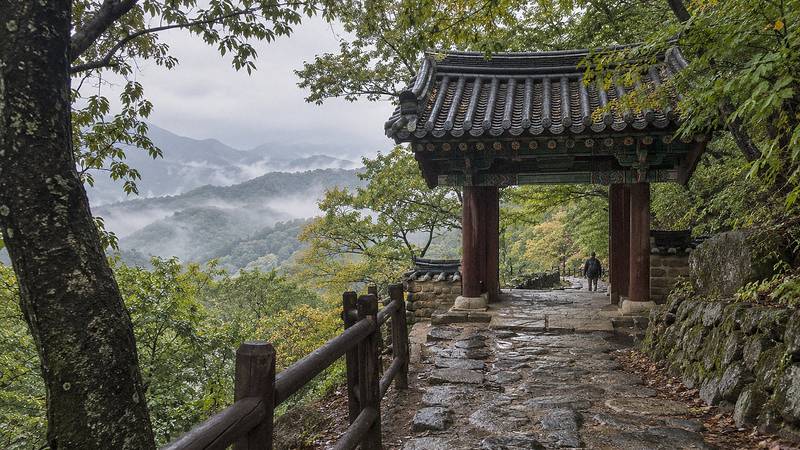
A granite Buddha in an artificial cave grotto high on Tohamsan, viewed through glass; reach it by bus or a mountain trail.
Updated
Essentials
- Hours
- Open every day from 09:00
- Last entry 18:00 (March–September), 17:30 (February and October), 17:00 (November–January)
- Closed
- Open all year; entry can be stopped during heavy rain, typhoon or snow warnings
- Admission
- Free (no admission fee since 4 May 2023)
- Seokguram car park: cars 2,000 won, buses 4,000 won
- Getting there
- City bus 12 from the 불국사 (Bulguksa) stop or the 불국사매표소 (Bulguksa ticket office) stop to 석굴암주차장 (Seokguram car park); 08:40–16:40, every 60–80 minutes
- On foot from Bulguksa: 2.2 km, about 50 minutes, on a gently graded forest trail
- From the car park, about 10 minutes' walk to the grotto
- Address
- 238 Seokgul-ro, Gyeongju, Gyeongsangbuk-do
경상북도 경주시 석굴로 238 - Website
- seokguram.org
Book your trip
Seokguram Grotto is free and opens at 09:00 every day, with last entry at 17:30 in October, 17:00 from November to January and 18:00 from March to September. Reach it by bus 12 from Bulguksa (08:40–16:40, about hourly) or a 2.2 km forest trail (about 50 minutes). The Buddha is seen through a glass wall, so the visit is short: allow about 2 hours from Bulguksa and back.
Seokguram is a man-made cave shrine of white granite high on Tohamsan, the mountain above Bulguksa. Inside sits a seated stone Buddha about 3.4 m tall, carved in the 8th century and counted among the masterpieces of East Asian Buddhist sculpture. The grotto and Bulguksa were listed together as a UNESCO World Heritage Site in 1995, and the grotto is a National Treasure.
Is Seokguram worth the trip up?
Go if you are already at Bulguksa, like sculpture or temples, and can spare about 2 hours. The ride up Tohamsan and the forest walk from the car park are part of the visit.
Skip it if you have only a few hours in Gyeongju, or you expect to walk inside. Since 1976 visitors have viewed the grotto from the entrance through a glass wall, which protects the stone from damp and temperature changes. You stand at the front, look in at the Buddha and the carved figures on the walls, and move on; the time at the grotto itself is short.
| Opens | 09:00 every day, all year |
| Last entry | 18:00 (Mar–Sep), 17:30 (Feb and Oct), 17:00 (Nov–Jan) |
| Admission | Free since 4 May 2023 |
| Car park | Cars 2,000 won, buses 4,000 won |
| Pets | Not allowed |
| Bad weather | Entry may be stopped under heavy rain, typhoon or snow warnings |
| Time needed | About 2 hours from Bulguksa and back, including the bus or walk |
Hours, fees, parking and weather rule from Seokguram’s own visitor page, with the same free entry, seasonal times and parking fees on VisitKorea’s Korean page, checked 23 October 2026. The temple has closed the grotto after heavy snow before, reopening the next afternoon once the snow was cleared, so check its notice board on a winter day.
Getting there: bus 12 or the trail
| Option | How | Time | Notes |
|---|---|---|---|
| City bus 12 | From the 불국사 (Bulguksa) stop or the 불국사매표소 (Bulguksa ticket office) stop up to 석굴암주차장 (Seokguram car park) | First bus 08:40, last 16:40, every 60–80 minutes | A loop: the same bus goes back down via the ticket office to 불국사. 1,500 won, 50 won less with a transport card |
| Trail from Bulguksa | National park forest trail from Bulguksa to the Seokguram car park | 2.2 km, about 50 minutes up | A gentle gradient; the national park rates it easier than its other trails |
| Car park to grotto | Footpath from the car park and gate | About 10 minutes, 0.6 km | Everyone walks this last part, whether by bus, car or trail |
| Taxi | From Bulguksa or the centre | Useful when the next bus is far off |
Bus times and stop order from Gyeongju City’s live bus system; trail distances and times from the Korea National Park Service, checked 23 October 2026.
- Plan around bus 12. With only one bus an hour or so, check the next departure on the stop display or the Gyeongju live bus site before you go up, and note the time of a bus down. The last bus leaves 불국사 at 16:40.
- Getting to Bulguksa first. From the bus terminals or the city centre, take bus 10 or 11 to the 불국사 stop; from Gyeongju Station (KTX), most visitors change at the terminal stop or take a taxi. The Bulguksa page has the full bus table.
- Walking up, riding down suits most people: the climb is steady but easy, and bus 12 takes the strain out of the return.
- By car. From Bulguksa, follow the Seokguram signs up Tohamsan for about 20 minutes to the car park.
What you see inside
The Korea Heritage Service dates the grotto to 751, when the minister Kim Dae-seong began it, the same year he began Bulguksa; it was finished in 774 and was first called Seokbulsa, “stone Buddha temple”. It is not cut into a cliff: the chamber was built by hand from white granite partway up the mountain.
- The layout. A rectangular antechamber leads through a short passage into a round main chamber. Its domed ceiling is made of more than 360 flat stones, a construction the heritage service calls without parallel anywhere.
- The main Buddha. A seated Shakyamuni about 3.4 m tall on a lotus pedestal, set slightly back from the centre of the round chamber. His right hand touches the ground, the gesture of the moment of enlightenment.
- The wall carvings. Of the original 40 figures, 38 remain. Eight guardian deities line the antechamber, two muscular door guardians flank the passage and the Four Heavenly Kings stand inside it. In the main chamber come gods, bodhisattvas and ten disciples, each with a different face.
- The eleven-headed Avalokiteshvara. On the back wall, directly behind the Buddha, stands the most finely carved figure in the grotto. It is hard to see from the glass, but it is the reason to take a moment at the front.
Seokguram is a working place of worship, so keep your voice down at the entrance. See Korean etiquette for temple manners and temples for other temples worth visiting.
Tohamsan summit trail closed this winter
The national park has closed the 1.4 km trail from the Seokguram ranger post to the summit of Tohamsan from 1 November 2026 to 31 March 2027 while Gyeongju City carries out a second phase of slope-reinforcement work around the grotto. It plans to open the trail for one day on 1 January 2027 for the New Year sunrise. The notice does not cover the grotto itself or the trail between Bulguksa and Seokguram. Korea National Park Service notice of 22 October 2026.
Tips for a first visit
- Go up first, then see Bulguksa. Taking an early bus 12 or walking up at 09:00 gets the grotto done while the day is fresh, and you finish at Bulguksa with no bus to catch.
- Mind the last entry. It is 17:30 in October and 17:00 from November to January, and the last bus 12 is at 16:40, so an afternoon visit needs a firm plan.
- Bring a layer. The grotto is higher up the mountain than Bulguksa, and the path runs through shaded forest.
- Autumn. Late October to early November is Tohamsan’s maple season and the busiest time on the bus. See autumn leaves.
Around Seokguram
Bulguksa, at the bottom of bus 12, is the natural pair; together they make a half day. Bomun Lake, on bus 10’s route back to town, has resort hotels and a lakeside path. Namsan is a mountain of Silla rock carvings for a half-day hike, and the grotto lies inside Gyeongju National Park.
Back in the centre, end the day at the lit-up Donggung Palace and Wolji Pond, open until 22:00, or the tomb park at Daereungwon. For trains, where to stay and the rest of the city, see the Gyeongju guide and the Gyeongsang region page. For a route that adds Gyeongju between Seoul and Busan, see Korea in 7 days.
Nearby
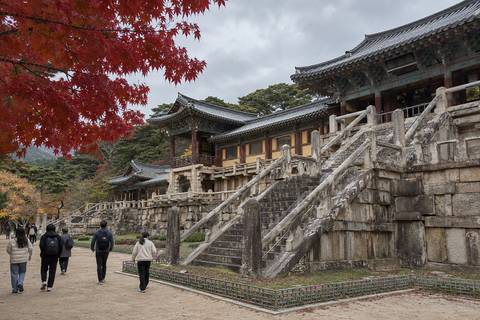
Bulguksa Temple
Korea's most celebrated temple, with Silla-era stone stairways, bridges and the twin pagodas Dabotap and Seokgatap.
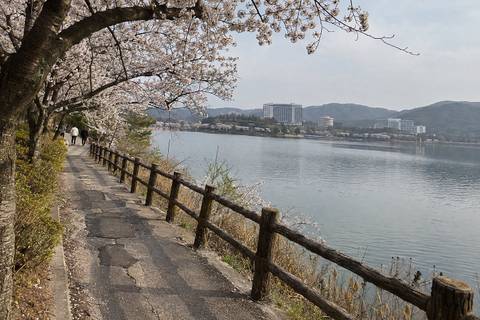
Bomun Lake
A resort lake with a shoreline path for walking and cycling, famous for cherry blossoms in early April.
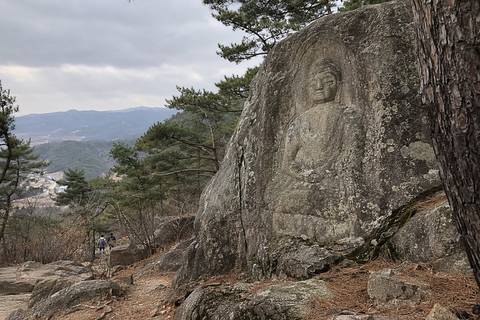
Gyeongju Namsan
A sacred mountain dotted with Buddhist rock carvings, stone pagodas and temple sites, explored on well-marked hiking trails.
Frequently asked questions
Is Seokguram Grotto worth visiting?
Yes, if you are already at Bulguksa and have about 2 hours more. The 8th-century granite Buddha is one of the finest Buddhist sculptures in East Asia, and the grotto shares Bulguksa's UNESCO listing. Set your expectations: you look at it from the entrance through a glass wall, and the visit inside takes only a few minutes.
Is Seokguram free?
Yes. Admission has been free since 4 May 2023. The only charge is parking: 2,000 won for a car and 4,000 won for a bus at the Seokguram car park.
What are Seokguram's opening hours?
It opens at 09:00 every day of the year. The last entry is 18:00 from March to September, 17:30 in February and October, and 17:00 from November to January. The grotto may close during heavy rain, typhoon or snow warnings.
How do I get from Bulguksa to Seokguram?
Take city bus 12 from the 불국사 stop or the Bulguksa ticket office stop up to the Seokguram car park. It runs from 08:40 to 16:40 about every 60–80 minutes. Or walk the national park trail from Bulguksa: 2.2 km, about 50 minutes, on a gentle slope. From the car park it is about 10 minutes on foot to the grotto.
Can I hike from Seokguram to the top of Tohamsan?
Not this winter. The national park has closed the 1.4 km trail from the Seokguram ranger post to the Tohamsan summit from 1 November 2026 to 31 March 2027 for slope-reinforcement work at the grotto, with a one-day opening planned for the New Year sunrise on 1 January 2027. The trail between Bulguksa and Seokguram is not on the closure notice.
Sources
Facts on this page were checked against these sources on 23 October 2026. Prices, hours and rules change — confirm with the operator before you go.
- 석굴암 – 관람시간 및 요금 (2023년 5월 4일부터 관람료 무료; 입장마감 11~1월 17:00, 2·10월 17:30, 3~9월 18:00, 오전 9시부터; 연중무휴; 반려동물 입장 불가; 기상특보 시 출입 통제; 주차요금 2,000 / 대형 4,000원) (Korean) · official
- 석굴암 – 찾아오시는 길 (석굴로 238, 054-746-9933; 불국사에서 12번 버스 환승; 주차장에서 도보 10분) (Korean) · official
- 석굴암 – 구조와 유물 (본존불 높이 약 3.4m, 항마촉지인; 십일면관음보살, 십대제자, 사천왕, 팔부신중, 금강역사) (Korean) · official
- 대한민국 구석구석 – 경주 석굴암 [유네스코 세계유산] (이용시간 3~9월 09:00~18:00 / 11~1월 09:00~17:00; 연중무휴; 입장료 무료; 주차 2,000 / 4,000원; 054-746-9933) (Korean) · official
- VISITKOREA – Gyeongju Seokguram Grotto [UNESCO World Heritage] (free admission, open all year, address, phone) · official
- 국가유산포털 – 경주 석굴암 석굴 (국보; 751~774년, 석불사; 40구 중 38구 현존; 360여 개 천장석; 1976년부터 유리벽 관람; 1995년 유네스코 세계유산) (Korean) · official
- 국립공원공단 – [경주] 토함산 불국사~석굴암 탐방코스 (총 2.8km 약 1시간; 불국사~석굴암 주차장 2.2km 약 50분, 경사 완만) (Korean) · official
- 국립공원공단 – [경주] 경주 석굴암 석굴 위험지 보강공사(2차)에 따른 탐방로 출입 통제 공고 (석굴암지킴터~토함산정상 1.4km, 2026.11.1~2027.3.31; 2027.1.1 해맞이 당일 개방 예정) (2026-10-22) (Korean) · official
- 경주시 실시간 버스정보 – 12번 노선 (불국사 → 불국사매표소 → 석굴암주차장 → 불국사매표소 → 불국사; 첫차 08:40, 막차 16:40, 배차 60~80분; 정류소 좌표) (Korean) · official
- 경주시 교통정보센터 – 버스요금 안내 (시내버스 일반 1,500원, 교통카드 50원 할인) (Korean) · official