Gyeongju · Bulguksa and Tohamsan
Bulguksa Temple 불국사
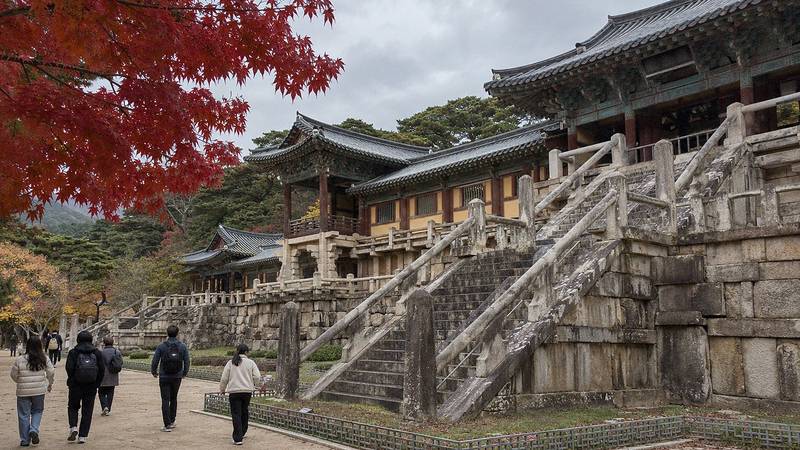
Korea's most celebrated temple, with Silla-era stone stairways, bridges and the twin pagodas Dabotap and Seokgatap.
Updated
Essentials
- Hours
- Open every day from 09:00
- Last entry 18:00 (March–September), 17:30 (February and October), 17:00 (November–January)
- Closed
- Open all year, weekends and holidays included
- Admission
- Free (no admission fee since 4 May 2023)
- Temple car parks: cars 2,000 won, buses 4,000 won
- Getting there
- City bus 10 or 11 from the 고속버스.시외버스터미널 (express and intercity bus terminal) stop to 불국사 (Bulguksa): 29 stops on bus 11, 33 on bus 10
- From Gyeongju Station (KTX): bus 700 or express bus 1150 run direct but rarely; most visitors ride any bus to the terminal stop and change, or take a taxi
- Bus 12 links the 불국사 stop and the temple ticket office with the Seokguram car park higher up Tohamsan
- Address
- 385 Bulguk-ro, Gyeongju, Gyeongsangbuk-do
경상북도 경주시 불국로 385 - Website
- bulguksa.or.kr
Book your trip
Bulguksa Temple is free to enter and opens at 09:00 every day. Last entry is 17:30 in October, 17:00 from November to January and 18:00 from March to September. Allow 1–1½ hours, go at opening time and pair it with Seokguram by bus 12. From town, take city bus 10 or 11 from the bus terminal stop.
Bulguksa sits on the western slopes of Tohamsan, about 12 km southeast of the Gyeongju bus terminals in a straight line. It is Korea’s best-known temple and, with the Seokguram grotto above it, has been on the UNESCO World Heritage list since 1995. Most first-time visitors come for its Silla stonework: two pagodas, stone stairways built as bridges and terraces of fitted stone that survived when the wooden halls burned.
Hours, fees and the main-hall repair
| Opens | 09:00 every day, all year |
| Last entry | 18:00 (Mar–Sep), 17:30 (Feb and Oct), 17:00 (Nov–Jan) |
| Admission | Free since 4 May 2023 |
| Temple car parks | Cars 2,000 won, buses 4,000 won |
| Pets | Not allowed |
| Time needed | 1–1½ hours; half a day with Seokguram |
Hours, fees and parking from the temple’s own visitor page, with the same free entry and a 09:00 start on VisitKorea, checked 23 October 2026. Older guides often give a 07:00 opening and an adult ticket price. Both are out of date.
The main hall. In February 2026 Korea’s heritage authorities said Daeungjeon, the main hall, needs to be taken apart and repaired after cracks and sagging were found in its main beams. On 8 March the temple posted that no repair schedule had been set and that the work does not affect entry. As of 23 October 2026 no start date has been published. Officials said a temporary shelter would go over the hall once work begins, so check the temple notice board before you go.
What to see at Bulguksa
The Korea Heritage Service dates the temple to 751, when the minister Kim Dae-seong began it. He died in 774 before it was finished, and the state completed it. The wooden halls burned during the Imjin War (1592–1598). Today’s main hall is a 1765 rebuild, and much of the rest was restored between 1969 and 1973. VisitKorea counts seven national treasures at the temple.
- The stone stairways. The 34 steps of Cheongungyo and Baegungyo (Blue Cloud and White Cloud bridges) lead up to the gate of the main hall. They are built like bridges with arched undersides, and the climb symbolises crossing from the everyday world into the Buddha’s land. To the west, the smaller Yeonhwagyo and Chilbogyo (18 steps) lead to the Paradise Hall; lotus petals are carved on their treads, and they are closed to walking to protect the worn carving. Both stairways are national treasures.
- Dabotap and Seokgatap. The two pagodas face each other in the courtyard in front of the main hall. Seokgatap, on the west, is a plain three-storey pagoda 10.75 m tall. Dabotap, on the east, is 10.29 m tall and far more ornate. In 1966 the world’s oldest known woodblock print, a Buddhist dharani sutra, was found inside Seokgatap. Dabotap once had four stone lions on its stairs; only one remains.
- Two gilt-bronze Buddhas. A seated Vairocana Buddha, 1.77 m tall, sits in Birojeon, and a seated Amitabha, 1.66 m tall, in Geungnakjeon. Both are national treasures from the Unified Silla period.
- Daeungjeon. The main hall, with an octagonal Silla stone lantern in front. Its repair has not started (see above).
Bulguksa is a working temple, so services may be under way in the halls. See Korean etiquette for how to behave at a temple, and temples for other temples worth visiting.
Getting there by bus
| From | Bus | Get off / notes |
|---|---|---|
| Express and intercity bus terminals | City bus 11 or 10 from the 고속버스.시외버스터미널 stop | 불국사 (Bulguksa): 29 stops on bus 11, which runs past Donggung Palace and the national museum; 33 stops on bus 10, which goes via Bomun Lake |
| Gyeongju Station (KTX) | A bus to the 고속버스.시외버스터미널 stop (61, 700 and 710 all pass it), then bus 10 or 11 | The direct bus 700 runs 07:50–14:50 with gaps of 1–5 hours, and express bus 1150 (4 stops to 불국사) only every 3–4 hours |
| Bulguksa to Seokguram | Bus 12 from the 불국사 stop or the 불국사매표소 (Bulguksa ticket office) stop | 석굴암주차장 (Seokguram car park); 08:40–16:40, every 60–80 minutes |
| Back to the centre | Bus 10 or 11 from the 불국사 stop | Bus 10 reaches 동궁과월지 (Donggung Palace and Wolji Pond) in 20 stops and the terminals in 28 |
Stop orders, first and last buses and frequencies from Gyeongju City’s live bus system, checked 23 October 2026.
- Buses 10 and 11 leave the start of the route between 06:00 and 21:40 (bus 10) or 06:15 and 22:00 (bus 11), every 20–50 minutes. They are the same loop in opposite directions, so either one gets you there and back.
- Fares. A city bus ride is 1,500 won, or 50 won less with a transport card.
- From the stop. The 불국사 stop is about 0.6 km in a straight line from the main courtyard. The 불국사매표소 (ticket office) stop on bus 12 is closer, about 0.4 km.
- Taxi. With luggage or from the KTX station, a taxi is the simple option.
By car. The temple has two car parks, one at the main gate (Iljumun) and one at the rear gate (Burimun). The temple says both are about a minute’s walk from the entrance, while the public car park lower down takes about 10 minutes on foot.
Tips for a first visit
- Go at 09:00, especially at weekends and in autumn. The courtyard in front of the pagodas is small, and the first hour is the easiest time to see it.
- Check the season’s last entry. It moves between 17:00 and 18:00, and from November it is 17:00.
- Do Seokguram first or second, but plan the bus. Bus 12 runs only every hour or so and stops at 16:40. Either take it up first and walk around Bulguksa afterwards, or time your visit to the next departure.
- Autumn. Bulguksa is a classic maple spot, and late October to early November is its busiest season. See autumn leaves.
- Evening plan. Bus 10 back to town passes Donggung Palace and Wolji Pond, which stays open until 22:00. Finish the day at the lit-up pond.
Around Bulguksa
Seokguram Grotto, the granite Buddha in its cave shrine near the top of Tohamsan, is the natural pair, by bus 12 or the mountain trail. Bomun Lake, on bus 11’s route back to town, has resort hotels and a lakeside path. Namsan, west of the temple, is a mountain of Silla rock carvings for a half-day hike.
In the centre, Daereungwon and the tomb parks are a short bus ride away. For trains, where to stay and the rest of the city, see the Gyeongju guide and the Gyeongsang region page. For a route that adds Gyeongju between Seoul and Busan, see Korea in 7 days, and for Korea’s national parks, including Gyeongju’s, see national parks.
Nearby
Seokguram Grotto
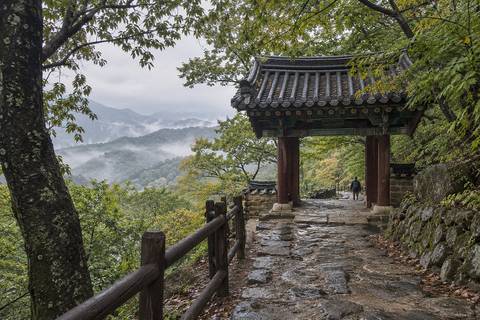
A granite Buddha in an artificial cave grotto high on Tohamsan, viewed through glass; reach it by bus or a mountain trail.
Bomun Lake
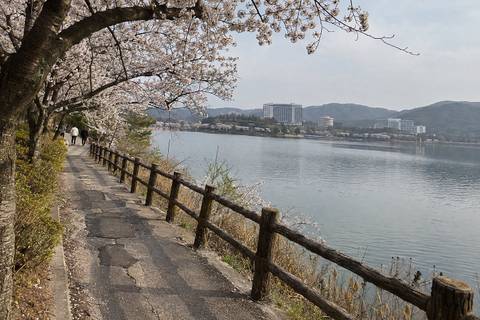
A resort lake with a shoreline path for walking and cycling, famous for cherry blossoms in early April.
Donggung Palace and Wolji Pond
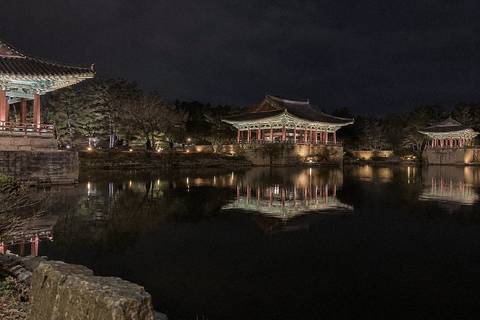
Reconstructed pavilions of a Silla crown prince's palace beside a landscaped pond, most popular after dark when they are lit up.
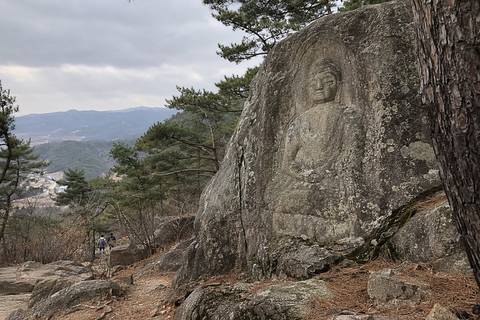
Gyeongju Namsan
A sacred mountain dotted with Buddhist rock carvings, stone pagodas and temple sites, explored on well-marked hiking trails.
Frequently asked questions
Is Bulguksa Temple free?
Yes. Admission has been free since 4 May 2023, when the fees at temples holding state-designated heritage were dropped. You only pay if you drive: the temple's own car parks charge 2,000 won for a car and 4,000 won for a bus.
What time does Bulguksa open and close?
It opens at 09:00 every day of the year. The last entry is 18:00 from March to September, 17:30 in February and October, and 17:00 from November to January. Older guides that list a 07:00 opening are out of date.
How do I get to Bulguksa from Gyeongju KTX station?
There are direct buses (700 and the express 1150), but they run only a few times a day. The usual way is a bus from the station to the 고속버스.시외버스터미널 stop by the bus terminals, then bus 10 or 11 to the 불국사 stop. A taxi saves the change.
Can I see Bulguksa and Seokguram on the same day?
Yes, and most visitors do. Bus 12 runs between the 불국사 stop, the temple ticket office and the Seokguram car park from 08:40 to 16:40, about every 60–80 minutes, so check the next departure before you start walking round the temple.
Is the main hall closed for repairs?
Not as of 23 October 2026. Korea's heritage authorities announced in February 2026 that the main hall, Daeungjeon, needs to be taken apart and repaired. In March the temple said no repair schedule had been set and that the work does not affect entry. Check the temple's notice board before you go.
Sources
Facts on this page were checked against these sources on 23 October 2026. Prices, hours and rules change — confirm with the operator before you go.
- 불국사 – 관람시간 및 요금 (2023년 5월 4일부터 관람료 무료; 입장마감 11~1월 17:00, 2·10월 17:30, 3~9월 18:00, 오전 9시부터; 연중무휴; 반려동물 입장 불가; 주차요금 2,000 / 대형 4,000원) (Korean) · official
- 불국사 – 찾아오시는 길 (불국로 385, 054-746-9913; 시내버스 10·11번; 일주문·불이문 매표소 주차장) (Korean) · official
- 불국사 공지사항 – 대웅전 보수와 입장은 무관합니다 (2026-03-08) (Korean) · official
- VISITKOREA – Gyeongju Bulguksa Temple [UNESCO World Heritage] (hours, free admission, no pets, address, phone) · official
- 국가유산포털 – 경주 불국사 다보탑 (국보; 751년 김대성 발원 창건, 높이 10.29m) (Korean) · official
- 국가유산포털 – 경주 불국사 삼층석탑 (국보; 높이 10.75m, 1966년 무구정광대다라니경 발견) (Korean) · official
- 국가유산포털 – 경주 불국사 청운교 및 백운교 (국보; 34계단) / 연화교 및 칠보교 (국보; 18계단, 통행 금지) (Korean) · official
- 국가유산포털 – 경주 불국사 대웅전 (보물; 1765년 중창) (Korean) · official
- 경주시 실시간 버스정보 – 10·11·12·700·1150번 노선 정류소 목록, 첫차·막차, 배차간격, 정류소 좌표 (Korean) · official
- 경주시 교통정보센터 – 버스요금 안내 (시내버스 일반 1,500원, 교통카드 50원 할인) (Korean) · official
- 뉴스1: 불국사 대웅전 곳곳 '노후화'…국립문화유산연구원 "해체 수리" (2026-02-23) (Korean)