Gyeongju · Central Gyeongju
Donggung Palace and Wolji Pond 동궁과 월지
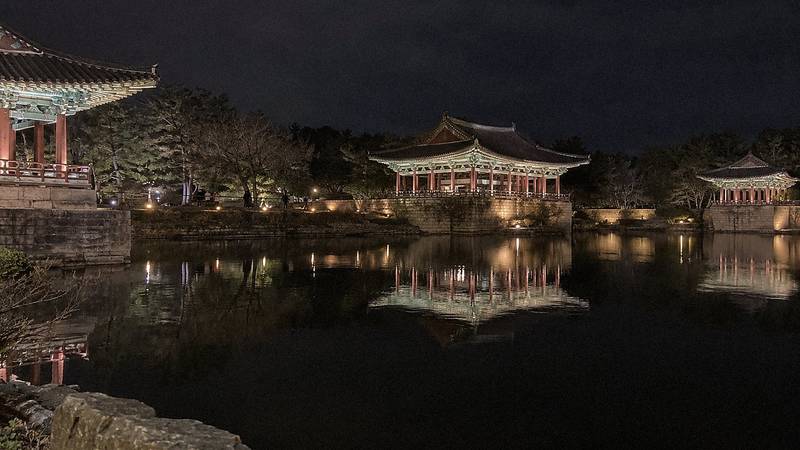
Reconstructed pavilions of a Silla crown prince's palace beside a landscaped pond, most popular after dark when they are lit up.
Updated
Essentials
- Hours
- Open every day, 09:00–22:00 (ticket sales end 21:30)
- Closed
- Open all year
- Admission
- Adults (19–64) 3,000 won, youth (13–18) 2,000 won, children (7–12) 1,000 won
- Free for children 6 and under, visitors 65 and over and people with disabilities
- Getting there
- City bus 710 from Gyeongju Station (KTX) to the 동궁과월지 (Donggung and Wolji) stop, the 18th stop, about 200 m from the site
- City bus 11 from the express and intercity bus terminals, 9 stops to 동궁과월지
- About 0.7 km on foot from Cheomseongdae and 1.3 km from Daereungwon
- Free car park at the site (Donggung and Wolji car park)
- Address
- 102 Wonhwa-ro, Gyeongju, Gyeongsangbuk-do
경상북도 경주시 원화로 102 - Website
- gyeongju.go.kr/tour/page.do?code_uid=1012&mnu_uid=4716&area_uid=50&cmd=2
Book your trip
Donggung Palace and Wolji Pond is open every day 09:00–22:00, with tickets sold until 21:30. Entry is ₩3,000 for adults, and it is Gyeongju’s best-known night view: rebuilt Silla pavilions lit up and reflected in a large garden pond. Arrive around sunset, not near the cut-off, and allow under an hour. From the KTX station, take city bus 710.
The pond was dug in 674 and the crown prince’s palace beside it was built in 679, after Silla unified the peninsula. For centuries the ruins were known as Anapji, the pond of geese and ducks. Since 2011 the site has used its Silla names again. It belongs to the Wolseong area of the UNESCO-listed Gyeongju Historic Areas.
When to go: day or night?
Go in the evening. That is when almost everyone comes, and the reason the pond is famous. Get there a little before sunset, walk the path while it is still light, and stay until the pavilions are lit. A daytime visit is quieter and shows the garden layout better, but most first-time visitors prefer the night.
| Hours | Every day 09:00–22:00; ticket sales end 21:30 |
| Adults (19–64) | 3,000 won |
| Youth (13–18) | 2,000 won |
| Children (7–12) | 1,000 won |
| Free | Age 6 and under, 65 and over, people with disabilities |
| Parking | Free car park at the site |
| Time needed | 40 minutes to 1 hour |
Hours and fees from Gyeongju City’s tourism pages, with the same hours on VisitKorea, checked 23 October 2026. Gyeongju City notes that so many people come for the night view that entry can be hard if you arrive close to the ticket cut-off. If you are 65 or over, carry your passport in case you are asked to show your age.
What you see
- The pond. Wolji is about 200 m east to west and 180 m north to south. Its south and west banks are straight, but the north and east banks wind in and out, so the whole pond can never be seen from one spot. Gyeongju City’s heritage page says it was dug with three islands and twelve small hills along the banks.
- The pavilions. Excavation from 1975 found 26 building sites and around 24,000 objects. In 1980 three buildings on the west bank were rebuilt, including the hall thought to be Imhaejeon, the palace’s banquet hall. Its name means “hall overlooking the sea”, a hint that the pond was made to look like the sea.
- A royal banquet hall. Silla kings held feasts here for state celebrations and foreign guests. In 931, King Gyeongsun, Silla’s last king, hosted Wang Geon, the founder of Goryeo, here.
- The walk. A path runs around the pond past the rebuilt pavilions. The lights come on at dusk.
- Seasons. Gyeongju City lists lotus ponds around the site that fill with flowers in summer. VisitKorea mentions spring flowers and pink muhly grass in autumn around the palace grounds.
Gyeongju National Museum, about 0.5 km south along the road, makes a good daytime visit before the pond.
Getting there
| From | Bus | Get off / walk |
|---|---|---|
| Gyeongju Station (KTX) | City bus 710 | 동궁과월지 (Donggung and Wolji), the 18th stop; about 200 m to the site |
| Express and intercity bus terminals | City bus 11 from the 고속버스.시외버스터미널 stop | 동궁과월지, 9 stops later |
| Daereungwon | Bus 710 from the 천마총후문.황리단길 stop | 동궁과월지, 3 stops; or walk about 1.3 km past Cheomseongdae |
| Bulguksa | City bus 10 from the 불국사 stop | 동궁과월지, 20 stops; about 150 m to the site |
| Back to Gyeongju Station | Bus 710 from the 동궁과월지 stop for the opposite direction | 16 stops to the station |
Stop orders, first and last buses and stop coordinates from Gyeongju City’s live bus system; distances are straight-line from those coordinates, checked 23 October 2026.
- Bus 710 is not frequent. It leaves Gyeongju Station between 06:30 and 20:46, with gaps of 50–60 minutes. Check the live times, or take a taxi, especially for the trip back after dark.
- Buses 10 and 11 are the Bulguksa loop buses. Bus 11 leaves the terminal side between 06:15 and 22:00 and bus 10 between 06:00 and 21:40, every 20–50 minutes. Bus 11 passes Donggung on its way out to Bulguksa, bus 10 on its way back.
- On foot. In the evening it is easy to walk from Daereungwon past Cheomseongdae, which is about 0.7 km west of the pond.
- Fares. A city bus ride is 1,500 won, or 50 won less with a transport card.
By car, use the Donggung and Wolji car park next to the site, which Gyeongju City lists as free.
Tips
- Pair it with the tombs. See Daereungwon and Cheomseongdae in the late afternoon, then walk east to the pond as it gets dark. Both Daereungwon and the pond stay open until 22:00.
- Don’t cut it fine. Ticket sales end at 21:30, and queues on busy nights can make that too late.
- Bring a jacket for autumn and winter evenings by the water.
- Have a plan for the ride back. Bus 710 runs about once an hour. If you stay near the KTX station rather than in the centre, a taxi is the simple option late in the evening.
- Stay central. For one night in Gyeongju, a hanok guesthouse near Hwangnidan-gil puts the pond and the tombs within walking distance.
Around Donggung and Wolji
The pond sits at the eastern end of central Gyeongju, with the national museum to the south, Cheomseongdae and Gyochon Hanok Village to the west and Daereungwon beyond. For Bulguksa, trains and where to stay, see the Gyeongju guide and the Gyeongsang region page. For Korea’s other royal sites, see palaces, and for a route that adds Gyeongju between Seoul and Busan, see Korea in 7 days.
Nearby
Cheomseongdae Observatory
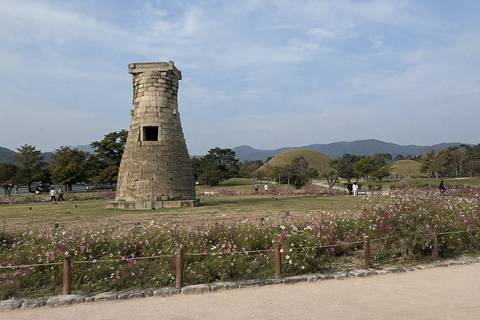
A bottle-shaped stone tower from the 7th century, often called East Asia's oldest surviving observatory, set in open fields.
Gyeongju National Museum
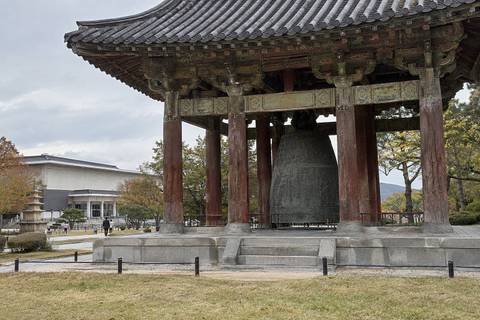
Silla gold crowns, Buddhist sculpture and the great bronze Divine Bell of King Seongdeok; the best introduction to the city.
Daereungwon Tomb Complex
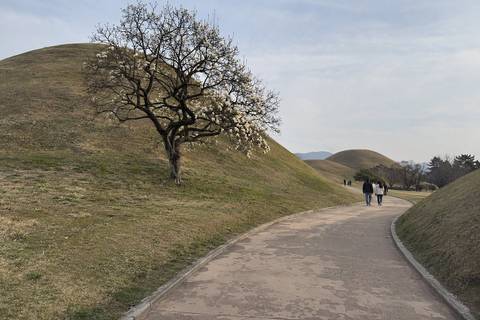
A park of huge grassy Silla burial mounds; inside Cheonmachong you can see how a royal tomb was built and what it held.
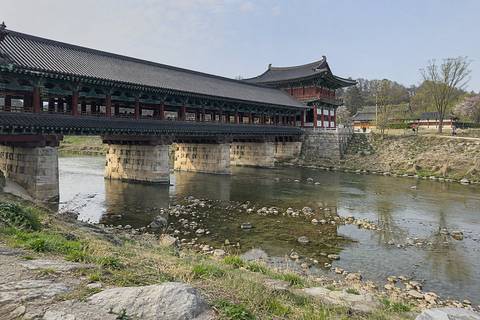
Gyochon Hanok Village
A small hanok village around the historic Choi family house, next to the rebuilt covered bridge of Woljeonggyo.
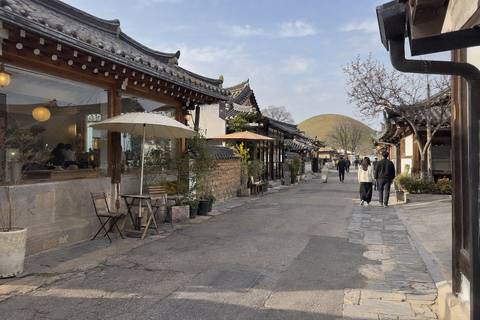
Hwangnidan-gil
A street of hanok cafes, bakeries and small shops beside the tomb park, the liveliest part of town in the evening.
Frequently asked questions
What time should I go to Donggung Palace and Wolji Pond for the night view?
Arrive a little before sunset and stay until the lights are on. The site is open 09:00–22:00 and ticket sales end at 21:30, but Gyeongju City warns that the evening crowds can make it hard to get in if you turn up close to the cut-off.
How much is the entrance fee?
3,000 won for adults aged 19–64, 2,000 won for ages 13–18 and 1,000 won for ages 7–12. Children 6 and under, visitors 65 and over and people with disabilities enter free. The car park is free.
How do I get to Wolji Pond from Gyeongju KTX station?
Take city bus 710 from Gyeongju Station and get off at 동궁과월지, the 18th stop. It runs about once an hour, so check the live times or take a taxi. From the bus terminals in town, bus 11 is more frequent and takes 9 stops.
Is Anapji the same place as Wolji Pond?
Yes. Anapji, meaning pond of geese and ducks, is the name the ruins were given after Silla fell. Gyeongju City says the site took back its Silla names, Donggung Palace and Wolji Pond, in 2011, after pottery inscribed with the name Wolji was found here.
How long do I need?
Allow 40 minutes to an hour for the loop path around the pond. Many visitors combine it with Daereungwon and Cheomseongdae in the late afternoon and finish here after dark.
Sources
Facts on this page were checked against these sources on 23 October 2026. Prices, hours and rules change — confirm with the operator before you go.
- 경주문화관광 – 동궁과 월지 (관람시간 09:00-22:00, 매표 마감 21:30, 연중무휴; 관람료 성인 3,000 / 청소년 2,000 / 어린이 1,000; 동궁과월지 주차장 무료; 674년 월지, 679년 동궁; 2011년 명칭 회복; 동서 200m·남북 180m) (Korean) · official
- 경주문화관광 – 입장료안내 (연령 구분, 무료 대상, 동궁과 월지 요금·주차 무료, 입장 마감 임박 시 입장이 어려울 수 있음) (Korean) · official
- 경주문화관광 – 경주 동궁과 월지 (사적, 1963년 지정; 건물터 26곳, 1980년 건물 3곳·연못 복원; 931년 경순왕 연회) (Korean) · official
- VISITKOREA – Donggung Palace and Wolji Pond (operating hours 9:00–22:00, address, phone; 1975 excavation, about 24,000 relics, pond about 15,600 m²) · official
- 경주시 실시간 버스정보 – 710·10·11번 노선 정류소 목록 (경주역(KTX)·터미널 → 동궁과월지), 첫차·막차, 배차간격, 정류소 좌표 (Korean) · official
- 경주문화관광 – 동궁과 월지(안압지) 주변 연꽃단지 (Korean) · official
- 경주시 교통정보센터 – 버스요금 안내 (시내버스 일반 1,500원, 교통카드 50원 할인) (Korean) · official