Gyeongju · Central Gyeongju
Cheomseongdae Observatory 첨성대
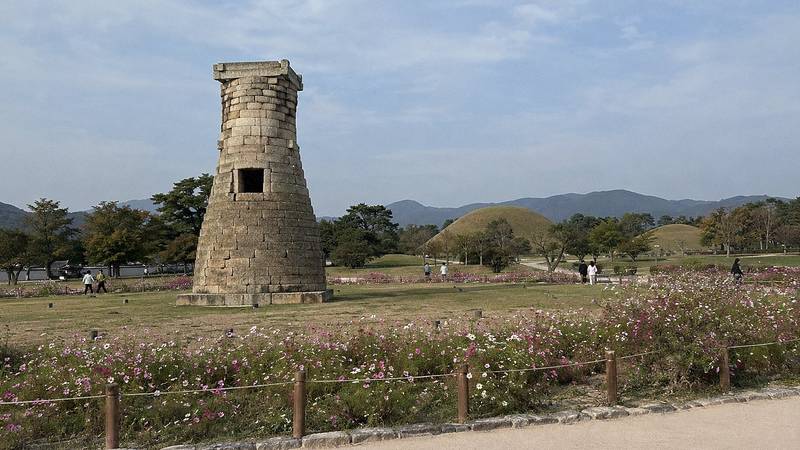
A bottle-shaped stone tower from the 7th century, often called East Asia's oldest surviving observatory, set in open fields.
Updated
Essentials
- Hours
- Open every day, 09:00–22:00 (until 21:00 in winter)
- Closed
- Open all year
- Admission
- Free
- Getting there
- City bus 60 or 61 from Gyeongju Station (KTX) to the 첨성대 (Cheomseongdae) stop, the 20th stop, about 120 m from the tower
- From the express and intercity bus terminals: the same buses, 5 stops, or about 1.4 km on foot
- About 650 m on foot from Daereungwon and 680 m from Donggung Palace and Wolji Pond
- Address
- 839-1 Inwang-dong, Gyeongju, Gyeongsangbuk-do
경상북도 경주시 인왕동 839-1 - Website
- gyeongju.go.kr/tour/page.do?code_uid=1012&mnu_uid=4716&area_uid=47&cmd=2
Book your trip
Cheomseongdae is free, has no gate and is open every day 09:00–22:00 (21:00 in winter). It is a 9 m stone tower from the 7th century, usually called East Asia’s oldest surviving observatory. Allow 15–30 minutes. It sits on the walk between Daereungwon and Wolji Pond, about 650 m from each. From the KTX station, take bus 60 or 61.
| Your situation | Do this |
|---|---|
| One afternoon and evening in Gyeongju | Walk Daereungwon → Cheomseongdae → Gyerim → Wolji Pond, arriving at the pond around sunset |
| Arriving at Gyeongju Station (KTX) | Bus 60 or 61 to the 첨성대 stop (20th stop); check the bus is not marked 천마총미경유 |
| Only after dark | Come on the way to Wolji Pond; the lawn is open to 22:00, 21:00 in winter |
| Here in October | Look for the pink muhly grass fields beside the tower |
| Short on time | Ten minutes from the path is enough; spend the saved time at the museum or Cheonmachong |
Is Cheomseongdae worth a stop?
Yes, because it costs nothing and is already on your route. It is small, and a first look can disappoint anyone expecting a building. What makes it worth five more minutes is the design: almost every number in the stonework is thought to mean something. Go when the light is low, in the late afternoon or after dark.
| Hours | Every day 09:00–22:00; until 21:00 in winter |
| Closed | Never; open all year |
| Admission | Free |
| Time needed | 15–30 minutes |
| Nearest bus stop | 첨성대 (Cheomseongdae), bus 60/61, about 120 m |
Hours and fee from Gyeongju City’s tourism pages, checked 31 October 2026. The city does not say which months count as winter, so in the colder months aim to be there by 21:00.
What you are looking at
The tower has three parts: a square stone base, a rounded body that swells and narrows like a bottle, and a square frame of long stones at the top. The body is built from 27 courses of curved stone blocks, and the whole tower stands about 9 m high.
- The window. A small opening faces south-east halfway up. The courses below it are packed with rubble; above it the tower is hollow to the top.
- How it was climbed. Stone beams poke through at courses 19–20 and 25–26, which would have held ladders. The likely route was a ladder outside to the window, then a ladder inside to the top.
- The numbers. Gyeongju City counts about 365 stones, one for each day of the year. The 27 courses are read as Queen Seondeok, the 27th ruler of Silla, and 12 courses above and 12 below the window as the 12 months and the 24 seasonal divisions.
- Round over square. The rounded body on a square base and top is read as heaven above earth.
It is thought to date from the reign of Queen Seondeok (632–647). Watching the sky mattered for setting the farming calendar and for reading omens for the state. The tower became National Treasure in December 1962. It is part of the Wolseong Belt of the UNESCO-listed Gyeongju Historic Areas.
Day, night or flower season?
- Daytime. The lawn and the tomb mounds behind it are at their greenest. It works well as the middle stop of a walk across central Gyeongju.
- After dark. The tower is lit, and Gyeongju City’s photo gallery shows it at night. Pair it with Wolji Pond, the city’s best-known night view.
- Spring and autumn. Gyeongju City’s flower calendar lists rapeseed in spring and pink muhly grass in autumn in the fields around the tower. A Korean daily reported about 4,170 m² of pink muhly there in October 2026.
Getting to Cheomseongdae
| From | How | Get off / walk |
|---|---|---|
| Gyeongju Station (KTX) | City bus 60 or 61 | 첨성대 (Cheomseongdae), the 20th stop; about 120 m to the tower |
| Express and intercity bus terminals | Bus 60 or 61 from the 고속버스.시외버스터미널 stop, or on foot | 5 stops; on foot about 1.4 km |
| Daereungwon (Cheonmachong) | On foot | About 650 m |
| Donggung Palace and Wolji Pond | On foot | About 680 m |
Stop order, first and last buses and stop coordinates from Gyeongju City’s live bus system; walking distances are straight-line from those coordinates, checked 31 October 2026.
- Check the sign on the bus. Runs marked 천마총미경유 (route 60 or 61) and 선덕여고경유 (route 61) do not stop at Cheomseongdae.
- Bus times. From the station, the first and last 60 leave at 06:00 and 19:40, and the 61 at 06:35 and 19:20. Gaps run from 20 minutes to 2 hours, so check the live times or take a taxi.
- Going back to the station. Buses 60 and 61 run a one-way loop. From Cheomseongdae they carry on around town for over 60 stops before reaching the station. Instead, walk to the bus terminal stop and take a 60 or 61 there, or take a taxi.
- Fares. A city bus ride is 1,500 won, or 50 won less with a transport card. One transfer within 30 minutes is free.
By car, Gyeongju City points to the paid Cheonmachong roadside car park, the roadside spaces around Gyochon Hanok Village and the free Jjoksaem temporary car park, entered from Wonhwa-ro 181beon-gil.
Tips
- Walk on to Gyerim. The small forest just south of the tower is open 24 hours and free. It is tied to the birth legend of Kim Alji, ancestor of the Kim royal line, and holds a tomb said to be King Naemul’s.
- Then Wolseong. The site of the Silla royal palace is beyond Gyerim, free with no set hours, and still being excavated. From there the path leads east to Wolji Pond.
- Use the free sites in the day, the paid ones at night. Cheomseongdae, Gyerim, Wolseong and Gyochon Hanok Village are all free. Daereungwon’s Cheonmachong tomb and Wolji Pond are the two that charge, and both sell tickets until 21:30.
- See the Silla gold. The crowns and treasures from the tombs are in Gyeongju National Museum, about 1 km south-east.
Around Cheomseongdae
The tower sits in the middle of central Gyeongju, with Daereungwon and the cafes of Hwangnidan-gil to the north-west and Wolji Pond to the east. For a day that fits it between Bulguksa and the pond, see Gyeongju in one day. For trains and where to stay, see the Gyeongju guide and the Gyeongsang region page. Other UNESCO sites in Korea are on the UNESCO page.
Nearby
Daereungwon Tomb Complex
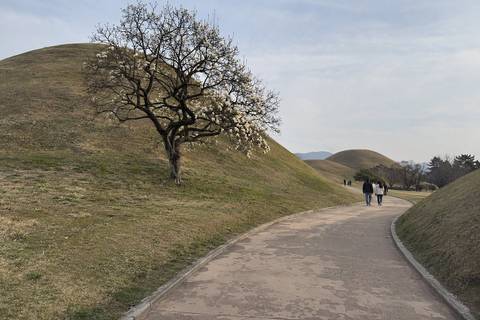
A park of huge grassy Silla burial mounds; inside Cheonmachong you can see how a royal tomb was built and what it held.
Donggung Palace and Wolji Pond
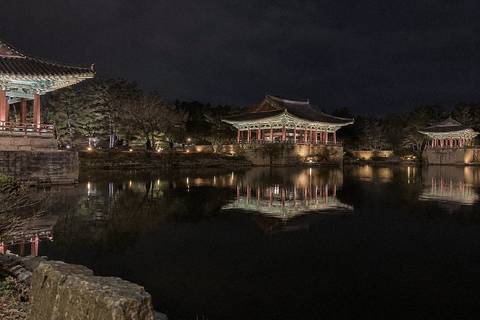
Reconstructed pavilions of a Silla crown prince's palace beside a landscaped pond, most popular after dark when they are lit up.
Gyochon Hanok Village
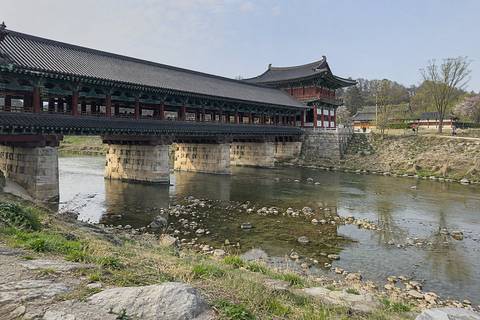
A small hanok village around the historic Choi family house, next to the rebuilt covered bridge of Woljeonggyo.
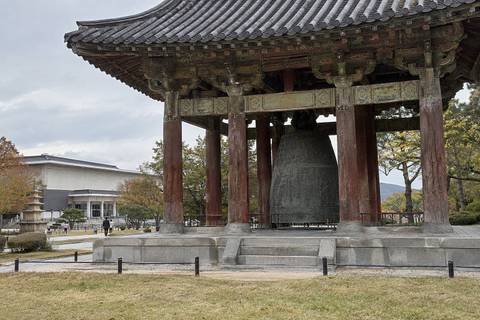
Gyeongju National Museum
Silla gold crowns, Buddhist sculpture and the great bronze Divine Bell of King Seongdeok; the best introduction to the city.
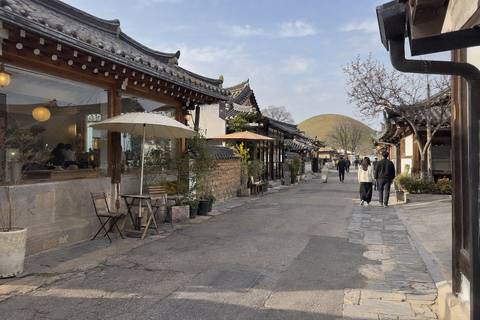
Hwangnidan-gil
A street of hanok cafes, bakeries and small shops beside the tomb park, the liveliest part of town in the evening.
Frequently asked questions
Is Cheomseongdae free?
Yes. Gyeongju City lists admission to Cheomseongdae as free, and there is no ticket office. The tower stands on an open lawn between the Daereungwon tomb park and Wolseong, so you can walk past it on the way from the tombs to Wolji Pond.
What time is Cheomseongdae open?
Gyeongju City gives the hours as 09:00–22:00 every day, closing at 21:00 in winter, with no closing days in the year. The city does not say which months count as winter, so plan to be there by 21:00 from late autumn to early spring.
Can you go inside Cheomseongdae?
No. It is a solid stone tower about 9 m high with a single small window halfway up. Silla-era observers are thought to have climbed a ladder to the window and another inside to reach the top. Today you look at it from the lawn around it.
How long do you need at Cheomseongdae?
About 15–30 minutes for the tower itself. Most visitors fold it into a walk: Daereungwon, then Cheomseongdae, then Gyerim forest and Wolseong, ending at Donggung Palace and Wolji Pond after dark. That walk takes half a day.
Is Cheomseongdae worth seeing at night?
Yes, if you are already heading to Wolji Pond. The tower is open until 22:00 (21:00 in winter) and is lit after dark, and Wolji is about 680 m east. In the day it is a short stop on the walk from the tomb park.
Sources
Facts on this page were checked against these sources on 31 October 2026. Prices, hours and rules change — confirm with the operator before you go.
- 경주문화관광 – 첨성대 (관람시간 09:00-22:00, 동절기 21:00까지, 연중무휴; 관람료 무료; 천마총 노상주차장·교촌한옥마을 주변 노상주차장·쪽샘임시주차장 무료; 높이 약 9m, 27단, 365개 내외의 돌) (Korean) · official
- 경주문화관광 – 입장료안내 (첨성대 무료, 대릉원주차장 이용) (Korean) · official
- 경주문화관광 – 세계문화유산 월성지구: 경주 첨성대 (국보, 1962년 12월 20일 지정, 선덕여왕 재위 632~647 건립 추정) (Korean) · official
- 국가유산청 국가유산 공개 API – 경주 첨성대 (국보, 소재지 인왕동 839-1, 좌표) (Korean) · official
- 경주시 실시간 버스정보 – 60·61번 노선 정류소 목록 (경주역(KTX) → 첨성대 20번째 정류소; 천마총미경유·선덕여고경유 운행은 미경유), 첫차·막차, 배차간격, 정류소 좌표 (Korean) · official
- 경주시 교통정보센터 – 버스요금 안내 (시내버스 일반 1,500원, 교통카드 50원 할인, 30분 이내 1회 환승 무료) (Korean) · official
- 경주문화관광 – 경주 계림 (연중무휴 24시간, 무료) · 경주 월성 (정해진 관람시간 없음, 무료) · 교촌마을 (무료) (Korean) · official
- 경주문화관광 – 경주꽃달력 (봄 #첨성대유채꽃, 가을 #첨성대핑크뮬리) (Korean) · official
- 매일신문 (2026-10-16) – 핑크뮬리 명소 5선: 경주 첨성대 동부사적지 약 4,170㎡에 8만 본 (Korean)