Gyeongju · Central Gyeongju
Hwangnidan-gil 황리단길
A street of hanok cafes, bakeries and small shops beside the tomb park, the liveliest part of town in the evening.
Updated
Essentials
- Getting there
- City bus 60 or 61 from Gyeongju Station (KTX) to 천마총후문.황리단길 (Cheonmachong back gate), the 17th stop, at the north end of the street
- About 0.5 km on foot from the Gyeongju express and intercity bus terminals
- By car: Hwangnidan-gil public car park (894 spaces), 30 Cheomseong-ro, about 650 m from the middle of the street
- Address
- 1080 Poseok-ro, Gyeongju, Gyeongsangbuk-do
경상북도 경주시 포석로 1080 (황남동) - Website
- gyeongju.go.kr/tour/page.do?code_uid=1012&mnu_uid=4716&area_uid=53&cmd=2
Book your trip
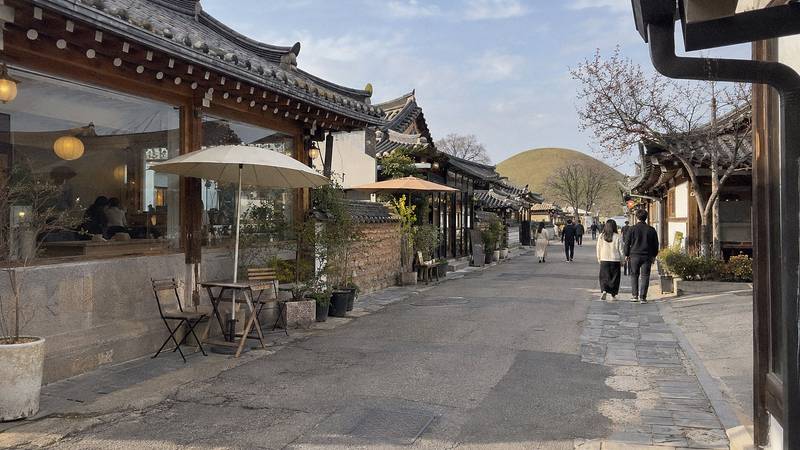
Hwangnidan-gil is Gyeongju’s street of cafes, bakeries and small shops, many of them in old tiled-roof houses. It runs along the west side of the Daereungwon tomb park. Entry is free and there are no set hours; each shop keeps its own. Come in the late afternoon, walk it in 1–2 hours, then go on to Cheomseongdae and Wolji Pond after dark. From the KTX station, take bus 60 or 61 to the 천마총후문.황리단길 stop.
| Your situation | Do this |
|---|---|
| One afternoon and evening in Gyeongju | Daereungwon, then Hwangnidan-gil for a cafe break, then Cheomseongdae and Wolji Pond at sunset |
| Arriving at Gyeongju Station (KTX) | Bus 60 or 61 to 천마총후문.황리단길, the 17th stop; skip runs marked 천마총미경유 |
| Arriving by express or intercity bus | Walk; the terminal is about 0.5 km from the street |
| Driving | Park at the Hwangnidan-gil public car park (30 Cheomseong-ro) and walk or take a Wolseong loop bus |
| Staying one night | Sleep around here; the tombs, Cheomseongdae and Wolji are all on foot |
Is Hwangnidan-gil worth it?
Yes, as a break between the sights rather than a sight of its own. Most of Gyeongju’s big historic sites are open fields, tomb mounds and stone ruins. Hwangnidan-gil is where you sit down, eat and buy a souvenir. It also sits between the tomb park and Cheomseongdae, so it costs no extra travel.
Skip a long visit if you dislike crowds, or if your only Gyeongju day is a weekend in the autumn season. Pass through on foot instead.
| Entry | Free; a public street |
| Hours | None fixed; each shop sets its own |
| Time needed | 1–2 hours |
| Nearest bus stop | 천마총후문.황리단길 (Cheonmachong back gate), bus 60/61, at the north end |
| Best time | Weekday, late afternoon into evening |
Street extent and parking from Gyeongju City’s tourism page; bus stops from Gyeongju City’s live bus system, checked 31 October 2026.
What Hwangnidan-gil is
Gyeongju City defines it as the road from Naenam intersection to Hwangnam Elementary School intersection, plus the lanes of Hwangnam-dong and Sajeong-dong on both sides. Shops first opened along the main road. Since then they have spread into the side lanes, so the area is wider than one street.
- The name. It joins Hwangnam-dong with Gyeongnidan-gil, a cafe street in Seoul’s Itaewon. Roughly, “Hwangnam-dong’s Gyeongnidan-gil”.
- The buildings. VisitKorea notes that many low buildings from the 1960s and 70s survive. Today they hold cafes, bakeries, restaurants and shops selling small gifts and stationery.
- The setting. The grass mounds of Daereungwon rise just behind the shops on the east side of the street.
- The award. In November 2025 the Ministry of Culture, Sports and Tourism named Hwangnidan-gil tourist destination of the year in its Korea Tourism Awards.
What to eat and buy
- Hwangnam-ppang. This small bun filled with red-bean paste is Gyeongju’s best-known snack. The original maker has been baking since 1939 and has its shop on Taejong-ro, the main road north of the tomb park.
- Ssambap. For a full meal, the restaurants on the street by the tomb park serve rice with leaf wraps and many side dishes.
- Cafes in old houses. The draw of the street is sitting in a converted low house within sight of the tomb mounds.
Getting to Hwangnidan-gil
| From | How | Get off / walk |
|---|---|---|
| Gyeongju Station (KTX) | City bus 60 or 61 | 천마총후문.황리단길 (Cheonmachong back gate), the 17th stop, at the north end of the street |
| Express and intercity bus terminals | On foot | About 0.5 km |
| Daereungwon (Cheonmachong) | On foot | The street runs along the park’s west side |
| Cheomseongdae | On foot | About 0.9 km from the middle of the street |
| Bulguksa | Bus 10 or 11 | Both pass the bus terminal and the public car park |
Distances are straight-line, from Gyeongju City’s map and bus-stop coordinates.
- Check the sign on the bus. Runs of 60 and 61 marked 천마총미경유 skip the Cheonmachong stops.
- Bus times. From the station, the first 60 leaves at 06:00 and the last at 19:40. Gaps run from 20 minutes to 2 hours, so check the live times or take a taxi if you have bags.
- Fares. A city bus ride is 1,500 won, or 50 won less with a transport card.
Driving and the public car park
The Hwangnidan-gil public car park opened in January 2026 at 30 Cheomseong-ro, with 894 spaces. Gyeongju City’s tourism page lists it as temporarily free. The city said it would be free for the first half of 2026 and then move to paid operation. No fee had been published by 31 October 2026, so check the sign at the entrance. The other option the city lists is the paid Nodong public car park at 767 Taejong-ro.
Weekend and autumn traffic on the street is heavy. It is easier to leave the car at the car park and walk.
Wolseong loop buses from the car park
Three loop buses start at the car park and link the sights of the old town:
| Bus | Route | First–last |
|---|---|---|
| 월정1 (Wolseong 1) | Gyochon Hanok Village → Woljeonggyo Bridge → National Museum → Wolji Pond → markets → bus terminal → car park | 08:30–22:00 |
| 월정2 (Wolseong 2) | The same loop in the opposite direction | 08:10–21:30 |
| 월정3 (Wolseong 3) | Gyochon → Woljeonggyo → National Museum → Wolji Pond → Cheomseongdae → Cheonmachong → car park | 10:00–20:30 |
Gaps are 60–90 minutes, according to the live bus system. On a short visit it is usually quicker to walk between the central sights.
Tips
- Pair it with the tombs. Do Daereungwon first, then step out onto the street for a drink. Cheonmachong sells tickets until 21:30, so there is room to swap the order.
- Walk south to Gyochon. Gyochon Hanok Village, free to walk around, and Woljeonggyo Bridge lie south of the street; the 월정 loop buses stop at both.
- Base yourself here. Guesthouses and small hotels around the street are within walking distance of the tombs, Cheomseongdae and Wolji Pond. See where to stay in Gyeongju.
- See the gold. The crowns found in the tombs next door are in the Gyeongju National Museum.
Around Hwangnidan-gil
The street is in central Gyeongju, between the bus terminals and the tomb park. For a day that fits it between Bulguksa and Wolji Pond, see Gyeongju in one day. For hanok cafes and stays elsewhere in Korea, see the hanok page; for regional food, see Korean food. For trains and hotels, see the Gyeongju guide and the Gyeongsang region page.
Nearby
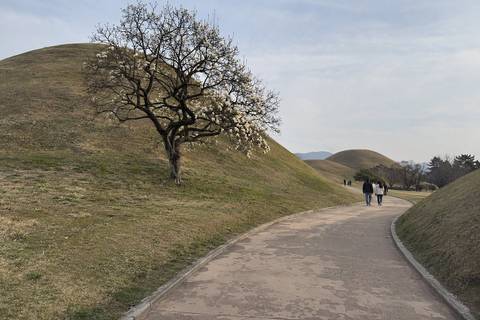
Daereungwon Tomb Complex
A park of huge grassy Silla burial mounds; inside Cheonmachong you can see how a royal tomb was built and what it held.
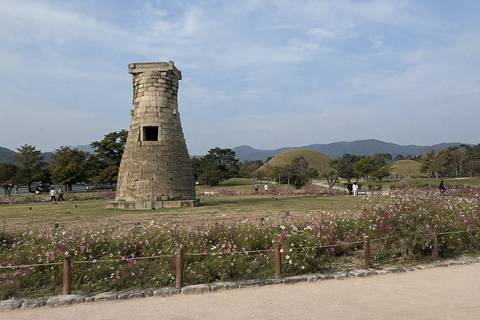
Cheomseongdae Observatory
A bottle-shaped stone tower from the 7th century, often called East Asia's oldest surviving observatory, set in open fields.
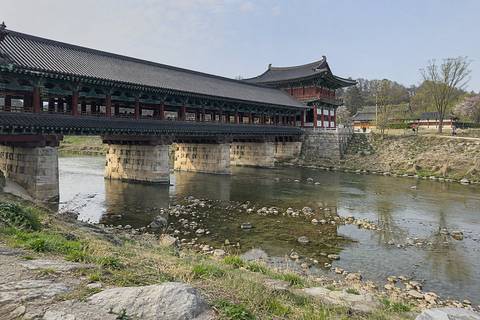
Gyochon Hanok Village
A small hanok village around the historic Choi family house, next to the rebuilt covered bridge of Woljeonggyo.
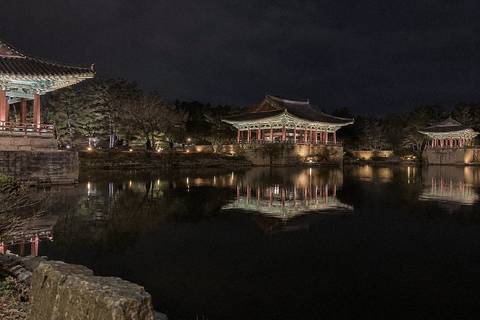
Donggung Palace and Wolji Pond
Reconstructed pavilions of a Silla crown prince's palace beside a landscaped pond, most popular after dark when they are lit up.
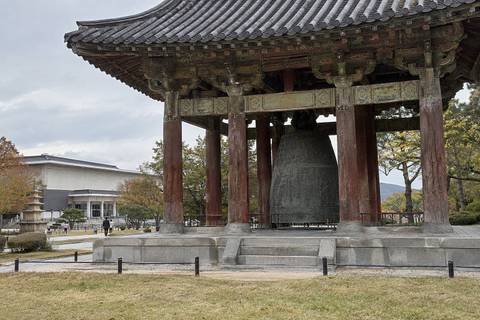
Gyeongju National Museum
Silla gold crowns, Buddhist sculpture and the great bronze Divine Bell of King Seongdeok; the best introduction to the city.
Frequently asked questions
What is Hwangnidan-gil?
A street in central Gyeongju lined with cafes, bakeries, restaurants and small shops, many in old tiled-roof houses. It runs along Poseok-ro from Naenam intersection to Hwangnam Elementary School intersection, plus the lanes of Hwangnam-dong and Sajeong-dong on both sides, right beside the Daereungwon tomb park.
What does the name Hwangnidan-gil mean?
It joins Hwangnam-dong, the neighbourhood, with Gyeongnidan-gil, a well-known cafe street in Seoul's Itaewon. So it means roughly 'the Gyeongnidan-gil of Hwangnam-dong'. 'Gil' means street or road.
Is Hwangnidan-gil free?
Yes. It is a public street with no gate or ticket. You pay only for what you buy. The paid sight next door is Cheonmachong, the tomb you can enter inside Daereungwon.
When is the best time to visit Hwangnidan-gil?
Late afternoon into early evening on a weekday. Shops set their own hours, so mornings can be quiet. Weekends and the autumn season bring heavy car traffic, so leave the car at the public car park or arrive by bus.
Where do you park for Hwangnidan-gil?
Gyeongju City points to the Hwangnidan-gil public car park (894 spaces, 30 Cheomseong-ro), opened in January 2026, and the paid Nodong public car park on Taejong-ro. The new car park was free in the first half of 2026 and is due to become paid; no fee had been published by 31 October 2026.
Sources
Facts on this page were checked against these sources on 31 October 2026. Prices, hours and rules change — confirm with the operator before you go.
- 경주문화관광 – 황리단길 (주소 포석로 1080; 내남사거리~황남초등학교 사거리, 황남동·사정동 일대; 주차: 노동공영주차장 유료, 황리단길 공영주차장 한시적 무료) (Korean) · official
- VisitKorea – 경주 황리단길 (황남동 + 경리단길, 1960~70년대 건물, 대릉원·첨성대 인근) (Korean) · official
- 경주시 웹진 아름다운 경주이야기 vol.167 – 황리단길 공영주차장 준공, 순환 노선 신설 (첨성로 30, 894면; 상반기 무료, 하반기 전문 운영; 월정1·2·3번, 10·11번) (Korean) · official
- 경주시 실시간 버스정보 – 60번 정류소 목록 (경주역(KTX) → 천마총후문.황리단길 17번째), 월정1·2·3번 노선·첫차·막차·배차간격, 정류소 좌표 (Korean) · official
- 경주시 교통정보센터 – 버스요금 안내 (시내버스 일반 1,500원) (Korean) · official
- 문화체육관광부 보도자료 (2025-11-27) – 올해 대한민국 관광을 빛낸 '한국 관광의 별' 10개 선정 (Korean) · official
- Korea JoongAng Daily (2025-11-30) – Gyeongju's Hwangnidan-gil among Korea Tourism Awards' tourist destinations of the year
- 아시아경제 (2026-01-16) – 경주 황리단길 공영주차장 준공…주차난 해소 본격화 (245억 원, 894면, 하반기 경주시설관리공단 이관 후 유료화 추진) (Korean)
- 경주 황남빵 – 공식 홈페이지 (Since 1939, 태종로 783) (Korean) · official