Gyeongju · Namsan and the Outskirts
Yangdong Village 경주 양동마을
A lived-in, UNESCO-listed Joseon clan village of tiled and thatched houses on wooded ridges; ₩4,000, bus 203 from the terminal.
Updated
Essentials
- Hours
- April–September: 09:00–19:00 (tickets sold until 18:00)
- October–March: 09:00–18:00 (tickets sold until 17:00)
- Closed
- Open every day; the village culture hall (문화관) closes on Mondays
- Admission
- Adults ₩4,000; middle and high school students and conscripts ₩2,000; elementary school children ₩1,500
- Free: 65 and over, children 7 and under with a guardian, visitors with a disability card
- Free for everyone on 1 January, Seollal, Jeongwol Daeboreum and Chuseok day
- Getting there
- Bus 203 (runs marked 양동마을경유) from the intercity bus terminal (시외버스터미널) to 양동민속마을, inside the village, 32nd stop; 06:20–20:15, every 70–105 min
- Buses 200, 201, 202, 205–208, 212 and 217 from the same terminal to 양동마을입구 (31st or 33rd stop), then a 1.2 km walk into the village
- No direct bus from Gyeongju Station (KTX): go into town to the bus terminal and change, or take a taxi
- Address
- 93 Yangdongmaeul-gil, Gangdong-myeon, Gyeongju, Gyeongsangbuk-do
경상북도 경주시 강동면 양동마을길 93 - Website
- yangdongvillage.or.kr/ko
Book your trip
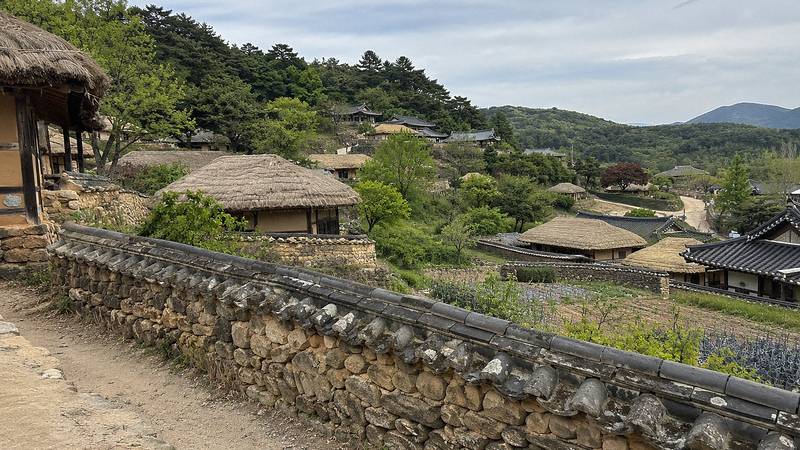
Yangdong Village is a lived-in Joseon-era clan village about 16 km northeast of central Gyeongju: some 150 old tiled and thatched houses spread over wooded ridges. With Hahoe in Andong, it was listed by UNESCO in 2010 as one of the Historic Villages of Korea. Entry is ₩4,000, and from October to March the village is open 09:00–18:00, with tickets sold until 17:00. Allow half a day from town. Bus 203 goes right into the village; the other 200-series buses drop you 1.2 km away.
| Your situation | Do this |
|---|---|
| One day in Gyeongju | Skip Yangdong; do Bulguksa, Seokguram and the tomb parks |
| A second day, and you like old houses | Bus 203 out in the morning, 2–3 hours in the village, back via Hwangnidan-gil |
| Short on time, want hanok in town | Walk Gyochon Hanok Village next to Cheomseongdae instead |
| Choosing between Yangdong and Hahoe | Yangdong if you are based in Gyeongju; Hahoe if you are going to Andong |
| Arriving by KTX | No direct bus: go to the bus terminal and change to the 203, or take a taxi |
| Visiting in winter | Buy your ticket by 17:00; the village closes at 18:00 |
Is Yangdong Village worth it?
It is worth half a day if you have more than one day in Gyeongju. Unlike the Silla sights in town, Yangdong is from the Joseon dynasty: it is a working village where descendants of two clans still live, not a museum. About 150 residents still live here and look after it (Newsis, July 2026).
It is less polished than a folk museum. Many houses are private and closed, paths are steep and unpaved in places, and the best houses sit on separate ridges, so you spend time walking between them. That is also its appeal: you see a real village spread over the land as it grew, rather than a single street.
With only one day in Gyeongju, it is a lower priority than Bulguksa, Seokguram and Daereungwon.
| Entry | ₩4,000 adults; free for 65+ and children 7 and under |
| Hours | 09:00–18:00 Oct–Mar, 09:00–19:00 Apr–Sep |
| Last ticket | 17:00 Oct–Mar, 18:00 Apr–Sep |
| Time needed | 2–3 hours in the village, half a day with the bus |
| Guided walk | Six a day, about 2 hours, no fee listed |
| Bus | 203 to 양동민속마을 from the intercity bus terminal |
Hours, fees and tour times from the official Yangdong Village site; checked 1 November 2026.
Hours, tickets and free days
The village is open every day:
- April to September: 09:00–19:00; tickets sold 09:00–18:00.
- October to March: 09:00–18:00; tickets sold 09:00–17:00.
The Yangdong Village Culture Hall (양동마을문화관) at the entrance has a free exhibition on the village and closes on Mondays. The village itself stays open.
| Ticket | Price |
|---|---|
| Adults (under 65) | ₩4,000 |
| Middle and high school students, conscripts | ₩2,000 |
| Elementary school children | ₩1,500 |
| 65 and over, children 7 and under with a guardian, disability card holders | Free |
- Free days. Entry is free for everyone on 1 January, on Seollal and Chuseok days, and on Jeongwol Daeboreum (the first full moon of the lunar year). On 25 September 2026, Chuseok day, the village opened free with traditional games, as Korean press reported. There are no guided walks on free days.
- Groups of 30 or more paying visitors get a discount (adults ₩3,400).
What to see
The village belongs to two clans, the Wolseong Son and the Yeogang Yi, who have lived here side by side since the early Joseon period. The yangban (gentry) families built their tiled houses on the ridges; thatched houses sit lower down. The Korea Heritage Service protects the whole village, almost 97 hectares, as National Folk Heritage (since 1984). Inside it, 3 buildings are Treasures and 12 more houses and pavilions are National Folk Heritage in their own right.
- Songcheom Jongtaek (송첨종택), also called Seobaekdang. The head house of the Son clan, built in 1459 by Son So. Two of the village’s famous sons were born here: Son Jung-don, an official remembered as incorruptible, and Son So’s grandson through his daughter, Yi Eon-jeok (1491–1553), one of the great Neo-Confucian scholars of the Joseon dynasty.
- Mucheomdang (무첨당). Part of Yi Eon-jeok’s family head house, from the mid-Joseon period (Treasure).
- Hyangdan (향단). A large house that Yi Eon-jeok built while he was governor of Gyeongsang Province, laid out for feng shui reasons in the shape of the Chinese character 用 (Treasure).
- Gwangajeong (관가정). The old home of Son Jung-don (1463–1529), (Treasure).
- Other old houses. Nakseondang (1540), Sujoldang (1616, built by Yi Eon-jeok’s fourth grandson) and Ihyangjeong (1695) are among the 12 National Folk Heritage houses and pavilions.
At designated houses, only the outer yards and buildings are open; the women’s quarters (안채) stay closed. All other houses are private homes. Do not walk through any gate unless it is marked as open to visitors.
Guided walks
Local guides lead free-to-join walks through the village at 10:00, 11:00, 13:00, 14:00, 15:00 and 16:00. Each takes about 2 hours, and the guide chooses the route.
- Where to join. At the guides’ house (해설사의 집) in front of the main gate of Yangdong Elementary School, at the entrance to the village. There is no booking: you join the next walk, and if a group has booked the same slot, you go along with them.
- Languages. The village lists Korean, English, Japanese and Chinese. To be sure of an English-speaking guide, call the guide team leader on 010-8960-4230 before you go.
- Fee. The village lists none.
Getting to Yangdong Village by bus
All buses to Yangdong start at the intercity bus terminal (시외버스터미널) in central Gyeongju.
| To | Bus | Stops | Times |
|---|---|---|---|
| 양동민속마을 (inside the village) | 203, runs marked 양동마을경유 | 32nd | 06:20–20:15, every 70–105 min |
| 양동마을입구 (main road, 1.2 km walk) | 200 | 33rd–35th | 06:35–19:50, every 50–130 min |
| 양동마을입구 | 201, 202, 205–208, 212, 217 | 31st on most runs | Every 2–4 h each |
Stop order, first and last departures and gaps from Gyeongju City’s live bus system, checked 1 November 2026.
- Which 203? Some 203 runs are marked 양동마을경유 and go into the village; the others stay on the main road and stop only at 양동마을입구. The live bus system does not say which departure is which, so check the sign on the front of the bus or ask the driver for 양동민속마을.
- Journey time. The village puts the ride at about 40 minutes and says one of the 200-series buses passes the 양동마을입구 stop about every 15 minutes.
- Back to town. Bus 203 heading back stops at 양동민속마을 (or 양동마을입구) and ends at the express and intercity bus terminals. On the way it stops at 서라벌사거리.황리단길, one stop before the terminal, which is handy for an evening on Hwangnidan-gil.
- From Gyeongju Station (KTX). No bus runs straight to Yangdong. Take a bus or taxi into town to the intercity bus terminal and change there, or take a taxi all the way.
- Fare. A city bus ride is ₩1,500, a little less with a transport card.
- Oksanseowon. Bus 203 continues beyond Yangdong to 옥산2리.옥산서원 and 옥산1리.독락당. Oksanseowon is the Confucian academy founded in 1572 to honour Yi Eon-jeok, a UNESCO site since 2019 as one of the Seowon, Korean Neo-Confucian academies. Dongnakdang next to it is the house where he lived after leaving office.
Staying overnight
Some houses take guests as homestays (민박). Each one is booked directly with the house, through the village site’s list of houses. Check-in is 14:00–22:00, check-out by 11:00. Cancelling the day before refunds 50%; same-day cancellations get nothing back.
The village also runs a one-night stay programme on weekends from May to October (none from the second week of July to late August). Places are limited and go first come, first served through a Korean online form. In 2026 it costs ₩10,000 per person with meals. For other ways to sleep in a traditional house, see hanok stays.
Tips
- Shoes. Paths between the ridges are partly steep and unpaved; wear proper shoes, especially after rain.
- Respect the residents. Keep your voice down, do not photograph people at home without asking, and take your rubbish with you. Bicycles and pets are not allowed in the village, and cooking, camping and smoking near the heritage buildings are banned.
- Go early or late. In summer, the open ridges have little shade; aim for the morning.
- Compare with town. For a quick look at hanok without leaving the centre, Gyochon Hanok Village is a short walk from Cheomseongdae. For all of Korea’s hanok villages, see hanok villages in Korea.
Around Yangdong Village
Yangdong is in the outskirts north of Gyeongju, on the way to Pohang. For other sights, trains and hotels, see the Gyeongju guide and the Gyeongsang region page. Yangdong and its partner village, Hahoe in Andong, are among Korea’s World Heritage sites.
Nearby
Gyochon Hanok Village
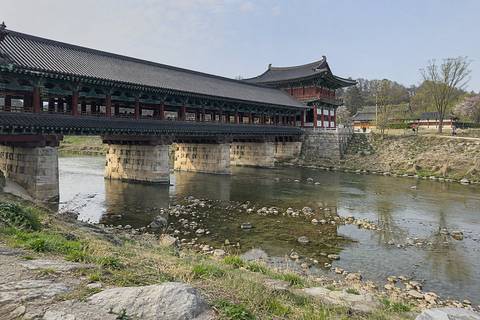
A small hanok village around the historic Choi family house, next to the rebuilt covered bridge of Woljeonggyo.
Hwangnidan-gil
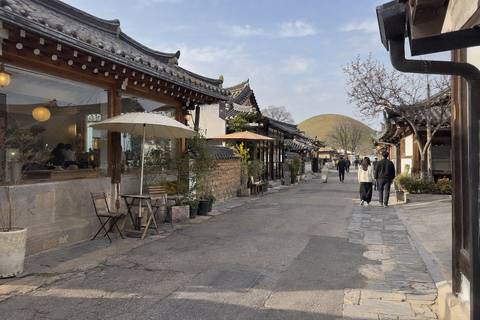
A street of hanok cafes, bakeries and small shops beside the tomb park, the liveliest part of town in the evening.
Daereungwon Tomb Complex
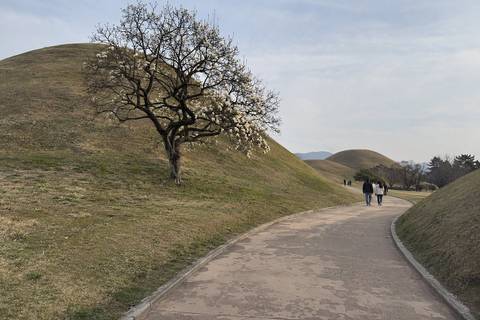
A park of huge grassy Silla burial mounds; inside Cheonmachong you can see how a royal tomb was built and what it held.
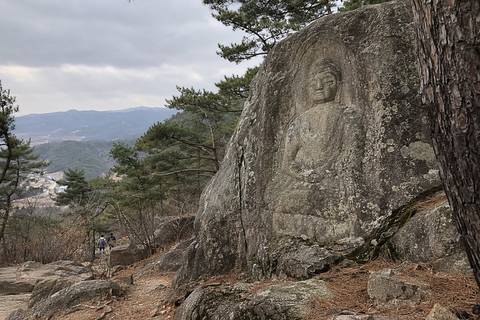
Gyeongju Namsan
A free UNESCO-listed mountain of Silla rock-carved Buddhas and pagodas; the Samneung trail climbs 2.1 km to the top (bus 500).
Frequently asked questions
Is Yangdong Village worth visiting?
Yes, if you have a second day in Gyeongju and want to see a real Joseon-era village where families still live. It is one of Korea's two UNESCO-listed historic villages, with 15th- and 16th-century yangban houses on the ridges and thatched houses below. With only one day in Gyeongju, the temples and tomb parks come first.
How much is the entrance fee for Yangdong Village?
₩4,000 for adults, ₩2,000 for middle and high school students and conscripts, and ₩1,500 for elementary school children. Visitors aged 65 and over and children 7 and under with a guardian go free, and so does everyone on New Year's Day, Seollal, Jeongwol Daeboreum and Chuseok day.
What are Yangdong Village's opening hours?
From April to September the village is open 09:00 to 19:00 and tickets are sold until 18:00. From October to March it is open 09:00 to 18:00, with tickets until 17:00. It is open every day; only the small culture hall closes on Mondays.
How do I get to Yangdong Village by bus?
From the intercity bus terminal in central Gyeongju, take bus 203 on a run marked 양동마을경유 to 양동민속마을, which stops inside the village. Other runs of the 203 and buses 200, 201, 202, 205 to 208, 212 and 217 stop at 양동마을입구 on the main road, 1.2 km from the village. There is no direct bus from the KTX station.
Is there an English tour of Yangdong Village?
The village runs walking tours with local guides six times a day, at 10:00, 11:00, 13:00, 14:00, 15:00 and 16:00, lasting about two hours. It lists English, Japanese and Chinese as well as Korean. Sign up at the guides' house by Yangdong Elementary School at the entrance; it is wise to call ahead (010-8960-4230) to ask about an English-speaking guide.
Sources
Facts on this page were checked against these sources on 1 November 2026. Prices, hours and rules change — confirm with the operator before you go.
- 양동마을 – 관람안내 (하절기 4~9월 매표 09:00~18:00·관람 09:00~19:00, 동절기 10~3월 매표 09:00~17:00·관람 09:00~18:00; 어른 4,000원, 청소년·군인 2,000원, 어린이 1,500원; 무료 대상; 일반가옥 비개방; 자전거·반려동물 금지; 문화관 무료, 월요일 휴관) (Korean) · official
- 양동마을 – 찾아오시는길 (시외버스터미널 → 양동마을입구 하차, 마을까지 1.2km 도보; 200·202~208·212번, 40분 소요; 양동마을길 93) (Korean) · official
- 양동마을 – 마을해설 운영안내 (10·11·13·14·15·16시, 약 2시간, 한국어·영어·일어·중국어; 양동초등학교 정문 앞 해설사의 집; 무료 관람일 1월 1일·설날·정월대보름·추석 당일) (Korean) · official
- 양동마을 – 일반현황 (총 150여 호의 고가옥과 초가집) (Korean) · official
- 양동마을 – 민박 이용안내 (각 가옥에 직접 예약; 입실 14:00~22:00, 퇴실 11:00; 1일 전 취소 50% 환불, 당일 환불 불가) (Korean) · official
- 양동마을 – 1박2일 숙박체험 (5~10월 주말, 7월 둘째 주~8월 말 미운영; 2026년부터 1인당 10,000원, 식사 포함; 네이버 폼 선착순) (Korean) · official
- 국가유산청 – 경주 양동마을 (국가민속문화유산, 1984.12.24 지정; 월성 손씨·여강 이씨 동족마을; 969,115㎡) (Korean) · official
- 국가유산청 – 경주 양동마을 송첨종택 (손소가 1459년에 지은 집; 손중돈·이언적 출생) (Korean) · official
- 국가유산청 – 국가유산 검색: 양동 (보물 무첨당·향단·관가정; 국가민속문화유산 고택·정자 12곳) (Korean) · official
- 경주시 실시간 버스정보 – 200~217번 노선 정류소 순서, 203번 양동마을경유 (양동민속마을), 첫차·막차, 배차간격 (Korean) · official
- 뉴시스 – '박제되지 않은 유산'… 오늘을 사는 경주 양동마을·옥산서원 (2010.7.31 세계유산 등재; 2013년부터 관람료; 주민 150명 정도) (2026-07-18) (Korean)
- 경향신문 – 하회마을·양동마을·소수서원 추석 당일 무료 (2026-09-24) (Korean)