Ulsan · Ulju county
Petroglyphs along the Bangucheon Stream (Bangudae) 반구천의 암각화
Prehistoric carvings of whales and hunters on stream cliffs, a UNESCO World Heritage Site since 2025; free, with a free shuttle.
Updated
Essentials
- Hours
- Viewing areas: open-air; Korea Tourism data lists them as open at all times. Go in daylight.
- Ulsan Petroglyph Museum: 09:00–18:00, last entry 17:30
- Free shuttle: Wednesday–Sunday, eight loops from the car park, first 09:50, last 17:50
- Closed
- The museum closes on Mondays; when a Monday is a public holiday it opens and closes on the next weekday instead. The shuttle does not run on Mondays or Tuesdays.
- Admission
- Free: museum, shuttle and the viewing areas
- Close-up guided walk to Bangudae (반구천을 누비다): free, booking needed; February–June and September–November
- Getting there
- Bus 383 from KTX Ulsan Station: departs 10:55, 13:35 and 18:25; about 35 minutes to the museum
- Back from the museum stop toward Ulsan Station: 12:05, 14:50 and 19:30
- Taxi from Ulsan Station if your times do not fit the bus
- Free loop shuttle (Wed–Sun) links the car park, museum, Bangudae path, Ulsan Daegok Museum and the Cheonjeon-ri entrance
- Address
- 254 Bangudaean-gil, Dudong-myeon, Ulju-gun, Ulsan (Ulsan Petroglyph Museum)
울산광역시 울주군 두동면 반구대안길 254 - Website
- ulsan.go.kr/s/bangudae/main.ulsan
Book your trip
The Bangudae petroglyphs are free but you see them from across the stream, not up close, and the museum closes on Mondays. Bus 383 from KTX Ulsan Station runs only three times a day, so plan around the 10:55 departure, then use the free shuttle (Wednesday to Sunday). Allow three to four hours for the museum and both carved cliffs.
| Your situation | Do this |
|---|---|
| Arriving by KTX at Ulsan Station | Catch bus 383 at 10:55 (museum about 11:30) and the 14:50 bus back, or take a taxi both ways |
| Visiting on a Monday | The museum is shut and the shuttle does not run; do central Ulsan instead |
| Visiting on a Tuesday | The museum is open but there is no shuttle; walk to the carvings or use a taxi |
| Want to see the whale carvings clearly | Book the free close-up walk (Feb–Jun, Sep–Nov) on 052-229-4794, or come for the 15:00–17:00 sun from March to October |
| Visiting after heavy summer rain | Check the Sayeon dam level first; above 52.99 m the carvings start to go under water |
| Travelling with a wheelchair or pushchair | Borrow one free at the museum desk; the path to the Bangudae deck is long and has no toilet near the end |
Ulsan Petroglyph Museum pages and the 2026 shuttle timetable, checked 11 November 2026.
Is it worth the trip?
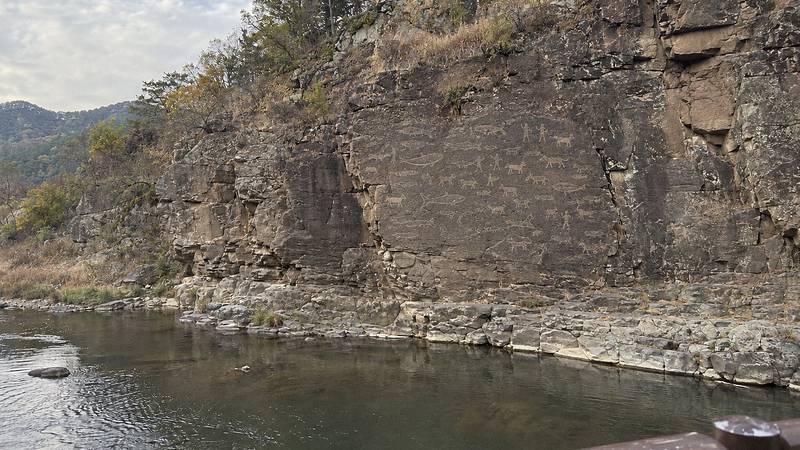
Yes, if you are interested in prehistory or are working through Korea’s UNESCO list: few rock-art sites anywhere show whales and the stages of a whale hunt, and this is the reason the valley was listed. Be realistic about the view. From the public deck the main panel is a pale rock face across the water, and even with the telescopes the figures are faint unless the sun is on them. A visitor quoted in Korean press in July 2026 said exactly that.
The visit improves a lot if you can do one of two things. Join the museum’s free close-up guided walk, which takes small groups to the foot of the Bangudae rock. Or time your visit for the hours when sunlight falls across the carvings and the lines stand out (see below).
If you have only one day in Ulsan and want scenery, the Taehwagang National Garden and Daewangam Park are easier to reach and more rewarding. The petroglyphs fit best on the day you arrive at or leave from the KTX station, which is in the same western part of the city.
What the petroglyphs are
The Petroglyphs along the Bangucheon Stream were inscribed as a UNESCO World Heritage Site on 12 July 2025. Two rock faces, about 2.3 km apart along a winding stream in sedimentary cliffs, carry carvings made over thousands of years, from around 5000 BC to the 9th century AD.
Daegok-ri (Bangudae). A main panel about 4.5 m high and 8 m wide, plus the rock around it, holds 312 recorded figures, generally dated to the Neolithic. There are 69 sea animals (56 of them whales, plus turtles, fish and seals), 108 land animals such as deer, boar, tigers and wolves, 16 human figures and 22 tools. More than 50 whales of at least seven species can be told apart, among them right whales, humpbacks and grey whales, by the shape of their blows, heads and flippers. Boats, harpoons, floats and nets show whale hunting step by step. The rock was found in December 1971 and became a National Treasure in 1995.
Cheonjeon-ri. About 1.4 km up the valley from the Bangudae terrace, a rock face about 9.5 m wide leans forward at roughly 25 degrees, which has sheltered it from rain. On the left are animals and a hunter with a bow, thought to be Neolithic; above them are diamonds and circles from the Bronze Age; across the face are fine-line drawings of people, boats, dragons and processions scratched with metal tools in the Silla period. Inscriptions record a visit in 525 by Galmunwang Sabuji, a younger brother of King Beopheung, who named the place “Valley of Written Stones”, and a second visit in 539 by his widow and their son, the future King Jinheung. The opposite bank has about 130 dinosaur footprints from the Early Cretaceous.
The Ulsan Petroglyph Museum
Start here. The free museum at the entrance to the valley has full-size replicas of both panels, so you can see every figure clearly before trying to find them on the real rock. It is open 09:00–18:00, with last entry at 17:30, and closes on Mondays (when Monday is a public holiday, it opens and closes on the next weekday instead). The museum lends wheelchairs and pushchairs free at the desk.
There is no shop, café or restaurant at the museum. You may eat a packed lunch at the outdoor tables, but there is nothing to buy near the carvings either, so bring water.
Getting there
By bus 383 from KTX Ulsan Station. This is the only city bus that runs to the museum door, and only three times a day.
| Bus 383 | Departs | Arrives at the museum |
|---|---|---|
| Ulsan Station → museum | 10:55, 13:35, 18:25 | about 11:30, 14:10, 19:00 |
| Museum → Ulsan Station | 12:05, 14:50, 19:30 | — |
Ulsan Petroglyph Museum directions page, checked 11 November 2026; times can change with traffic. The workable pattern is the 10:55 out and the 14:50 or 19:30 back. The 18:25 arrives after the museum closes.
By taxi. If you are changing trains at Ulsan Station, a taxi there and back is the practical choice. The museum gives no fare.
By car. Leave the Gyeongbu Expressway at Seoulsan (West Ulsan) IC and follow Route 35 toward Gyeongju to the petroglyph turn-off. Large coaches may not park at the museum and use the public car park about 1.3 km back toward the main road.
From central Ulsan, Busan or Gyeongju. Go to Ulsan Station first (see the Ulsan guide for limousine buses 5001 and 5003 and Donghae line trains), then take bus 383 or a taxi. A visitor quoted in Korean press in July 2026 instead took bus 313 to the Guryangcheonjeon stop on the main road and changed to the free shuttle there; check Naver Map or KakaoMap for that route.
The free shuttle
Since April 2026 a free loop bus runs Wednesday to Sunday, eight times a day, from the Bangudae petroglyph car park. Each loop takes 50 minutes.
| Stop | Times (every hour, no 11:50 run) |
|---|---|
| Car park (start) | 09:50, 10:50, 12:50, 13:50, 14:50, 15:50, 16:50, 17:50 |
| Petroglyph Museum | 5 minutes later |
| Public toilet stop | 10 minutes later |
| Museum, car park, Bangudae Entrance and Guryangcheonjeon bus stops | 15–28 minutes later |
| Ulsan Daegok Museum | 32 minutes later |
| Cheonjeon-ri entrance | 35 minutes later |
| Back at the car park | 50 minutes later |
Official 2026 shuttle timetable posted by the museum, checked 11 November 2026. The last loop leaves the car park at 17:50 and passes the Cheonjeon-ri entrance at 18:25. With one bus an hour, note the next time before you walk off. Korean press reported in July 2026 that most visitors still arrive by car and the shuttle runs nearly empty on weekdays.
Seeing the carvings
Bangudae. From the museum a path follows the stream toward the Bangudae terrace and a viewing deck facing the main panel across the water. Fixed telescopes on the deck help; in July 2026 Ulju County added four “XR” telescopes with 100× zoom and commentary in four languages. The toilet near the deck was removed in May 2026. The nearest one is about 700 m, or roughly 15 minutes’ walk, back along the path (Korean press).
Cheonjeon-ri. Upstream, past the Ulsan Daegok Museum, the shuttle stops at the entrance to the Cheonjeon-ri rock. Korean press notes there is no space there for coaches to park or turn, so the shuttle or a car is the way in.
When the light is right. The carvings are shallow, so the sun’s angle decides what you see. The museum’s guidance:
- Bangudae: about 15:00–17:00 from March to October.
- Cheonjeon-ri: about 09:00–12:00 from March to November; in other months the sun reaches it only briefly, around 12:00–13:00.
In winter, then, a morning Cheonjeon-ri and early-afternoon museum visit gives the best chance of seeing detail.
When the water is high. The Bangudae panel sits beside the Sayeon Dam reservoir. The water is held at 48 m above sea level so the rock stays dry, but after heavy summer rain the reservoir cannot drain fast enough and the panel is often under water for one to two months. Figures start to go under at 52.99 m and are fully covered at 56.71 m. To check, open the national disaster safety portal (safekorea.go.kr), go to dam water levels and search for 사연 (Sayeon).
Around the petroglyphs
On the way back toward Ulsan Station, Eonyang is known for thin, grilled Eonyang bulgogi (see the Ulsan food section). The Taehwagang National Garden and its bamboo forest are in the city centre, with the sea cliffs of Daewangam Park beyond. Gyeongju is the natural next stop north. The Bangucheon valley joined Korea’s other World Heritage Sites listed on the UNESCO sites in Korea page; the Gyeongsang region guide covers the cities around it.
Nearby
Ulsan Petroglyph Museum
Free museum at the petroglyph valley with full-size replicas of the carved panels; closed Mondays.
Taehwagang National Garden
Korea's second national garden: 83 ha of themed gardens on both banks of the Taehwa river; free and open at all hours.
Ganjeolgot
Free south-coast cape with a 1920 lighthouse and a working giant postbox; sunrise about 07:31 on 1 Jan 2027; bus 1715.
Frequently asked questions
Can you see the Bangudae petroglyphs up close?
Not on your own. The public viewing deck is across the stream, and the carvings are hard to make out without the fixed telescopes. The museum's free 70-minute guided walk, 반구천을 누비다, takes groups close to the rock from February to June and September to November; book on 052-229-4794 or at the museum desk.
Are the Bangudae petroglyphs under water?
Usually not. The Sayeon Dam is kept at 48 m, below the carvings, but after heavy summer rain the panel can be submerged for one to two months. Drawings start to go under at 52.99 m and are fully covered at 56.71 m. Check the live Sayeon dam level on the national safety portal before going in summer or early autumn.
How do you get to the Bangudae petroglyphs from Ulsan Station?
Bus 383 leaves KTX Ulsan Station at 10:55, 13:35 and 18:25 and reaches the Ulsan Petroglyph Museum about 35 minutes later. It returns from the museum at 12:05, 14:50 and 19:30. From Wednesday to Sunday a free shuttle then loops to the carvings; otherwise walk or take a taxi.
When is the best time to see the carvings?
Bangudae shows its figures best in direct sun, from about 15:00 to 17:00 between March and October. Cheonjeon-ri is clearest from about 09:00 to 12:00 between March and November; outside those months the sun reaches it only briefly around midday.
Is it worth visiting the petroglyphs?
Yes if you care about prehistory or are collecting Korea's UNESCO sites, and especially if you can join the close-up walk. If you only want views, the Taehwagang bamboo garden and Daewangam's coast in central Ulsan are easier and more photogenic; the carvings are faint from the public deck.
Sources
Facts on this page were checked against these sources on 11 November 2026. Prices, hours and rules change — confirm with the operator before you go.
- 울산암각화박물관 – 자주하는 질문 (관람시간 09:00–18:00, 17:30 입장 마감, 월요일 휴관, 입장료 없음, 매점 없음, 휠체어·유아차 대여) (Korean) · official
- 울산암각화박물관 – 찾아오시는 길 (383번 버스 울산역 출발 10:55·13:35·18:25, 박물관 도착·출발 시간) (Korean) · official
- 울산암각화박물관 – 대형버스 주차 불가 및 공영주차장 무료 셔틀버스 안내, 무료순환버스 시간표 (2026-05-06) (Korean) · official
- 울산암각화박물관 – 반구천을 누비다 (2~6월·9~11월, 화~금 15:00, 토·일 10:30·15:00, 약 70분, 무료, 전화·현장 예약) (Korean) · official
- 울산암각화박물관 – 대곡리 반구대 암각화 근접 관람 사진 (2026-04-17) (Korean) · official
- 울산암각화박물관 – 사연댐 수위 확인 방법 (EL 48.0m 유지, 52.99m 침수 시작, 56.71m 완전 침수) (Korean) · official
- 울산암각화박물관 – 암각화 현장 문양 관찰 가능 시간 안내 (Korean) · official
- 울산암각화박물관 – 대곡리 반구대 암각화 (국보, 312점, 고래 50마리 이상·최소 7종, 2025년 7월 세계유산) (Korean) · official
- 울산암각화박물관 – 천전리 명문과 암각화 (국보, 525년·539년 명문, 대곡리에서 약 2.3 km) (Korean) · official
- 울산 반구천의 암각화 – 세계유산적 가치 (약 3 km, 기원전 5,000년–기원후 9세기) (Korean) · official
- 울산 반구천의 암각화 – 반구천 일원 (집청정, 반구서원, 천전리 공룡발자국 화석) (Korean) · official
- Petroglyphs along the Bangucheon Stream inscribed on the UNESCO World Heritage List (Ministry of Foreign Affairs) · official
- K-Trip Tips (Korea Tourism data) – Petroglyphs of Bangudae Terrace in Daegok-ri: open all year, 24 hours, UNESCO 12 July 2025
- Asia Economy – Ulsan City to launch shuttle bus service for Bangucheon rock engravings (from 24 April 2026, Wed–Sun, 8 runs)
- 울산매일UTV – 세계유산 1주년 반구천의 암각화 현장 (전망대 인근 화장실 철거, 약 700m, XR 망원경 4대, 순환버스, 2026-07-12) (Korean)