Pyeongchang · Jinbu and Odaesan
Odaesan National Park 오대산국립공원
Five peaks led by Birobong (1,563 m), old fir forest and the temples of Woljeongsa and Sangwonsa; autumn colour peaks in mid-October.
Updated
Essentials
- Hours
- Sangwon centre (to Bukdae) and Jeokmyeol Bogung post (to Birobong): enter 05:00–15:00 (Nov–Mar), 04:00–16:00 (Apr–Oct)
- Jingogae centre → Noinbong: 05:00–14:00 (Nov–Mar), 04:00–15:00 (Apr–Oct)
- Guryong Falls post (Sogeumgang) → Noinbong: 05:00–13:00 (Nov–Mar), 04:00–14:00 (Apr–Oct)
- Dongpigol and Jingogae → Dongdaesan: 05:00–15:30 and 05:00–15:00 (Nov–Mar), 04:00–16:00 (Apr–Oct)
- Closed
- Autumn fire-prevention closure from 15 November to 15 December 2026: Birobong, Sangwangbong, Durobong, Dongdaesan, Noinbong and Gyebangsan are all shut. Open: Seonjae-gil (Haetalgyo–Sangwonsa, 10 km), Sangwonsa–Jeokmyeol Bogung (2 km) and Sangwonsa–Jungdae (Sajaam), the Woljeongsa fir forest, and Sogeumgang from Mureunggye to Guryong Falls. Any trail can close at short notice in snow, heavy rain or other weather warnings.
- Admission
- Park entry: free (no admission at Woljeongsa, Sangwonsa or Sogeumgang)
- Sogeumgang car park: small cars ₩4,000 weekdays, ₩5,000 at weekends, holidays and peak periods; large vehicles ₩6,000 / ₩7,500
- Woljeongsa temple car park: ₩3,000 for cars under 1,000 cc and electric cars, ₩6,000 for other cars
- Jinbu county buses to Woljeongsa and Sangwonsa: ₩1,000 adults
- Getting there
- Woljeongsa and Sangwonsa: county bus 226 from Jinbu bus terminal (225 for the first run, Woljeongsa only); about 20 min and ₩1,000 to Woljeongsa
- Jinbu (Odaesan) KTX Station from Seoul or Cheongnyangni: about 1 h 20 min, then taxi about 15 min to Woljeongsa
- Sogeumgang (Gangneung side): Gangneung city bus 302, 314 or 315 to Yeongok-myeon office, then village bus 921-1 or 922 to Sogeumgang
- Jingogae (for Noinbong): no bus; taxi from Jinbu terminal
- Address
- 2 Odaesan-ro, Jinbu-myeon, Pyeongchang-gun, Gangwon (park office)
강원특별자치도 평창군 진부면 오대산로 2 - Website
- knps.or.kr/front/portal/visit/visitCourseMain.do?parkId=120900&menuNo=7020094
Book your trip
Odaesan National Park is free to enter. Most visitors come for the gentle valley around Woljeongsa and Sangwonsa, about 20 minutes by county bus from Jinbu, the Pyeongchang town with the KTX station. The easy walks there are the riverside Seonjae-gil (9 km) and the 2 km path to the Jeokmyeol Bogung relic shrine. The summit, Birobong (1,563 m), is a 3–3½-hour return hike from Sangwonsa. From 15 November to 15 December 2026, Birobong and every other peak are closed for wildfire prevention; the valley walks stay open.
| Your situation | Do this |
|---|---|
| Not a hiker, half a day | Walk the 1 km fir avenue to Woljeongsa, then take the bus up to Sangwonsa |
| One easy, flat walk | Seonjae-gil from Sangwonsa down to Woljeongsa: 9 km, about 3½ h, mostly level |
| A short climb with a view of the temples | Sangwonsa → Jungdae (Sajaam) → Jeokmyeol Bogung: about 1½ h there and back from the car park |
| Want a summit (outside the closure) | Birobong from Sangwonsa: 6.8 km return, 3 h 10 min – 3 h 30 min; enter by 15:00 in winter |
| Here 15 November – 15 December 2026 | Peaks closed; do Seonjae-gil, Jeokmyeol Bogung, or Sogeumgang as far as Guryong Falls |
| Based in Gangneung | Sogeumgang valley: waterfalls and granite gorges, 2.5 km to Guryong Falls |
Is Odaesan worth it?
Yes, especially if you are already in Pyeongchang for the snow or in Gangneung by the sea. Odaesan is a soft, heavily forested mountain park, not a rocky one like Seoraksan. Its appeal is old fir and oak forest, clear streams and some of Korea’s most important Buddhist sites, linked by easy paths.
The park has three parts. The Odaesan district north of Jinbu holds the temples, the Seonjae-gil and the five peaks. The Sogeumgang district to the east, on the Gangneung side, is a granite gorge of waterfalls below Noinbong. Gyebangsan to the west, added in 2011, is the park’s highest peak at 1,577 m.
| Admission | Free |
| Main entrances | Woljeongsa and Sangwonsa (Jinbu, Pyeongchang); Sogeumgang (Gangneung) |
| Highest peaks | Gyebangsan 1,577 m, Birobong 1,563 m, Horyeongbong 1,561 m |
| Autumn 2026 closure | 15 Nov – 15 Dec: all peaks and ridge routes |
| Time to allow | Half a day for the temples; a full day for Birobong or the Seonjae-gil |
| Best for | Forest walks, temples, autumn colour, snow scenery |
Closures, trail times and entry hours from the Korea National Park Service’s Odaesan pages and notices; checked 16 November 2026.
The park became Korea’s 11th national park on 1 February 1975 and covers about 328 km². Sogeumgang was named the country’s first scenic site in November 1970, before the park existed. The Odaesan wetland is a Ramsar site (2008), and the park has been on the IUCN Green List since 2014.
What is open from 15 November to 15 December 2026
Korea’s national parks close their high, fire-prone trails each autumn. Odaesan’s 2026 closure runs from 15 November to 15 December. The park’s closure map shows these routes open:
- Seonjae-gil: Haetalgyo bridge to Sangwonsa, 10 km, plus the Woljeongsa fir forest
- Sangwonsa → Jeokmyeol Bogung, 2 km, and the path to Jungdae (Sajaam) hermitage
- Sogeumgang: Mureunggye entrance to Guryong Falls, 2.5 km
Everything else is closed, including Birobong, the Sangwangbong loop, Durobong and Dongdaesan from Jingogae, Noinbong from either side, and Gyebangsan. Entering a closed trail is fined under the Natural Parks Act. Weather warnings can close any trail at short notice; the park’s live closure page is in Korean. The high routes reopen on 16 December until the spring closure, whose 2027 dates had not been announced on 16 November 2026. See national parks for how the closures work.
Easy walks: Seonjae-gil, the fir forest and Jeokmyeol Bogung
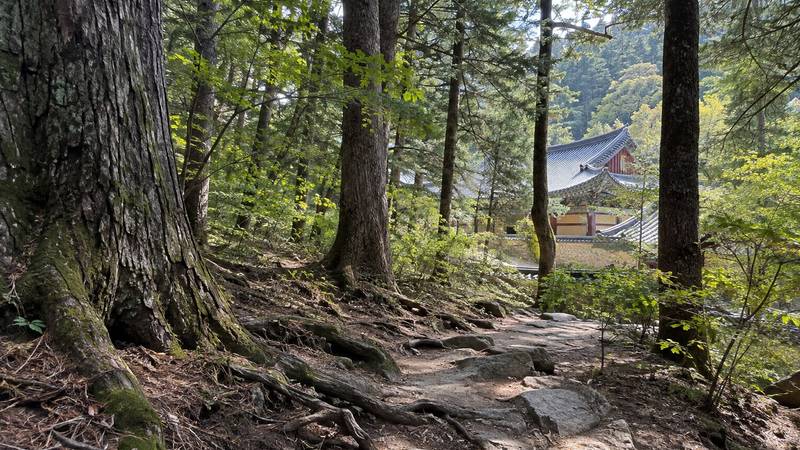
Seonjae-gil is the old path monks and pilgrims used between the two temples before the road was built in the late 1960s. It follows the Odaecheon stream under tall oaks and maples, with wooden decks and bridges. The park service gives it in two sections:
| Section | Distance | Time | Notes |
|---|---|---|---|
| Woljeongsa (One-Pillar Gate) → Dongpigol | 5.4 km | 2 h 10 min | Mostly level forest path |
| Dongpigol → Sangwonsa | 3.6 km | 1 h 20 min | Past a native-plant garden, briefly on the gravel road |
| Fir forest (One-Pillar Gate → Woljeongsa) | about 1 km | – | Flat avenue of old firs; see the Woljeongsa guide |
The common plan is to ride bus 226 up to Sangwonsa and walk down, so the walk ends near Woljeongsa and the buses back to Jinbu. Snow lingers on the shaded path, and the park says crampons and gaiters may be needed as late as April. After heavy summer rain the stream can flood the path; the park asks walkers to phone first (033-332-6417).
Jeokmyeol Bogung is a shrine said to hold relics of the Buddha. From the Sangwonsa car park, the path climbs gently past Sangwonsa, home of Korea’s oldest bronze bell, to Jungdae (Sajaam) in 1.3 km and about 30 minutes, then on to the shrine. The park service puts the round trip at about 1½ hours.
Climbing Birobong and the Sangwangbong loop
Birobong is the park’s best-known summit and the usual first climb. All three routes below are closed from 15 November to 15 December 2026. Times are from the park service:
| Route | Distance | Time | What it is like |
|---|---|---|---|
| Birobong from Sangwonsa, return | 6.8 km | 3 h 10 min – 3 h 30 min | Gentle to Jeokmyeol Bogung, then a steep stair for the last 400 m |
| Sangwangbong loop via Birobong, Durryeong and Bukdae | about 14 km | 5 h 20 min – 6 h | Easy ridge, long walk out on an old forest road |
| Durobong from Jingogae via Dongdaesan | 10 km one way | 4 h 40 min – 5 h, about 7 h back to Sangwonsa | The park’s hardest route; few hikers, deep snow in winter |
From Birobong the ridge to Sangwangbong (1,491 m) is 2.3 km and nearly level, past a stand of yew trees more than 300 years old. The descent from Durryeong to the Sangwonsa car park follows a former road, with deep drifts in winter.
Entry hours. Each trailhead stops letting hikers in at a set time:
| Start | Toward | Nov–Mar | Apr–Oct |
|---|---|---|---|
| Sangwon centre (Sangwonsa) | Bukdae | 05:00–15:00 | 04:00–16:00 |
| Jeokmyeol Bogung post | Birobong | 05:00–15:00 | 04:00–16:00 |
| Jingogae centre | Noinbong | 05:00–14:00 | 04:00–15:00 |
| Jingogae | Dongdaesan | 05:00–15:00 | 04:00–16:00 |
| Dongpigol | Dongdaesan | 05:00–15:30 | 04:00–16:00 |
| Guryong Falls post (Sogeumgang) | Noinbong | 05:00–13:00 | 04:00–14:00 |
There is no bookable mountain shelter at Odaesan, only an unstaffed emergency hut below Noinbong where cooking is not allowed. Plan every route as a day hike. See hiking in Korea for gear and etiquette.
Sogeumgang and Noinbong
Sogeumgang means “little Geumgang”, after the famous granite mountains in North Korea. Unlike the soft, earthy Odaesan district, it is a rocky gorge of pools and falls on the Gangneung side of the park.
| Section | Distance | Time | Notes |
|---|---|---|---|
| Mureunggye → Guryong Falls | 2.5 km | 1 h | Gentle climb past Sipjaso pools and Sikdangam rock; open during the closure |
| Guryong Falls → Baegundae | 1.7 km | 1 h | Metal stairs and bridges past Manmulsang (about 30 min from the falls) |
| Baegundae → Noinbong | 5.2 km | 3 h 20 min | Rocky and slippery, with ropes and rails |
| Noinbong → Jingogae | 3.9 km | 1 h 40 min | Long descent on steps |
The full traverse from Jingogae over Noinbong (1,338 m) down to Sogeumgang is 13.3 km and 7–8 hours. The park service says more than 70% of the park’s accidents happen on this course and advises beginners not to attempt it. For most visitors the walk to Guryong Falls and back, about 2 hours, is the right choice. In winter, entry from the Guryong Falls post toward Noinbong stops at 13:00.
Getting there
- Woljeongsa and Sangwonsa. From Jinbu bus terminal, county bus 226 runs up the valley past Woljeongsa to Sangwonsa; the first run of the day (07:50) is a 225 that stops at Woljeongsa. By the county timetable, departures from Jinbu are 07:50, 09:05, 10:00, 11:00, 12:00, 13:10, 14:50, 15:40, 17:00 and 17:30. Woljeongsa is about 20 minutes and ₩1,000 by bus, or 15 minutes and about ₩18,000 by taxi. Get off at the Sangwon information centre for Birobong and Jeokmyeol Bogung. Check the last bus down before you set off.
- From Seoul. KTX trains from Seoul and Cheongnyangni reach Jinbu (Odaesan) Station in about 1 h 20 min. Few buses link the station with the town terminal, so take a taxi. Intercity buses from Dong Seoul run to Jinbu terminal. See getting to Pyeongchang.
- Sogeumgang. From Gangneung, take city bus 302, 314 or 315 toward Yeongok to the Yeongok-myeon office, then village bus 921-1 or 922 to Sogeumgang. The park service gives about 4 hours from Dong Seoul by this route and asks you to check timetables, which are sparse.
- Jingogae. There is no bus to this pass, the start for Noinbong and Dongdaesan; the park service suggests a taxi from Jinbu terminal.
When to go
October is the high season for autumn colour, first on the ridges and then down the Seonjae-gil valley. It is also when the car parks fill. Winter turns the fir forest and Seonjae-gil white, and the high routes reopen after 15 December, but you will need crampons, warm layers and an early start. Pyeongchang’s ski resorts are nearby; see Korea in winter. Spring brings fresh green and another closure of the high trails, and summer is cool in the forest but brings heavy rain.
Around Odaesan
Combine the park with the fir forest and the two museums at Woljeongsa, or with the Balwangsan Cable Car at Mona Yongpyong, about 20 minutes from Jinbu. For the rest of the county, see the Pyeongchang guide; for the coast and Sogeumgang, Gangneung; and for the province, the Gangwon region guide. Temple etiquette is covered on Korean temples.
Nearby
Woljeongsa Temple
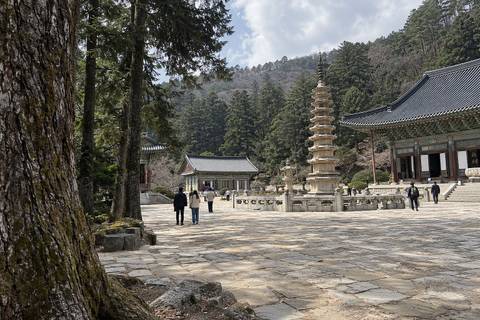
A great Odaesan temple founded in 643, approached through a 1 km avenue of old firs; free entry, with a nine-storey stone pagoda.
Sangwonsa Temple
A small mountain temple deep in Odaesan, home to Korea's oldest bronze bell (725), and the start of the walk to Jeokmyeol Bogung.
Pyeongchang Trout Festival
Ice and indoor trout fishing on the Odaecheon stream in Jinbu; it ran 9 January–9 February in 2026, with 2027 dates not yet announced.
Mona Yongpyong
Korea's best-known ski resort: 28 slopes, 14 lifts; opens 22 November 2026. KTX to Jinbu, then about 20 min by taxi.
Frequently asked questions
Is Odaesan open in November and December?
Partly. From 15 November to 15 December 2026 the park closes its high trails for the wildfire season, including Birobong and Noinbong. The Seonjae-gil between Woljeongsa and Sangwonsa, the 2 km path from Sangwonsa to Jeokmyeol Bogung, the Woljeongsa fir forest and the Sogeumgang valley as far as Guryong Falls stay open.
What is the easiest way to climb Birobong?
Start at the Sangwonsa car park and walk up past Sangwonsa, Jungdae (Sajaam) and Jeokmyeol Bogung. The park service puts the return trip at 6.8 km and 3 h 10 min to 3 h 30 min. Most of it is gentle; the last 400 m before the 1,563 m summit is a steep staircase. The summit is closed from 15 November to 15 December 2026.
Is there an entrance fee for Odaesan National Park?
No. Korean national parks charge no admission, and Woljeongsa stopped charging its heritage fee in May 2023. You pay only for parking: for example ₩4,000–5,000 for a small car at Sogeumgang, and ₩3,000–6,000 at the Woljeongsa temple car park.
Can I visit Odaesan as a day trip from Seoul?
Yes. Take the KTX to Jinbu (Odaesan), about 1 h 20 min, then a taxi of about 15 minutes or the county bus from Jinbu terminal to Woljeongsa and Sangwonsa. That is enough for the fir forest plus Jeokmyeol Bogung, or for Birobong outside the closure. Sogeumgang is a separate trip from Gangneung.
Do I need crampons on Odaesan in winter?
Usually, yes. The park service says snow lies long on the shaded Seonjae-gil and that winter gear (crampons and gaiters) is needed as late as April. The Sogeumgang climb to Noinbong has many metal stairs and bridges that ice over, and accounts for most of the park's accidents.
Sources
Facts on this page were checked against these sources on 16 November 2026. Prices, hours and rules change — confirm with the operator before you go.
- 국립공원공단 오대산 – 가을철 산불조심기간에 따른 탐방로 부분통제 공고 (2026-11-02; 통제 11.15.~12.15.; 개방: 상원사~적멸보궁 2km, 해탈교~상원사 10km 선재길 포함; 자연공원법 제28·86조 과태료) (Korean) · official
- 국립공원공단 오대산 – 산불조심기간 탐방로 통제 안내도 (첨부, 2026-11-09; 개방·통제 구간과 구간별 거리·시간) (Korean) · official
- 국립공원공단 – 오대산국립공원 (1975년 11번째 국립공원, 327.904㎢, 비로봉 1,563m 등 봉우리 높이) (Korean) · official
- 국립공원공단 – 오대산 공원안내·연혁 (1970.11.23. 소금강 명승 제1호, 1975.02.01. 지정, 2011 계방산 편입) 및 요금안내 (소금강주차장 4,000/5,000원·대형 6,000/7,500원) (Korean) · official
- 국립공원공단 – 오대산 탐방코스 (선재길 9km: 월정사~동피골 5.4km 2시간10분·동피골~상원사 3.6km 1시간20분; 비로봉 왕복 6.8km 3시간10분~3시간30분; 상왕봉 14km; 소금강산 13.3km 7~8시간; 두로봉 10km) (Korean) · official
- 국립공원공단 – 오대산 교통편 안내 (진부터미널→진부시내버스 상원사방향; 진고개는 진부터미널에서 택시; 소금강은 강릉 302·314·315번→연곡면사무소→마실버스 921-1·922번) (Korean) · official
- 국립공원공단 – 입산시간지정제 (오대산 탐방로별 동절기·하절기 입산·통제시간) (Korean) · official
- 국립공원공단 – 탐방로 통제 정보 (실시간) (Korean) · official
- 오대산 월정사 – 찾아오시는 길 (진부터미널→월정사 20분, 1,000원; 택시 15분 18,000원; KTX 진부역 1시간20분) (Korean) · official
- 오대산 월정사 – 관람안내·주차요금 (Korean) · official
- 평창군 버스정보 – 노선 검색 (225·226번) (Korean) · official
- 뉴스핌 – 오대산국립공원, 내달 15일까지 산불 예방 일부 탐방로 통제 (2026-11-05; 개방: 해탈교~상원사·상원사~적멸보궁·상원사~중대·소금강~구룡폭포) (Korean)
- 경향신문 – 오대산국립공원 산불조심기간 탐방로 통제 (2026-11-05) (Korean)