Seoul · Palace Quarter (Jongno)
Cheonggyecheon Stream 청계천
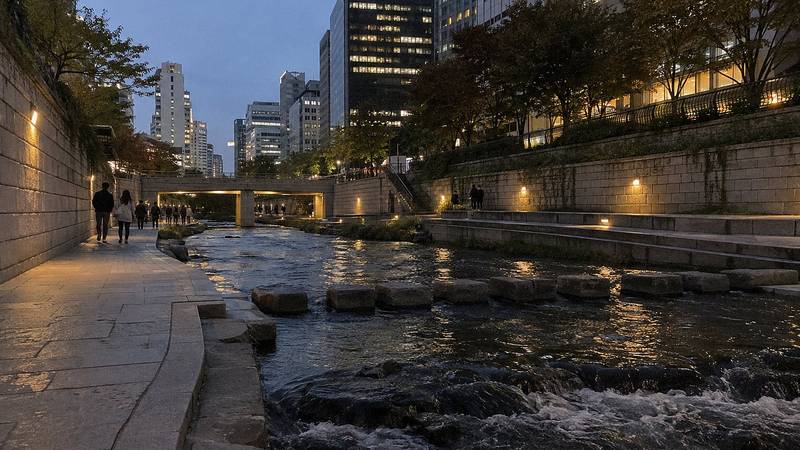
A restored urban stream with walking paths below street level, running east from Gwanghwamun; pleasant on summer evenings.
Updated
Essentials
- Hours
- Stream walkways: no gates or tickets; closed when rain is forecast
- Gwanggyo Digital Canvas (fog screen): 19:00–21:00, 8 minutes every 30 minutes, 1 March–30 November (20:00–21:30 from May to September)
- Fountain at the start (Cheonggye Plaza): 12:00–21:00, 1 April–15 November; Cheonggye Waterfall runs all year
- Cheonggyecheon Museum: 09:00–18:00, last entry 17:30
- Closed
- The walkways close during rain and ahead of forecast rain. Cheonggyecheon Museum and the shack theme zone close on Mondays; the museum also closes on 1 January.
- Admission
- Free: the stream walkways, Cheonggyecheon Museum and the shack theme zone
- Getting there
- Start at Cheonggye Plaza, a short walk from Gwanghwamun Station (Line 5) or City Hall Station (Lines 1 and 2)
- Mid-stream: Jongno 5-ga Station (Line 1) for Gwangjang Market and Majeongyo Bridge
- Cheonggyecheon Museum: Yongdu Station (Line 2), Exit 5, about 10 minutes on foot
- Address
- Cheonggye Plaza, Taepyeong-ro 1-ga, Jung-gu, Seoul
서울 중구 태평로1가 청계광장 - Website
- sisul.or.kr/open_content/cheonggye
Book your trip
Cheonggyecheon is a free stream walk sunk below street level, starting at Cheonggye Plaza just south of Gwanghwamun Square. Walk the first 2–3 km east, ideally after dark when the lights and fog screen are on, and skip it if rain is forecast: the walkways close. Allow 30 minutes for a taste, or about an hour to reach Gwangjang Market.
The stream crossed the middle of Joseon-era Seoul for six centuries. It was paved over from 1958, then lay under a road and the 5.6 km Cheonggye Overpass for decades. Seoul tore the overpass down and restored the stream between July 2003 and September 2005; it reopened on 1 October 2005. Today it is a long, green walk through the business district, 8.12 km from the plaza to the Jungnangcheon.
When to go
What you want to see decides the time of day.
| Time | What is on | Good for |
|---|---|---|
| Daytime, any day | Walkways, stepping stones, the waterfall at the plaza | A cool, quiet break between palaces and markets |
| 12:00–21:00, to 15 Nov 2026 | Fountain at the start, by Cheonggye Plaza | Photos at the plaza end |
| 19:00–21:00, to 30 Nov 2026 | Digital Canvas fog screen at Gwanggyo Bridge, 8 min every 30 min | Night walk after dinner |
| December–January evenings | Seoul Lantern Festival on the first stretch | Winter visitors |
| Rain forecast | Walkways closed | Use the street above, or go elsewhere |
Times from the Seoul Facilities Corporation’s facility schedule and Seoul’s festival listings, checked 28 October 2026.
Sit on the stones by the water, but do not dip your feet or wade outside an official event.
Which stretch to walk
The managed stream runs 8.12 km, but its character changes as you go east. The Seoul Facilities Corporation suggests three courses.
| Course | From → to | Why walk it |
|---|---|---|
| History walk (역사길) | Mojeongyo → Gwansugyo, 2.9 km | The plaza, the waterfall, old bridge sites and the busiest, best-lit part |
| Lively walk (활력길) | Majeongyo (Gwangjang Market) → DDP | Markets on both banks, ending at DDP |
| Quiet walk (휴식길) | Dumul Bridge → Yongdap | Greener and quieter, near the museum |
Courses from the Seoul Facilities Corporation’s Cheonggyecheon site, checked 28 October 2026.
For a first visit, walk from the plaza to Gwangjang Market, eat there, and take the subway from Jongno 5-ga. With more time, carry on to DDP. Only come to the quiet eastern end if you plan to see the museum.
What to see along the way
- Cheonggye Plaza and the waterfall. The start of the stream, with a waterfall that runs all year and the Palseokdam stone basin, where visitors throw coins for luck. Staff collect the coins every week; foreign coins go to UNICEF Korea and won coins to a Seoul scholarship fund.
- Gwangtonggyo and the old bridge sites. Gwangtonggyo was the busiest crossing in Joseon Seoul, on the main road from the palace to the south gate. It was buried under the road when the stream was paved over in 1958; the history course passes its site and those of other Joseon bridges.
- Gwanggyo Digital Canvas. A mist fountain and light display near Gwanggyo Bridge, running in the evening from March to November.
- HiKR Ground. The tourism organization’s free K-culture centre at 40 Cheonggyecheon-ro, near the start. See K-culture in Korea.
- Gwangjang Market and Dongdaemun. Around Majeongyo the stream reaches Gwangjang Market, then the fabric and fashion markets of Dongdaemun and DDP.
- Cheonggyecheon Museum and the shack zone. Near the eastern end, a free museum tells the story of the stream, its covering and its restoration. In front of it, the shack theme zone keeps the outside of 1960s riverside shacks, now holding nature and ecology exhibits.
Hours and admission
| Part | Hours | Closed |
|---|---|---|
| Stream walkways | No gates | During rain and ahead of forecast rain |
| Cheonggye Waterfall | All day, all year | – |
| Fountain at the start | 12:00–21:00, 1 Apr–15 Nov | Winter |
| Gwanggyo Digital Canvas | 19:00–21:00 (20:00–21:30 May–Sep), 1 Mar–30 Nov | Winter |
| Cheonggyecheon Museum | 09:00–18:00, last entry 17:30 | Mondays, 1 January |
| Shack theme zone | 10:00–18:00 | Mondays |
Hours from the Seoul Facilities Corporation and the Cheonggyecheon Museum, checked 28 October 2026. Everything on this list is free.
The museum gives Korean-language talks at 10:00 and 15:00 at the entrance to the 4th-floor permanent exhibition. It is at 530 Cheonggyecheon-ro, about 10 minutes on foot from Exit 5 of Yongdu Station (Line 2).
Rules on the stream
Seoul city stepped up patrols in July 2026 after people bathed in the stream and took coins from Palseokdam. Forty safety staff now patrol the whole length, and the city is preparing fines for repeat offences. The posted rules ban:
- swimming, bathing, wading and fishing;
- smoking and drinking alcohol;
- camping, cooking and sleeping rough;
- cycling and inline skating on the walkways;
- dogs and other pets (assistance dogs excepted);
- littering and damaging the walls or plants.
Rules from the Seoul Facilities Corporation’s visitor notice and Seoul city’s 29 July 2026 briefing.
Getting there and getting around
- Start (Cheonggye Plaza). A short walk from Gwanghwamun Station (Line 5) or City Hall Station (Lines 1 and 2). From Gwanghwamun Square, keep walking south.
- Mid-stream. Jongno 5-ga Station (Line 1) for Gwangjang Market; for DDP, Dongdaemun History & Culture Park Station.
- Steps and step-free access. There are 65 ways down from the road, mostly stairs. The restored section has eight ramps, and only two lifts, at Samilgyo and Hwanghakgyo bridges, so check your route if you have a stroller or wheelchair.
- Toilets. 77 toilets line the route, public and in nearby buildings. Information booths are at Cheonggye Plaza, Ogansugyo and Gosanjagyo.
Tips
- Pair it with the palaces. Start the walk after Gyeongbokgung and Gwanghwamun Square, or drop in from Insadong, Jogyesa or Myeongdong, all a short walk away.
- Lantern season. The Seoul Lantern Festival fills the first stretch with large lanterns every winter; the 2025 edition ran from 12 December to 18 January, 18:00–23:00, free. Seoul lists the 2026 festival for December, with dates still to come.
- Plan the day. See Seoul in 3 days for how the stream fits into a first trip.
Nearby
Gwanghwamun Square
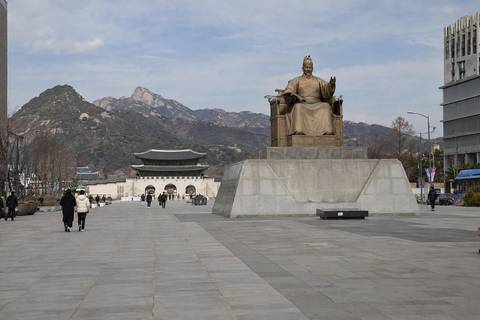
The broad plaza in front of Gyeongbokgung's main gate, with statues of King Sejong and Admiral Yi Sun-sin and the mountains beyond.
Gwangjang Market
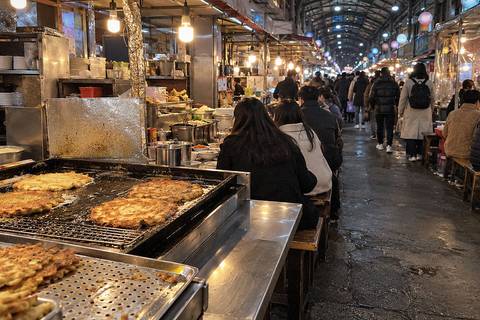
One of Seoul's oldest covered markets, best known for its food alleys serving mung bean pancakes, gimbap and raw beef dishes.
Dongdaemun Design Plaza (DDP)
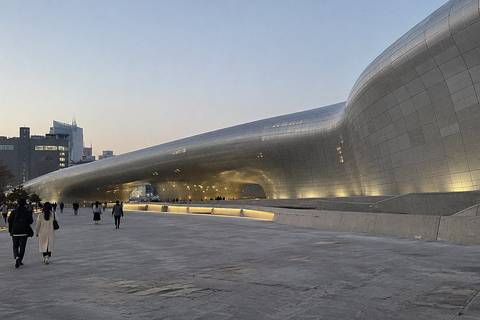
Zaha Hadid's curving silver landmark hosting exhibitions and events, surrounded by Dongdaemun's late-night fashion malls.
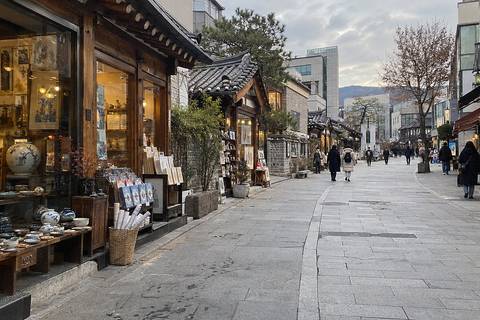
Insadong
A pedestrian-friendly street of craft and antique shops, tea houses and galleries, good for souvenirs such as hanji paper and ceramics.
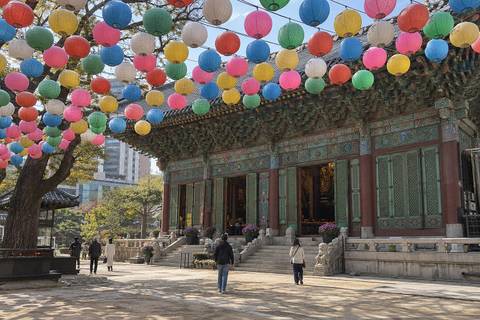
Jogyesa Temple
The head temple of Korea's largest Buddhist order, right in the city center and decked with thousands of lanterns before Buddha's Birthday.
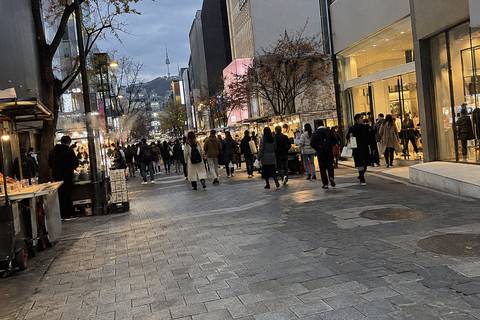
Myeongdong
Seoul's best-known shopping district for cosmetics and fashion, with evening street-food stalls and a historic cathedral.
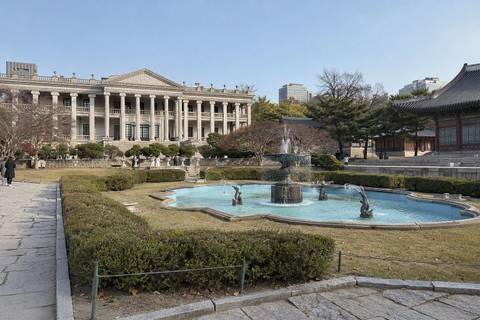
Deoksugung Palace
A compact palace by City Hall mixing Korean halls with early 1900s Western-style stone buildings; its stone-wall road is a classic stroll.
Frequently asked questions
Is Cheonggyecheon Stream free?
Yes. There are no gates or tickets for the walkways along the stream, and the Cheonggyecheon Museum near the eastern end is free as well (closed on Mondays and 1 January).
Where does Cheonggyecheon start, and how far should you walk?
It starts at Cheonggye Plaza, just south of Gwanghwamun Square, and runs 8.12 km east to the Jungnangcheon. Most visitors walk the first stretch: the official history course from Mojeongyo to Gwansugyo is 2.9 km, and you can carry on to Gwangjang Market or DDP and take the subway back.
What time are the Cheonggyecheon lights on?
The stream is lit every evening. Until 30 November 2026 the Digital Canvas fog screen at Gwanggyo Bridge runs 19:00–21:00 for 8 minutes every half hour, and the fountain at the start runs 12:00–21:00 until 15 November. The Cheonggye Waterfall at the plaza runs all year.
Is Cheonggyecheon open when it rains?
No. The walkways flood quickly, so the Seoul Facilities Corporation closes them during rain and often ahead of a forecast shower, posting each closure and reopening on its notice board. Walk along the street-level road above instead, and do not shelter under the bridges.
When is the Seoul Lantern Festival on Cheonggyecheon?
It is held every winter on the stream's first stretch. The 2025 edition ran from 12 December 2025 to 18 January 2026, 18:00–23:00, free. Seoul lists the 2026 festival for December along the stream, but exact dates had not been announced on 28 October 2026.
Sources
Facts on this page were checked against these sources on 28 October 2026. Prices, hours and rules change — confirm with the operator before you go.
- 서울시설공단 청계천 – 시설물현황 (분수·폭포·디지털 캔버스 운영시간, 하천연장 8.12km, 진출입시설·엘리베이터) (Korean) · official
- 서울시설공단 청계천 – 시민 유의사항 (강우 시 대피, 교량 하부 위험, 금지행위) (Korean) · official
- 서울시설공단 청계천 – [안전특보] 청계천 산책로 통제 알림 (2026-10-18, 강우 예보 선제 통제) (Korean) · official
- 서울시설공단 청계천 – 청계천 걷기 (역사길·활력길·휴식길 코스) (Korean) · official
- 서울시설공단 청계천 – 판잣집 테마존 (10:00~18:00, 월요일 휴관) (Korean) · official
- 서울시설공단 청계천 – 청계천 행운의 동전 (2026년 9월 기준 기부 현황) (Korean) · official
- 서울시설공단 청계천 – 청계천역사: 1950년대 이후 (복개와 청계고가도로) (Korean) · official
- 서울시설공단 청계천 – 문화유적: 옛다리들 (광통교, 수표교, 오간수문) (Korean) · official
- Seoul Museum of History – Cheonggyecheon Museum (restoration 2003–2005, exhibitions) · official
- 청계천박물관 – 관람시간·휴관일·관람료 (화~일 09:00~18:00, 무료) (Korean) · official
- 청계천박물관 – 찾아오시는 길 (청계천로 530, 용두역 5번 출구) (Korean) · official
- 내 손안에 서울 – 청계천 질서위반 행위 대응 (2026-07-29) (Korean) · official
- 서울문화포털 – 2025 서울빛초롱축제 (2025.12.12~2026.1.18, 청계광장~삼일교, 무료) (Korean) · official
- 서울축제 – 2026 서울빛초롱축제 (예정: 12월, 청계천 일대) (Korean) · official
- OpenStreetMap – Cheonggye Plaza (coordinates)