Seoul · Palace Quarter (Jongno)
Jongmyo Shrine 종묘
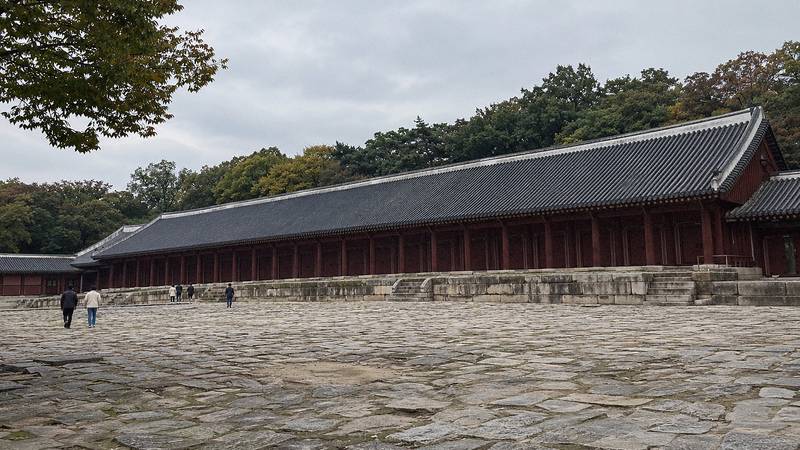
The austere royal ancestral shrine of the Joseon kings, a UNESCO site whose long main hall is one of Korea's finest wooden buildings.
Updated
Essentials
- Hours
- February–May and September–October: 09:00–18:00 (last entry 17:00)
- June–August: 09:00–18:30 (last entry 17:30)
- November–January: 09:00–17:30 (last entry 16:30)
- Mondays, Thursdays and Fridays: timed guided entry only. English tours 10:00, 12:00, 14:00, 16:00 (about 50 minutes)
- Wednesdays, Saturdays, Sundays and public holidays: walk around freely during opening hours
- Closed
- Tuesdays (if a Tuesday is a public holiday the shrine opens and closes on the next non-holiday day instead)
- Admission
- Adults (foreign visitors aged 19–64): 1,000 won
- Free for foreign visitors aged 18 and under or 65 and over, and for anyone wearing hanbok
- Free for everyone on Wednesdays (Culture Day)
- Integrated palace ticket (6,000 won, valid 6 months) covers Jongmyo and the four main palaces, but not the Secret Garden
- Getting there
- Subway Line 1, Jongno 3-ga Station, Exit 11 (about 5 minutes on foot)
- Subway Lines 3 and 5, Jongno 3-ga Station, Exit 8 (about 5 minutes on foot)
- Bus: Jongno 4-ga · Jongmyo stop (central bus lane)
- Address
- 157 Jong-ro, Jongno-gu, Seoul 03135
서울 종로구 종로 157 - Website
- royal.khs.go.kr/ROYAL/contents/menuInfo-jms.do?grpCode=jms
Book your trip
Jongmyo costs ₩1,000 (free on Wednesdays and in hanbok) and is closed on Tuesdays. On Mondays, Thursdays and Fridays you can only enter on a guided tour of about 50 minutes, with English tours at 10:00, 12:00, 14:00 and 16:00. On Wednesdays, weekends and public holidays you walk around on your own. Allow about an hour.
Jongmyo is the royal ancestral shrine of the Joseon dynasty, where the spirit tablets of its kings and queens and of the emperors and empresses of the Korean Empire are kept and honoured with Confucian rites. It became a UNESCO World Heritage Site in 1995. There are no palaces or gardens here, just a wooded compound and two very long, plain wooden halls, and it is one of the quietest major sights in Seoul. It sits at the southern end of the palace quarter, so it combines easily with Changdeokgung and the other Seoul palaces.
Which day to go
The day of the week decides how you visit, so pick the day first.
| Day | How you visit | English tour | Admission |
|---|---|---|---|
| Monday, Thursday, Friday | Timed guided entry only | 10:00, 12:00, 14:00, 16:00 | ₩1,000 |
| Wednesday | Walk around freely | 10:00, 12:00, 14:00, 16:00 (optional) | Free |
| Sunday | Walk around freely | 10:00, 12:00, 14:00, 16:00 (optional) | ₩1,000 |
| Saturday, public holidays | Walk around freely | None (Korean tours only) | ₩1,000 |
| Tuesday | Closed | – | – |
Day rules and tour times from the Royal Palaces and Tombs Center’s hours, tour and fee pages, checked 17 October 2026. Want the background in English? Go on a Monday, Thursday or Friday and join a tour. Prefer to wander at your own pace? Go on a Wednesday, when entry is also free.
Every Wednesday has been a free-entry Culture Day since October 2026; before that it was only the last Wednesday of the month, so older guides are out of date. The shrine also switches to free viewing at short notice for festivals, holidays and severe weather. In July and August 2026 it was self-guided all week because of the heat. Check the notices on the official site before a weekday visit.
Opening hours and admission
| Months | Opening hours | Last entry |
|---|---|---|
| February–May, September–October | 09:00–18:00 | 17:00 |
| June–August | 09:00–18:30 | 17:30 |
| November–January | 09:00–17:30 | 16:30 |
Hours from the official 관람시간 page, checked 17 October 2026. These hours apply to free-viewing days. On guided days you can only go in at a tour start time. Korean tours start every hour from 09:20 to 16:20 (plus 16:40 from March to September). Japanese tours start at 09:40, 11:40, 13:40 and 15:40, and Chinese tours at 11:00 and 15:00.
Admission for foreign visitors aged 19–64 is ₩1,000. It is free for foreign visitors aged 18 and under or 65 and over, and for anyone in hanbok. Jongmyo is also included in the ₩6,000 integrated palace ticket, which is valid for six months and covers Gyeongbokgung, Changdeokgung (not the Secret Garden), Changgyeonggung and Deoksugung as well. You can buy it at the Jongmyo ticket office.
How the guided tours work
- No booking for small groups. Under 10 people, just arrive at the main gate, Oedaemun, a few minutes before a start time. Each session takes up to 200 people: 100 booked online and 100 walk-ups.
- Groups of 10 or more must book online, from 30 days to 3 days before the visit.
- Foreign-language tours are for foreign visitors. Korean nationals can join only when they are with a foreign visitor.
- Ask before you record. Filming the guide or recording their commentary needs the guide’s consent.
- Weather can cut the tour short. When a weather advisory is in force, the shrine switches to free viewing and tours are shortened or cancelled.
- No foreign-language tours on public holidays. Only five Korean tours run, at 10:00, 11:00, 13:00, 14:00 and 15:00.
See tours and activities in Korea for the English palace tours at the other palaces.
What you see
The tour route follows the raised stone path from the main gate past the king’s preparation hall and the ritual kitchen to the two shrine halls, then loops back.
- Jeongjeon (Main Hall) – the main shrine hall, about 101 m long and divided into 19 chambers that hold 49 spirit tablets of kings and queens. In front lies a broad stone platform used for the royal rites.
- Yeongnyeongjeon – a second, smaller hall of 16 chambers built in 1421 for tablets moved out of the main hall; it now holds 34.
- Gongsindang – a hall honouring meritorious subjects who served the kings.
- The stone path (Sindo) – the slightly raised middle lane was reserved for the spirits. Walk on the lower paths on either side.
- Jaegung, Jeonsacheong and Hyangdaecheong – where the king prepared for the rites, where the ritual food was cooked, and where incense and written prayers were stored.
- Mangmyoru – the officials’ pavilion near the gate, beside a pond.
Getting there
Take Line 1 to Jongno 3-ga Station and use Exit 11, or take Line 3 or 5 to the same station and use Exit 8. The main gate on Jong-ro is about five minutes’ walk. Buses stop at Jongno 4-ga · Jongmyo in the central bus lane. A tap with a T-money card pays the subway fare; see the Seoul subway guide for how to ride. There is no shrine car park; the nearest is the paid Jongmyo public car park run by Jongno-gu. The address for taxis is 서울 종로구 종로 157.
On free-viewing days a second gate, Buksinmun, is also open on Yulgok-ro at the northern edge of the shrine. Changgyeonggung’s own Yulgok-ro gate is open at weekends and on public holidays, so a weekend is the easiest time to pair Jongmyo with Changgyeonggung.
Tips for visiting
- Pair it with the market. Gwangjang Market is a short walk east along Jong-ro. A 10:00 or 12:00 English tour leaves time for lunch there afterwards.
- Plan around Tuesday. Jongmyo and Gyeongbokgung both close on Tuesdays; Changdeokgung, Changgyeonggung and Deoksugung close on Mondays instead.
- It is a shrine, not a park. Alcohol, picnic mats, camping gear and pets (except assistance dogs) are not allowed, food may only be eaten in designated areas, and the whole site is non-smoking.
- Wear comfortable shoes. The paths are gravel and uneven stone, and the tour is on foot for about 50 minutes.
- Watch the royal rite. The Jongmyo Jerye rite, with its court music, is a UNESCO-listed Intangible Cultural Heritage. It is held on the first Sunday of May (3 May in 2026) and draws large crowds.
History in brief
King Taejo built Jongmyo in 1395, soon after founding the Joseon dynasty, following the rule that the ancestral shrine stands to the east of the main palace and the Altar of Land and Grain to the west. The main hall started with seven chambers. Yeongnyeongjeon was added in 1421, and the halls were extended several times as the line of kings grew, reaching today’s 19 and 16 chambers in 1836.
The shrine burned during the Japanese invasion of 1592 and was rebuilt in 1608. The royal rites stopped in 1945 and were revived in 1969. The shrine joined the UNESCO World Heritage List in 1995, and the rite and its music were inscribed by UNESCO in 2001. The main hall was closed for its largest repair in about 30 years from 2020. On 20 April 2025 the 49 tablets, kept at Changdeokgung during the work, were carried back in procession, the first such ceremony since 1870.
Nearby
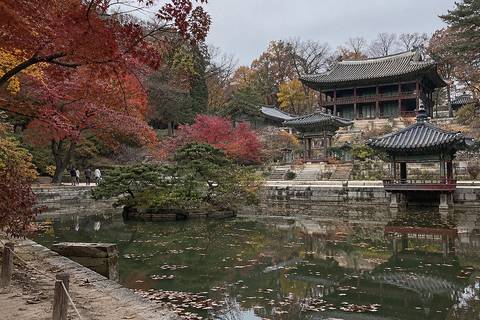
Changdeokgung Palace
A UNESCO-listed palace laid out to follow the hills, famous for its Secret Garden of ponds and pavilions visited on guided tours.
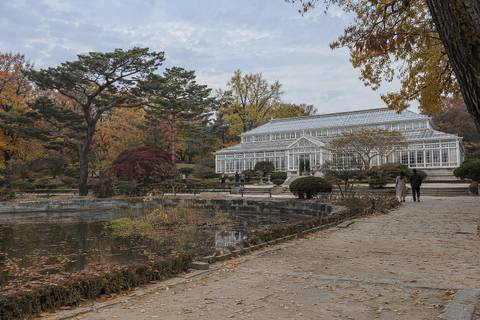
Changgyeonggung Palace
A quieter palace next to Changdeokgung, with a pond, wooded paths and a white Victorian-style glasshouse.
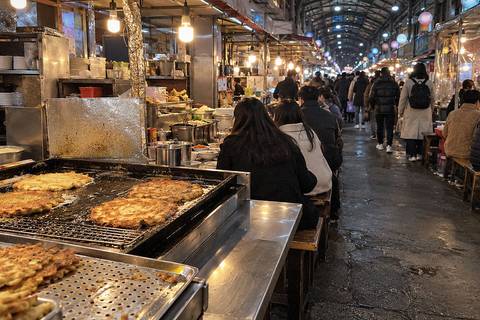
Gwangjang Market
One of Seoul's oldest covered markets, best known for its food alleys serving mung bean pancakes, gimbap and raw beef dishes.
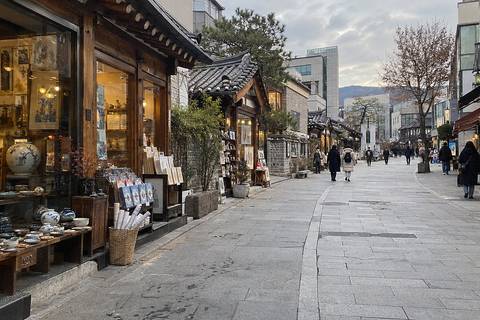
Insadong
A pedestrian-friendly street of craft and antique shops, tea houses and galleries, good for souvenirs such as hanji paper and ceramics.
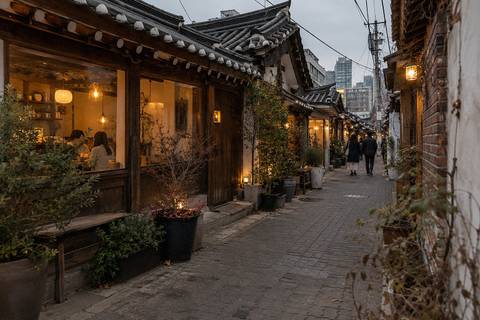
Ikseon-dong
A tight cluster of 1920s urban hanok turned into cafes, bakeries and small restaurants, busiest on weekend evenings.
Frequently asked questions
Can I visit Jongmyo without a guided tour?
Yes, on Wednesdays, Saturdays, Sundays and public holidays you can walk around on your own during opening hours. On Mondays, Thursdays and Fridays entry is only on a timed tour with a shrine guide, about 50 minutes; English tours start at 10:00, 12:00, 14:00 and 16:00.
Do I need to book the English tour at Jongmyo?
Not if your group has fewer than 10 people. Turn up at the main gate before a start time; half of each session's 200 places are kept for walk-ups. Groups of 10 or more must book online, from 30 days to 3 days before the visit.
How much does Jongmyo cost?
1,000 won for foreign visitors aged 19–64. It is free for foreign visitors aged 18 and under or 65 and over, for anyone wearing hanbok, and for everyone on Wednesdays. Jongmyo is also covered by the 6,000-won integrated palace ticket.
Is Jongmyo open on Tuesday?
No. Jongmyo closes every Tuesday, as does Gyeongbokgung. When a Tuesday is a public holiday the shrine opens and closes on the next working day instead. Changdeokgung and Changgyeonggung are open on Tuesdays.
Are there English tours on Saturdays?
No. On Saturdays and public holidays Jongmyo runs five Korean-language tours only, at 10:00, 11:00, 13:00, 14:00 and 15:00. English tours run on Mondays, Wednesdays, Thursdays, Fridays and Sundays.
Sources
Facts on this page were checked against these sources on 17 October 2026. Prices, hours and rules change — confirm with the operator before you go.
- Royal Palaces and Tombs Center – Opening hours and Jongmyo timed-entry sessions (관람시간) (Korean) · official
- Royal Palaces and Tombs Center – Jongmyo guided tours and booking rules (해설안내 종묘) (Korean) · official
- Royal Palaces and Tombs Center – Admission fees, integrated ticket and free days (관람요금) (Korean) · official
- Royal Palaces and Tombs Center – Directions to Jongmyo (오시는 길) (Korean) · official
- Royal Palaces and Tombs Center – Visitor rules (관람규칙) (Korean) · official
- Royal Palaces and Tombs Center – Every Wednesday becomes free Culture Day (notice, 7 Oct 2026) (Korean) · official
- Royal Palaces and Tombs Center – Jongmyo tour times on 9 Oct 2026 holiday (notice, 7 Oct 2026) (Korean) · official
- Royal Palaces and Tombs Center – July–August 2026 heat-season entry change at Jongmyo (notice) (Korean) · official
- Royal Palaces and Tombs Center – Jongmyo Shrine and Its History · official
- Royal Palaces and Tombs Center – Jongmyo Shrine (UNESCO World Heritage Site) · official
- Seoul Media Hub – Jongmyo visitor tips: Jeongjeon reopening, route and station exits (종묘 관람 팁) (Korean) · official
- Newsis – 49 royal tablets returned to the restored Jeongjeon, 20 April 2025 (신주 환안) (Korean)
- OpenStreetMap – Jongmyo (coordinates)