Seoul · Central Seoul (Jung-gu)
Deoksugung Palace 덕수궁
A compact palace by City Hall mixing Korean halls with early 1900s Western-style stone buildings; its stone-wall road is a classic stroll.
Updated
Essentials
- Hours
- Palace grounds: 09:00–21:00 all year (last entry 20:00)
- Seokjojeon (Daehan Empire History Museum): 09:30–17:30, guided entry only, last tour 16:30
- Dondeokjeon hall: 09:00–17:30 (last entry 17:00)
- Jungmyeongjeon hall (outside the palace walls, on Jeongdong-gil): 09:30–17:30 (last entry 17:00)
- English palace tours: Tuesday–Sunday 10:45 and 13:30 (about 45 minutes)
- Closed
- Mondays (if a Monday is a public holiday the palace opens and closes on the next non-holiday day instead)
- Admission
- Adults (foreign visitors aged 19–64): 1,000 won
- Free for foreign visitors aged 18 and under or 65 and over, and for anyone wearing hanbok
- Free for everyone on Wednesdays (Culture Day)
- Integrated palace ticket (6,000 won, valid 6 months) covers Deoksugung, Gyeongbokgung, Changdeokgung (not the Secret Garden), Changgyeonggung and Jongmyo
- The Deoksugung branch of the National Museum of Modern and Contemporary Art needs its own ticket on top of palace admission
- Getting there
- Subway Lines 1 and 2, City Hall Station, Exit 2 (about 2 minutes on foot)
- Subway Line 5, Gwanghwamun Station, Exit 6 or Exit 2 (about 10 minutes on foot)
- Bus: City Hall · Deoksugung stop (시청앞·덕수궁)
- Address
- 99 Sejong-daero, Jung-gu, Seoul 04519
서울 중구 세종대로 99 - Website
- royal.khs.go.kr/ROYAL/contents/menuInfo-dsg.do?grpCode=dsg
Book your trip
Deoksugung costs ₩1,000 (free on Wednesdays and in hanbok), is closed on Mondays and stays open until 21:00, later than any other Seoul palace. The guard changing ceremony is at 11:00 and 14:00 at the main gate. Allow 1–1½ hours, or about 2 hours with a Seokjojeon tour.
Deoksugung is the palace of the Korean Empire (1897–1910), the last chapter of the Joseon royal line, and the only one where traditional wooden halls stand beside Western-style stone buildings from the early 1900s. It is small and flat and sits right across the road from Seoul City Hall, so it fits into a gap in a day around central Seoul without much planning. For how it compares with the other four, see Seoul’s palaces.
When to go
What you can see depends on the time of day, so pick the time first.
| Time | What happens | Good for |
|---|---|---|
| 10:45 or 13:30 | Free English palace tour (about 45 min), Tuesday–Sunday | First visit, history in English |
| 11:00 or 14:00 | Royal guard changing ceremony at Daehanmun gate, Tuesday–Sunday | Photos, families |
| 11:50 or 14:50 | English Seokjojeon tour, booked at the hall’s desk on the day | The Korean Empire interiors |
| After 17:30 | Halls closed; grounds lit and open until 21:00 (last entry 20:00) | Evening stroll, fewer tour groups |
| Wednesday | Free entry for everyone (Culture Day) | Budget |
| Monday | Palace closed, no guard ceremony | – |
Times from the Royal Palaces and Tombs Center’s hours and tour pages and Seoul’s royal guard site, checked 18 October 2026. For a first visit, arrive just before 11:00: watch the ceremony at the gate, go in for the grounds, and book an 11:50 or 14:50 Seokjojeon slot at the desk as soon as you are inside. Want the palace without the halls? Come after dark, when the stone buildings are lit.
Every Wednesday has been a free-entry Culture Day at Deoksugung since October 2026; before that it was only the last Wednesday of the month, so older guides are out of date.
Hours and admission
| Part | Opening hours | Last entry |
|---|---|---|
| Palace grounds | 09:00–21:00, all year | 20:00 |
| Seokjojeon (Daehan Empire History Museum) | 09:30–17:30, guided only | last tour 16:30 |
| Dondeokjeon | 09:00–17:30 | 17:00 |
| Jungmyeongjeon (outside the walls) | 09:30–17:30 | 17:00 |
Hours from the official 관람시간 page, checked 18 October 2026. The palace closes on Mondays; when a Monday is a public holiday it opens and closes on the next non-holiday day instead.
Admission for foreign visitors aged 19–64 is ₩1,000. It is free for foreign visitors aged 18 and under or 65 and over, for anyone in hanbok, and for everyone on Wednesdays. Seokjojeon and Dondeokjeon are inside the palace and need no extra ticket; the Deoksugung branch of the National Museum of Modern and Contemporary Art, also inside the grounds, sells its own ticket. Deoksugung is included in the ₩6,000 integrated palace ticket, valid for six months, which also covers Gyeongbokgung, Changdeokgung (not the Secret Garden), Changgyeonggung and Jongmyo.
Tours and the Seokjojeon booking
- English palace tour, no booking. Under 10 people, just turn up at the palace map board about 10 m inside Daehanmun at 10:45 or 13:30, Tuesday–Sunday. Groups of 10 or more book by phone (02-751-0742).
- Seokjojeon is guided only. You cannot wander the museum on your own. Korean sessions run through the day and are booked on the Royal Palaces and Tombs Center website from one week ahead, 15 places per session and up to 5 per person.
- Walk-up places for foreign visitors. Each standard Korean session keeps 5 places for foreign visitors and over-65s, and the English sessions at 11:50 and 14:50 are booked at the Seokjojeon desk on the day. Bring your passport.
- Be on time. Seokjojeon lets you in from 3 minutes before your slot, and latecomers are turned away. The standard tour takes about 45 minutes.
- Tour rules. Foreign-language tours are for foreign visitors; Korean nationals can join only with a foreign companion. Recording the guide needs their consent, and tours are shortened or cancelled during weather advisories.
The rest of Seoul’s palace tours are compared in tours and activities in Korea.
What you see
- Daehanmun – the main gate on Sejong-daero, where the guard ceremony takes place. Costumed guards stand here from 10:00 to 15:30 between ceremonies.
- Junghwajeon – the throne hall of the Korean Empire, where state ceremonies were held, with a stone-paved courtyard in front.
- Seogeodang – a two-storey wooden hall left unpainted, the oldest corner of the palace, where King Seonjo lived after the Japanese invasion of the 1590s.
- Hamnyeongjeon – Emperor Gojong’s living quarters, where he died in 1919.
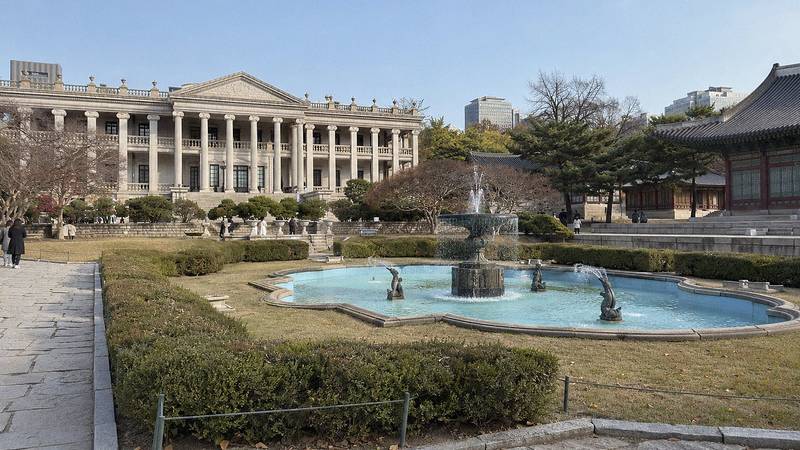
- Seokjojeon – the neoclassical stone hall with columns and a fountain garden in front, built as the emperor’s residence and office. It now houses the Daehan Empire History Museum, and the US–Soviet Joint Commission met here in 1946–47.
- Dondeokjeon – a red-brick, European-style reception hall for foreign envoys, demolished in the colonial era and rebuilt in 2023. It now holds exhibitions on Korean Empire diplomacy.
- Jungmyeongjeon – a separate exhibition hall of the palace a short walk away on Jeongdong-gil, outside the palace walls, with its own opening hours.
Getting there
Take Line 1 or 2 to City Hall Station and use Exit 2; Daehanmun is about two minutes’ walk. From Line 5, Gwanghwamun Station Exit 6 or Exit 2 is about ten minutes on foot. Buses stop at City Hall · Deoksugung (시청앞·덕수궁). A tap with a T-money card pays the fare; see the Seoul subway guide for how to ride. There is no car park. The address for taxis is 서울 중구 세종대로 99.
Tips for visiting
- Pair it with the evening. Deoksugung is open until 21:00, so it is the easiest palace to save for the end of the day after Gyeongbokgung or a museum.
- Walk the stone-wall road. Jeongdong-gil, the lane along the palace’s stone wall, is a well-known stroll and one of central Seoul’s best autumn-leaf streets.
- Plan around Monday. Deoksugung, Changdeokgung and Changgyeonggung close on Mondays; Gyeongbokgung and Jongmyo close on Tuesdays.
- Combine it with the neighbours. Seoul Plaza is across the road, Gwanghwamun Square is north along Sejong-daero, and Myeongdong and Namdaemun Market are both within walking distance for shopping or dinner.
- Children. The grounds are flat and compact and the guard ceremony is a hit with children; foreign visitors aged 18 and under enter free.
History in brief
Deoksugung began as a private mansion of Grand Prince Wolsan. In 1593, after the Japanese invasion had destroyed every palace in the capital, King Seonjo returned and used it as a temporary palace. It became an official palace named Gyeongungung in 1611, then a secondary palace once Changdeokgung was rebuilt.
In 1897 Emperor Gojong returned here from the Russian legation, proclaimed the Korean Empire and made Gyeongungung its imperial palace, adding Western-style buildings beside the traditional halls. Much of it burned in a great fire in 1904. After Japan forced Gojong to abdicate in 1907 the palace was renamed Deoksugung. Under colonial rule (1910–1945) it lost most of its buildings and was turned partly into a public park; restoration has continued since the war, most recently with the rebuilding of Dondeokjeon in 2023.
Nearby
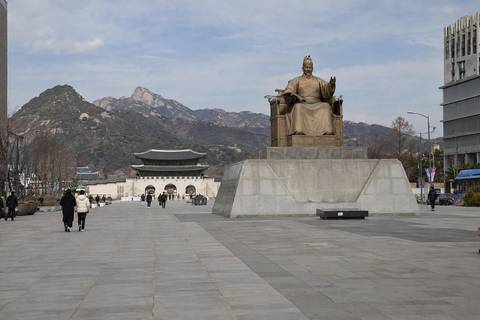
Gwanghwamun Square
The broad plaza in front of Gyeongbokgung's main gate, with statues of King Sejong and Admiral Yi Sun-sin and the mountains beyond.
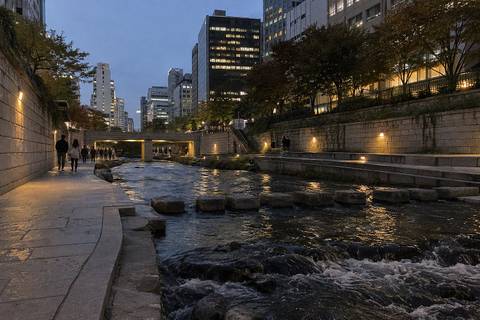
Cheonggyecheon Stream
A restored urban stream with walking paths below street level, running east from Gwanghwamun; pleasant on summer evenings.
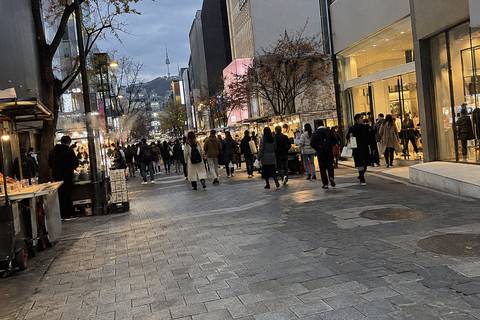
Myeongdong
Seoul's best-known shopping district for cosmetics and fashion, with evening street-food stalls and a historic cathedral.
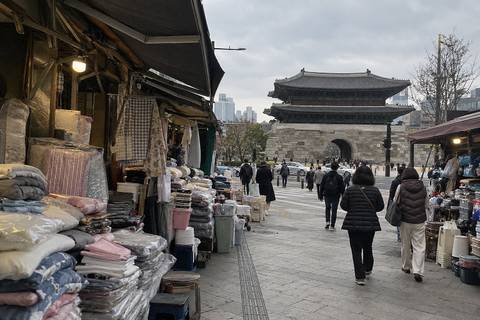
Namdaemun Market
A sprawling traditional market of hundreds of stalls selling clothing, kitchenware and ginseng, with a famous hairtail-stew alley.
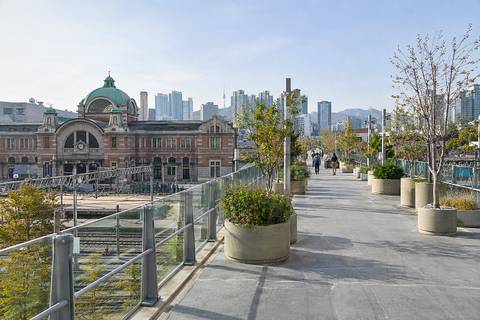
Seoullo 7017
A former highway overpass by Seoul Station reborn as an elevated walkway planted with trees and flowers in round planters.
Frequently asked questions
What time is the changing of the guard at Deoksugung?
The royal guard changing ceremony runs at 11:00 and 14:00 in front of Daehanmun, the main gate, every day except Monday. It is free and takes place outside the gate, so you do not need a palace ticket. Costumed guards also stand at the gate from 10:00 to 15:30.
Is Deoksugung open at night?
Yes. The palace grounds are open until 21:00 every day except Monday, with last entry at 20:00. The exhibition halls inside, Seokjojeon and Dondeokjeon, close at 17:30, so after dark you see the lit grounds and buildings from outside only.
How much is Deoksugung entrance?
1,000 won for foreign visitors aged 19–64. It is free for foreign visitors aged 18 and under or 65 and over, for anyone in hanbok, and for everyone on Wednesdays. The 6,000-won integrated palace ticket also covers it.
Do I need to book Seokjojeon?
Yes, Seokjojeon is entered only on a guided tour. Korean sessions are booked online from one week ahead, with five walk-up places per session kept for foreign visitors and over-65s. The two English sessions, 11:50 and 14:50, are booked at the Seokjojeon desk on the day; bring your passport.
Is Deoksugung closed on Monday?
Yes, Deoksugung closes every Monday, as do Changdeokgung and Changgyeonggung, and there is no guard ceremony on Mondays. Gyeongbokgung is open on Mondays and closes on Tuesdays instead.
Sources
Facts on this page were checked against these sources on 18 October 2026. Prices, hours and rules change — confirm with the operator before you go.
- Royal Palaces and Tombs Center – Opening hours, Deoksugung and its halls (관람시간 덕수궁) (Korean) · official
- Royal Palaces and Tombs Center – Admission fees, integrated ticket and free days (관람요금) (Korean) · official
- Royal Palaces and Tombs Center – Deoksugung guided tours and Seokjojeon booking rules (해설안내 덕수궁) (Korean) · official
- Royal Palaces and Tombs Center – Directions to Deoksugung (오시는 길) (Korean) · official
- Royal Palaces and Tombs Center – Every Wednesday becomes free Culture Day (notice, 7 Oct 2026) (Korean) · official
- Royal Palaces and Tombs Center – Deoksugung Palace and Its History · official
- Seoul Royal Guard – Ceremony, gate guard and patrol times (서울 왕궁수문장 행사 소개) (Korean) · official
- Ministry of Culture, Sports and Tourism – Seoul Royal Guard Changing Ceremony 2026 (서울 왕궁수문장 교대의식) (Korean) · official
- Seoul Media Hub – Deoksugung visitor tips: Seokjojeon tours and the rebuilt Dondeokjeon (덕수궁 관람 꿀팁) (Korean) · official