Jeju Island · East Jeju
Sangumburi Crater 산굼부리
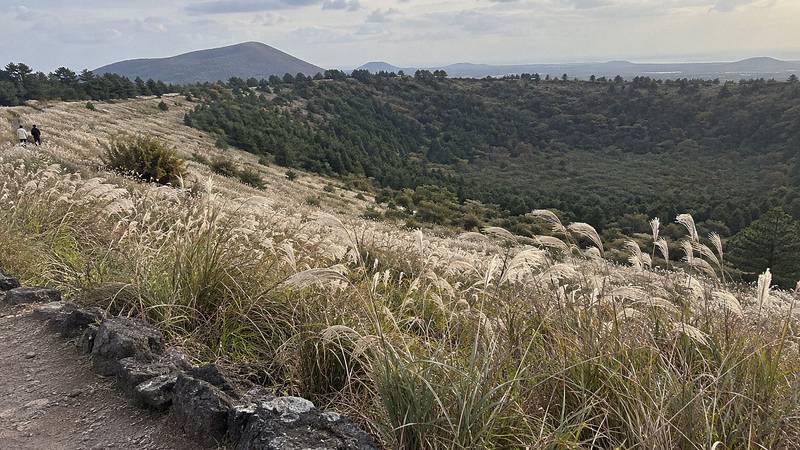
A broad, deep crater without a cone, rimmed by silver grass that glows in autumn.
Updated
Essentials
- Hours
- March–June and September–October: 09:00–18:40, last entry 18:00
- July–August and November–February: 09:00–17:40, last entry 17:00
- Closing time can change with the weather (operator website, checked 30 Oct 2026)
- Closed
- Open every day of the year
- Admission
- Adults and university students: 7,000 won
- Teenagers and children (age 4 and over): 6,000 won
- 65 and over, Jeju residents, national merit holders, visitors with disabilities (with ID): 5,000 won
- Groups of 20 or more: 6,000 won (adults), 5,000 won (teenagers and children)
- Getting there
- Bus 212 (Jeju Bus Terminal ↔ Seongsan Port) to the Sangumburi (산굼부리) stop
- Bus fare 1,150 won by card, 1,200 won in cash (adults)
- Address
- 768 Bijarim-ro, Jocheon-eup, Jeju-si, Jeju
제주 제주시 조천읍 비자림로 768 - Website
- sangumburi.net
Book your trip
Sangumburi (산굼부리) is a huge, bowl-shaped crater in the grassland between Jeju City and the east coast. It is the only maar crater in Korea. It is open every day, adults pay 7,000 won, and a visit takes about 40 minutes. Go in autumn, when silver grass covers the slopes around the rim; at other times of year it is a quick stop rather than a highlight.
The crater has no cone. The ground simply drops away: the rim is barely higher than the surrounding plain, but the floor lies 100–146 m below it. It has been a Natural Monument since 21 June 1979 and is managed by a private company, Sangumburi Co., together with Jeju Province. You view it from a deck on the rim; the inside is off-limits.
Is Sangumburi worth it?
In October and November, yes, if you are driving between Jeju City and the east coast: the silver grass is the reason most people come. Outside autumn, it is a pleasant 40-minute walk to a viewpoint, but the 7,000 won fee is high for what you see.
| Your situation | Do this |
|---|---|
| Driving to the east coast in Oct–Nov | Stop for 40–60 minutes on the way to Seongsan Ilchulbong or Bijarim |
| Visiting from March to summer | The grass is cut back from early March; go for the crater view only if you are passing |
| No car | Bus 212 from Jeju Bus Terminal stops at the gate, on the way to Seongsan |
| Late afternoon in November | Arrive before 17:00 — last entry is earlier from November |
| Using a wheelchair | The rim can be reached, but some slopes need someone to push |
Hours and fees from the operator’s website, checked 30 October 2026.
Hours and fees
| Details | |
|---|---|
| March–June, September–October | 09:00–18:40, last entry 18:00 |
| July–August, November–February | 09:00–17:40, last entry 17:00 |
| Closed | Never; open all year |
| Adults and university students | 7,000 won |
| Teenagers and children (4+) | 6,000 won |
| 65+, Jeju residents, visitors with disabilities | 5,000 won |
Operator website and Visit Jeju, checked 30 October 2026. Ticket sales stop 40 minutes before closing, and the operator can close earlier in bad weather. Discounts need ID and cover only the holder. Groups of 20 or more pay 6,000 won (adults) and 5,000 won (teenagers and children). English guides listing 6,000 won and 3,000 won use old prices.
Pets are not allowed, and flying drones is banned.
Silver grass season
Silver grass (eoksae, 억새) covers the plain and the outer slopes of the crater. It turns silver in autumn and lasts well into November: the operator confirmed it was still in full flower on 28 November 2025. Each spring, the grass is cut back. In 2026 the work began on 8 March, so from then until summer you see short regrowth, not the tall plumes in the photos.
Silver grass is a pale, feathery grass, not a flower.
The crater
A maar forms when a short burst of gas-driven explosions blows a hole in the ground without building up a cone of lava. According to the national heritage record, Sangumburi is the only maar in Korea. The record gives these figures:
- Outer rim: 2,067 m around
- Crater floor: 756 m around
- Depth: 100–146 m
- Protected area: 464,469 m²
The operator gives a depth of 132 m from the highest point of the rim (437.4 m above sea level) to the floor (305.4 m). That is deeper than Hallasan’s summit crater, Baengnokdam. Even so, no lake forms: rainwater drains away through the basalt gravel in the crater walls.
The inside of the crater is the reason for its protection. Its plants have grown cut off from the rest of the island for a long time. Warm-climate evergreens grow on the sunny inner slope, and deciduous trees on the shaded one. The operator calls it a “crater botanical garden”. It cannot be entered, but binoculars help from the deck.
What a visit involves
From the ticket gate, a gently sloping path leads up through the grass to the observation deck on the rim. The operator puts the whole visit at about 40 minutes, round trip.
The operator runs short guided talks at the rim every day in 2026, at 09:30, 10:30, 11:00, 13:00, 14:00, 15:00 and 16:00. The notice does not mention English; groups of 20 or more can book by phone (064-783-9900).
Accessibility: the operator says a wheelchair can reach the rim, but some parts slope and need a companion to help.
Getting there
Sangumburi is at 768 Bijarim-ro in Gyorae-ri, Jocheon-eup, in the island’s east district, on the inland road from Jeju City towards Songdang and Seongsan. The operator’s website and Visit Jeju do not give driving times.
| Bus | Route | Get off at |
|---|---|---|
| 212 | Jeju Bus Terminal ↔ Jeju National University ↔ Saryeoni Forest Path ↔ Gyorae ↔ Songdang ↔ Seongsan Ilchulbong ↔ Seongsan Port | Sangumburi (산굼부리) |
Jeju Bus Information System, checked 30 October 2026. The fare is 1,150 won by card or 1,200 won in cash for adults. Use the [South] stop heading towards Seongsan and the [North] stop heading back to Jeju City. Rural buses are not frequent, so check the next departure in a map app before you go in.
Around Sangumburi
The same bus 212 continues east to Seongsan Ilchulbong, so the two fit into one day without a car. Drivers can add Bijarim and the Manjanggul lava tube to the north-east, or the Haenyeo Museum on the coast; the thatched houses of Seongeup Folk Village are to the south. For other autumn scenery around the country, see autumn leaves in Korea. For flights, buses and where to stay, see the Jeju guide and the Jeju region page.
Nearby
Bijarim Forest
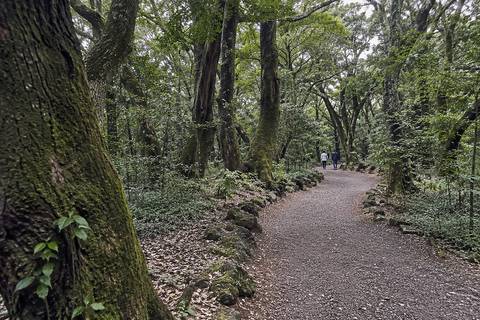
A shady old-growth forest of nutmeg yew trees, some many centuries old, with an easy loop path.
Seongeup Folk Village
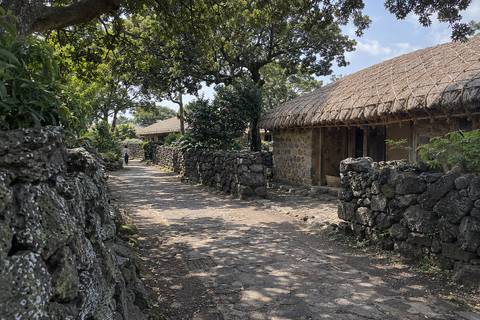
A lived-in village of thatched stone houses and black lava walls, preserving Jeju's traditional architecture.
Manjanggul Lava Tube
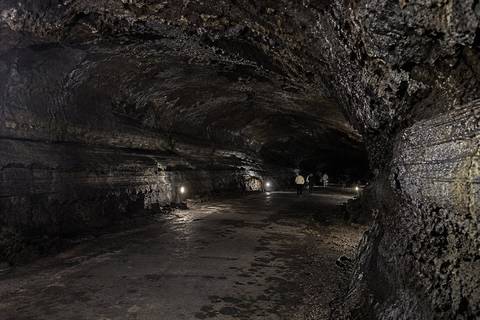
A huge lava tube with a walkable section ending at a tall lava column; reopened in May 2026 after safety works.
Seongsan Ilchulbong
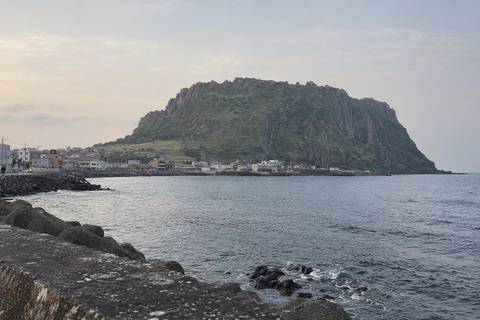
A steep tuff cone rising from the sea at the eastern tip, climbed by a stair path to a vast grassy crater.
Haenyeo Museum
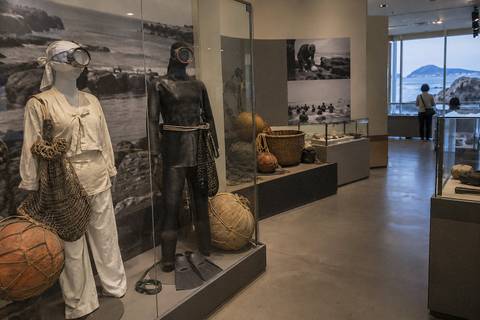
Explains the life of Jeju's female free divers, whose culture is recognised by UNESCO as intangible heritage.
Frequently asked questions
How much is the entrance fee for Sangumburi?
Adults and university students pay 7,000 won, and teenagers and children aged 4 and over pay 6,000 won. Visitors aged 65 and over, Jeju residents and visitors with disabilities pay 5,000 won with ID. These are the operator's prices, checked 30 October 2026. Older English guides that list 6,000 won and 3,000 won are out of date.
What are Sangumburi's opening hours?
It is open every day. From March to June and in September and October, hours are 09:00–18:40 with last entry at 18:00. In July, August and November to February, it closes at 17:40 and the last entry is 17:00. Bad weather can bring the closing time forward.
When is the silver grass at Sangumburi best?
The grass turns silver in autumn. The operator confirmed that the grass was still in full flower on 28 November 2025. The grass is cut back each spring; in 2026 the work started on 8 March, so late winter and spring visits show cut stubble rather than tall grass.
How long does a visit to Sangumburi take?
The operator puts it at about 40 minutes: a gentle walk up to the observation deck on the crater rim, time to look around, and the walk back. Allow up to an hour in silver-grass season if you want photos.
Can you go down into the crater?
No. You look into the crater from the rim. The inside is a protected Natural Monument, and its isolated plant life is the reason it is protected.
Sources
Facts on this page were checked against these sources on 30 October 2026. Prices, hours and rules change — confirm with the operator before you go.
- 산굼부리 – 관람안내 (개인 성인/대학생 7,000원, 청소년/어린이 만4세 이상 6,000원, 경로·도민·국가유공자·장애인 5,000원; 단체 20인 이상 6,000/5,000원; 3~6월·9~10월 09:00~18:40 입장마감 18:00, 7~8월·11~2월 09:00~17:40 입장마감 17:00; 관람 약 40분; 드론·반려동물 금지) (Korean) · official
- 산굼부리 – 공지 '2026년도 해설 프로그램 운영 안내' (2025-12-25; 연중무휴, 해설 09:30·10:30·11:00·13:00·14:00·15:00·16:00) 및 질문답변 (억새 정비 2026-03-08부터; 2025-11-28 억새 만개; 휠체어 정상까지 가능하나 보호자 동행 필요; 할인 대상) (Korean) · official
- 산굼부리 – 산굼부리 소개 (마르형 화구; 최고점 437.4m, 화구 바닥 305.4m, 깊이 132m; 백록담 115m) (Korean) · official
- 국가유산청 – 천연기념물 제주 산굼부리 분화구 (1979-06-21 지정; 464,469㎡; 바깥둘레 2,067m, 안쪽둘레 756m, 깊이 100~146m; 마르, 국내 유일; 물이 고이지 않음; 격리된 식물상) (Korean) · official
- Visit Jeju – Sangumburi Crater (768 Bijarim-ro; seasonal hours and last admission; adults 7,000 won; about 40 minutes; Natural Monument No. 263; map coordinates) · official
- 비짓제주 – 산굼부리 (관람시간·요금·연중무휴; 완만한 탐방로를 따라 분화구 전망대) (Korean) · official
- 제주버스정보시스템 – 정류소 산굼부리[남]·[북] 경유 노선 (212 제주버스터미널↔제주대학교↔사려니숲길↔교래↔송당↔성산일출봉입구↔성산항) 및 간선 요금 1,150원 카드/1,200원 현금 (Korean) · official