Gongju · Royal tombs and the museum quarter
Royal Tombs of Gongju 공주 무령왕릉과 왕릉원
Baekje royal tombs, including King Muryeong's, found intact in 1971; an exhibition hall reproduces the chambers. ₩3,000.
Updated
Essentials
- Hours
- November–February 09:00–17:00; March–October 09:00–18:00
- Last entry 30 minutes before closing
- Closed
- 1 January, Seollal day and Chuseok day
- Admission
- Adult ₩3,000; youth or soldier ₩2,000; child ₩1,000
- Combined ticket with Gongsanseong and Seokjang-ri Museum: adult ₩6,000; youth ₩4,000; child ₩2,000
- Preschoolers and disabled visitors free; over-65s free, though foreign visitors are not specified
- Getting there
- From Gongju Bus Terminal: bus 125 from the 종합버스터미널 stop marked 옥룡동 방면, 10 stops to 무령왕릉
- From Gongsanseong: bus 125 from the stop marked 무령왕릉 방면, 2 stops to 무령왕릉
- Going back: bus 125 from 문예회관.금성여고, 3 stops to Gongsanseong or 11 to the terminal
- Express bus from Seoul Express Bus Terminal to Gongju about 1 h 30 min
- Free parking on site
- Address
- 37 Wangneung-ro, Gongju
충청남도 공주시 왕릉로 37 - Website
- gongju.go.kr/tour/sub01_01_03.do
Book your trip
The Royal Tombs of Gongju are worth ₩3,000 only if you also see the free National Museum, because the real chambers are closed and the gold is kept there. At the site you get a full-size replica of King Muryeong’s tomb and a short walk among the mounds. Winter hours apply now: 09:00–17:00, last entry 16:30, until the end of February.
| Your situation | Do this |
|---|---|
| Day trip from Seoul | Gongsanseong in the morning, bus 125 to the tombs, then the National Museum |
| Short on time | Skip the mounds and go straight to the museum for the treasures, free |
| Arriving on a Monday | The tombs are open and the museum is closed, so see what you can see without it or swap days |
| Late afternoon in winter | Do the tombs first, since they shut at 17:00 and the museum at 18:00 |
| Visiting all three paid sites | Buy the combined ticket at the first one |
| Travelling with children | The replica and the interactive history hall hold attention better than the mounds |
What will you actually see?
Mostly reconstruction, plus the setting. Seven tombs of the Baekje court from its Ungjin period (475–538) are preserved on a low hillside south of the Geumgang River. Colonial-era surveys recorded dozens more, but only these seven remain in their maintained state. All the chambers are shut for conservation, so what you see of the tombs themselves is grass mounds.
Korea Tourism Organization data suggests this order for a visit:
- Ungjin Baekje History Hall (웅진백제역사관), before the ticket office. It teaches the period through screens and interactive displays, and is listed as free.
- Ticket office, then the exhibition hall (왕릉원 전시관). This is the main event: a full-size replica of King Muryeong’s tomb, so you can see the lotus-pattern brick walls and tunnel ceiling that you could not otherwise see.
- The mounds. King Muryeong’s tomb and Tombs 5 and 6 sit on the west side of a small valley, and Tombs 1–4 on the north-east side.
- Sungdeokjeon (숭덕전), a shrine to King Onjo and the kings of the Ungjin period.
Allow about an hour for this, as an estimate. From there, the city says a ridge path continues to the National Museum.
Why does this tomb matter?
It is the only royal tomb of the Three Kingdoms period whose occupant is known for certain. Workers digging a drain for Tombs 5 and 6 found it by chance in 1971, intact after about 1,500 years. A stone tablet inside named King Muryeong, the 25th Baekje king (r. 501–523), who was buried here with his queen.
The tomb also shows how far Baekje’s contacts reached. The brick construction follows the style of China’s Liang dynasty, the coffin wood is Japanese umbrella pine, and some ornaments point to trade with Thailand and India. Tomb 6, the other brick tomb, is the only brick tomb in Korea with paintings of the four guardian animals.
The city counts about 4,600 finds, with 12 listed National Treasures among them. The site is a Historic Site of Korea and has been part of the UNESCO Baekje Historic Areas since July 2015.
Which ticket should you buy?
| Ticket | Adult | Youth or soldier | Child |
|---|---|---|---|
| Royal Tombs only | ₩3,000 | ₩2,000 | ₩1,000 |
| Combined (with Gongsanseong and Seokjang-ri Museum) | ₩6,000 | ₩4,000 | ₩2,000 |
| Groups of 20 or more, Royal Tombs only | ₩2,500 | ₩1,500 | ₩500 |
From Gongju City’s site and fee pages, checked 7 November 2026. Pay separately unless you are going to all three sites: the tombs and Gongsanseong already cost ₩6,000 together, so the combined ticket saves money only if you add Seokjang-ri. It is sold at whichever site you visit first.
The city defines adults as 19–64, youth as middle and high school students and soldiers, and children as elementary school pupils. Preschoolers and disabled visitors enter free. Over-65s are listed as free too, without saying whether that covers foreign visitors, so bring a passport and be ready to pay.
When should you go?
The site keeps winter hours now: 09:00–17:00 until the end of February, then 09:00–18:00 from March to October. Last entry is 30 minutes before closing. The city manages the site and gives these hours, though the Baekje World Heritage Center’s visitor page lists 18:00 all year.
It closes only on 1 January and on Seollal and Chuseok days, so the next closures are 1 January 2027 and 7 February 2027.
- Time of day: the mounds and the replica need little daylight, so this is a good stop after the fortress. On a winter day trip, aim to be through the gate by 15:00 to leave time for the hall.
- Guided commentary: the city lists talks on the hour from 09:00 to 16:00. It states no language, while one listing based on tourism data mentions English and Japanese, so phone 041-856-3151 before you plan around it.
- Rain: the replica and the history hall are indoors, and the museum is close by, so this half of the Gongju day copes with bad weather better than the fortress.
How do you get there?
| From | Bus | Stops | Runs |
|---|---|---|---|
| Gongju Bus Terminal (종합버스터미널, 옥룡동 방면) | 125 | 10 to 무령왕릉 | 29 on weekdays, 22 on holidays and in vacation periods |
| Gongsanseong (공산성, 무령왕릉 방면) | 125 | 2 to 무령왕릉 | Same bus |
| Back from the tombs (문예회관.금성여고) | 125 | 3 to Gongsanseong, 11 to the terminal | Same bus |
From Gongju City’s bus system, checked 7 November 2026; run counts are for the whole line in each direction. The first bus leaves the start of the line at 06:20 and the last at 22:00, so the time at your stop will be later. Check Naver Map for the live bus.
Going back, do not look for a 무령왕릉 stop. The bus system lists that name only in the outbound direction. Use 문예회관.금성여고, marked 공산성, about 300 m on the map from the outbound stop. The city’s tourism page tells you to get off at the Arts Center (문예회관), one stop past 무령왕릉, and cross the road, which also works. It names a bus 101 as well, but the bus system has no such route.
From Seoul, take an express bus from Seoul Express Bus Terminal (Gyeongbu side), about 1 h 30. Gongju Station (KTX) is far south of town, so see Gongju’s transport section before choosing it. Parking at the site is free.
How do you get to the museum and what else is nearby?
- Gongju National Museum: about 800 m on foot. It holds the tablet, gold crown ornaments and guardian beast, is free, and opens 09:00–18:00 except Mondays. Bus 108 links the 문예회관.금성여고 stop to the museum in 3 stops, but with only 9 runs on weekdays and 5 on other days it is not worth waiting for.
- Hanok Village: new-built traditional houses next to the tombs, for a walk or an overnight stay.
- Gongsanseong: the Baekje royal fortress, 2 stops back on bus 125.
- Gomanaru: the riverside pine grove, about 1 km on foot from the Arts Center stop.
For the rest of the day, see the Gongju city guide. The next stop in Baekje history is Buyeo, with its own royal tombs and Busosanseong. For the wider picture, see museums in Korea and the Chungcheong guide.
Nearby
Gongju National Museum
The gold crown ornaments, stone tablets, guardian beast and other finds from King Muryeong's tomb; free, closed Mondays.
Gongju Hanok Village
A city-run cluster of new-built hanok next to the royal tombs, with rooms for overnight stays and a courtyard to stroll through.
Gongsanseong Fortress
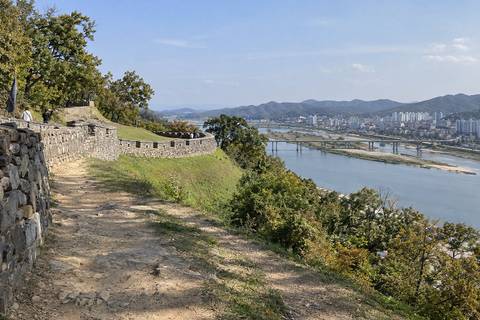
Baekje's royal fortress of 475–538, a wall walk along a ridge above the Geumgang River with the Geumseoru gate; ₩3,000, allow about 1 h 30.
Gomanaru
A pine grove on the Geumgang at the old ferry crossing, with the Ungjindan altar and a bear legend behind Gongju's old name; free.
Hwangsaebawi Martyrs' Shrine
A hillside shrine to the Catholics executed in Gongju in the 18th and 19th centuries, a short walk from Gongsanseong; free.
Frequently asked questions
Can you go inside King Muryeong's tomb?
No. The real chamber is closed to visitors for conservation, and so are the other tomb chambers. You walk past the grass mounds outside, and the exhibition hall has a full-size replica of the king's tomb that shows the brickwork and layout.
Is King Muryeong's tomb worth visiting?
Yes, if you pair it with the free Gongju National Museum, which holds the gold from the tomb. The ₩3,000 site alone is a replica and some grass mounds, so it can feel slight on its own. Together with Gongsanseong, the three make a full day from Seoul.
How long do you need at the Royal Tombs of Gongju?
Allow about an hour for the exhibition hall and the walk around the mounds, as an estimate. Add at least an hour for the National Museum, about 800 m away, and keep in mind that the site shuts at 17:00 from November to February.
Which bus goes to King Muryeong's tomb?
Bus 125 from Gongju Bus Terminal, 10 stops to 무령왕릉, with 29 runs a day on weekdays and 22 on holidays and in vacation periods. The city's tourism page also names a bus 101, but the bus system lists no such route. Check Naver Map for the live bus.
Are the tombs free on Wednesdays?
Sometimes, and it is worth asking. The city lists free entry on the last Wednesday of the month. Korea's national Culture Day now runs every Wednesday, but no Gongju notice was found extending the free entry, so be ready to pay ₩3,000 on other Wednesdays.
Where are the treasures from King Muryeong's tomb?
In the Gongju National Museum, about 800 m from the tombs. It is free and closed on Mondays. The city counts about 4,600 finds from the tomb, including the stone tablet, gold crown ornaments and earrings, and a stone guardian beast.
Sources
Facts on this page were checked against these sources on 7 November 2026. Prices, hours and rules change — confirm with the operator before you go.
- 공주시 문화관광 – 공주 무령왕릉과 왕릉원 (역사, 운영시간, 입장료, 무료입장, 해설, 통합권) (Korean) · official
- 공주시 문화관광 – 공주 무령왕릉과 왕릉원 (주소, 시간, 요금, 주차, 교통) (Korean) · official
- 공주시 문화관광 – 관광지 입장료 현황 (통합권, 경로증, 국립공주박물관) (Korean) · official
- 공주시 버스정보시스템 – 노선 정보 (125번·108번 정류장 순서, 운행 횟수) (Korean) · official
- 백제세계유산센터 – 공주 무령왕릉과 왕릉원 (무덤 구조, 6호분 벽화, 조사 연혁) (Korean) · official
- 백제세계유산센터 – 관람 안내 (요금, 주차, 전화) (Korean) · official
- 국가유산포털 – 공주 무령왕릉과 왕릉원 (사적 지정, 면적, 위치) (Korean) · official
- 문화체육관광부 – 매주 수요일은 문화가 있는 날 (2026) (Korean) · official
- UNESCO World Heritage Centre – Baekje Historic Areas · official
- 여기유 – 공주 무령왕릉과 왕릉원 (한국관광공사 자료, 2026년 10월: 시설, 둘러보기 코스) (Korean)
- 맘맘 – 무령왕릉과 왕릉원 (내부 비공개, 재현 모형) (Korean)
- 케이트립팁스 – 웅진백제역사관 (요금, 2026년 4월 수정) (Korean)
- KTrip Tips – Gongju Songsan-ri Tombs and Royal Tomb of King Muryeong (Korea Tourism Organization data)
- OpenStreetMap – 무령왕릉 (coordinates)