Buyeo · Central Buyeo (old Sabi)
Busosanseong Fortress 부소산성
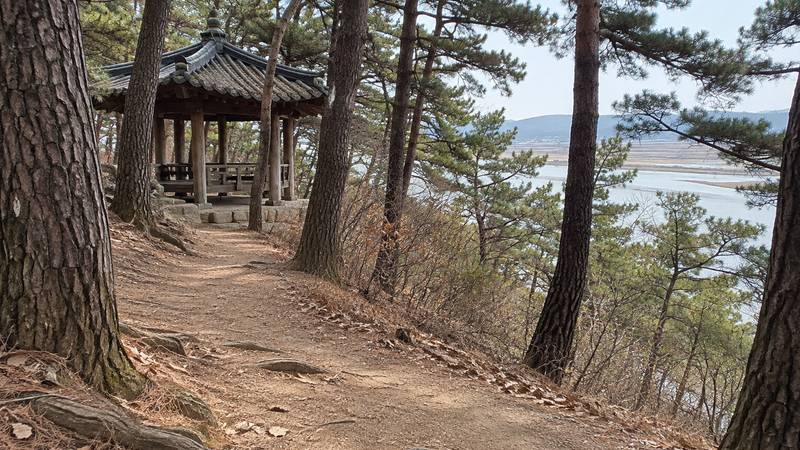
Wooded fortress hill above the river with the Nakhwaam cliff and Goransa temple; ₩2,000, free 12:00–13:00, allow about 2 hours.
Updated
Essentials
- Hours
- November–February 09:00–17:00
- March–October 09:00–18:00
- Closed
- 1 January, Seollal day and Chuseok day on the county's sight page; other sources show no closed days, so ring first
- Admission
- Adult ₩2,000; youth ₩1,100; child ₩1,000
- Free for everyone 12:00–13:00
- Age 6 and under, 65 and over, and disabled visitors free; foreign seniors are not specified
- Includes Nakhwaam and Goransa; the river boat is extra
- Getting there
- From Buyeo Intercity Bus Terminal: about 1 km on foot, roughly 15 minutes (map estimate)
- From Seoul Nambu Terminal: bus to Buyeo, about 2 hours, ₩20,400
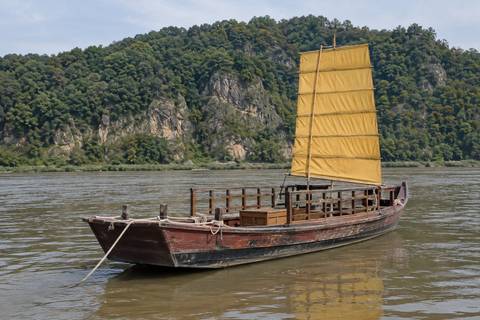
- River boat from Goransa pier to Gudure: 10 minutes, ₩7,000 one way
- Free parking at the fortress car park
- Address
- 31 Buso-ro, Buyeo-eup, Buyeo
충청남도 부여군 부여읍 부소로 31 - Website
- buyeo.go.kr/html/tour/info/info_010101.html
Book your trip
Busosanseong is worth a day from Seoul if you want a quiet forest walk rather than grand walls: ₩2,000 and about 2 hours through pine woods to the Nakhwaam cliff, then a boat down the river. Until the end of February it opens 09:00–17:00, and the last boats may stop as early as 16:00.
| Your situation | Do this |
|---|---|
| Day trip from Seoul | Take a bus before 09:00, see the Jeongnimsa pagoda, then walk the hill and ride the boat to Gudure |
| Visiting in winter | Enter by about 13:30, so you reach the pier by 15:30 |
| Travelling with a stroller or wheelchair | Borrow one at the ticket office and stay on the upper paths; skip the steep way to Nakhwaam and Goransa |
| Saving money | Enter between 12:00 and 13:00, when it is free for everyone |
| Expecting a big stone wall | Go to Gongsanseong in Gongju instead; the walls here are mostly earth banks |
| Short of time | Enter, go straight to Nakhwaam and Goransa, and take the boat out |
What will you see on the walk?
This route starts at the main ticket office and ends at the river, so you do not have to double back. The stops follow Korea Tourism’s suggested walk, with Yeongillu and Banwollu added.
| Stop | What it is | Why stop |
|---|---|---|
| Samchungsa (삼충사) | Shrine to three loyal Baekje officials: Seongchung, Heungsu and Gyebaek | First stop after the ticket office |
| Yeongillu (영일루) | Pavilion on the south-eastern peak, named for watching the sunrise | The start of the loop along the ridge |
| Gunchangji (군창지) | Site of a military storehouse | Burnt rice and barley found here in 1915 led to its excavation |
| Banwollu (반월루) | Pavilion on the same south-eastern peak | The south side of the hill overlooks the old capital |
| Sajaru (사자루) | Pavilion on the north-western peak | Turn here for the way to the cliff |
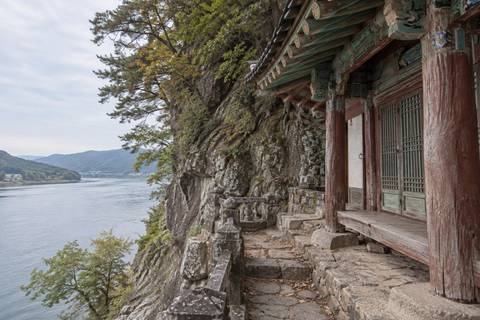
| Nakhwaam (낙화암) and Baekhwajeong (백화정) | Cliff about 60 m high over the river, with a pavilion above it | The main view over the Baengmagang River |
| Goransa (고란사) | Small temple on the slope below the cliff, known for its spring | On the way down to the pier |
From Buyeo County and Korea Tourism Organization pages, checked 6 November 2026. Goransa takes its name from the gorancho fern on the rock behind it, and its spring is the subject of a local legend about Baekje kings.
The county’s trail map lists its Busosan path at 2.0 km. This fuller route is roughly 3 km by OpenStreetMap, which is an estimate and not an official figure. To shorten it, skip Yeongillu and Gunchangji.
The hill itself is the attraction. It is low and mostly gentle, and the shrines and pavilions along the paths were excavated, restored or newly built after Baekje. The county warns that the final stretch to Nakhwaam and Goransa is a steep stone path. Wear shoes with grip.
Why does this hill matter?
Baekje moved its capital to Sabi, now Buyeo, in 538, and this hill guarded the royal compound at its foot. It worked as a palace garden in peacetime and a last refuge in war, until the capital fell to Silla and Tang forces in 660. It belongs to the UNESCO-listed Baekje Historic Areas, along with the Gwanbuk-ri palace site below it.
The Baekje rampart is rammed earth, about 2.4 km around the whole hill and at most 4 m high where it survives. Shorter walls inside it date from the Unified Silla period and from the late Goryeo to early Joseon period. The name comes from an old Baekje word for pine, and the pines remain.
Nakhwaam means Falling Flowers Rock. By tradition, court women jumped from it into the river as the city fell, a story recorded in the medieval Samguk Yusa. The figure of 3,000 women is legend rather than record. The red characters carved on the cliff by the scholar Song Si-yeol are visible only from the water, which is one good reason to take the boat.
How much is it?
| Ticket | Adult | Youth | Child |
|---|---|---|---|
| Busosanseong (includes Nakhwaam and Goransa) | ₩2,000 | ₩1,100 | ₩1,000 |
| Group of 10 or more | ₩1,800 | ₩1,000 | ₩900 |
From Buyeo County’s fee table, checked 6 November 2026. Korea Tourism’s data puts the group threshold at 30 rather than 10, so ask if you are in a mid-sized group.
The river boat is a separate ticket: ₩7,000 one way or ₩11,000 return, or ₩5,000 and ₩7,000 for ages 3 to primary school. Seniors do not ride free.
Entry is free for everyone from 12:00 to 13:00, and the Royal Tombs have the same free hour. Age 6 and under, disabled visitors and those aged 65 and over also enter free. The county does not say whether the senior rule covers foreign visitors, so carry a passport and be ready to pay ₩2,000.
When should you go?
The fortress keeps winter hours now, 09:00–17:00 until the end of February, then 09:00–18:00 from March to October. The county’s table calls these entry hours, and no separate last entry time is published, so allow the full 2 hours before closing.
- Closures: the county’s sight page lists 1 January, Seollal day and Chuseok day. Its hours table and Korea Tourism’s data show no closed days, so ring 041-830-2884 if you are visiting on one of those dates. Seollal day falls on 7 February in 2027.
- Season: maple and cherry trees line the paths, so spring and autumn are the prettiest times, but no official peak dates are published.
- Rain: the steep section is stone, so take care in the wet. The boat can be cancelled in bad weather.
- English help: Korea Tourism’s data says English, Chinese and Japanese guidance needs advance booking. The tourist information centre (041-830-2880) has interpreters and asks visitors to get in touch first. Culture guides are posted at Samchungsa and the Banwollu plaza, 10:00–16:00 in winter, but the county does not say which languages they speak.
How do you get there, and how do you leave?
| From | How | Time and cost |
|---|---|---|
| Seoul Nambu Terminal | Bus to Buyeo Intercity Bus Terminal | About 2 h, ₩20,400; 18 a day, first 06:30 |
| Gongju bus terminal | Bus to Buyeo Intercity Bus Terminal | About 55 min, from ₩5,900; 13 a day |
| Buyeo Intercity Bus Terminal | Walk north through the town | About 1 km, roughly 15 minutes |
| Jeongnimsa | Walk north | About 10 minutes |
Bus details from the T-money Bus system and county fare table, and walking times from OpenStreetMap and Korea Tourism, checked 2–6 November 2026. The last bus from Buyeo to Seoul Nambu leaves at 20:30, according to the county’s timetable dated 1 October 2026. See Buyeo’s transport section for every route.
Leaving by boat: boats run between Goransa pier and Gudure in 10 minutes, and buying a one-way ticket suits this route. The county lists boat hours as 09:00–17:00 from November to February and 09:00–18:00 from March to October, but Korea Tourism’s data says 16:00 and 17:00. No timetable is published, so plan on the earlier time and ring the pier on 041-835-4690. Goransa pier has no car park, and if the boat has stopped, the way out is back up the steep path and over the hill.
From Gudure, the bus terminal is about 1.3 km on foot, roughly 20 minutes by OpenStreetMap.
What is around Busosanseong?
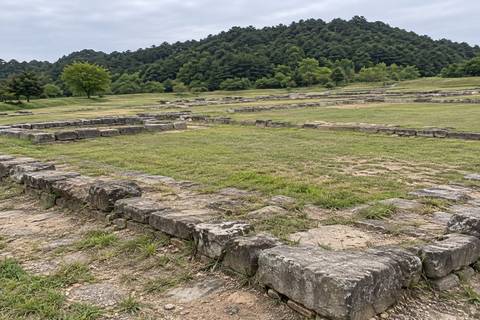
- Gwanbuk-ri palace site: the excavated royal compound at the foot of the hill, part of the UNESCO listing and an easy stop on the way to the gate.
- Jeongnimsa: the five-storey stone pagoda in the town centre, on the walk from the terminal.
- Buyeo National Museum: main galleries closed until 14 December 2026, but the incense burner hall is open with a free timed ticket.
- Gudure and the river boat: where the boat lands, with a restaurant street for lunch.
- Gungnamji: the free lotus pond south of the centre.
For the rest of the day, see the Buyeo city guide. For similar walks, see fortresses in Korea and UNESCO sites in Korea, or the wider Chungcheong guide.
Nearby
Nakhwaam and Goransa
A cliff over the river tied to Baekje's fall in 660 and a small temple below it by the pier; in the Busosanseong ticket.
Baengmagang River Boat and Gudure
Sail-shaped boats between Gudure park and the Goransa pier, 10 minutes each way; ₩7,000 one way, ₩11,000 return.
Gwanbuk-ri Royal Palace Site
The excavated site of the Baekje royal compound at the foot of Busosanseong, part of the UNESCO listing; dig areas vary.
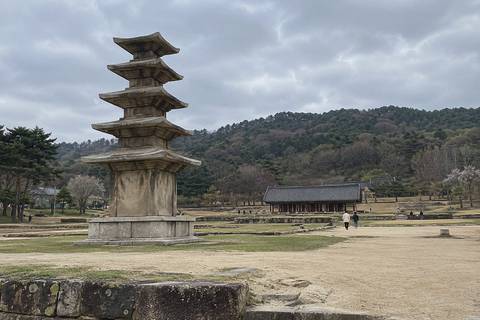
Jeongnimsa Temple Site
A Baekje five-storey stone pagoda, a National Treasure, on a free open temple site, with a free museum that closes on Mondays.
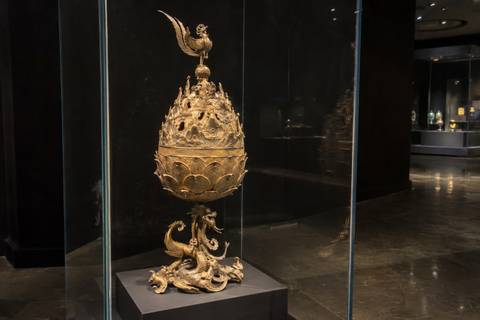
Buyeo National Museum
Home of the Gilt-bronze Incense Burner of Baekje; free, closed Mondays. Main galleries closed until 14 December 2026.
Frequently asked questions
Is Busosanseong worth visiting?
Yes, if you enjoy a shaded forest walk with history along the way, and it is the best thing to do in Buyeo on foot. Do not come expecting a stone wall or palace. The Baekje rampart is mostly an earth bank, and the pavilions are later buildings.
How much does Busosanseong cost?
Adults pay ₩2,000, youths ₩1,100 and children ₩1,000, and the ticket covers Nakhwaam and Goransa. Entry is free for everyone from 12:00 to 13:00. Age 6 and under, 65 and over, and disabled visitors also enter free, though the county does not say whether the senior rule covers foreign visitors.
How long does Busosanseong take?
Buyeo County suggests 2 hours, including Nakhwaam and Goransa. Allow longer if you add the 10-minute boat to Gudure and the wait for it. A shorter visit that skips the eastern pavilion and granary site is possible, but the climb down to Goransa is the steepest part either way.
Can I take a stroller or wheelchair to Nakhwaam?
Not easily. The county warns that the way to Nakhwaam and Goransa is a steep stone path that is hard for wheelchairs and strollers. Both can be borrowed at the ticket offices, so they are usable on the gentler paths, but plan to stop short of the river side.
What is the legend of Nakhwaam?
Nakhwaam means Falling Flowers Rock. By tradition, Baekje's court women threw themselves from this cliff into the river when the capital fell in 660, and the medieval Samguk Yusa records the story. The often-quoted figure of 3,000 women is legend rather than record.
Can I do Busosanseong as a day trip from Seoul?
Yes. Buses from Seoul Nambu Terminal take about 2 hours and cost ₩20,400, with the first at 06:30. The last bus back to Nambu leaves Buyeo at 20:30, so the fortress, the boat and the Jeongnimsa pagoda all fit in one day.
Sources
Facts on this page were checked against these sources on 7 November 2026. Prices, hours and rules change — confirm with the operator before you go.
- 부여군 – 부소산 낙화암 (소재지, 이용시간, 휴무일, 편의시설) (Korean) · official
- 부여군 – 주요 관광지 입장료 현황 (부소산성, 백마강 유람선) (Korean) · official
- 부여군 – 관광지 개방시간 안내 (입장시간, 소요시간) (Korean) · official
- 부여군 – 백마강 수상관광 (Korean) · official
- 부여군 – 백마강길 코스 (부소산길 2.0km) (Korean) · official
- 부여군 – 충남종합관광안내소 (근무시간, 외국어 통역안내) (Korean) · official
- 부여군 – 문화관광해설사 (Korean) · official
- 부여군 – 부여 터미널 시간표 (2026. 10. 1 기준) (Korean) · official
- 부여군 – 고란약수 전설 (Korean) · official
- 한국관광공사 대한민국 구석구석 – 아름다운 단풍 숲에서 백제의 역사를 만나다, 부여 부소산 (2021년 9월 작성) (Korean) · official
- 케이트립팁스 – 관북리유적과 부소산성 (한국관광공사 자료, 2026년 2월 갱신) (Korean)
- 케이트립팁스 – 고란사유람선 (한국관광공사 자료, 2025년 11월 갱신) (Korean)
- 한국민족문화대백과사전 – 부여 부소산성 (성벽 둘레와 구조) (Korean)
- 한국민족문화대백과사전 – 고란사 (Korean)
- 브라보마이라이프 – 부소산성 숲길 (복원 건조물, 탐방 시간) (Korean)
- UNESCO World Heritage Centre – Baekje Historic Areas · official