Buyeo · Royal Tombs and Naseong
Royal Tombs of Neungsan-ri 부여 왕릉원
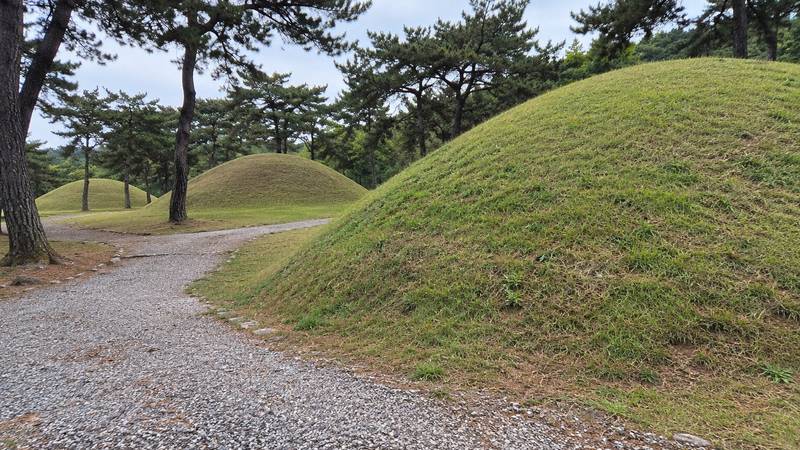
Grassy mounds of Baekje kings on a hillside, part of the UNESCO listing; ₩1,000, free 12:00–13:00, about 40 minutes.
Updated
Essentials
- Hours
- November–February: 09:00–17:00
- March–October: 09:00–18:00
- No last-entry time is published
- Closed
- Buyeo County lists the site as open every day; the Baekje World Heritage Center lists 1 January, Seollal day and Chuseok day as closed, so avoid those days
- Admission
- Adult ₩1,000; youth ₩600; child ₩400
- Free for everyone 12:00–13:00
- Free for age 6 and under, 65 and over, and disabled visitors; the sources do not say whether the senior rule covers foreign visitors
- Card payment accepted
- Getting there
- From Buyeo Intercity Bus Terminal: about 3.5 km east, a short taxi ride or about 45–50 minutes on foot (map estimate)
- From Seoul Nambu Terminal: bus to Buyeo, about 2 hours, ₩20,400
- Free parking: about 100 car and 20 coach spaces
- Address
- 61 Wangneung-ro, Buyeo-eup, Buyeo
충청남도 부여군 부여읍 왕릉로 61 - Website
- buyeo.go.kr/html/tour/info/info_010104.html
Book your trip
The royal tombs are worth the short taxi ride east of Buyeo if Baekje history brought you here: ₩1,000, free from 12:00 to 13:00, about 40 minutes. You see grassy burial mounds of the last Baekje kings from the paths, not the painted chambers inside. Until the end of February the gate shuts at 17:00.
| Your situation | Do this |
|---|---|
| Day trip from Seoul, one day in Buyeo | Busosanseong and Jeongnimsa first; add the tombs by taxi if you still have 90 minutes |
| Watching the budget | Arrive between 12:00 and 13:00, when entry is free for everyone |
| Came to see the incense burner | It was found at the temple site beside the tombs but is shown at the National Museum in town |
| Here on a Wednesday or Thursday | The tombs open as normal; only the small art museum at the site is closed |
| Want the guided story in English | Book a foreign-language guide ahead on 041-830-2330 |
| Using a wheelchair | Borrow one at the ticket office; the county lists step-free entry and an accessible toilet |
What will you see at the tombs?
The site was the burial ground of the Baekje court during the Sabi period, 538 to 660, when Buyeo was the capital. Seven mounds stand at the centre, with further tomb groups to the east and west. The central seven are thought to be royal.
| Tomb | Chamber type | What it is known for |
|---|---|---|
| Tomb 1 (동하총, East Lower Tomb) | Flat ceiling, square cross-section | Murals of the Four Guardians and lotus and cloud paintings on the ceiling |
| Tomb 2 (중하총, Middle Lower Tomb) | Tunnel-shaped arched ceiling | A different building method from the rest |
| Tombs 3–7 | Flat ceiling, six-sided cross-section | The most common form at the site |
From the Baekje World Heritage Center and Buyeo County, checked 15 November 2026. All are stone chambers entered through a side passage.
Expect a landscape, not a museum. The tombs were surveyed in 1915 and 1917 after early looting. Only coffin fragments with lacquer and gold leaf, gilt-bronze ornaments, a belt and a skull were recovered.
Tomb 1’s murals are the treasure. The Blue Dragon is painted on the east wall, the White Tiger on the west, the Black Tortoise on the north and the Red Phoenix on the south. No official page offers entry into the chambers, so the paintings are known from boards and displays, not seen in place.
Korea Tourism’s English page describes a tomb-model display at the entrance with cut-away miniatures of Baekje tomb types. Buyeo County separately lists an art museum at the site, open Friday to Tuesday from 10:00 to 15:00 with a break from 12:00 to 13:00, and closed on Wednesdays and Thursdays.
Why do the tombs matter?
They sit just outside the Naseong, the earthen outer wall that ringed the capital. Baekje did not bury its dead inside the city, so the royal tombs lie beyond the wall’s eastern line. The Baekje World Heritage Center calls the Naseong, with the outer wall of Luoyang in China, the earliest known example in East Asia of a defensive wall around a whole capital.
The temple in the valley is the other half of the story. Excavations just west of the tombs uncovered a temple site (능산리사지). It yielded the Gilt-bronze Incense Burner of Baekje and a stone reliquary inscribed with the name of King Chang, both National Treasures. A full-size rebuild of this temple, Neungsa, with its five-storey wooden pagoda, stands across the river at Baekje Cultural Land.
The site was made a Historic Site on 21 January 1963. Together with the Naseong’s 6.3 km eastern section, it is part of the UNESCO-listed Baekje Historic Areas, inscribed in 2015 with sites in Gongju and Iksan. For the rest of the listing, see UNESCO sites in Korea.
Two names, one place. The official Korean name is now 부여 왕릉원, Buyeo Royal Tombs. Korea Tourism’s English page and many maps still use the older Neungsan-ri Ancient Tombs (능산리 고분군), so search either in Naver Map.
How much does it cost, and when is it open?
| Ticket | Price |
|---|---|
| Adult | ₩1,000 |
| Youth | ₩600 |
| Child | ₩400 |
| Everyone, 12:00–13:00 | Free |
| Age 6 and under, 65 and over, disabled visitors | Free |
Buyeo County fee table (July 2026), cross-checked with the Baekje World Heritage Center and Korea Tourism’s data (updated 11 November 2026). Residents of Buyeo, Gongju and Cheongyang also enter free with ID. The sources do not say whether the over-65 rule covers foreign visitors. Cards are accepted.
| Period | Hours |
|---|---|
| November – February | 09:00–17:00 |
| March – October | 09:00–18:00 |
Buyeo County and the Baekje World Heritage Center. No last-entry time is published, so arrive at least 40 minutes before closing.
- Closed days: Buyeo County’s page says the site is open every day of the year. The Baekje World Heritage Center lists 1 January, Seollal day and Chuseok day as closed, and Korea Tourism’s data lists Seollal and Chuseok days. Seollal day falls on 7 February in 2027.
- Time needed: the county suggests 40 minutes. Allow an hour if you also walk over to the temple site.
- Guides: Korean-language culture guides take groups of 10 or more from 10:00 to 17:00. Guides in English, Chinese and Japanese must be booked in advance on 041-830-2330.
- Access: wheelchairs can be borrowed at the ticket office, and the county lists accessible parking, an accessible toilet and step-free entry. Pets are not allowed.
How do you get there from Buyeo town?
| From | How | Time and cost |
|---|---|---|
| Buyeo Intercity Bus Terminal | Taxi east along Wangneung-ro | About 3.5 km by road |
| Buyeo Intercity Bus Terminal | On foot | About 45–50 minutes (map estimate) |
| Seoul Nambu Terminal | Bus to Buyeo, then taxi | About 2 h by bus, ₩20,400; 18 a day |
| Gongju bus terminal | Bus to Buyeo, then taxi | About 55 min by bus, from ₩5,900 |
Bus details from Buyeo County and the T-money Bus system (checked November 2026); distance from OpenStreetMap. There is no railway in Buyeo. See Buyeo’s transport section for every route.
A taxi is the practical choice. The county’s rural bus timetable does not list a stop under the tombs’ name, and rural buses in Buyeo run only every hour or two. The tourist information centre in the Busosanseong car park (041-830-2880, 09:00–18:00) can give current bus times.
Drivers park free at the site, which has about 100 car spaces. Search 부여왕릉원 or 능산리고분군 in Naver Map.
What else is nearby?
- Naseong Wall: the earthen eastern wall of the capital, right beside the site; free and open at all times.
- Buyeo National Museum: back in town, home of the incense burner. Its main galleries are closed until 14 December 2026, but the incense burner hall stays open with a free timed ticket.
- Jeongnimsa Temple Site: the free Baekje stone pagoda near the bus terminal.
- Gungnamji: the free lotus pond on the south side of town.
- Busosanseong: the fortress hill above the river, also free from 12:00 to 13:00.
A practical order for one day: Jeongnimsa and Busosanseong in the morning, a taxi to the tombs over the free lunch hour, then back to Gungnamji before the bus out. For the full picture of the town, see the Buyeo city guide and the wider Chungcheong guide.
Nearby
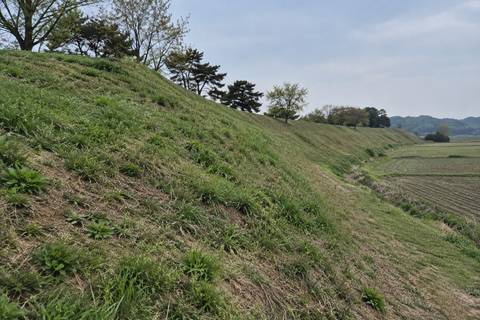
Naseong Wall
The earthen outer wall of the Baekje capital, its eastern line part of the UNESCO listing; free and open at all times.
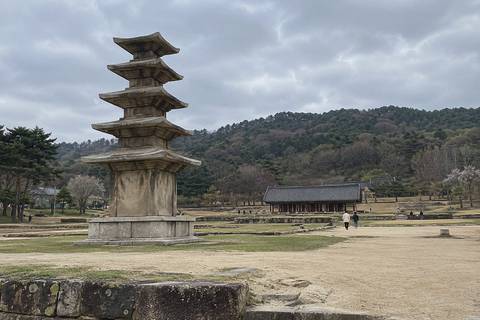
Jeongnimsa Temple Site
A Baekje five-storey stone pagoda, a National Treasure, on a free open temple site, with a free museum that closes on Mondays.
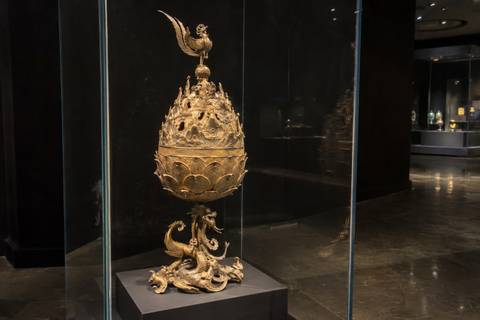
Buyeo National Museum
Home of the Gilt-bronze Incense Burner of Baekje; free, closed Mondays. Main galleries closed until 14 December 2026.
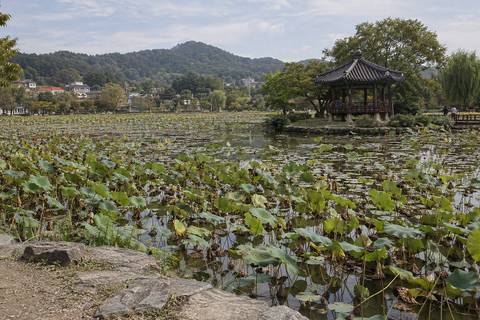
Gungnamji Pond
A Baekje-era palace pond, restored, with a pavilion on an island and wide lotus fields; free and open at all times.
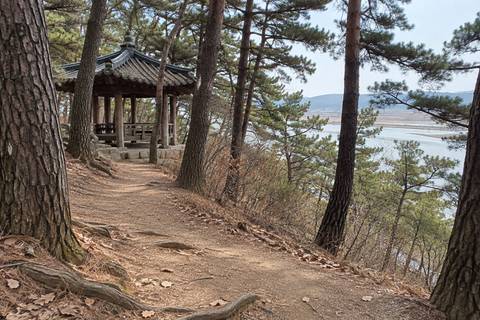
Busosanseong Fortress
Wooded fortress hill above the river with the Nakhwaam cliff and Goransa temple; ₩2,000, free 12:00–13:00, allow about 2 hours.
Frequently asked questions
Are the Neungsan-ri royal tombs worth the trip out of town?
Yes, if Baekje history is why you came to Buyeo. The ticket costs ₩1,000, the walk round takes about 40 minutes, and the same stop gives you the temple site where the incense burner was found and a stretch of the UNESCO-listed Naseong wall. With only a few hours in Buyeo, Busosanseong and Jeongnimsa come first.
How much is admission, and when is it free?
Adults pay ₩1,000, youths ₩600 and children ₩400. Entry is free for everyone from 12:00 to 13:00, according to Buyeo County's July 2026 fee table. Children 6 and under, people 65 and over and disabled visitors also enter free.
Can you go inside the tombs?
No official page offers entry into the burial chambers. You walk the paths between the mounds and see them from outside. The painted chamber of Tomb 1 is the reason the site is famous, so look for the explanation boards and any model displays rather than expecting to see the murals.
How do I get to the royal tombs from Buyeo bus terminal?
Take a taxi; the site is about 3.5 km east of the terminal by road. Walking takes roughly 45–50 minutes by map estimate. The county's rural bus timetable does not list a stop under the tombs' name, so check with the tourist information centre (041-830-2880) before relying on a bus.
Is it the same place as the Neungsan-ri Ancient Tombs?
Yes. The official Korean name is now 부여 왕릉원 (Buyeo Royal Tombs), but the old name, Neungsan-ri Ancient Tombs (능산리 고분군), is still used on Korea Tourism's English page and on many maps. Search either name in Naver Map.
Is the site open on Seollal and Chuseok?
The sources disagree. Buyeo County's tourism page says it is open all year, while the Baekje World Heritage Center lists 1 January, Seollal day and Chuseok day as closures. Seollal day is 7 February in 2027, so plan another day or ring 041-830-2890.
Sources
Facts on this page were checked against these sources on 15 November 2026. Prices, hours and rules change — confirm with the operator before you go.
- 부여군 – 부여왕릉원 (사적 지정, 관람시간, 연중무휴, 편의시설, 아트뮤지엄) (Korean) · official
- 부여군 – 주요 관광지 입장료 현황 (2026. 7., 점심시간 무료) (Korean) · official
- 부여군 – 관광지 개방시간 안내 (소요시간 40분) (Korean) · official
- 백제세계유산센터 – 부여 왕릉원 (무덤 형식, 동하총 사신도, 능산리사지) (Korean) · official
- 백제세계유산센터 – 부여 나성 (동나성 6.3km) (Korean) · official
- 백제세계유산센터 – 유적 관람안내 (휴무일, 무료 대상, 문화해설사, 주차) (Korean) · official
- VisitKorea – Buyeo Neungsan-ri Ancient Tombs [UNESCO World Heritage] · official
- UNESCO World Heritage List – Baekje Historic Areas · official
- 부여군 – 부여 터미널 시간표 및 농어촌버스 시간표 (2026. 3. 1 / 2026. 10. 1 기준) (Korean) · official
- 케이트립팁스 – 부여 왕릉원 (한국관광공사 자료, 2026-11-11 갱신: 휴일, 요금, 주차, 외국어 해설) (Korean)
- OpenStreetMap – 터미널–왕릉원 도보 거리 추정