Buyeo · Central Buyeo (old Sabi)
Jeongnimsa Temple Site 정림사지
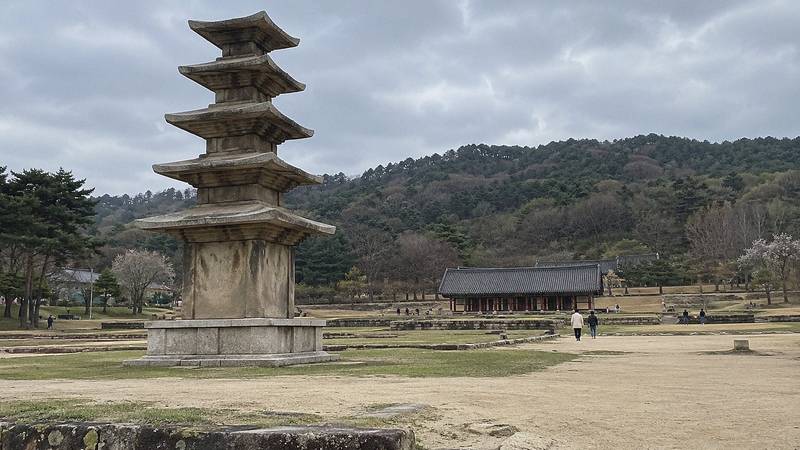
A Baekje five-storey stone pagoda, a National Treasure, on a free open temple site, with a free museum that closes on Mondays.
Updated
Essentials
- Hours
- Grounds and pagoda: open every day of the year
- Museum, November–February: 09:00–17:00, last entry 16:00
- Museum, March–October: 09:00–18:00, last entry 17:00
- The museum says the grounds can be visited until 21:00 in winter and 22:00 from March to October
- Closed
- Museum only: Mondays, 1 January, Seollal day and Chuseok day; if a Monday is a public holiday, it closes on the next weekday instead
- Admission
- Free for all visitors, both grounds and museum
- Getting there
- From Buyeo Intercity Bus Terminal: about 600 m on foot, under 10 minutes (map estimate)
- From Seoul Nambu Terminal: bus to Buyeo, about 2 hours, ₩20,400
- From Gongju bus terminal: bus to Buyeo, about 55 minutes, from ₩5,900
- Free parking during visiting hours
- Address
- 83 Jeongnim-ro, Buyeo-eup, Buyeo
충청남도 부여군 부여읍 정림로 83 - Website
- jeongnimsaji.or.kr/index.php?mid=Pages05
Book your trip
Jeongnimsa is worth a short stop on any Buyeo day: free, about 40 minutes, and under 10 minutes on foot from the bus terminal. You come for one 8.33 m Baekje stone pagoda, not a working temple. The grounds never close, but the museum shuts on Mondays and takes last entry at 16:00 until the end of February.
| Your situation | Do this |
|---|---|
| Day trip from Seoul | Make this your first stop from the terminal, then walk north to Busosanseong |
| Here on a Monday | See the pagoda and grounds; the museum is closed, and so is the National Museum |
| Arriving after 16:00 in winter | Skip the museum and walk the grounds while there is light |
| Only 30 minutes between buses | Walk to the pagoda and back, and look for the text on its first storey |
| With children | Go inside for the digital lotus pond and the dome show |
| Using a wheelchair or stroller | Both can be borrowed, and the county lists an elevator and step-free entry |
What will you see, in what order?
The temple was laid out in a straight south–north line, so you can walk it in its original order. Excavations found a south gate, two ponds, a middle gate, the pagoda, the main hall and the lecture hall, all surrounded by corridors.
| Stop | What it is | Why stop |
|---|---|---|
| Ponds (연지) | Two lotus ponds south of the middle gate | Dug out in 1984 from over 4 m below ground, with charred lotus stems inside |
| Five-storey pagoda (오층석탑) | National Treasure, 8.33 m | One of only two Baekje stone pagodas left in Korea |
| Main hall site (금당지) | The hall directly behind the pagoda | One pagoda and one hall in line is the classic Baekje plan |
| Stone Buddha (석조여래좌상) | Seated Buddha, a Treasure, in a protective hall on the lecture hall site | A Goryeo figure on a far older site |
| Museum (정림사지박물관) | Two galleries joined by a media bridge | Explains what the empty ground once held |
| Outdoor exhibition (야외전시) | Stone relics along a tree-lined path | Looks down over the site and pagoda |
From the museum’s site pages and Buyeo County, checked 7 November 2026. The county suggests 40 minutes for the sight. As a planning estimate, allow an hour if you also want the museum’s media rooms.
Look at the first storey of the pagoda. The roof stones are thin, wide and slightly upturned at the corners, and small blocks echo timber building. The carved text sits on the first-storey body and the roof supports just above it.
The Buddha is a battered survivor. The body is so worn that its details are hard to read, and the head and crown were made later and added. The eight-sided base is the better-carved part. The museum’s and county’s pages do not say whether its hall opens on Mondays or after dark.
Why does this pagoda matter?
The temple stood at the heart of Sabi, Baekje’s last capital from 538, directly south of the royal compound. The pagoda’s exact date is unknown. The museum says only that the style suggests it came a little later than the Mireuksa stone pagoda in Iksan, the only other one to survive from Baekje.
Baekje’s masons were moving from wood to stone. The museum treats this pagoda as the point where the form settled, and as a starting model for later Korean stone pagodas. The temple site also shows a plan the museum calls unique to Baekje, with monks’ quarters joined to the corridors.
The conqueror’s text is the striking part. After taking the capital in 660, the Tang general Su Dingfang had a victory text cut into the pagoda, dated 15 August that year. In the Joseon period it was known as the Pyeongje Pagoda, the pagoda of the conquest of Baekje, and a 1759 gazetteer says he built it. He did not; he only used it.
Even the name came later. Nobody knows what the temple was called in Baekje times. A roof tile found in 1942 is inscribed with a date equal to 1028 and the name Jeongnimsa (定林寺), from when the temple was rebuilt under Goryeo. Burnt earth at the main hall suggests the original temple burned when Baekje fell.
The site joined the UNESCO-listed Baekje Historic Areas on 4 July 2015. For the wider listing, see UNESCO sites in Korea and temples in Korea.
Is the museum worth going into?
Yes if you have the time, since it costs nothing and gives the bare site its meaning. The museum reopened in June 2021 after a rebuild built around digital displays rather than rows of cases.
- Gallery 1, Jeongnimsa Hall: an infinity room, the excavation story, a hands-on section on how the pagoda was built, and finds from the site.
- The bridge: a digital lotus pond that blooms as you walk through it, the part most likely to please children.
- Gallery 2, Baekje Buddhism: how Buddhism reached and spread from Baekje, ending in a 360-degree dome show.
- Gallery 2 mezzanine: tiles, pottery and celadon from after Baekje’s fall.
English help is limited. The museum’s app is listed in English, Japanese and simplified Chinese as well as Korean, and it adds AR content in the galleries, so download it first. The museum says it runs no exhibition tour programme, and its pages do not say which languages the labels use.
Culture guides are posted at the site from 10:00 to 16:00 in winter and to 17:00 from March to October. They serve groups of 10 or more, by phone on 010-7330-2891, and the museum does not list the languages they speak.
House rules: no flash, tripods, or food in the museum. Pets are not allowed on the site, except guide dogs in the museum. Bicycles, scooters and skateboards are banned on the outdoor paths.
When should you go?
| Period | Museum open | Last museum entry | Grounds |
|---|---|---|---|
| 1 Nov 2026 – 28 Feb 2027 | 09:00–17:00 | 16:00 | Every day, to 21:00 |
| March – October | 09:00–18:00 | 17:00 | Every day, to 22:00 |
From the museum’s visitor page and its notice of 22 October 2026. The county’s hours table lists only the daytime hours, and Korea Tourism’s data calls the pagoda always open.
- Closures: the museum closes on Mondays, 1 January, Seollal day and Chuseok day. Seollal day falls on 7 February in 2027. If a Monday is a public holiday, the museum opens and closes on the next weekday instead. It also posts occasional one-off closures, so check its notices or ring 041-832-2721.
- Evenings: no source found confirms that the pagoda is lit on ordinary nights. The last bus to Seoul Nambu leaves at 20:30, so a night visit suits people staying over, and only if you accept it may be dark.
- Light shows: the 2026 media art event, the sixth, lit the pagoda free of charge every evening from 7 to 27 September. The 2027 dates had not been announced when this page was checked.
- Rain: the museum is the natural shelter, except on Mondays.
How do you get there, and where next?
| From | How | Time and cost |
|---|---|---|
| Seoul Nambu Terminal | Bus to Buyeo Intercity Bus Terminal | About 2 h, ₩20,400; 18 a day, first 06:30 |
| Gongju bus terminal | Bus to Buyeo Intercity Bus Terminal | About 55 min, from ₩5,900; 13 a day |
| Daejeon Seonambu Terminal | Bus to Buyeo Intercity Bus Terminal | About 1 h 30 min, ₩9,600; 16 a day |
| Buyeo Intercity Bus Terminal | Walk east along the town streets | About 600 m, under 10 minutes |
Bus details from the T-money Bus system and county tables, and walking estimates from OpenStreetMap, checked 2–7 November 2026. There is no railway in Buyeo. See Buyeo’s transport section for every route.
Drivers can use the free car park of about 78 spaces, including accessible bays. Search for 정림사지박물관 in Naver Map. The county’s address is 정림로 83, though one museum page prints 38.
- Busosanseong: about 10 minutes north, the fortress hill and Nakhwaam cliff, and the natural next stop.
- Buyeo National Museum: about 10 minutes south-east by map estimate. Its main galleries are closed until 14 December 2026, but the incense burner hall is open with a free timed ticket.
- Gungnamji: the free lotus pond, about 1.3 km south, roughly 20 minutes by map estimate.
- Gwanbuk-ri palace site: the excavated royal compound at the foot of Busosanseong, on the way to the fortress gate.
- Royal Tombs of Neungsan-ri: about 3 km east, by taxi or rural bus.
For the rest of the day, see the Buyeo city guide. To pair it with the earlier Baekje capital, see Gongju and the wider Chungcheong guide.
Nearby
Busosanseong Fortress
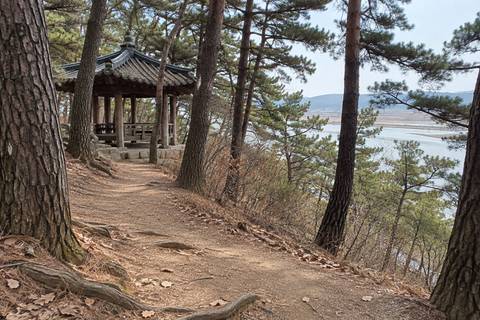
Wooded fortress hill above the river with the Nakhwaam cliff and Goransa temple; ₩2,000, free 12:00–13:00, allow about 2 hours.
Buyeo National Museum
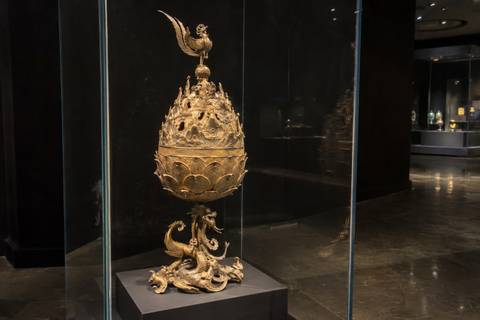
Home of the Gilt-bronze Incense Burner of Baekje; free, closed Mondays. Main galleries closed until 14 December 2026.
Gwanbuk-ri Royal Palace Site
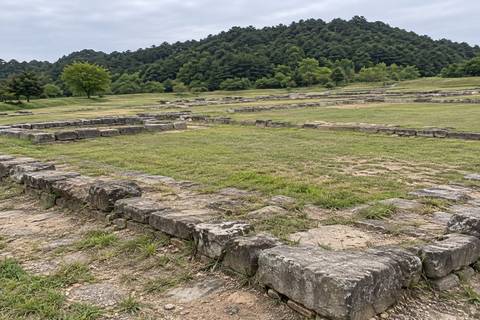
The excavated site of the Baekje royal compound at the foot of Busosanseong, part of the UNESCO listing; dig areas vary.
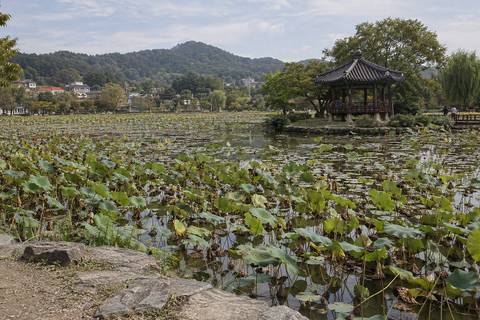
Gungnamji Pond
A Baekje-era palace pond, restored, with a pavilion on an island and wide lotus fields; free and open at all times.
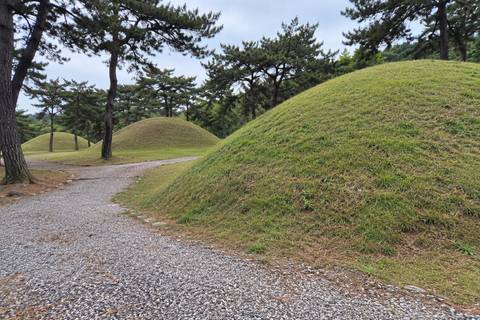
Royal Tombs of Neungsan-ri
Grassy mounds of Baekje kings on a hillside, part of the UNESCO listing; ₩1,000, free 12:00–13:00, about 40 minutes.
Frequently asked questions
Is Jeongnimsa worth visiting?
Yes, as a short stop. It is free, under 10 minutes on foot from the bus terminal, and home to one of only two Baekje stone pagodas left in Korea. Do not expect a working temple. Apart from the pagoda and a later Buddha, the buildings are gone.
Does Jeongnimsa cost anything?
No. The museum's own page says admission is free for all visitors, and Buyeo County's July 2026 fee table lists every category as free. Parking is free too during visiting hours.
Is Jeongnimsa open on Mondays?
The grounds and pagoda are. The museum is closed on Mondays, and if a Monday is a public holiday it closes on the next weekday instead. It also closes on 1 January and on Seollal and Chuseok days.
Can I see the pagoda at night?
The museum says the grounds can be visited until 21:00 from November to February and 22:00 from March to October, and Korea Tourism's data calls the pagoda always open. No source found confirms lighting outside events, so a night visit may be a dark one.
What is written on the pagoda?
A victory text carved after Baekje fell in 660. The Tang general Su Dingfang (소정방) had it cut into the first storey, dated 15 August 660. It led Joseon-era Koreans to call this the Pyeongje Pagoda, and a 1759 gazetteer wrongly credits him with building it.
Is there English at the Jeongnimsa museum?
The museum's app is listed in English, Japanese and simplified Chinese as well as Korean, with AR content that works on site. The museum runs no exhibition tour programme, and its pages do not say which languages the gallery labels use.
Sources
Facts on this page were checked against these sources on 7 November 2026. Prices, hours and rules change — confirm with the operator before you go.
- 정림사지박물관 – 관람안내 (관람시간, 무료 관람, 휴관일, 야간 관람) (Korean) · official
- 정림사지박물관 – 동절기 운영시간 안내 (2026.11.1~2027.2.28, 2026-10-22 공지) (Korean) · official
- 정림사지박물관 – 세계유산 정림사지 관람안내 (주차, 유모차·휠체어, 반려동물) (Korean) · official
- 정림사지박물관 – 관람시 유의사항 (Korean) · official
- 정림사지박물관 – 관람해설안내 (문화관광해설사) (Korean) · official
- 정림사지박물관 – 시설안내 (Korean) · official
- 정림사지박물관 – 오시는 길 (Korean) · official
- 정림사지박물관 – 발굴조사 (가람배치, 연지) (Korean) · official
- 정림사지박물관 – 정림사지 5층석탑 (건립연대) (Korean) · official
- 정림사지박물관 – 역사속의 정림사지 (1028년 기와, 660년 명문, 평제탑) (Korean) · official
- 정림사지박물관 – 정림사지 석조여래좌상 (Korean) · official
- 정림사지박물관 – 제1전시실 정림사지관 (Korean) · official
- 정림사지박물관 – 제2전시실 백제불교역사관 (Korean) · official
- 정림사지박물관 – 브릿지 (디지털 연못과 연꽃) (Korean) · official
- 정림사지박물관 – 야외전시 (Korean) · official
- 정림사지박물관 – 주요연혁 (2015.7.4 세계유산 등재) (Korean) · official
- 부여군 – 정림사지5층석탑 (국보 지정, 편의시설) (Korean) · official
- 부여군 – 주요 관광지 입장료 현황 (2026. 7.) (Korean) · official
- 부여군 – 관광지 개방시간 안내 (소요시간 40분) (Korean) · official
- 부여군 – 부여 터미널 시간표 (2026. 10. 1 기준) (Korean) · official
- 백제세계유산센터 – 부여 정림사지 (Korean) · official
- 케이트립팁스 – 부여 정림사지 오층석탑 (한국관광공사 자료, 2026년 6월 갱신) (Korean)
- 한국민족문화대백과사전 – 당평백제국비 (Korean)
- gninews – 부여 국가유산 미디어아트 개막, 정림사지 (2026.9.7~9.27) (Korean)
- App Store – 정림사지 박물관 앱 (언어, AR) (Korean)
- OpenStreetMap Nominatim – 도보 거리 추정용 위치