Gongju · Royal tombs and the museum quarter
Gongju National Museum 국립공주박물관
The gold crown ornaments, stone tablets, guardian beast and other finds from King Muryeong's tomb; free, closed Mondays.
Updated
Essentials
- Hours
- 09:00–18:00 every opening day, weekends and public holidays included
- Closed
- Mondays (when a Monday is a public holiday the museum opens and closes on the next weekday instead), 1 January, Seollal day and Chuseok day
- Admission
- Free (special exhibitions may sometimes charge)
- Getting there
- From Gongju Bus Terminal: bus 125 to 문예회관 (Gongju Arts Center), then about 800 m on foot past the royal tombs
- Bus 108 runs from the terminal to the museum gate, but only about 9 times on weekdays and 5 on other days
- Taxi about 15 minutes from Gongju Bus Terminal, about 5 minutes from the Sanseong-dong bus stop by Gongsanseong
- Express bus from Seoul Express Bus Terminal to Gongju about 1 h 30 min
- Free parking, according to Gongju City
- Address
- 34 Gwangwangdanji-gil, Gongju, Chungcheongnam-do
충청남도 공주시 관광단지길 34 - Website
- gongju.museum.go.kr/eng/index.do
Book your trip
The Gongju National Museum is where the treasures from King Muryeong’s tomb are kept, and it is free. It opens 09:00–18:00 daily except Mondays, 1 January, Seollal and Chuseok. The main gallery shows the stone tablets that named the king, his stone guardian beast and the gold ornaments, laid out like the tomb itself. Allow about an hour. It sits about 800 m on foot from the royal tombs, so see both in one visit.
| Your situation | Do this |
|---|---|
| Day trip from Seoul | Gongsanseong in the morning, bus 125 to the royal tombs, then walk to the museum |
| Only an hour in Gongju | Skip the tomb site and come straight here. The real finds are in the museum, and the museum is free |
| Arriving on a Monday | The museum is closed. The fortress and the tombs stay open |
| With children aged about 6–8 | Book the free-entry children’s room online before you go. Sessions are 40 minutes |
| Visiting before 21 February 2027 | The finds from the queen’s coffin are shown together in the main gallery until then |
| Rainy day | Everything worth seeing here is indoors. Do the outdoor fortress walk another day |
What is the Gongju National Museum?
Gongju was Ungjin, the capital of the Baekje kingdom from 475 to 538. In 1971, workers digging a drain at the Songsan-ri tombs found a tomb by chance. Its stone tablet named the dead man as King Muryeong, Baekje’s 25th king. It is the only tomb from Korea’s Three Kingdoms period whose owner is known for certain, according to the museum.
The museum began in 1946 as a branch of the National Museum. It moved in 2004 to its present building in Ungjin-dong, below the royal tombs. It drew 868,555 visitors in 2025, according to a 2026 press report on its 80th anniversary.
What do you see inside?
Ungjin Baekje Gallery (웅진백제실)
This is the reason to come. The museum built a display case the same size as the floor of King Muryeong’s tomb. Inside it, the guardian beast, the ritual vessels and the restored coffins of the king and queen sit where they lay in the tomb. Look for these:
- The two stone tablets (지석). The king’s records that he died in 523 at the age of 62 and was buried in 525. On the back is a grid of the 60-year cycle, which served as a map of the tomb.
- The stone guardian beast (진묘수). A horned, winged creature, 32 cm high and weighing 48.5 kg, with iron horns. It is the first tomb guardian of this kind found in Korea.
- Gold crown ornaments and earrings. Gold crown ornaments (관꾸미개) from the king’s and queen’s headdresses, plus pairs of gold earrings. The museum’s analysis puts the king’s earrings at 97.9–99.8% gold.
- Bronze mirrors, gold-bronze shoes and the wooden headrests. The king’s shoes are about 38 cm long. They were made for burial, not for wearing. The black-lacquered pillow and footrest are carved to hold the head and feet.
Until 21 February 2027, the gallery also has 1,500 Years Together (1,500년의 동행), showing the objects found inside the queen’s coffin, according to the museum’s exhibition list.
The rest of the museum
| Space | What is there |
|---|---|
| Chungcheongnam-do History and Culture Gallery | The province from the Stone Age to the Joseon era, in three parts |
| Special exhibition hall | Korea’s Sacred Mountain, Gyeryongsan (한국의 영산, 계룡산), on the mountain east of Gongju, until 1 March 2027 |
| Chungcheong Storage Facility | An open storage building, opened in 2021, where you look into the stacks of pottery, roof tiles and stone tools from the region’s national museums |
| Outdoor garden | 32 stone pieces in the Guardian’s Garden, 17 of them donated by the late Samsung chairman Lee Kun-hee, plus stone guardian animals, lanterns and Buddhas |
| Digital immersive cinema | 8-minute screenings for about 10 people at a time. Sign up on the spot; no screenings 12:00–13:00 |
| Ungjin Baekje Children’s Room | For ages up to primary school, best for ages 6 to second grade. 40-minute sessions of 30 people, booked online in advance |
From the museum’s Korean and English pages, checked 15 November 2026. The museum lists both exhibitions as current, but does not state a separate fee for either.
How do you get there?
The museum is in Ungjin-dong in the west of Gongju, below the royal tombs, across the river from the bus terminal. See Gongju’s transport section for buses from Seoul, Daejeon and Incheon Airport.
- Bus 125 + walk. From the Gongju Bus Terminal, take bus 125 to 문예회관 (Gongju Arts Center). Then walk about 800 m past the royal tombs. Bus 125 also stops at Gongsanseong, so it is the easy link from the fortress.
- Bus 108. It stops at the museum gate, but runs only about 9 times on weekdays and 5 times on other days. That count is from the city’s bus system, checked 7 November 2026, so check Naver Map before you wait.
- Taxi. About 15 minutes from the bus terminal, or about 5 minutes from the Sanseong-dong bus stop by Gongsanseong, according to the museum. A taxi is worth it on a cold day.
- Car. Gongju City says parking is free.
The city’s tourism page also mentions the Sama-wang trail behind the museum. It climbs to the Jeongjisan site, a Baekje ritual site with a view of Gongsanseong and the Geumgang River.
Visitor tips
- Mondays and holiday Mondays. If the Monday is a public holiday, the museum opens and closes on Tuesday instead. In 2026 this happened in February, March, May, August and October.
- Get the app before you arrive. Search 국립박물관 전시안내 in the App Store or Google Play and download the Gongju content on Wi-Fi. It plays audio automatically as you reach each object. Bluetooth and location must be on, and you need your own earphones.
- Photos are fine without flash or a tripod. Food and drink are not allowed in the galleries, and visitors are asked not to bring pets.
- Order of the day. The royal tombs close at 17:00 from November to February, and the museum stays open until 18:00. Do the tombs first and the museum last.
- Guided talks. The volunteer talks in the galleries are suspended for now, according to the museum’s English page. Groups can ask for a guided visit one week ahead on 041-850-6300.
- The city’s hours are out of date. Gongju City’s tourism page still lists 10:00 opening. The museum’s own pages say 09:00.
Is it worth it?
Go if you are visiting the royal tombs. The tomb site has only a replica and grass mounds, and the real objects are here, free. The life-size layout of the tomb chamber is worth seeing even with little interest in archaeology. On a Baekje trip, it pairs with the Buyeo National Museum, the other Baekje capital’s museum.
Skip it only on a Monday or a holiday closure, or if museums are not your thing and time is short. Then spend your Gongju day on the fortress walls instead.
See the Gongju city guide for the rest of the day, museums in Korea for more collections, and the Chungcheong region page for the area.
Nearby
Royal Tombs of Gongju (King Muryeong's tomb)
Baekje royal tombs, including King Muryeong's, found intact in 1971; an exhibition hall reproduces the chambers. ₩3,000.
Gongju Hanok Village
A city-run cluster of new-built hanok next to the royal tombs, with rooms for overnight stays and a courtyard to stroll through.
Gomanaru
A pine grove on the Geumgang at the old ferry crossing, with the Ungjindan altar and a bear legend behind Gongju's old name; free.
Gongsanseong Fortress
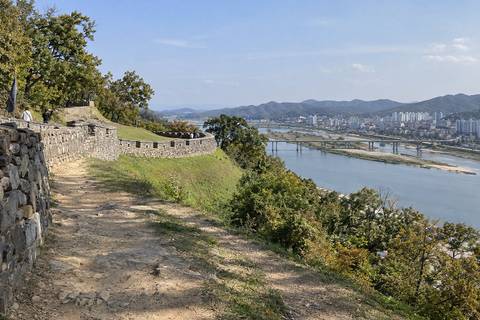
Baekje's royal fortress of 475–538, a wall walk along a ridge above the Geumgang River with the Geumseoru gate; ₩3,000, allow about 1 h 30.
Hwangsaebawi Martyrs' Shrine
A hillside shrine to the Catholics executed in Gongju in the 18th and 19th centuries, a short walk from Gongsanseong; free.
Frequently asked questions
Is the Gongju National Museum free?
Yes. Entry to the museum is free, including the permanent galleries, the outdoor garden and the open storage building. The museum says special exhibitions may charge in some cases, so check the exhibition page before a big show.
What are the Gongju National Museum opening hours?
09:00–18:00, the same on weekends and public holidays. It is closed on Mondays, 1 January, and on Seollal day and Chuseok day. When a Monday is a public holiday, the museum opens that day and closes on the next weekday instead.
Where are the treasures from King Muryeong's tomb?
In the Ungjin Baekje Gallery of the Gongju National Museum, about 800 m on foot from the tomb site. The gallery holds the two stone tablets naming the king and queen, the stone guardian beast, gold crown ornaments, gold earrings, bronze mirrors and the restored wooden coffins.
How long do you need at the Gongju National Museum?
About an hour covers the Ungjin Baekje Gallery and a look at the second gallery, as an estimate. Add 30 minutes for the outdoor stone garden and the open storage building, and more if you walk over from the royal tombs.
Is there information in English?
The free National Museum exhibition guide app (국립박물관 전시안내) gives location-based audio for the main objects in English, Chinese and Japanese as well as Korean. Bring your own earphones. The volunteer gallery talks are suspended for now, according to the museum's English page.
Sources
Facts on this page were checked against these sources on 15 November 2026. Prices, hours and rules change — confirm with the operator before you go.
- 국립공주박물관 – 관람 (관람시간 09:00~18:00, 무료, 휴관일 월요일·1월 1일·설날·추석, 2026년 대체휴관일, 디지털 실감 영상관, 전시안내 앱) (Korean) · official
- Gongju National Museum – General Information (viewing hours, free admission, days closed, 2026 substitute closures, guided service halted) · official
- 국립공주박물관 – 시설 (웅진백제실·충청남도역사문화실·기획전시실 면적, 옥외전시, 충청권역수장고, 주차장) (Korean) · official
- 국립공주박물관 – 오시는길 (주소, 125번 문예회관 하차 후 도보 800m, 108번, 택시 15분·5분) (Korean) · official
- 국립공주박물관 – 특별전시 현재전시 (1,500년의 동행-무령왕비 목관 내 부장품 2026-10-27~2027-02-21 웅진백제실; 한국의 영산, 계룡산 2026-09-22~2027-03-01 기획전시실) (Korean) · official
- 국립공주박물관 – 상설전시 웅진백제실 유물 (지석, 진묘수, 관꾸미개, 금귀걸이, 청동거울, 금동신발, 나무베개·발받침) (Korean) · official
- Gongju National Museum – Major Collection (stone guardian beast, king's and queen's epitaph plaques) · official
- Gongju National Museum – Outdoor Exhibition (Guardian's Garden, 32 stone artifacts incl. 17 donated by Lee Kun-hee; Jangmyeong Garden; Forest of Stone Guardian) · official
- 국립공주박물관 – 웅진백제 어린이 체험실 이용안내 (0세~초등학생, 회차 40분, 30명, 온라인 사전 예약) (Korean) · official
- Gongju National Museum – History (1946 branch, 1973 building, 2004 move to Ungjin-dong, 2021 Chungcheong Storage Facility) · official
- 공주시 문화관광 – 국립공주박물관 (주소, 무료 주차, 108번·125번, 사마왕 둘레길과 정지산유적; listed hours out of date) (Korean) · official
- 공주시 버스정보시스템 – 노선 정보 (108번·125번 운행 횟수, checked 7 November 2026) (Korean) · official
- 중도일보 via 다음 – 국립공주박물관 개관 80년 (2025년 관람객 868,555명, 무령왕릉 출토품, 계룡산 특별전 예고, 2026-04-09) (Korean)
- OpenStreetMap – 국립공주박물관 (coordinates)