Gongju · Temples and the countryside
Magoksa Temple 마곡사
A valley temple founded in 643 and split in two by a stream, one of the seven UNESCO-listed Sansa; free, about 40 minutes by bus 770.
Updated
Essentials
- Hours
- Temple grounds: open every day of the year; no gate hours are published
- Seongbo Museum: 10:00–17:00 April–October, 10:00–16:00 November–March
- Closed
- Temple: no closing day. Museum: closed Mondays, 1 January, Seollal and Chuseok
- Admission
- Temple: free
- Parking: free (about 280 cars, per Gongju City)
- Getting there
- City bus 770 from Sanseong-dong (산성동) in the old town, via Gongju Bus Terminal, to its last stop, Magoksa; about 40 minutes
- 8 buses a day towards the temple (06:20–20:30) and 9 back (07:10–21:10), the same every day
- From Seoul: express bus from Seoul Express Bus Terminal to Gongju, about 1 h 30 min, then bus 770
- Address
- 966 Magoksa-ro, Sagok-myeon, Gongju
충청남도 공주시 사곡면 마곡사로 966 - Website
- magoksa.or.kr
Book your trip
Magoksa is worth a half day from Gongju if you want a quiet, working mountain temple on the UNESCO list. It is free and open every day, and city bus 770 takes about 40 minutes from town. Only 8 buses a day run out and 9 back, and none leaves the temple between 07:10 and 11:00, so pick your return bus before you leave.
| Your situation | Do this |
|---|---|
| One day in Gongju | Do Gongsanseong and the royal tombs first; add Magoksa in the afternoon: 13:20 out with the 15:40 back, or 14:40 out with the 16:50 back |
| A night in Gongju | Give Magoksa the second morning: 10:00 bus out, 13:00 or 14:20 back |
| Day trip from Seoul | Express bus to Gongju (about 1 h 30 min), then the 10:00 or 11:30 bus 770; back on the 15:40 or 16:50 |
| Choosing one temple, no car | Magoksa for the UNESCO listing and the stream-split layout; Gapsa on Gyeryongsan is the other big temple near Gongju |
| Want to stay overnight | Book Magoksa’s templestay on templestay.com; it is listed as specialising in foreign guests |
| Rainy day | The temple museum is indoors (10:00–16:00 in winter, closed Mondays) |
Why Magoksa matters
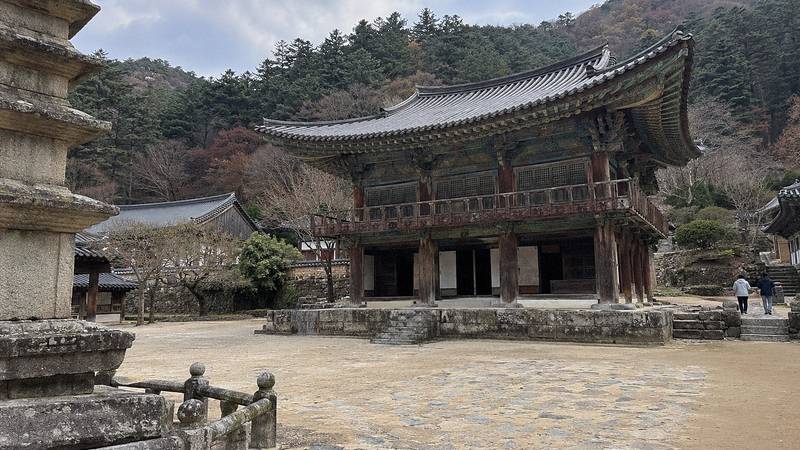
Magoksa (마곡사) sits in a valley of Taehwasan, in Sagok-myeon north-west of Gongju. It is the head temple of the Jogye Order’s 6th district and one of the seven mountain monasteries inscribed by UNESCO in 2018 as Sansa, Buddhist Mountain Monasteries in Korea. Its founding is traditionally credited to the Silla monk Jajang; the temple gives 640 and Gongju City 643.
What sets it apart is the layout. A stream divides the temple into a north court, built around the main Daegwangbojeon hall and its pagoda, and a smaller south court around Yeongsanjeon and the meditation quarters. The temple was badly damaged during the Japanese invasions of the 1590s, when it served as a gathering point for monk soldiers, and took its present form in the 18th century.
Getting there by bus 770
City bus 770 starts at Sanseong-dong (산성동/시내버스정류장), the city bus stop in the old town near Gongsanseong. It crosses the river to Gongju Bus Terminal (종합버스터미널, the 7th stop) and runs on to its last stop, Magoksa (마곡사). The city puts the ride at about 40 minutes.
| Bus 770 | Times |
|---|---|
| Sanseong-dong → Magoksa | 06:20, 10:00, 11:30, 13:20, 14:40, 16:00, 19:20, 20:30 |
| Magoksa → Sanseong-dong | 07:10, 11:00, 13:00, 14:20, 15:40, 16:50, 18:40, 20:10, 21:10 |
Gongju City timetable and bus information system, checked 13 November 2026. The same timetable runs on weekdays, weekends and holidays. Outbound times are from Sanseong-dong, so the bus reaches the terminal stop a few minutes later.
- Plan the return first. There is no bus back between 07:10 and 11:00, and the afternoon gaps are 70–110 minutes.
- Two extra runs take a detour through nearby villages: bus 771 leaves town at 08:00 (via Bugok), and bus 772 leaves town at 17:20 and Magoksa at 09:20 (via Daejung).
From Seoul, express buses leave Seoul Express Bus Terminal for Gongju about 28 times a day and take about 1 h 30 min (see the Gongju guide for fares). A Seoul day trip works with the 10:00 or 11:30 bus 770 out and the 15:40 or 16:50 back.
Hours and fees
| Hours | Fee | |
|---|---|---|
| Temple grounds | Open every day of the year | Free |
| Seongbo Museum | 10:00–17:00 April–October, 10:00–16:00 November–March; closed Mondays, 1 January, Seollal and Chuseok | Not stated |
| Parking | Free (about 280 cars) |
Gongju City and the Magoksa museum, checked 13 November 2026. Gongju City publishes no opening and closing time for the grounds, so treat daylight as the practical limit and call the temple office (041-841-6221) for evening visits.
What to see
A bridge over the stream links the south and north courts. Allow about 1 h 30 min for both courts and the museum, and an hour more for the Kim Gu trail.
- Five-storey stone pagoda. It stands in the north court in front of Daegwangbojeon and dates from the late Goryeo period. Its top is a gilt-bronze finial shaped like a small Tibetan-style stupa. It was raised from Treasure to National Treasure on 9 January 2025.
- Daegwangbojeon (대광보전). The main hall, rebuilt in 1813, enshrines Vairocana Buddha.
- Daeungbojeon (대웅보전). A two-storey hall, rebuilt in 1651, with Shakyamuni flanked by the Medicine and Amitabha Buddhas.
- Yeongsanjeon (영산전). The oldest building, also from 1651, in the south court. It holds a thousand small Buddha figures, hence its other name, the Thousand Buddha Hall.
- Seongbo Museum (성보박물관). The temple’s museum of its own treasures. Magoksa trained so many Buddhist painters that it was called the “southern painting studio”, and a memorial rite for them is still held every year.
Kim Gu and the Solbaram trail
Kim Gu (Baekbeom), later leader of Korea’s provisional government in exile, hid at Magoksa in 1898 after escaping from prison in Incheon. He was ordained here as a monk under the name Wonjong. The temple keeps Baekbeomdang, a small hall in his name, and a juniper he is said to have planted when he came back in 1946, after liberation.
The Baekbeom Solbaram Meditation Trail (백범 솔바람 명상길) runs through the pine woods above the temple, and Gongju City describes it as a walk of about an hour. It has three courses; check the map board at the temple before you set off, and allow for the return bus.
Templestay and visiting manners
Magoksa runs a Templestay, booked through templestay.com, the national booking site, which lists it as one of the temples specialising in foreign visitors. Programmes, dates and prices are on the booking page, and the temple’s templestay office answers on 041-841-6226. See temple stays in Korea for what an overnight involves.
- Dress. Cover shoulders and knees; this is a working monastery.
- Quiet. Speak softly and stay out of areas signed as meditation quarters, especially in the south court.
- Inside halls. Take off your shoes, enter by a side door rather than the central one and ask before photographing monks or people at prayer.
- Season. The valley is best known for fresh spring green, when Gongju holds a spring festival at the temple, and for autumn colour from late October.
For more monasteries, see temples in Korea, UNESCO sites in Korea, the Gongju guide and the Chungcheong region guide.
Nearby
Gongsanseong Fortress
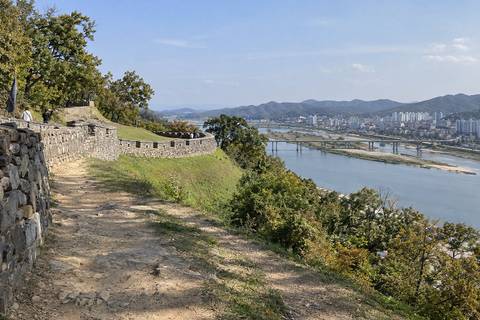
Baekje's royal fortress of 475–538, a wall walk along a ridge above the Geumgang River with the Geumseoru gate; ₩3,000, allow about 1 h 30.
Gapsa Temple
An old temple on the western slope of Gyeryongsan, reached by a 2 km forest path famous in autumn; free.
Royal Tombs of Gongju (King Muryeong's tomb)
Baekje royal tombs, including King Muryeong's, found intact in 1971; an exhibition hall reproduces the chambers. ₩3,000.
Frequently asked questions
Is Magoksa free to visit?
Yes. Gongju City lists Magoksa as free and open all year, and its parking (about 280 cars) as free too. The temple museum keeps its own hours: 10:00–17:00 from April to October and 10:00–16:00 from November to March, closed Mondays, 1 January, Seollal and Chuseok.
How do I get to Magoksa from Gongju Bus Terminal?
Take city bus 770 to its last stop, Magoksa; the city puts the ride at about 40 minutes. It starts at Sanseong-dong in the old town and calls at the terminal a few minutes later. There are 8 buses a day towards the temple and 9 back, the same timetable every day.
What time is the last bus back from Magoksa?
The last bus 770 leaves Magoksa at 21:10, with earlier ones at 15:40, 16:50, 18:40 and 20:10. Afternoon gaps run up to two hours, so note the return time before you get off. Bus 772 adds one morning departure from Magoksa at 09:20.
Can I do Magoksa as a day trip from Seoul?
Yes, but it is a long day. Express buses from Seoul Express Bus Terminal reach Gongju in about 1 h 30 min, then bus 770 takes about 40 minutes more. Catch the 10:00 or 11:30 bus 770 from town and the 15:40 or 16:50 back, and you can still see Gongsanseong in the morning or evening.
Does Magoksa offer a templestay for foreigners?
Yes. The national booking site, templestay.com, lists Magoksa as one of its temples specialising in foreign visitors. Programmes, dates and prices are on the booking site; the temple's templestay office is on 041-841-6226.
Sources
Facts on this page were checked against these sources on 13 November 2026. Prices, hours and rules change — confirm with the operator before you go.
- 공주시 문화관광 – 마곡사 (연중무휴 개방, 이용요금 무료, 주차 280여대 무료, 770번 약 40분; 주소 사곡면 마곡사로 966, 041-841-6221) (Korean) · official
- 공주시 – 세계유산 산사, 한국의 산지승원: 마곡사 (남원·북원, 14세기 오층석탑, 대웅보전·대광보전·영산전, 백범 김구 1898년 은신·향나무, 백범 솔바람 명상길 약 1시간, 입장료 무료) (Korean) · official
- 공주시 – 주요관광지 입장료 (마곡사 입장료·주차료 무료) (Korean) · official
- 공주시 – 시내버스 노선·시간표 (770번 산성동→마곡사 06:20…20:30, 마곡사→산성동 07:10…21:10; 771번 08:00 부곡경유; 772번 17:20·09:20 대중경유) (Korean) · official
- 공주시 버스정보시스템 – 770번 노선 정보·시간표 (정류장 43개, 종합버스터미널 7번째, 평일·휴일 각 8회, 25.5 km) (Korean) · official
- Magoksa Temple – official site (English introduction; Jogye Order 6th district head temple; UNESCO 2018; Kim Gu; tel. 041-841-6220~3, templestay 041-841-6226) · official
- 마곡사 성보박물관 – 관람시간 (하절기 4~10월 10:00~17:00, 동절기 11~3월 10:00~16:00; 휴관 월요일·1월 1일·설날·추석) (Korean) · official
- 템플스테이 – 운영사찰 소개: 마곡사 (유네스코 사찰, 외국인 전문사찰, 041-841-6226) (Korean) · official
- 뉴스1 – '국보' 지정된 공주 마곡사 오층석탑 (2025-01-09 국가유산청 지정, 상륜부 금동보탑) (Korean)
- 한국민족문화대백과사전 – 공주 마곡사 오층석탑 (고려 후기, 1984년 보물, 2025년 국보) (Korean)
- 뉴스와 – 단풍 드는 공주 마곡사의 국보 석탑 (2026-11-01; 770번 약 40분, 입장료 없음, 640년 창건 설화) (Korean)