Suncheon · Naganeupseong and Jogyesan
Songgwangsa Temple 송광사
One of Korea's Three Jewel Temples, a training monastery on the far side of Jogyesan; free, with a direct bus from Seoul.
Updated
Essentials
- Hours
- November–March: 09:00–17:00
- April–October: 08:00–18:00
- Seongbo Museum: 09:00–17:00 in summer, 09:00–16:00 in winter
- Bulilam hermitage: visits 08:00–16:00 only
- Closed
- Temple: open every day. Museum: closed Mondays and over the Seollal and Chuseok holidays
- Admission
- Temple: free
- Seongbo Museum: free
- Getting there
- City bus 111 from Suncheon Station or Suncheon Bus Terminal to its last stop, Songgwangsa; about 1 h 25 min from the terminal by the city's figure
- 13 runs a day reach the temple on weekdays, 9 on weekends and public holidays; last bus back 20:20
- Direct intercity bus from Seoul Central City terminal: 08:40 and 15:10, about 4 hours
- Address
- 100 Songgwangsa-angil, Songgwang-myeon, Suncheon
전남광주통합특별시 순천시 송광면 송광사안길 100 - Website
- songgwangsa.org/sub/sub_1_11.jsp
Book your trip
Songgwangsa is worth a half day from Suncheon if you want a large, working Korean monastery rather than a postcard sight. It is free and open every day, 09:00–17:00 from November to March, and city bus 111 takes about 1 h 25 min from the terminal. On weekdays 13 buses a day reach the temple and on weekends 9, and the last one back leaves at 20:20.
| Your situation | Do this |
|---|---|
| One day in Suncheon | Spend it on the National Garden and Suncheon Bay Wetland; Songgwangsa is a day-two trip |
| Choosing one temple, no car | Seonamsa is closer (bus 1, about 50 min) and prettier; pick Songgwangsa for its size, history and monastic life |
| Coming from Seoul | Take the direct 08:40 bus from Central City and the 16:03 back; buy the return before you leave Seoul |
| Want two sights in one day | Morning at Songgwangsa, then bus 63 at 11:05 or 15:05 to Naganeupseong |
| Fit hiker | Cross Jogyesan from Seonamsa (about 3–4 h) and ride bus 111 back from here |
| Want to stay the night | Book a Templestay on templestay.com; a New Year programme starts on 31 December 2026 |
Why Songgwangsa matters
Songgwangsa (송광사) sits on the western side of Jogyesan, a provincial park north-west of Suncheon. It is one of Korea’s Three Jewel Temples, each standing for one of Buddhism’s “three treasures”. Tongdosa holds relics of the Buddha and Haeinsa the Tripitaka Koreana woodblocks, the Dharma. Songgwangsa stands for the Sangha, the community of monks.
The title comes from its line of teachers. In the Goryeo period the monk Bojo Jinul made the temple the base of a reform movement in Korean Seon (Zen) Buddhism. Fifteen National Preceptors followed him, so the temple counts sixteen in all. It is still a large training monastery, with a meditation hall and a college for monks, and much of the site is closed to visitors for that reason.
Songgwangsa is not one of the seven UNESCO-listed mountain monasteries; Seonamsa, across the ridge, is. For those, see UNESCO sites in Korea.
Getting there by bus 111
City bus 111 runs from Haeryong Daean (해룡대안) through Suncheon Station (순천역) and Suncheon Bus Terminal (종합버스터미널) to its last stop at Songgwangsa (송광사). Suncheon City puts the ride at about 1 h 25 min from the terminal; the temple says about 1 h 30 min from the station.
| Bus 111 | Towards Songgwangsa (leaves Haeryong Daean) | Back from Songgwangsa |
|---|---|---|
| Weekdays | 05:40, 07:10, 08:00, 09:05, 10:10, 11:15, 12:10, 13:20, 14:30, 15:35, 16:40, 17:40, 18:40 | 07:00, 08:50, 09:40, 10:45, 11:50, 12:55, 13:50, 15:00, 16:10, 17:15, 18:20, 19:20, 20:20 |
| Weekends and public holidays | 07:10, 08:30, 09:50, 11:10, 12:35, 14:00, 15:30, 17:00, 18:40 | 06:50, 08:50, 10:10, 11:30, 12:50, 14:15, 15:40, 17:10, 18:40, 20:20 |
Suncheon City bus timetable PDF dated 19 October 2026, checked 12 November 2026. The outbound times are when the bus leaves Haeryong Daean, so it passes the station and terminal some minutes later; check the arrival board at your stop or a map app.
- Plan the return first. In winter the temple closes at 17:00, so the useful buses back are 15:00, 16:10 and 17:15 on weekdays, or 15:40 and 17:10 at weekends.
- Not every 111 goes to the temple. The city counts 17 weekday runs, but four turn at Gwangcheon (광천) short of Songgwangsa; the late 21:00 and 22:00 runs from Gwangcheon end at Jeil High School. Some runs also detour through Haengjeong village, which adds a few minutes.
- Pay with T-money or another Korean transit card and tag off when you get down, which gives a free transfer within 60 minutes.
Bus 63 to Naganeupseong
Bus 63 calls at Songgwangsa only on its way back to the city, at 08:55, 11:05, 15:05 and 17:35. It then passes Naganeupseong, the walled folk town, before reaching the terminal, so a morning here and an afternoon there works. The Naganeupseong page has the onward times.
Direct bus from Seoul
Since January 2026 the intercity bus between Boseong and Seoul’s Central City terminal (센트럴시티, at Express Bus Terminal station) stops at Songgwangsa, according to the temple and the Herald.
| Direction | Departs | Arrives |
|---|---|---|
| Seoul Central City → Songgwangsa | 08:40, 15:10 | 12:40, 19:10 |
| Songgwangsa → Seoul Central City | 09:33, 16:03 | 13:35, 20:05 |
Songgwangsa directions page, checked 12 November 2026. For boarding at Songgwangsa, the temple lists only the express-bus apps (KOBUS or 고속버스티머니), not a counter. Buy your return at the Central City counter or in the app before you set off.
The 08:40 out and 16:03 back give about three hours at the temple, which makes a long but workable day trip. Otherwise, the temple suggests KTX to Suncheon (about 2 h 30 min from Yongsan) and bus 111.
Hours and fees
| Hours | Fee | |
|---|---|---|
| Temple, November–March | 09:00–17:00 | Free |
| Temple, April–October | 08:00–18:00 | Free |
| Seongbo Museum | 09:00–17:00 summer, 09:00–16:00 winter; closed Mondays, Seollal and Chuseok | Free |
| Bulilam hermitage | Visits 08:00–16:00 only |
Songgwangsa visitor information, checked 12 November 2026. The temple has no closing day.
What to see
The approach follows a stream through the woods. The halls start where the path crosses the water, with buildings standing over the stream and reflected in it.
- The main courtyard. The main hall and the halls around it open onto a wide courtyard; this is the part every visitor sees.
- Seongbo Museum (성보박물관). The temple’s museum of its own heritage objects; free, and the best rainy-day stop (no flash; some rooms ban photos).
- Guksajeon and Eungjindang. Guksajeon, the hall honouring the sixteen National Preceptors, is a National Treasure. Eungjindang (응진당; the temple’s page calls it 응진전), built in 1504 and repaired in 1623, holds the Buddha with his sixteen arhat disciples and became a Treasure in July 2026. Both lie inside the monks’ practice area and open to the public only twice a year: seven days of New Year prayers and Buddha’s Birthday.
Allow two hours for the walk in, the courtyard and the museum; most halls you will see from outside. Add an hour for Bulilam.
Bulilam and the Musoyu-gil
Bulilam (불일암) is a small hermitage in the woods above the temple, reached by the path known as the Musoyu-gil (무소유길, the “path of non-possession”).
It is 800 m from Tapjeon, about 30 minutes on foot each way, and visits are allowed only from 08:00 to 16:00. This is a place of practice, so walk quietly and keep to the path.
Hiking from Seonamsa
A forest trail crosses Jogyesan (888 m) between Seonamsa and Songgwangsa, and Suncheon City puts it at 3–4 hours. Most people start at Seonamsa on bus 1 and finish here, because bus 111 has more runs back than bus 1. The Seonamsa page covers the route, the winter cautions and the forest-fire season, which runs to 15 December.
Templestay and visiting manners
Songgwangsa runs a Templestay, booked through templestay.com, the national booking site. In November 2026 it listed a New Year 2027 experience programme starting on 31 December 2026; prices and schedules are on the booking page. See temple stays in Korea for what an overnight involves.
- Temple rules. Do not bring food in, leave pets at home, and do not fly drones or run photo shoots without permission. Children must stay with an adult.
- Dress. The temple bars revealing clothes from its dining hall; cover shoulders and knees anyway, as it is a monastery.
- Services. The day starts with the dawn service at 03:30; the evening service (19:00, 18:00 in winter) falls after visiting hours, so only templestay guests attend it.
- Quiet. Speak softly, stay out of signed practice areas and ask before photographing monks.
For more monasteries, see temples in Korea, the Suncheon guide and the Jeolla region guide.
Nearby
Seonamsa Temple
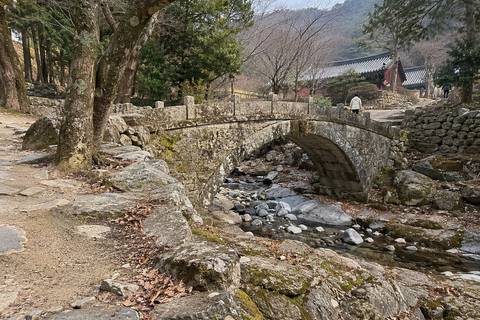
Monastery on Jogyesan reached over an arched stone bridge, with old plum trees; one of the UNESCO Sansa; free.
Jogyesan Provincial Park
The 888 m mountain between the two temples; a forest trail over the ridge links Seonamsa and Songgwangsa.
Naganeupseong Folk Village
A walled Joseon county town where people still live in some 290 thatched houses inside a 1.41 km wall; ₩4,000.
Frequently asked questions
Is Songgwangsa free to visit?
Yes. The temple's own visitor page lists entry as free for adults, students and groups, and the Seongbo Museum inside the grounds is free too. The museum is closed on Mondays and over the Seollal and Chuseok holidays; the temple itself has no closing day.
What are Songgwangsa's opening hours?
09:00–17:00 from November to March and 08:00–18:00 from April to October, according to the temple. The Seongbo Museum opens 09:00–17:00 in summer and 09:00–16:00 in winter, and the path to Bulilam hermitage is open for visits from 08:00 to 16:00.
How do I get to Songgwangsa from Suncheon Station?
Take city bus 111 to its last stop, Songgwangsa. Suncheon City puts the ride at about 1 h 25 min from the bus terminal; the temple says about 1 h 30 min from the station. On weekdays 13 runs reach the temple and on weekends 9, so check the return times before you go. The last bus back leaves at 20:20.
Is there a direct bus from Seoul to Songgwangsa?
Yes. Since January 2026 the intercity bus between Boseong and Seoul's Central City terminal stops at Songgwangsa. It leaves Seoul at 08:40 and 15:10 (about 4 hours) and Songgwangsa at 09:33 and 16:03. The temple says tickets for boarding at Songgwangsa are sold through the express-bus apps, so buy the return in Seoul or on the KOBUS app.
Can I go inside Guksajeon, the National Treasure hall?
Usually not. Guksajeon and Eungjindang (called 응진전 on the temple's site) stand inside the monks' practice area and are opened to the public only twice a year: for seven days of New Year prayers and on Buddha's Birthday. You can see the rest of the main courtyard, the halls along the stream and the museum.
Sources
Facts on this page were checked against these sources on 12 November 2026. Prices, hours and rules change — confirm with the operator before you go.
- 송광사 – 관람정보안내 (입장료 무료; 4월~10월 08~18시, 11월~3월 09~17시; 성보박물관 하절기 09~17시·동절기 09~16시, 매주 월요일·설·추석 휴관; 국사전·응진전 연 2회 개방; 불일암 08:00~16:00, 탑전~불일암 800m 도보 30분; 유의사항) (Korean) · official
- 송광사 – 찾아오시는 길 (서울 센트럴시티↔송광사 고속버스 하행 08:40·15:10, 상행 09:33·16:03; 송광사 승차는 앱 예매; 순천역 111번 약 1시간 30분) (Korean) · official
- 송광사 – 승보종찰이란? (삼보사찰: 통도사 불보, 해인사 법보, 송광사 승보; 보조국사 지눌과 16국사) (Korean) · official
- 송광사 – 암자소개 (현존 암자: 광원암, 천자암, 감로암, 부도암, 불일암, 인월암 등) (Korean) · official
- 순천시 버스정보시스템 – 시내버스 운행시간표 (2026. 10. 19. 기준): 111번 평일 17회·주말 13회, 63번 복편 송광사 경유 (Korean) · official
- 순천시 순천여행 – 시내버스 노선 (송광사 111번 17회, 63번 4회; 종합버스터미널→송광사 1시간 25분) (Korean) · official
- 템플스테이 (한국불교문화사업단) – 프로그램 목록: 송광사(순천) 2027년 새해 맞이 템플스테이 (체험형) (Korean) · official
- 헤럴드경제 – 보성~서울행 고속버스 '송광사(순천)' 경유한다 (2026-01-04; 정류장 2025년 12월 준공, 하루 2회) (Korean)
- 서울Pn – 순천 선암사 원통전·송광사 응진당 보물 지정 (2026-07-09; 응진당 1504년 창건, 1623년 중수) (Korean)