Suncheon · Naganeupseong and Jogyesan
Naganeupseong Folk Village 낙안읍성
A walled Joseon county town where people still live in some 290 thatched houses inside a 1.41 km wall; ₩4,000.
Updated
Essentials
- Hours
- Tickets November–January 09:00–17:30
- Tickets February–April and October 09:00–18:00
- Tickets May–September 08:30–18:30
- Closed
- No regular closing day is published
- Admission
- Adult ₩4,000
- Middle and high school students, military ₩2,500
- Elementary school children ₩1,500
- Age 6 and under free
- Free at 65+ for Korean nationals only; foreign visitors pay
- Getting there
- Bus 63, 68 or 61 from Suncheon Bus Terminal, about 35 minutes
- Fare ₩1,400 by card, ₩1,500 in cash
- Parking is free
- Address
- 30 Chungmin-gil, Nagan-myeon, Suncheon
순천시 낙안면 충민길 30 - Website
- suncheon.go.kr/nagan
Book your trip
Naganeupseong (낙안읍성) is a walled Joseon county town where people still live in about 290 thatched houses, 35 minutes by city bus from Suncheon Bus Terminal. Tickets cost ₩4,000, and the desk closes at 17:30 from November to January. It is worth a half day if you are already staying in Suncheon and want a lived-in old town. It is not worth a special trip from Seoul on its own.
| Your situation | Do this |
|---|---|
| One day in Suncheon | See the National Garden and wetland first; they fill the day |
| A second morning in Suncheon | Take a morning bus here and return for lunch or an onward train |
| You are 65 or over and not Korean | Budget ₩4,000; free senior entry is for Korean nationals only |
| You want the music and dance show | Come on a Saturday or Sunday for 14:00 and check the weather |
| You are seeing the garden and wetland too | Compare the ₩12,000 city pass with single tickets |
| You want to wake up inside the walls | Book a homestay by phone, with help from your hotel |
Is Naganeupseong worth the bus ride?
Yes, if you like old towns and have spare time in Suncheon. The stone wall is 1,410 m around and 4–5 m high, and you can walk on top of it and look down over the thatched roofs. The official welcome page counts about 230 residents. That makes it feel different from a museum village, although it is still a ticketed tourist site with about 1.2 million visitors a year.
Skip it if you have only one day in Suncheon or you have already seen enough hanok villages. It is also not a World Heritage Site: it has been on Korea’s UNESCO tentative list since 2011, which is not an inscription. It is a Korean Historic Site, designated in 1983.
What does a ticket cost and when does the desk close?
| Visitor | Price | Group of 20+ |
|---|---|---|
| Adult, under 65 | ₩4,000 | ₩3,000 |
| Middle and high school student, military | ₩2,500 | ₩2,000 |
| Elementary school child | ₩1,500 | ₩1,000 |
| Age 6 and under | Free | Free |
| Age 65+, Korean nationals only | Free | Free |
From the official fee page, checked 6 November 2026. Most first-time visitors pay ₩4,000; a foreign visitor of 65 or over pays the same.
The group rate also applies to holders of a Naeilro, S-Train or EBLPASS express bus ticket. KORAIL PASS is not on the list, so ask at the desk. The 50% discount for residents of listed cities requires a Korean address, so it does not help most visitors.
| Months | Tickets on sale |
|---|---|
| November–January | 09:00–17:30 |
| February–April, October | 09:00–18:00 |
| May–September | 08:30–18:30 |
From the official fee page, checked 6 November 2026. These are ticket-desk hours. The site does not publish a separate closing time for the grounds or list a regular closing day, so plan to finish in daylight.
The ₩12,000 city pass also covers the National Garden, wetland and drama set. It lasts 1 night and 2 days. The garden-and-wetland ticket (₩10,000) plus this one (₩4,000) comes to ₩14,000, so the pass saves money if you are seeing them too.
Which bus gets you there and back?
Start from Suncheon Bus Terminal (순천종합버스터미널), where all three routes stop. From there it is about 35 minutes to the Naganeupseong stop (낙안읍성). The fare is ₩1,400 by card or ₩1,500 in cash, with one free transfer within 60 minutes.
Coming off a train at Suncheon Station (순천역), use 61 or 68, which list the station on their detailed routes. The city’s summary table also puts 63 through the station, but its detailed route lists Aratjang Market and the terminal instead, so confirm it on a map app first.
| Route | Runs a day | Leaves start of line | Leaves far end |
|---|---|---|---|
| 63 | 10 | 05:55, 07:10, 09:20, 11:20, 13:20, 15:50, 17:10, 19:40, 21:10 | 06:40, 07:20, 08:40, 10:50, 12:50, 14:50, 17:20, 18:40, 21:10, plus 22:00 from Naganeupseong itself |
| 68 | 8 | 06:35, 07:45, 10:10, 12:00, 15:20, 18:40, 20:30 | 05:50, 08:00, 09:15, 11:30, 13:20, 16:40, 20:00, 21:40 |
| 61 | 5 | 08:25, 11:40, 15:00, 18:10 | 06:50, 09:40, 13:00, 16:20, 19:20 |
From the city’s timetable dated 19 October 2026. These are not times at your stop. The start of the line comes well before the terminal on each route, so buses reach the terminal later. The far end is past Naganeupseong, so return buses reach you later too.
Bus 63’s far end is Dolmen Park (고인돌공원), about 20 minutes beyond Naganeupseong by the city’s ride times, and the runs at 08:40, 10:50, 14:50 and 17:20 go via Songgwangsa first, which adds more time. Bus 68’s far end is Gugi (구기), and its 21:40 run stops at Suncheon Station. Bus 61’s far end is near Naganeupseong, and some runs detour through nearby villages.
For the time at your stop, look up the route on a map app or the city’s live bus site in English. For a late-afternoon return, aim for the 16:20–17:20 departures in the table, which leave later buses as a backup. The timetable also lists route 16, but the live bus system showed no service on 6 November 2026, so do not plan on it.
What should you see in 2–3 hours?
The official site suggests two loops from the East Gate, and they fit together in one visit. Allow 2–3 hours, an editorial estimate.
- Inside the walls. The route goes from the East Gate past the Im Gyeong-eop stele to the Gaeksa guest house, the Dongheon magistrate’s office and the Nangmin-gwan exhibition hall. It then runs to the West Gate, the Daejanggeum drama set and the big well, then the South Gate, the old jail and the lotus pond.
- On top of the wall. The rampart walk runs between the East, West and South Gates and has a marked viewpoint over the roofs.
The wall has a long history: it began as an earthen rampart in 1397 under general Kim Bin-gil, built against Japanese raiders, and was rebuilt in stone in the 1400s and again in the 1620s. Nine of the houses are National Folk Heritage. Craft stalls offer things like weaving, dyeing and gayageum (a zither); what runs varies by day, so ask at the gate.
When is the performance and when is the festival?
Traditional music, dance and folk song are performed at 14:00 on Saturdays and Sundays at the Gaeksa, following a monthly plan. Rain cancels them, and the official site’s notices are in Korean, so check the forecast and ask at the desk.
The folk culture festival takes place in autumn. The 31st ran on 24–25 October 2026, and dates for 2027 have not been published.
Where can you eat or stay?
The official site lists restaurants inside the walls, including Arirang, Myeongwolgwan and Seongpunggwan, with local dishes such as cockle bibimbap. Check prices on the menu when you sit down, since the site’s list is undated.
About 30 private homes run homestays with 76 rooms in total. There is no central booking, and you call the owner directly, usually in Korean. Ask your hotel or the 1330 travel line to help. Staying over means you see the lanes after the day visitors leave, but most visitors are better off returning to Suncheon, which has more choice.
Around Naganeupseong
The National Garden and Suncheon Bay Wetland are the main reasons to come to Suncheon, and you should see them first. Bus 63 continues towards Songgwangsa, one of Korea’s Three Jewel Temples; on its way back it leaves Songgwangsa at 08:55, 11:05, 15:05 and 17:35 and passes Naganeupseong, so a temple morning and a folk-town afternoon can be combined. Yeosu is an easy next stop by train, and the rest of the south-west is in the Jeolla region guide.
For similar places, see fortresses in Korea and hanok villages.
Nearby
Suncheonman National Garden
Korea's first national garden, built for the 2013 expo: themed gardens, lakes and grass mounds; closed the last Monday of each month.
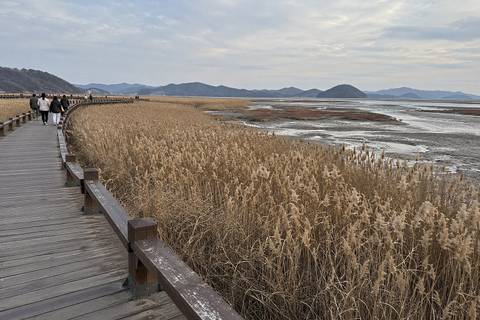
Suncheon Bay Wetland
Korea's largest reed beds, crossed by boardwalks over a tidal bay; part of the UNESCO Getbol listing; the garden ticket covers it.
Songgwangsa Temple
One of Korea's Three Jewel Temples, a training monastery on the far side of Jogyesan; free, with a direct bus from Seoul.
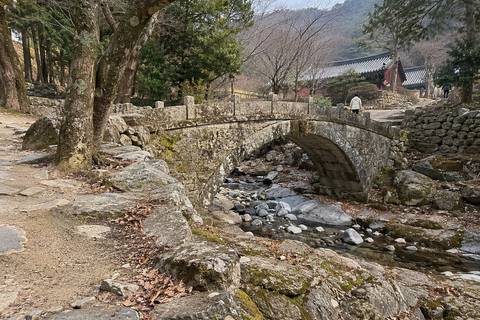
Seonamsa Temple
Monastery on Jogyesan reached over an arched stone bridge, with old plum trees; one of the UNESCO Sansa; free.
Suncheon Drama Filming Site
A rebuilt hillside of 1960s–80s Seoul and Suncheon streets used in Korean dramas and films; ₩3,000, open every day.
Frequently asked questions
How much is Naganeupseong's entrance fee?
Adults pay ₩4,000, middle and high school students and military ₩2,500, and elementary school children ₩1,500. Age 6 and under are free. Groups of 20 or more, and holders of a Naeilro, S-Train or EBLPASS ticket, pay the group rate of ₩3,000 for an adult.
Do foreign seniors get in free?
No. The official site limits free entry at 65 and over to Korean nationals, and its FAQ confirms that foreign visitors of that age pay. Expect to pay the ₩4,000 adult fee.
How do I get to Naganeupseong from Suncheon Station?
Take city bus 61 or 68, which both list Suncheon Station on their detailed routes, or go to the bus terminal and take bus 63. It is about 35 minutes from the terminal. Together the three routes make about 23 trips a day, so check your return before you go in.
How long do you need at Naganeupseong?
Allow about 2–3 hours for the lanes and the wall walk, an editorial estimate and not an official time. Add a meal or the weekend performance and it fills a half day, including the bus.
Is Naganeupseong a UNESCO World Heritage Site?
No. It has been on Korea's UNESCO tentative list since 2011, which is not an inscription. It is a Korean Historic Site, designated in 1983.
Can I stay overnight inside the walls?
Yes. The official site lists about 30 private homestays with 76 rooms. Each is run by its owner and booked directly, usually by phone in Korean, so ask your hotel or the 1330 travel line for help.
Sources
Facts on this page were checked against these sources on 12 November 2026. Prices, hours and rules change — confirm with the operator before you go.
- 순천 낙안읍성 – 관람요금·매표시간 (Korean) · official
- 순천 낙안읍성 – 인사말 (성곽 1,410m, 초가 290여 동) (Korean) · official
- 순천 낙안읍성 – 자주 묻는 질문 (만 65세 이상 외국인 요금) (Korean) · official
- 순천 낙안읍성 – 관람 코스 (Korean) · official
- 순천 낙안읍성 – 상설 공연 (Korean) · official
- 순천 낙안읍성 – 민박 (Korean) · official
- 순천시 버스정보시스템 – 시내버스 운행 시간표 (2026. 10. 19. 기준) (Korean) · official
- 순천시 문화관광 – 시내버스 안내 (요금, 소요시간) (Korean) · official
- 문화체육관광부 – 낙안읍성 민속문화축제 (관람료) (Korean) · official
- 텔트립 – 순천 낙안읍성 민속마을 (Korean)