Suncheon · Naganeupseong and Jogyesan
Seonamsa Temple 선암사
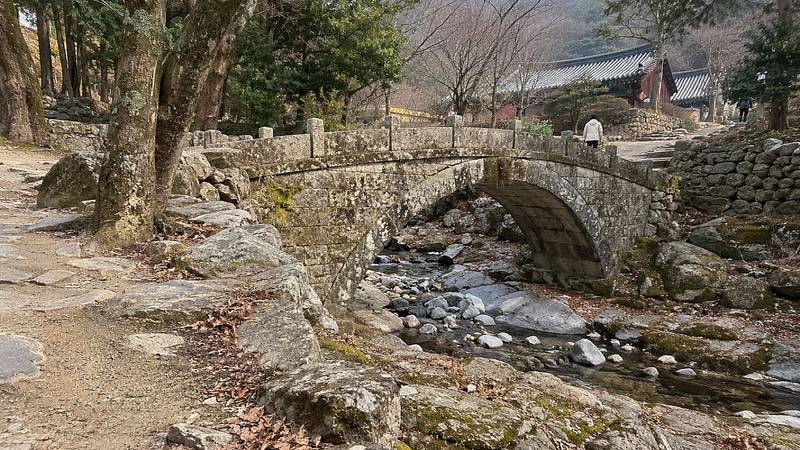
Monastery on Jogyesan reached over an arched stone bridge, with old plum trees; one of the UNESCO Sansa; free.
Updated
Essentials
- Hours
- March–May and October–November: 07:00–19:00
- June–September: 06:00–19:30
- December–February: 07:00–18:00
- Closed
- Open every day
- Admission
- Temple: free
- Car park (about 330 spaces): free
- Getting there
- City bus 1 from Suncheon Station or Suncheon Bus Terminal to the last stop, Seonamsa; about 50 minutes from the terminal
- 10 buses a day towards Seonamsa; 11 back towards the city, the last at 20:50 from Seonamsa
- From the bus stop and car park it is about 1 km on foot to the temple
- Address
- 450 Seonamsa-gil, Seungju-eup, Suncheon
전남광주통합특별시 순천시 승주읍 선암사길 450 - Website
- suncheon.go.kr/tour/tourist/0007
Book your trip
Seonamsa is worth a half day on a second day in Suncheon. The temple and car park are free and it is open every day, 07:00–19:00 now and 07:00–18:00 from December to February. City bus 1 takes about 50 minutes from the terminal. The arched stone bridge and the old halls are the draw, and the last bus back leaves the temple at 20:50.
| Your situation | Do this |
|---|---|
| One day in Suncheon | Spend it on the National Garden and Suncheon Bay Wetland; come to Seonamsa on day two |
| A second morning, no car | Catch bus 1 at Suncheon Station or the terminal, allow 2–3 hours at the temple, and ride back for lunch or a train |
| Here for autumn colour | Come now: Korean press reported the maples and ginkgo turning on 2 November 2026 |
| Fit and up for a full day | Hike over Jogyesan to Songgwangsa (about 3–4 hours) and return on bus 111 |
| Visiting in March | Go for the old plum trees, a Natural Monument, which usually bloom in March |
| You love tea | Book the city’s Wild Tea Experience Center on the approach road two weeks ahead |
What is Seonamsa?
Seonamsa (선암사) sits at the eastern foot of Jogyesan, a provincial park in the hills north-west of Suncheon. By tradition, a hermitage was founded here in the Baekje period and the temple itself by the monk Doseon in the Silla period. Suncheon City describes it as the central temple of the Taego Order in the Honam region, a married-clergy order distinct from the larger Jogye Order.
In 2018 UNESCO inscribed Seonamsa with six other temples as Sansa, Buddhist Mountain Monasteries in Korea. See UNESCO sites in Korea for the other six.
The city also tells a royal story. King Jeongjo, who had no heir, is said to have prayed here for 100 days before his son, the future King Sunjo, was born. The hall linked to that prayer, Wontongjeon, was designated a Treasure in July 2026.
What to see, in walking order
From the last bus stop and car park, the path follows the stream uphill. VisitKorea puts the entrance-to-temple walk at about 1 km, and it is gentle all the way.
- Seungseongyo Bridge (승선교, Treasure No. 400). This semicircular stone arch springs from bedrock on both banks. It is the photo everyone comes for: stand on the stream bank below, and the arch frames the pavilion beyond.
- Gangseonru pavilion (강선루), the two-storey gate pavilion just past the bridge.
- The tea fields and cypress wood. Tea grows around the temple, and its wild tea field is said to be about 800 years old.
- Daeungjeon (main hall) with its two three-storey stone pagodas in front, and the courtyards and walled lanes around it.
- The plum trees (선암매, Natural Monument No. 488). White and red plums stand behind the walls of the inner halls; in bloom they are the temple’s best-known sight.
- The old toilet (측간, cheukgan). This two-storey wooden latrine is famous across Korea. On 30 September 2026 the Korea Heritage Service made it one of three temple toilets designated National Folk Heritage. It is still a working toilet, so respect anyone using it.
Allow about two hours for the walk in, the temple and the walk out. Add an hour if you stop for tea or walk up into the cypress wood above the temple.
Hours and fees
| Months | Open |
|---|---|
| March–May, October–November | 07:00–19:00 |
| June–September | 06:00–19:30 |
| December–February | 07:00–18:00 |
Suncheon City tourism page, checked 11 November 2026. There is no closing day. Entry is free, and so is the car park, which Suncheon lists at about 330 spaces.
Some third-party listings, based on Korea Tourism Organization data, give 08:00–17:00 and a ₩2,000 parking charge. Those figures do not match the city or VisitKorea’s English page, so treat them as out of date. In winter, aim to leave the temple by about 17:00 to reach the bus stop before dark.
Getting there by bus
City bus 1 is the route to take. It runs from Haeryong Daean in the south-east of the city, through Suncheon Station (순천역) and Suncheon Bus Terminal (종합버스터미널), out to its last stop at Seonamsa (선암사). Suncheon City puts the ride at about 50 minutes from the terminal, and the station comes a few stops earlier.
| Direction | Departures |
|---|---|
| Haeryong Daean → Seonamsa (10 a day) | 07:00, 08:45, 10:30, 12:00, 13:40, 15:15, 16:50, 18:20, 19:40, 21:30 |
| Seonamsa → city (11 a day) | 05:50, 07:10, 08:10, 10:00, 11:45, 13:15, 14:55, 16:30, 18:05, 19:35, 20:50 |
Suncheon bus information system, timetable for route 1, checked 11 November 2026; the same times on weekdays and weekends. The outbound times are when the bus leaves Haeryong Daean, so it reaches the station and terminal some minutes later. Check the live arrival board at your stop, or a map app. There is one more run back from Seonamsa at 22:40, but it ends at Jeil High School (제일고), short of the station.
- Plan the return first. On a winter afternoon the useful buses back leave at 14:55, 16:30 and 18:05.
- Route 16 also calls at Seonamsa on some runs, on its way to Naganeupseong, so the two can be combined. Its times vary by run; check the city’s bus site.
- Pay with T-money or another Korean transit card. Tag off when you get down, which gives a free transfer within 60 minutes.
By car, the temple is signposted from Seungju-eup; park at the free car park at the end of the road and walk up.
Hiking over Jogyesan to Songgwangsa
Jogyesan (888 m) is a provincial park, and trails cross it from Seonamsa to Songgwangsa, one of the Three Jewel Temples of Korea, on the far side. Korea Tourism Organization data gives about 3 hours via the summit; Suncheon City says 3–4 hours. Allow the longer time with breaks.
- Go this way round. Take bus 1 out in the morning and walk to Songgwangsa. Bus 111 runs from Songgwangsa back to the city, about 1 h 25 min to the terminal by the city’s figure.
- Fire season. Korea’s autumn forest-fire prevention period runs to 15 December. Some trails may close during it, but no Jogyesan-specific closure had been posted when this page was checked on 11 November 2026. Before you set out, call Suncheon’s forest office on 061-749-8757 or ask at your hotel.
- Winter. Days are short and the ridge can be icy. Start by 09:00, carry water, warm layers and a torch, and wear proper boots.
For more routes across the country, see hiking in Korea.
Tea, food and staying the night
The Wild Tea Experience Center (전통야생차체험관), run by the city, sits on the approach road at 450-1 Seonamsa-gil. You can make tea from local leaves there; it is open 09:00–18:00, with last entry at 17:00.
| Session (by phone, two weeks ahead: 061-749-4500) | Adult | Teen | Child |
|---|---|---|---|
| Tea making (groups of 5 or more; leaves cost extra) | ₩10,000 | ₩7,000 | ₩5,000 |
| Tea food making | ₩5,000 | ₩5,000 | ₩5,000 |
| Tea ceremony | ₩3,000 | ₩3,000 | ₩3,000 |
Suncheon City, checked 11 November 2026. The centre is closed on Mondays, unless the Monday is a public holiday, and over Seollal and Chuseok. It also has family rooms at ₩50,000 a night, booked by phone only.
- Food. Restaurants by the car park serve mountain-vegetable set meals and bibimbap, grilled deodeok root and pajeon, and there is a convenience store. Suncheon city centre has far more choice; see Suncheon food.
- Templestay. Seonamsa runs a Templestay: a rest-type stay for individuals and a program for groups of 10 or more. Book on templestay.com. See temple stays in Korea for what a stay involves.
Visitor tips
- Go early. Autumn weekends bring crowds; the 07:00 or 08:45 bus 1 gets you to the bridge before most day-trippers, and leaves the afternoon free.
- Temple manners. Keep to the paths, speak quietly in the courtyards, and do not enter halls during services. Leave your shoes outside if you step into a hall.
- Pair it with Songgwangsa or Naganeupseong. Both are free or cheap and on bus routes; see the Suncheon guide for the full area, and temples in Korea for more monasteries.
- Wear grippy shoes. The stones around the bridge and the stream can be slippery after rain or frost.
For the rest of the region, see the Jeolla guide.
Nearby
Suncheon Wild Tea Experience Center
Hanok complex near Seonamsa where you can learn to make tea from wild tea plants; book two weeks ahead, closed Mondays.
Jogyesan Provincial Park
The 888 m mountain between the two temples; a forest trail over the ridge links Seonamsa and Songgwangsa.
Songgwangsa Temple
One of Korea's Three Jewel Temples, a training monastery on the far side of Jogyesan; free, with a direct bus from Seoul.
Naganeupseong Folk Village
A walled Joseon county town where people still live in some 290 thatched houses inside a 1.41 km wall; ₩4,000.
Frequently asked questions
Is Seonamsa free to visit?
Yes. Suncheon City and the Korea Tourism Organization both list entry as free, and the car park by the bus stop, with about 330 spaces, is free too. Older guides that mention a ticket booth or a ₩2,000 parking charge are out of date.
How do I get to Seonamsa from Suncheon Station?
Take city bus 1 from Suncheon Station or the bus terminal to its last stop, Seonamsa. The city puts the ride at about 50 minutes from the terminal. There are 10 buses a day out and 11 back, so note the return times before you set off. The last bus back leaves Seonamsa at 20:50.
What are Seonamsa's opening hours in winter?
From December to February, Seonamsa is open from 07:00 to 18:00, by Suncheon City's figures. It is 07:00–19:00 in spring and in October–November, and 06:00–19:30 from June to September. The temple has no closing day.
Can I hike from Seonamsa to Songgwangsa?
Yes. A trail crosses Jogyesan (888 m) between the two temples; Korea Tourism Organization data gives about 3 hours via the summit, and you should allow 3–4 hours with stops. Take bus 1 out and bus 111 back from Songgwangsa. Start in the morning, and in winter carry a torch and warm layers.
When do Seonamsa's plum blossoms bloom?
The old plum trees, a Natural Monument, usually flower in March. In 2026 they were at their best through late March, according to the Herald. Autumn is the other peak season, when maples and ginkgo turn around the bridge and halls.
Sources
Facts on this page were checked against these sources on 11 November 2026. Prices, hours and rules change — confirm with the operator before you go.
- 순천시 순천여행 – 선암사 (관람시간 춘추기 07:00~19:00, 하절기 06:00~19:30, 동절기 07:00~18:00; 입장료 무료; 휴무일 없음; 시내버스 1번; 승선교 보물 400호; 선암매 천연기념물 488호) (Korean) · official
- 순천시 순천여행 – 조계산 (높이 888m, 도립공원; 선암사 주차장 330면, 주차장 사용료 무료; 시내버스 1번·111번) (Korean) · official
- 순천시 순천여행 – 야생차체험관 (09:00~18:00, 17:00까지 입장; 2주 전 예약; 차 만들기 체험 5인 이상 성인 10,000원; 월요일·설·추석 휴무) (Korean) · official
- 순천시 순천여행 – 시내버스 안내 (주요 관광지 소요시간: 선암사 50분, 송광사 1시간 25분) (Korean) · official
- 순천시 버스정보시스템 – 운행시간표 1번 (해룡대안→선암사 10회, 선암사→해룡대안 11회, 선암사→제일고 22:40) 및 노선 정류장 (순천역, 종합버스터미널 경유) (Korean) · official
- VisitKorea – Seonamsa Temple [UNESCO World Heritage] (fees free, parking free, open all year, entrance to temple about 1 km) · official
- 국가유산청 – 「순천 선암사 측간」 등 사찰 해우소 3개소 국가민속문화유산 지정 (2026-09-30) (Korean) · official
- UNESCO World Heritage Centre – Sansa, Buddhist Mountain Monasteries in Korea · official
- 서울Pn – 순천 선암사 원통전·송광사 응진당 보물 지정 (2026-07-09) (Korean)
- 리포테라 – 순천 선암사 가을 단풍 (입장료·주차요금 무료, 야생차밭, 2026-11-02) (Korean)
- 리포테라 – 순천 선암사 (템플스테이 휴식형·체험형, 2026-08-20) (Korean)
- 헤럴드경제 – 순천 선암사 매화 (2026-03-23) (Korean)
- K-TRIP TIPS (한국관광공사 데이터) – 조계산도립공원 등산코스 (선암사~송광사 약 3시간) (Korean)