Gangneung · Gyeongpo, Chodang and Ojukheon
Seongyojang House 선교장
A 300-year-old 99-kan noble estate, still in the family and open to visitors; ₩5,000, with hanok rooms for overnight stays.
Updated
Essentials
- Hours
- March–October 09:00–18:00; November–February 09:00–17:00
- On the 18:00 schedule, ticket sales stop at 17:30
- Closed
- Visit Gangneung lists Seollal day and Chuseok day as closed; Korea Tourism Organization data says open all year. One-off closures are posted on the house's notice page
- Admission
- Adult ₩5,000; discounted ₩3,000 (youth, age 65+, soldiers, police, disabled visitors); child ₩2,000
- Groups of 30 or more: ₩4,000 / ₩2,500 / ₩1,500
- Free for guests staying in the house's hanok rooms
- Getting there
- From Gangneung Station: bus 202 from the 강릉역건너편 stop (across the road), via the bus terminal and Ojukheon, to the 선교장 stop; ₩1,530 by T-money, ₩1,700 cash
- From Ojukheon: bus 202 one stop on to 선교장
- Back to the station: bus 202-1 from the 선교장 stop on the opposite side of the road
- Free parking
- Address
- 63 Unjeong-gil, Gangneung
강원특별자치도 강릉시 운정길 63 - Website
- knsgj.net
Book your trip
Seongyojang is worth about an hour and ₩5,000 if you want to see how a wealthy Joseon family lived, and it pairs neatly with Ojukheon one bus stop away. The estate has stayed in the same family for about 300 years and they still look after it. From November to February it is open 09:00–17:00, and from March to October 09:00–18:00. From Gangneung Station, take bus 202 from the stop across the road.
| Your situation | Do this |
|---|---|
| One afternoon in Gangneung | Ojukheon first, then bus 202 one stop to Seongyojang, then on to Gyeongpo Beach |
| Visiting in winter (November–February) | Arrive by about 16:00, since the gate shuts at 17:00 |
| Here on a Wednesday | Time it for the free 13:00 organ recital in Yeolhwadang, about 30 minutes |
| You want one night in a real hanok | Book a building here, and entry is then free |
| Seollal or Chuseok day | Phone first, because Visit Gangneung lists these days as closed |
| You only have time for one old house | Ojukheon for the banknote story, Seongyojang for the estate and setting |
What will you see inside?
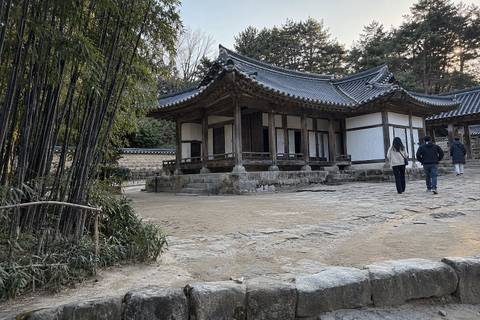
A whole estate rather than a single house. The buildings went up over about a century as the family grew, so there is no grand plan, just separate halls spread along the foot of a low pine hill.
| Stop | What it is |
|---|---|
| Hwallaejeong (활래정) | The pavilion standing in the square lotus pond outside the main gate, built in 1816; its floor reaches out over the water on stone pillars |
| Yeolhwadang (열화당) | The men’s reception hall, built in 1815 and named after a line by the Chinese poet Tao Yuanming; the Wednesday organ recitals are held here |
| Anchae (안채) | The women’s quarters and the oldest part, first built in the 1700s, with a large kitchen for a big household |
| Dongbyeoldang (동별당) | The master’s private L-shaped wing next to the main house, added in 1920 |
| Seongyojang Museum (선교장 박물관) | About 300 objects the family kept, including a royal appointment letter to the family founder, an early-1800s map of Korea and a signboard by the calligrapher Kim Jeong-hui |
| Old granary (곳간채) | About 200 household objects; in 1908 this storehouse became the Dongjin School, closed under Japanese pressure |
| Pine-wood path (둘레길) | Two short trails through the pines behind the estate, looking down over the roofs |
From the Seongyojang site and the Korea Heritage Service record, checked 14 November 2026. Some doors stay closed because the family still uses the estate. The heritage record warns that the owner may restrict viewing.
Why does this house matter?
It is the best-preserved upper-class house in the region and a National Folklore Cultural Heritage, listed by the Korea Heritage Service in 1967. The family’s own site gives 1965. Lee Nae-beon, a descendant of King Sejong’s elder brother, settled here in the early 1700s. Family legend says a pack of weasels led him to the site.
The name means “boat-bridge estate.” Gyeongpo Lake once reached the front of the house, and people crossed it on a bridge of boats. The lake has since shrunk, and rice fields now fill the gap.
The family grew rich on rice and became famous for hospitality. Scholars and artists touring the Gangwon coast stayed here, and the operator says the granary was opened to neighbours in famine years. The Dongjin School in the granary had backing from the independence leader Kim Gu, and the politician Yeo Un-hyeong taught English there.
How much is it, and what do the extras cost?
Foreign visitors pay the general rates. Gangneung residents get in free, which will not apply to you.
| Ticket | Individual | Group of 30+ |
|---|---|---|
| Adult | ₩5,000 | ₩4,000 |
| Discounted (youth, 65+, soldier, police, disabled) | ₩3,000 | ₩2,500 |
| Child | ₩2,000 | ₩1,500 |
From the Seongyojang site, cross-checked with Korea Tourism Organization data updated 11 November 2026. The 65+ rate is not restricted to Koreans on the price page, so show your passport.
Three hands-on extras are run on site, all paid on top of the ticket and booked online through Naver first:
- Dasik (tea-cake) making: ₩25,000 per person, minimum two, about 40–60 minutes in the Cafe Leemong building. It starts on the hour, 10:00–16:00, skipping 12:00. Children under 14 need an adult taking part, and people with soy, nut or dairy allergies cannot join.
- Hanbok wear: ₩20,000 per person for about two hours of free time around the estate. Sizes are limited, so yours may not be in stock.
- Boat-bridge model kit: ₩20,000 per person, minimum two, about 30 minutes, age 8 and up.
When should you go?
Any day, but watch the season. The gate closes at 17:00 from November to February, so arrive by about 16:00. On the 18:00 summer schedule, ticket sales stop at 17:30.
Wednesdays have a free organ recital in Yeolhwadang at 13:00, about 30 minutes of mainly classical pieces. The programme may change on the last Wednesday of the month.
Guided talks start on the hour, 09:00–16:00, with no talks 12:00–13:30, and last 30–40 minutes. They are given by city guides, and only Korean is listed.
Check the notice page (선교장 소식) before you go. The house closed for a day on 20 October 2026, and parts were shut for filming on 4–5 November. Paths get slippery in rain and snow, especially on the hill trail.
How do you get there?
Bus 202 serves the 선교장 stop in front of the house. Board on the correct side of the road at the station.
| From | Bus | Board at | Note |
|---|---|---|---|
| Gangneung Station | 202 towards 경포해변 | 강릉역건너편 (across the road) | Via the bus terminal and Ojukheon |
| Express and intercity terminal | 202 towards 경포해변 | 강릉시외.고속터미널 | Via Ojukheon |
| Ojukheon | 202 | 오죽헌 | One stop |
| Gyeongpo Beach (coming back from the coast) | 202-1 | 경포해변 | Via Gyeongpodae and Chodang |
From the Seongyojang site and the Gangneung bus information system, checked 12–14 November 2026. Bus 202 makes about 24 runs a day. Fares are ₩1,530 by T-money or ₩1,700 in cash. The city publishes no journey times, so follow the ride on Naver Map.
Do not take 202-1 from the station, because it heads straight to the coast past the lake. To get back, take 202-1 from the 선교장 stop on the opposite side; it runs via Ojukheon and the terminal to the station. A taxi is safer if you have a train to catch.
A second stop, 선교장입구, is a 5–10 minute walk from the gate. Drivers get free parking.
Can you stay the night?
Yes, and it is one of the few places in Korea where the hanok you sleep in sits inside a listed heritage estate. Each option is a whole building, booked by phone on 010-3479-3270 or through Naver.
| Building | Sleeps | Off-season weeknight | Weekend / peak |
|---|---|---|---|
| Seobyeoldang (서별당) | 4 (up to 6, ₩15,000 per extra person) | ₩250,000 | ₩280,000 |
| Yeonjidang (연지당) | 6; shared outdoor shower and toilet | ₩170,000 | ₩200,000 |
| Thatched cottage 1 or 2 (초가) | 6; the only units with a kitchen | ₩170,000 | ₩200,000 |
From the Seongyojang hanok-stay pages, checked 14 November 2026. Cooking is not allowed in the other buildings, and Wi-Fi or TV may not work. The cancellation refund falls to 70% at 3–6 days out, 50% at 1–2 days and 30% on the day. Today’s Seobyeoldang is a rebuilt wing, since the heritage record notes the original no longer stands.
What is around Seongyojang?
The estate sits in the Gyeongpo area, the best base for a night in Gangneung.
- Ojukheon, one stop back on bus 202, is the birthplace of Yulgok and Shin Saimdang (₩3,000).
- Gyeongpo Lake and the Gyeongpodae pavilion are further along route 202, which ends at Gyeongpo Beach.
- Chodang tofu village is the obvious lunch, with the Heo memorial park next to it.
For trains, where to stay and the coast, see the Gangneung guide. For more historic houses, see hanok in Korea.
Nearby
Ojukheon and the Gangneung City Museum
The Joseon house where the scholar Yulgok Yi I was born in 1536, among black bamboo; ₩3,000 includes the city museum.
Gyeongpo Lake and Gyeongpodae
A lagoon behind the beach with a level path around it and, on the hill above, Gyeongpodae, a pavilion first built in 1326; free.
Chamsori Gramophone and Edison Museum
A private museum by Gyeongpo Lake with more than 5,000 gramophones, music boxes and Edison inventions from over 60 countries.
Heo Gyun and Heo Nanseolheon Memorial Park
A park around the birthplace site of the poet Heo Nanseolheon and her brother Heo Gyun, author of Hong Gil-dong; free, hall closed Mondays.
Chodang Sundubu Village
A cluster of family tofu restaurants near Gyeongpo, known for soft tofu set with seawater; breakfast or lunch here is a Gangneung habit.
Gyeongpo Beach
The city's main beach, 1.8 km of sand backed by pine trees and hotels; free, and busiest in the July–August swimming season.
Frequently asked questions
Is Seongyojang worth visiting?
Yes, if you want to see how a rich Joseon family actually lived, rather than a palace. It is a working estate still owned by the same family, with a lotus-pond pavilion, a family museum and a pine-wood path behind the houses. Allow about an hour. Pair it with Ojukheon, one stop away on bus 202, instead of making a separate trip for it.
Seongyojang or Ojukheon: which should you choose?
Choose Ojukheon (₩3,000) for its story, since it is the birthplace of the two people on Korea's ₩5,000 and ₩50,000 notes. Choose Seongyojang (₩5,000) for scale and setting, with a whole estate of buildings, a pond pavilion and the woods behind. They are one stop apart on bus 202, so most visitors see both in one afternoon.
What time does Seongyojang close in winter?
17:00 from November to February, and 18:00 from March to October, according to Visit Gangneung and Korea Tourism Organization data. The house's own site gives the same summer and winter times without naming the months. Arrive by about 16:00 in winter to see everything.
Can you stay overnight at Seongyojang?
Yes. Several buildings are rented out as whole-building hanok stays, booked by phone (010-3479-3270) or through Naver. Off-season weeknight prices start at ₩170,000 for a building that sleeps six, up to ₩250,000–280,000 for the Seobyeoldang wing. There is no cooking except in the two thatched cottages, and Wi-Fi may be unreliable. Staying guests get free entry.
Is there an English guide at Seongyojang?
No English commentary is listed. City-appointed guides give free talks on the hour from 09:00 to 16:00 (not 12:00–13:30), lasting 30–40 minutes, but Korea Tourism Organization data lists only Korean-language guiding. The house's own history page has an English section.
How do you get from Gangneung Station to Seongyojang?
Cross the road from the station to the 강릉역건너편 stop and take bus 202 towards 경포해변; it goes via the bus terminal and Ojukheon to the 선교장 stop. It runs about 24 times a day. To return, take bus 202-1 from the stop on the opposite side. A taxi is quicker if you have a train to catch.
Sources
Facts on this page were checked against these sources on 14 November 2026. Prices, hours and rules change — confirm with the operator before you go.
- 강릉선교장 – 관람료 안내 (요금, 할인대상, 문화관광해설, 관람수칙) (Korean) · official
- 강릉선교장 – 선교장 역사 (이내번, 99칸, 활래정; English section) (Korean) · official
- 강릉선교장 – 오시는 길 (202번 선교장 정류장, 선교장입구 정류장) (Korean) · official
- 강릉선교장 – 홈 (하절기·동절기 관람시간, 매표 마감 17:30, 수요음악산책) (Korean) · official
- 강릉선교장 – 선교장 소식 (임시 휴관, 관람 제한 공지) (Korean) · official
- 강릉선교장 – 선교장 박물관 · 생활유물 전시관 (동진학교) (Korean) · official
- 강릉선교장 – 선교장 둘레길 (Korean) · official
- 강릉선교장 – 수요음악 산책 (열화당 오르간, 매주 수요일 13시) (Korean) · official
- 강릉선교장 – 체험 (다식 만들기, 한복, 배다리 만들기: 요금, 시간) (Korean) · official
- 강릉선교장 – 한옥스테이 (서별당/연지당, 초가 요금) (Korean) · official
- 국가유산청 – 강릉 선교장 (국가민속문화유산, 지정 1967-04-20, 열화당 1815) (Korean) · official
- 비짓강릉 – 선교장 (이용시간 3~10월 / 11~2월, 휴무일, 주차, 장애인편의) (Korean) · official
- 강릉시 버스정보시스템 – 노선 검색 (202, 202-1) (Korean) · official
- 케이트립팁스 – 강릉 선교장 (한국관광공사 자료: 시간, 요금, 해설, 2026-11-11 갱신) (Korean)
- K-Trip Tips – Seongyojang House (Korea Tourism Organization data, English)