Gangneung · Gyeongpo, Chodang and Ojukheon
Gyeongpo Beach 경포해변
The city's main beach, 1.8 km of sand backed by pine trees and hotels; free, and busiest in the July–August swimming season.
Updated
Essentials
- Hours
- Beach, lakeside path and Gyeongpodae pavilion: open at all times, all year
- Swimming: only in the summer season, when lifeguards and facilities run 09:00–18:00 (2026: 4 July–23 August)
- Gyeongpo Tourist Information Center: 09:00–18:00, open all year
- Closed
- No closing day. Swimming outside the summer season is not supervised
- Admission
- Beach, Gyeongpo Lake and Gyeongpodae: free
- Parking at the public car parks: free (Gangneung City)
- Showers: summer season only, for a small fee (the city's Korean page says ₩3,500, its English page ₩3,000)
- Getting there
- From Gangneung Station: bus 202-1 from the 강릉역 stop runs straight to the beach via Gyeongpo Lake; bus 202 from 강릉역건너편 goes the long way round via the bus terminal, Ojukheon and Seongyojang
- Each route has about 24 departures a day from the beach end, roughly 07:00 to 20:00–21:00; fare ₩1,530 by card, ₩1,700 cash
- KTX-Eum from Seoul Station or Cheongnyangni to Gangneung: about 1 h 30 min – 2 h
- Address
- San 1-9 Anhyeon-dong, Gangneung (Gyeongpo Beach)
강원특별자치도 강릉시 안현동 산1-9 - Website
- visitgangneung.net/en/Region_01.do?mode=v&seq=2
Book your trip
Gyeongpo Beach is Gangneung’s main beach, free and open all year, and the easiest place on the east coast to watch a winter sunrise without a car: 07:40 on 1 January 2027. Buses 202-1 and 202 run here from Gangneung Station. Stay a night by the beach, walk out at dawn, then see Gyeongpo Lake and the Gyeongpodae pavilion behind it. Allow two to three hours for beach, lake and pavilion.
| Your situation | Do this |
|---|---|
| One night in Gangneung | Stay at Gyeongpo; sunset on the lake, sunrise on the beach, soft tofu in Chodang for breakfast |
| Here for New Year’s Day | Book a beach hotel early and walk out; buses do not start before about 07:00 |
| Day trip from Seoul | Bus 202 from the station via Ojukheon and Seongyojang, ending at the beach; 202 back (the direct way from the beach end), off at 강릉역건너편 |
| Want to swim | Come in July or August only; lifeguards work 09:00–18:00 in the season |
| Cold or windy day | Walk the sheltered lake path and stop at the Chamsori museum instead of the open sand |
Is Gyeongpo Beach worth it?
Yes, if you are spending a night in Gangneung. Gyeongpo is the city’s biggest beach: 1.8 km of sand with about 4 km of pine trees behind it, 6 km north of the centre. Gangneung City calls it the largest beach on the east coast. A shallow lagoon, Gyeongpo Lake, lies just inland, with the old pavilion of Gyeongpodae on a hill above it, and the soft-tofu restaurants of Chodang a short walk south.
Outside July and August it is a quiet place for walking, sunsets over the lake and sunrises over the sea. For a first-timer from Singapore, Malaysia or the Philippines, the draw in winter is a cold, clear East Sea sunrise, not swimming.
Skip it if you only have a day and want the coffee street: Anmok is closer to the station and also faces the sea. If the famous seaside railway station matters more than an easy morning, go to Jeongdongjin instead.
Sunrise times at Gyeongpo
The beach faces east across open sea, so the sun comes up straight out of the water. These are the Korea Astronomy and Space Science Institute’s times for Gangneung, at sea level.
| Date | Sunrise | Sky starts to brighten |
|---|---|---|
| 15 November 2026 | 07:04 | 06:36 |
| 1 December 2026 | 07:21 | 06:52 |
| 15 December 2026 | 07:32 | 07:03 |
| 31 December 2026 | 07:40 | 07:10 |
| 1 January 2027 | 07:40 | 07:10 |
| 15 January 2027 | 07:39 | 07:10 |
| 1 February 2027 | 07:29 | 07:01 |
KASI monthly sunrise table for Gangneung, checked 12 November 2026. Be on the sand 20–30 minutes before sunrise: the sky glows first, and clouds on the horizon often hide the first few minutes.
New Year’s Day. About 130,000 people came to Gyeongpo for the first sunrise of 2026, according to Korean press. Gangneung City held its New Year event at Gyeongpo Square (경포광장) and at Sandglass Park in Jeongdongjin on 31 December and 1 January. The 2026 notice went up on the city’s tourism site in mid-October 2025; nothing for 2027 had been posted by 12 November 2026. Check visitgangneung.net in December, and book a room near the beach well ahead.
What to see at Gyeongpo
- The beach. A broad strip of fine sand, with hotels and cafés along the road behind the pines. The southern end is the Gangmun Sotdae Bridge, an arched footbridge that marks the boundary with the smaller Gangmun Beach.
- Gyeongpo Lake. A lagoon about 4 km round and only 1–2 m deep, cut off from the sea by the sand bar the beach sits on. A level path and cycle track circle it, and its cherry trees bloom in early April; see cherry blossoms.
- Gyeongpodae. A wooden pavilion on a low hill on the lake’s west side, first built in 1326 and a national Treasure. It looks over the lake towards the sea and is free and open at all hours. Gangneung City notes the old saying that from here you can see the moon five different ways, reflected in sky, sea and lake.
- Chodang soft tofu village. Family restaurants south of the lake serve tofu set with seawater; a Gangneung breakfast after sunrise.
The Chamsori gramophone museum and the Heo Gyun and Heo Nanseolheon Memorial Park sit between the lake and Chodang, and both work as an indoor or quiet stop on a cold day.
How do you get to Gyeongpo Beach?
From Seoul. KTX-Eum trains run from Seoul Station and Cheongnyangni to Gangneung in about 1 h 30 min – 2 h. Express buses also run from Seoul.
From Gangneung Station. Two city bus routes loop between the station and the beach in opposite directions. Both end at the 경포해변 stop.
| Bus | Board at | Route | Departures from the beach |
|---|---|---|---|
| 202-1 | 강릉역 (Gangneung Station) | Station → Gyeongpo Lake → beach: the direct way | About 24 a day, 07:06–20:50 |
| 202 | 강릉역건너편 (across from the station) | Station → bus terminal → Ojukheon → Seongyojang → Chodang → Gyeongpodae → beach | About 24 a day, 07:19–20:06 |
Gangneung bus information system timetables (in force since 1 January 2025) and route maps, checked 12 November 2026. The times are departures from the beach end; check Naver Map or Kakao Map for live times at your stop. Gangneung was consulting on a bus network reform in October 2026, so routes may change.
Going back. Because the routes form a loop, the direction flips on the return trip: from the beach, 202 is the direct way back to the station (via Gyeongpo Lake, alighting at 강릉역건너편), while 202-1 goes the long way round via Gyeongpodae, Chodang, Seongyojang, Ojukheon and the bus terminal.
The fare is ₩1,530 with a T-money or other transport card and ₩1,700 in cash. Card users get free transfers within an hour. Arriving from the express or intercity bus terminal, take bus 202 or 202-1 from the 강릉시외.고속터미널 stop. Gangneung City puts the beach about 15 minutes from the city centre by road, so a taxi is the quickest option.
By car. The public car parks along the beach are free (Gangneung City).
Swimming season and winter
The beach is open every day of the year with no fee. Swimming is supervised only in summer: lifeguards, showers and the marked swimming zone run 09:00–18:00. In 2026 Gyeongpo opened on 4 July, earlier than the other Gangneung beaches, and closed on 23 August, with night swimming from 25 July to 8 August. Dates for 2027 had not been set on 12 November 2026.
From November to February the beach is cold and windy and the summer facilities are closed. The Gyeongpo Tourist Information Center (513 Gyeongpo-ro) is open 09:00–18:00 all year, with staff who speak English, Japanese and Chinese.
Tips for your visit
- Dress for wind. Dawn on the open beach in December and January is cold; bring gloves and a hat for the sunrise wait.
- Go round the lake by bike in spring and autumn; the path is flat. Rental shops near the lake set their own prices.
- Do not swim outside the season or outside the buoys in summer; the city lists the beach as having no special access facilities, and waves can be strong.
- Combine it with Ojukheon and Seongyojang on bus 202, which stops at both on its way to the beach.
- Stay near the beach for sunrise. The first buses leave the beach end at about 07:00, so none arrives from the station in time for a winter dawn.
For hotels, food and the rest of the city see the Gangneung guide and the Gangwon region. Other beaches across Korea, from Busan to Jeju, are compared in beaches in Korea; for more winter ideas see winter in Korea.
Nearby
Gyeongpo Lake and Gyeongpodae
A lagoon behind the beach with a level path around it and, on the hill above, Gyeongpodae, a pavilion first built in 1326; free.
Chodang Sundubu Village
A cluster of family tofu restaurants near Gyeongpo, known for soft tofu set with seawater; breakfast or lunch here is a Gangneung habit.
Chamsori Gramophone and Edison Museum
A private museum by Gyeongpo Lake with more than 5,000 gramophones, music boxes and Edison inventions from over 60 countries.
Heo Gyun and Heo Nanseolheon Memorial Park
A park around the birthplace site of the poet Heo Nanseolheon and her brother Heo Gyun, author of Hong Gil-dong; free, hall closed Mondays.
Seongyojang House
A 300-year-old 99-kan noble estate, still in the family and open to visitors; ₩5,000, with hanok rooms for overnight stays.
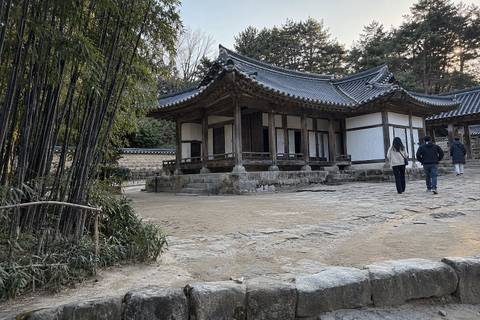
Ojukheon and the Gangneung City Museum
The Joseon house where the scholar Yulgok Yi I was born in 1536, among black bamboo; ₩3,000 includes the city museum.
Frequently asked questions
What time is sunrise at Gyeongpo Beach on New Year's Day 2027?
07:40 on 1 January 2027, from the Korea Astronomy and Space Science Institute's table for Gangneung. The sky starts to brighten at about 07:10. Sunrise stays between 07:37 and 07:40 from late December to mid-January.
How do I get from Gangneung Station to Gyeongpo Beach?
Take bus 202-1 from the 강릉역 stop: it runs straight to the beach past Gyeongpo Lake. Bus 202 from the 강릉역건너편 stop also ends at the beach, but goes the long way via the bus terminal, Ojukheon and Seongyojang. A taxi is quickest: the city puts the beach about 15 minutes from the centre by road.
Can you swim at Gyeongpo Beach in winter?
No supervised swimming. Lifeguards, showers and the swimming zone run only in the summer season, which in 2026 was 4 July to 23 August. The rest of the year the beach is open for walking, and the water off Gangwon is cold.
Is there a New Year sunrise festival at Gyeongpo for 2027?
Not announced on 12 November 2026. For 2026, Gangneung City held its sunrise event at Gyeongpo Square and Sandglass Park in Jeongdongjin on 31 December and 1 January, and about 130,000 people came to Gyeongpo. The 2026 notice went up in mid-October.
Is Gyeongpo or Jeongdongjin better for sunrise?
Gyeongpo is easier: hotels sit right on the beach and the city buses run here, so you can walk out at 07:00. Jeongdongjin has the famous seaside station but is 18 km south, so you need an early train or a room there.
Sources
Facts on this page were checked against these sources on 12 November 2026. Prices, hours and rules change — confirm with the operator before you go.
- 비짓강릉 (강릉시) – 경포해변 (안현동 산1-9, 길이 1.8km, 면적 1.44㎢, 송림 4km, 시내에서 북으로 6km, 상시이용·여름 해수욕장 기간 09:00~18:00, 샤워장 3,500원, 무료주차) (Korean) · official
- Visit Gangneung (Gangneung City) – Gyeongpo Beach (always available, shower 3,000 won in summer, free parking, 15 minutes from downtown) · official
- 비짓강릉 (강릉시) – 경포대 (경포로 365, 정면 6칸·측면 5칸, 상시이용, 무료, 1월 1일 일출 인파) (Korean) · official
- 비짓강릉 (강릉시) – 경포호 (둘레 약 4km, 수심 1~2m, 자전거도로, 상시·무료) (Korean) · official
- 비짓강릉 (강릉시) – 강문솟대다리 (강문해변과 경포해변의 경계) (Korean) · official
- 국가유산청 – 강릉 경포대 (보물) 공개 API (Korean) · official
- Visit Gangneung – Tourist Information Centers (Gyeongpo: 513 Gyeongpo-ro, 09:00–18:00, year-round) · official
- 강릉시 버스정보시스템 – 노선별 시간표 (202·202-1, 경포해변 기점, 시행일 2025-01-01) 및 노선도 (Korean) · official
- 강릉시 버스정보시스템 – 요금 안내 (Korean) · official
- 강릉시 버스정보시스템 – 공지사항 (시내·마실버스 노선 개편 추진 의견수렴, 2026-10-12) (Korean) · official
- 한국천문연구원 – 월별 해/달 출몰시각 (강릉, 2026년 11월 ~ 2027년 2월) (Korean) · official
- 비짓강릉 (강릉시) – 2026 병오년 해맞이 행사 개최안내 (2025-12-31~2026-01-01, 경포광장 / 정동진 모래시계공원; 2025-10-15 게시) (Korean) · official
- MTN 머니투데이방송 – 강릉 경포해변 워터슬라이드·유아 놀이공간 (경포 7월 4일~8월 23일 51일간, 야간개장 7월 25일~8월 8일), 2026-06-24 (Korean)
- 쿠키뉴스 – 강릉 병오년 첫 일출 30만명 (경포 13만·정동진 11만), 2026-01-01 (Korean)