Gangneung · Gyeongpo, Chodang and Ojukheon
Ojukheon and the Gangneung City Museum 오죽헌
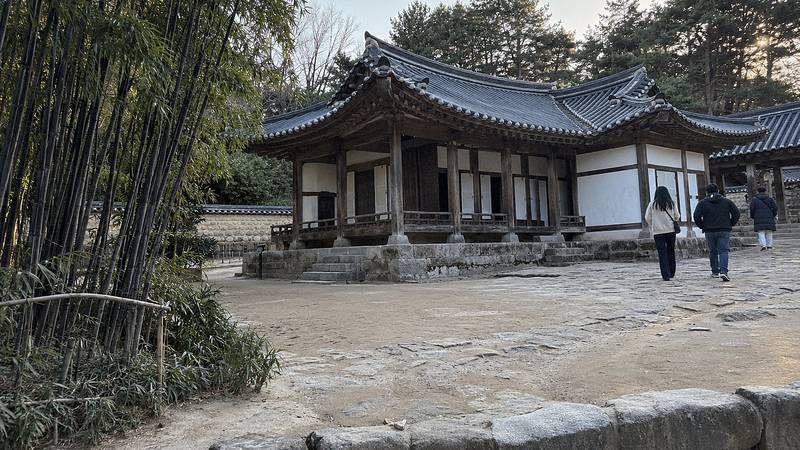
The Joseon house where the scholar Yulgok Yi I was born in 1536, among black bamboo; ₩3,000 includes the city museum.
Updated
Essentials
- Hours
- Daily 09:00–18:00, last entry 17:00
- Closed
- Open all year, but on 1 January, Seollal day and Chuseok day only the Ojukheon house is open, not the indoor halls
- Admission
- Adult ₩3,000; youth or soldier ₩2,000; child ₩1,000; city museum included
- Half price on the last Wednesday of the month: 25 November and 30 December 2026
- Age 6 and under free; age 65 and over free with ID, though foreign visitors are not specified
- Getting there
- From Gangneung Station: bus 300 towards 향호리 from the 강릉역 stop, 11 stops to 오죽헌, ₩1,530 by T-money
- On to Seongyojang and Gyeongpo Beach: bus 202 from the 오죽헌 stop where bus 300 sets you down
- KTX-Eum from Seoul Station to Gangneung about 1 h 50 min – 2 h 10 min
- Free parking on site
- Address
- 24 Yulgok-ro 3139beon-gil, Gangneung
강원특별자치도 강릉시 율곡로3139번길 24 - Website
- gn.go.kr/museum
Book your trip
Ojukheon is worth about 90 minutes and ₩3,000 if you are already in Gangneung, because that one ticket covers a Joseon house and three small museums. The house is tiny, and the story is the draw: Yi I and his mother Shin Saimdang, the two faces on Korea’s ₩5,000 and ₩50,000 notes, were both born here. It is open daily, 09:00–18:00, with last entry at 17:00. From Gangneung Station, take bus 300 towards 향호리 for 11 stops.
| Your situation | Do this |
|---|---|
| One night in Gangneung | Go on the afternoon you arrive, then ride bus 202 on to Seongyojang and the lake |
| Day trip from Seoul | Bus 300 from the station first, then bus 202 to Gyeongpo Beach |
| Only the beach and coffee interest you | Skip it; the house alone will not hold you |
| Raining | Good choice, since the memorial hall and both museums are indoors |
| Travelling with children | Head for the money museum, where they can design a banknote |
| Arriving on 1 January, Seollal or Chuseok day | Only the house is open, so choose another stop |
What does the ₩3,000 ticket include?
Everything inside the gate, so you do not have to choose. This is the order to walk it, following the museum’s own site map.
| Stop | What is there | Time |
|---|---|---|
| Munseongsa (문성사) | The shrine to Yi I, also known as Yulgok | A few minutes |
| Ojukheon house (오죽헌) | The early Joseon building and the Mongryongsil room where he was born, with the black bamboo behind | 15 minutes |
| Eojegak (어제각) | Built in 1788 for his handwritten book and his boyhood inkstone | A few minutes |
| Yulgok Memorial Hall (율곡기념관) | Works by Saimdang, including her plant and insect paintings, and by Yi I and their family | 20 minutes |
| Gangneung Money Museum (강릉화폐전시관) | Banknote history, the portraits behind the notes, and make-your-own-note corners | 20 minutes |
| City Museum (시립박물관) | Local prehistory, Buddhist art and writers, and the Dano festival | 30 minutes |
From the Ojukheon and City Museum site, checked 5 November 2026; times are rough estimates. If you are short of time, see the house and the memorial hall, since they hold the story that makes this place different.
Why does this house matter?
Few Korean houses have this much of the country’s history tied to one family. Saimdang was born here in 1504 and became a celebrated painter. Her son Yi I was born here in 1536 and became one of the great Confucian scholars of the Joseon dynasty. The museum calls them the world’s first mother and son to appear on banknotes, and the money museum opened in 2023 to mark it.
The notes point back to this place. The ₩5,000 note carries Yi I, and its back uses Saimdang’s watermelon and cockscomb paintings. The ₩50,000 note carries Saimdang, with her grapes. The portraits that the note designs came from, by the painter Lee Jong-sang, hang in the money museum.
The building is a rare survivor as well. It was a detached residence in the early Joseon style, only three bays wide and two deep, and it has been a state-listed Treasure since 1963. It passed down the family to a grandson, Gwon Cheo-gyun, who named it Ojukheon, “black bamboo house”, after the dark-stemmed bamboo around it. The Gwon family looked after it until management passed out of the family in 1975, and it was restored to its present look that year.
How much is it, and who pays what?
Foreign visitors pay the general rates below. The museum’s exemptions for Gangneung residents will not apply to you.
| Ticket | Individual | Group of 30 or more |
|---|---|---|
| Adult | ₩3,000 | ₩2,000 |
| Youth or soldier | ₩2,000 | ₩1,500 |
| Child | ₩1,000 | ₩500 |
From the Ojukheon and City Museum site, cross-checked with Korea Tourism Organization data, checked 5 November 2026. Everyone pays half on the last Wednesday of the month, which falls on 25 November and 30 December 2026. Children aged 6 and under who are not yet in school get in free.
Seniors should not count on the exemption. Free entry is listed for age 65 and over with ID, but the page does not say whether that includes foreign visitors. Show your passport and ask.
The package ticket helps only if you already plan one of these sights. It is sold only at the Ojukheon ticket office, you must show that day’s Ojukheon ticket, and it is valid that day only.
| Sight | Normal | With package |
|---|---|---|
| Daegwallyeong Museum | – | Free |
| Gyeongpo Aquarium | ₩20,000 | ₩14,000 |
| Arainavi | ₩20,000 | ₩16,000 |
| Haslla Art World | ₩17,000 | ₩10,000 |
| Coffee Cupper museum | ₩5,000 | ₩4,000 |
From the Ojukheon and City Museum site, last edited 14 August 2026 and checked 5 November 2026. Most of these need a taxi or car, so the savings rarely justify changing your route.
When should you go?
Any day works, and it is open all year. Arrive by about 15:30 to see everything without rushing before the 18:00 close. Last entry is 17:00.
Three extras have their own times:
- Hanbok rental: 10:00–12:00 and 13:00–17:00, with the last rental at 16:00. It costs ₩10,000 for up to two hours, props included, and stops in rain or snow.
- Guided commentary: 10:00, 10:30, 11:00, 14:00, 14:30, 15:00, 15:30 and 16:00, booked online. No language is stated, so assume Korean unless the office on 070-8890-3321 confirms otherwise.
- Performances: Weekend shows change each month, and the calendar appears in Korean on the museum’s notices page. Ask at the ticket office on the day.
How do you get there?
Choose the right side of the road at the station, because the two stops send you different ways. Both are on the city’s bus system, and adult fares are ₩1,530 by T-money or ₩1,700 in cash.
| From | Bus and direction | Board at | Stops to 오죽헌 |
|---|---|---|---|
| Gangneung Station | 300 towards 향호리 | 강릉역 | 11 |
| Gangneung Station | 202 towards 경포해변 | 강릉역건너편 (across the road) | 22 |
| Gangneung Station | 302 towards 향호리 | 강릉역 | 19 |
| Express and intercity terminal | 202 towards 경포해변 | 강릉시외.고속터미널 | 13 |
From the Gangneung bus information system, checked 5 November 2026. Bus 300 is the frequent one, with more than 80 runs a day between its two operators, and the last ones leave the start of the route at about 21:30. The city publishes no journey time, so keep Naver Map open to see the next bus and when to get off.
Do not board 202-1, 202-2, 300-1 or 300-2 at the station. All of them have already passed Ojukheon by then and carry on away from it.
Getting back: take bus 202-1 towards 경포해변 from the 오죽헌 stop on the opposite side of the road, 22 stops to 강릉역. It runs about 24 times a day between two operators. A taxi is the safer choice if you have a train to catch.
The gate is on a short side road off Yulgok-ro, and Naver Map shows the walk from the stop. Driving is easy, since parking is free, with overflow at the nearby Gangneung Nongak hall (강릉농악전수관).
What is around Ojukheon?
Bus 202 links the sights east of here, from the same stop that bus 300 uses, so you can see them without going back to the station.
- 선교장 for Seongyojang, a noble estate still held by its family (₩5,000; closes at 17:00 from November to February). Pair it with this page if you came for hanok.
- 경포대.참소리박물관 for the Chamsori gramophone museum and Gyeongpo Lake.
- 경포해변 for Gyeongpo Beach, the end of the line.
Lunch is a short trip away at Chodang tofu village, though check the route on Naver Map, since it is not a simple stop on this bus. For the rest of the city, including where to sleep and how to fit in the Anmok coffee street, see the Gangneung guide. For more places like this, see museums in Korea.
Nearby
Seongyojang House
A 300-year-old 99-kan noble estate, still in the family and open to visitors; ₩5,000, with hanok rooms for overnight stays.
Gyeongpo Lake and Gyeongpodae
A lagoon behind the beach with a level path around it and, on the hill above, Gyeongpodae, a pavilion first built in 1326; free.
Chamsori Gramophone and Edison Museum
A private museum by Gyeongpo Lake with more than 5,000 gramophones, music boxes and Edison inventions from over 60 countries.
Gyeongpo Beach
The city's main beach, 1.8 km of sand backed by pine trees and hotels; free, and busiest in the July–August swimming season.
Chodang Sundubu Village
A cluster of family tofu restaurants near Gyeongpo, known for soft tofu set with seawater; breakfast or lunch here is a Gangneung habit.
Frequently asked questions
Is Ojukheon worth visiting?
Yes, if you are already in Gangneung and want some history with your beach. A mother and son from this house, Shin Saimdang and Yi I, are on Korea's ₩50,000 and ₩5,000 notes, and ₩3,000 also buys the memorial hall, money museum and city museum. It is not worth a separate trip from Seoul by itself.
How long do you need at Ojukheon?
Allow about 90 minutes for the house, the memorial hall and the money museum, and about two hours if you want the city museum too. The historic house is only three bays wide, so a quick look takes minutes. Last entry is 17:00.
Which bus goes from Gangneung Station to Ojukheon?
Bus 300 towards 향호리 is the most direct, at 11 stops from the 강릉역 stop. Bus 202 also goes there from the stop across the road, 강릉역건너편, but takes 22 stops. Do not board 202-1 at the station, because it heads for the coast without reaching Ojukheon. Check Naver Map before you board.
How do you get from Ojukheon back to Gangneung Station?
Take bus 202-1 from the 오죽헌 stop on the opposite side of the road, 22 stops to 강릉역. Plain 300-1 and 300-2 buses from that stop do not call at the station, and the versions marked 강릉역 run only about three times a day each. A taxi is the simple alternative when you have a train to catch.
Is Ojukheon free for seniors from overseas?
The museum lists free entry for age 65 and over with ID, but does not say whether foreign visitors qualify. Bring your passport and ask at the ticket office, and be ready to pay ₩3,000. Children aged 6 and under not yet in school are free, and everyone pays half on the last Wednesday of the month.
Is there an English guide at Ojukheon?
The official page does not say. Guided commentary runs eight times a day from 10:00 to 16:00 and is booked online, but no language is stated, so assume Korean unless confirmed on 070-8890-3321.
Sources
Facts on this page were checked against these sources on 5 November 2026. Prices, hours and rules change — confirm with the operator before you go.
- 오죽헌·시립박물관 – 관람안내 (시간, 요금, 무료 대상, 휴관, 주차, 시설 배치도) (Korean) · official
- 오죽헌·시립박물관 – 오시는 길 (주소) (Korean) · official
- 오죽헌·시립박물관 – 패키지 관람권 (판매처, 할인 가격, 거리) (Korean) · official
- 오죽헌·시립박물관 – 문화관광해설 (해설 시간, 예약) (Korean) · official
- 오죽헌·시립박물관 – 한복 체험 (시간, 요금) (Korean) · official
- 오죽헌·시립박물관 – 오죽헌 (건물 내력, 몽룡실, 보물 지정) (Korean) · official
- 오죽헌·시립박물관 – 연혁 (사임당과 율곡 출생, 어제각, 시립박물관 통합) (Korean) · official
- 오죽헌·시립박물관 – 율곡기념관 (전시 작품) (Korean) · official
- 오죽헌·시립박물관 – 강릉화폐전시관 (모자 화폐, 체험 코너) (Korean) · official
- 오죽헌·시립박물관 – 시립박물관 전시 (선사, 불교, 문인, 단오) (Korean) · official
- 오죽헌·시립박물관 – 화폐 도안에 대한 이해 (오천원권, 오만원권 보조 소재) (Korean) · official
- 오죽헌·시립박물관 – 공지사항 (월별 공연 일정) (Korean) · official
- 강릉시 버스정보시스템 – 노선 검색 (정류장별 노선, 정차 순서, 운행 횟수) (Korean) · official
- 강릉시 버스정보시스템 – 시간표 (첫차, 막차) (Korean) · official
- 비짓강릉 – 오죽헌·시립박물관 (시간, 주차, 패키지 관람권) (Korean) · official
- 케이트립팁스 – 오죽헌 (한국관광공사 자료: 시간, 요금, 주차) (Korean)