Sokcho · Seorak-dong and Seoraksan
Ulsanbawi Rock 울산바위
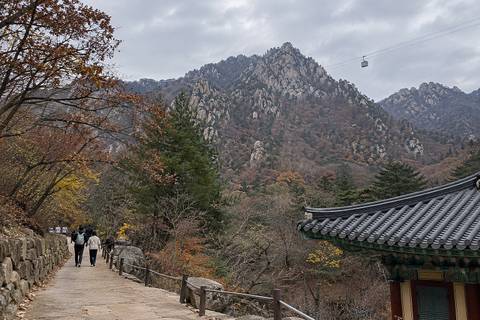
Granite pinnacles at the end of a 3.8 km trail from Sogongwon, the last part on long stairs; allow about 4 hours there and back.
Updated
Essentials
- Hours
- Trail open from 2 hours before sunrise until sunset; no hiking from sunset onwards (park service rule since 11 July 2026)
- Allow about 4 hours there and back from Sogongwon
- Closed
- Open during the 15 November – 15 December 2026 autumn fire closures, which shut only the high Seoraksan routes. Any trail can close at short notice for heavy rain, heavy snow, typhoons or rockfall risk.
- Admission
- Free: no national park admission and no Sinheungsa entry fee
- Parking at Sogongwon is paid (Sinheungsa car park); see the Seorak Cable Car page
- Getting there
- Sokcho city bus 7 or 7-1 to the last stop, Seoraksan (Sogongwon), ₩1,700
- Trailhead: Sogongwon park entrance, Seorak-dong; walk past Sinheungsa temple
- Sokcho from Seoul: express bus about 2 h 20 min
- Address
- 833 Seoraksan-ro, Seorak-dong, Sokcho, Gangwon (Sogongwon park office, start of the trail)
강원특별자치도 속초시 설악산로 833 - Website
- knps.or.kr/front/portal/visit/visitCourseSubMain.do?parkId=120400&parkNavGb=guide&menuNo=7020093
Book your trip
Ulsanbawi is a free hike in Seoraksan National Park: 3.8 km each way from the Sogongwon entrance, about 4 hours there and back, gentle for the first 2.8 km and then a steep hour of stairs up a granite wall. The trail closes at sunset, so start by late morning in winter. It stays open during the 15 November – 15 December 2026 autumn closures.
| Your situation | Do this |
|---|---|
| Staying in Sokcho, reasonably fit | Take an early bus 7 or 7-1 to Sogongwon and hike to the top; back for a late lunch |
| Day trip from Seoul | Possible only with an early express bus; you need about 4 hours on the trail plus the bus to and from the park |
| Unsure about steep stairs | Walk to Heundeulbawi and Gyejoam (2.8 km, about 1 hour each way); the rock towers above you there |
| Only a short time at the park | Skip it. Ride the Seorak cable car instead and see Ulsanbawi across the valley from Gwongeumseong |
| Here 15 November – 15 December 2026 | Open: the fire closures hit only the summit and ridge routes. Bring grip for icy stairs |
| Starting after about 13:00 in winter | Too late for the top. Turn around at Heundeulbawi so you are down before sunset |
Is Ulsanbawi worth it?
Yes, if you have half a day and can handle stairs. It is the best hike in the Seoraksan area that fits into a morning, and the park service names the view from the top: the East Sea, the city of Sokcho and Daecheongbong, Seorak’s highest peak. You pass a temple, a famous “rocking rock” and three small hermitages on the way.
Ulsanbawi itself is a wall of six granite peaks, close to 900 m high according to the park service. Korea’s heritage service made it a national Scenic Site (명승) on 11 March 2013, describing five pot-shaped hollows on the summit and the old name Cheonhusan, “the mountain that roars in the wind”, from the sound the wind makes in the rock.
It is not a walk in the park. The last kilometre is a sustained climb on steel stairs and decks with drops beside them. If you only want an easy outing, choose Biseondae or the cable car.
| Distance | 3.8 km one way, 7.6 km return |
| Time | About 4 h return (2 h up, per the park service) |
| Climb | Gentle to Heundeulbawi; steep stairs for the last 1.0 km |
| Admission | Free |
| Trail hours | 2 h before sunrise until sunset |
| Start | Sogongwon, Seorak-dong (end of bus 7 / 7-1) |
| Best for | Views, autumn colour, a half-day hike |
Distances, times and hours from the Korea National Park Service’s Seoraksan course page and its July 2026 entry-hours notice; checked 14 November 2026.
The trail, step by step
The park service splits the route into two parts. Both are the same path up and down; there is no loop.
| Section | Distance | Time one way | What it is like |
|---|---|---|---|
| Sogongwon → Sinheungsa → Heundeulbawi (Gyejoam) | 2.8 km | About 1 h | Gentle valley path, partly on decks, then earth and stone; fine for children and older walkers |
| Heundeulbawi → Ulsanbawi summit | 1.0 km | About 1 h | Steep stairs and steel decks up the rock face; rockfall zone |
| Total | 3.8 km | About 2 h | Return the same way: 7.6 km, about 4 h |
Sogongwon to Sinheungsa. From the bus stop, walk through the park entrance to Sinheungsa, the temple just inside Sogongwon; the trail to Ulsanbawi continues beyond it, signposted to Heundeulbawi (흔들바위) and Ulsanbawi (울산바위).
Up the valley to Heundeulbawi. The path climbs gently along a stream, past the small hermitages of Anyangam and Naewonam. At the end of this section is Gyejoam, a small hermitage at the foot of the rock, and next to it Heundeulbawi, a boulder that visitors push to make it rock. The park service lists it as one of the course’s sights. It is a popular turning point, with Ulsanbawi rising directly above.
The stairs. Beyond Gyejoam the trail climbs the granite on long flights of steel stairs and decks. The park service says to check how you feel before starting this part and warns of falling rocks. Near the top, Korean press describes three viewing points facing different ways: the face of Ulsanbawi itself, and back across the valley to Dalmabong, Gwongeumseong and the summit, Daecheongbong. From the top you also look east over Sokcho and the sea.
Hours, closures and fines
| Trail hours | Closures | Admission |
|---|---|---|
| From 2 h before sunrise until sunset | Weather warnings, rockfall risk; not the autumn 2026 fire closure | Free |
Seoraksan National Park entry-hours notice 2026-24 (in force from 11 July 2026) and autumn closure notice of 30 October 2026, checked 14 November 2026.
Sunset rule. Unlike the summit routes, which have fixed start-time windows, the Sogongwon–Ulsanbawi trail is simply off-limits from sunset until 2 hours before the next sunrise. Since the round trip takes about 4 hours, work back from sunset: winter afternoons are short, so aim to start before late morning from November to February.
Fire closures. Twice a year Seoraksan closes its high, fire-prone trails. In autumn 2026 (15 November – 15 December) the park’s closure map keeps the Sogongwon trail to Heundeulbawi and Ulsanbawi open, together with Biseondae and Biryong Falls. It was also open during the spring 2026 closure (4 March – 15 May). See the Seoraksan page for which routes close.
Weather. Any trail can be shut at short notice in heavy rain, heavy snow, typhoons, thaw-season rockfall risk or other emergencies. The park service’s live control status is on knps.or.kr.
Fines. Hiking a closed trail or outside the permitted hours costs ₩200,000, then ₩300,000 and ₩500,000 for repeat offences.
How to get there
| From | How | Notes |
|---|---|---|
| Central Sokcho | City bus 7 or 7-1 to the last stop, Seoraksan (Sogongwon) | ₩1,700; 7 runs via Yeongnang-dong, 7-1 via the medical centre |
| Sokcho bus terminals | Bus 7 or 7-1, or a taxi | Check live bus times in Naver Map or KakaoMap |
| Seoul | Express bus to Sokcho (about 2 h 20 min), then bus 7 or 7-1 | See getting to Sokcho |
| By car | Paid Sinheungsa car park at Sogongwon | Fills early on autumn weekends; details on the cable car page |
The city bus fare is ₩1,700 for adults, with one free transfer to another city bus within 90 minutes if you tap your card when you get off. The trail starts at the park entrance where the bus terminates; the cable car, Sinheungsa and the other lowland trails start there too.
Tips for hiking Ulsanbawi
- Start early. You get more daylight in hand, and the stairs are quieter before the day-trippers arrive, especially on autumn weekends.
- Shoes and grip. Wear proper hiking shoes. From late November the stairs can be icy, so carry light traction spikes in winter.
- Pack. The park service advises spare layers and snacks, because mountain weather changes fast. Carry enough water for 4 hours.
- Best season. The park service recommends mid-October to early November for autumn colour against the grey rock. Spring brings fresh green along the stream.
- Respect the temples. Sinheungsa and the hermitages on the way are working temples; keep your voice down and don’t climb on the halls.
- Combine. Do Ulsanbawi in the morning and the cable car in the afternoon, or the reverse if you arrive early enough to buy a cable car ticket first. Both start at Sogongwon.
Around Ulsanbawi
The rest of the Sogongwon area is covered on the Seoraksan National Park page: the flat walk to Biseondae and the Geumganggul cave, Biryong Falls, and the Seorak cable car to Gwongeumseong, which faces Ulsanbawi across the valley.
Back in town, the Sokcho guide covers the fish market, Abai Village and where to stay, with Seorak-dong hotels closest to the trail for an early start. For more mountains, see hiking in Korea, national parks and the Gangwon region.
Nearby
Seoraksan National Park
Granite peaks topped by Daecheongbong (1,708 m), a UNESCO biosphere reserve since 1982; easy trails start at Seorak-dong.
Sinheungsa Temple
The temple just inside the Sogongwon entrance, on the way to Ulsanbawi and Biseondae; a flat walk for anyone not hiking.
Seorak Cable Car
A 1,128 m, 5-minute ride from Sogongwon up to the cliffs below Gwongeumseong; ₩16,000 return, tickets on the day only.
Biseondae and Geumganggul
An easy 3 km valley walk from Sogongwon to the smooth rock pools of Biseondae, with a steep 0.6 km climb on to the Geumganggul cave.
Biryong Falls and Towangseong Falls viewpoint
An easy 2.4 km trail past Yukdam Falls to Biryong Falls, then up to a viewpoint for Towangseong Falls on the far cliff.
Frequently asked questions
Is Ulsanbawi open in late November and December 2026?
Yes. Seoraksan's autumn fire closure from 15 November to 15 December 2026 shuts the summit and high ridge routes only; the park's closure map keeps the Sogongwon trail to Heundeulbawi and Ulsanbawi open. Weather warnings can still close it on the day, and the stairs can be icy, so check the park service's live control page before you set out.
How long does the Ulsanbawi hike take?
About 4 hours there and back, according to the park service: 3.8 km each way. The first 2.8 km to Heundeulbawi take about an hour on a gentle path; the last 1.0 km is a steep climb on stairs and takes about another hour. Add time for photos at the top and for Sinheungsa on the way.
Is the Ulsanbawi hike hard?
It is moderate. The park service says the walk to Heundeulbawi is fine for children and older people, but the final kilometre climbs a granite face on steep steel stairs and decks. Anyone in normal shape can do it slowly; if stairs are a problem, turn back at Heundeulbawi, which has views of the rock.
Can you take the cable car to Ulsanbawi?
No. The Seorak cable car runs from Sogongwon to Gwongeumseong, on the opposite side of the valley. You can see Ulsanbawi from the top station, but reaching the rock itself means hiking from Sogongwon.
When is the latest time to start the Ulsanbawi hike?
The trail closes at sunset and the round trip takes about 4 hours, so in winter start by late morning and in summer by early afternoon. The park service asks hikers to plan around their fitness and the sunset time, because the trail returns to the start.
Sources
Facts on this page were checked against these sources on 14 November 2026. Prices, hours and rules change — confirm with the operator before you go.
- 국립공원공단 – 설악산 탐방코스: 울산바위코스 (신흥사~흔들바위~울산바위 편도 3.8km 2시간, 왕복 7.6km 4시간; 흔들바위까지 2.8km 1시간, 울산바위까지 1.0km 1시간 계단; 낙석 주의; 단풍 10월 중순~11월 초순) (Korean) · official
- 국립공원공단 설악산 – 입산시간지정제 변경 공고 (공고 제2026-24호, 2026.7.11. 시행; 소공원↔울산바위 일몰 후부터 익일 일출 2시간 전까지 탐방제한; 과태료 20·30·50만원) (Korean) · official
- 국립공원공단 설악산 – 2026년 가을철 설악산국립공원 탐방로 출입통제 공고 (11.15.~12.15.; 첨부 탐방안내도의 개방 탐방로: 소공원~울산바위) (Korean) · official
- 국립공원공단 설악산 – 봄철 산불예방 탐방로 통제 (보도자료 2026-02-12: 3.4.~5.15. 고지대 통제, 와선대·울산바위·토왕성폭포 전망대·주전골 개방) (Korean) · official
- 국립공원공단 – 설악산국립공원 (공원 안내, 요금 안내: 입장료 없음) (Korean) · official
- 국가유산청 국가유산 공공데이터 – 명승 설악산 울산바위 (2013.3.11. 지정, 631,090㎡, 6개 봉우리·항아리 모양 구멍 5개, 천후산, 계조암·신흥사, 김홍도 실경산수화, 소유 신흥사 외) (Korean) · official
- 속초시 – 시내버스 노선 및 요금 (7·7-1번 장사동~설악산, 일반 1,700원, 90분 내 1회 환승; 최종수정 2026-09-11) (Korean) · official
- 설악케이블카 – 이용안내 (소공원~권금성 왕복) (Korean) · official
- 리포테라 – 초보 산행객도 주목할 설악산 울산바위 코스 (소공원~신흥사~내원암~흔들바위~울산바위, 흔들바위~울산바위 약 1km 1시간, 전망 포인트 3곳, 입장료 무료, 2026-09-09) (Korean)
- 경북매일 – 울산바위 앞에서 가을을 즐기다 (이름 유래: 울타리·우는 산·울산 설, 2026-10-19) (Korean)