Sokcho · Seorak-dong and Seoraksan
Sinheungsa Temple 신흥사
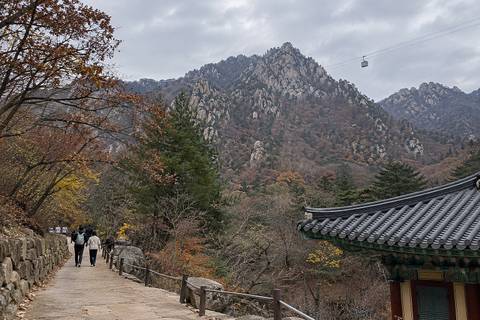
The temple just inside the Sogongwon entrance, on the way to Ulsanbawi and Biseondae; a flat walk for anyone not hiking.
Updated
Essentials
- Hours
- Temple grounds: open at all times, every day (Korea Tourism Organization data, 11 November 2026)
- The national park trails beyond the temple (Ulsanbawi, Biseondae): closed from sunset to 2 hours before sunrise
- Monthly services: 10:00 on the 1st and 18th days of the lunar month, in Geungnakbojeon hall
- Closed
- The temple has no closing day. The templestay office has a weekly day off (see Templestay below).
- Admission
- Temple: free (Sinheungsa stopped charging admission on 4 May 2023)
- Car park at Sogongwon (run by Sinheungsa): ₩6,000 a day for a car (Korea Tourism Organization data)
- Overnight templestay: from ₩90,000 per adult (templestay.com, 2026)
- Getting there
- Sokcho city bus 7 or 7-1 to the last stop, Seoraksan (Sogongwon), ₩1,700; then walk through the park entrance past the cable car station
- From Seoul: express bus to Sokcho, about 2 h 20 min, then bus 7 or 7-1
- Address
- 1137 Seoraksan-ro, Seorak-dong, Sokcho, Gangwon
강원특별자치도 속초시 설악산로 1137 (설악동) - Website
- sinheungsa.kr
Book your trip
Sinheungsa is free, open at all times and right on the path from the Seoraksan entrance to Ulsanbawi and Biseondae, so give it 30–45 minutes on the way to or from a trail or the cable car. Its 14.6 m bronze Buddha and 17th-century main hall are the sights. It also runs a templestay; international guests book it by email.
| Your situation | Do this |
|---|---|
| Waiting for your cable car slot | Buy the ticket first, then walk to the temple; it is a short, flat walk past the cable car station, and you can be back for your boarding time |
| Hiking Ulsanbawi or Biseondae | You pass the temple anyway; see the courtyard on the way back down, when the morning crowds have thinned |
| Here 15 Nov–15 Dec 2026 | The high Seoraksan routes are closed for fire prevention, but the temple and the Sogongwon lowland trails stay open |
| Not a hiker, or with older relatives | The walk from the bus stop to the temple is flat; the bronze Buddha and the main courtyard are near the main path |
| Want to stay the night | Email the templestay office (details below); do not book on the Korean-language program pages |
| It is a Monday | The temple is open; Monday rules only matter for the templestay office |
What is Sinheungsa?
Sinheungsa (신흥사) is the head temple of the Jogye Order’s 3rd district. It sits inside Seoraksan National Park at Sogongwon, the main entrance on the Sokcho side. Seoraksan’s peaks, including Ulsanbawi, rise behind it. It is the temple that almost every visitor to Seorak-dong walks past, whether they come for the Seorak cable car, Ulsanbawi or the valley walk to Biseondae.
The temple tells its history as three foundings:
- 652. The monk Jajang founded Hyangseongsa on the spot where the Kensington Hotel now stands, at the entrance to Seorak-dong. It burned down in 698.
- About 701. Uisang rebuilt it higher up the valley as Seonjeongsa, on the site of today’s Naewonam hermitage. It lasted until another fire in 1642.
- 1644. Three monks, Yeongseo, Hyewon and Yeonok, rebuilt it on the present site. They said a white-haired spirit appeared to them in a dream and chose the spot. The name first meant “the temple that prospered by a spirit’s choice” (神興寺).
After the Korean War destroyed Geonbongsa in Goseong, Sinheungsa took over as the district’s head temple. In 1995 it changed the first character of its name to “new” (新興寺), for a new start for Buddhism on the east coast.
Getting there
Sinheungsa is at the end of the road into Seorak-dong, inside the park entrance at Sogongwon.
- Bus. Sokcho city buses 7 and 7-1 end at the Seoraksan (Sogongwon) stop; the adult fare is ₩1,700 by card. Walk through the park entrance and past the cable car station; the temple gate is beyond it, on the trail signed for Heundeulbawi and Ulsanbawi. Korea Tourism Organization data puts the temple about 500 m from the cable car.
- From Seoul. Express buses to Sokcho take about 2 h 20 min; then take bus 7 or 7-1 from town. See getting to Sokcho.
- By car. The car park at Sogongwon belongs to Sinheungsa and charges ₩6,000 a day for a car. It fills early on autumn weekends; the cable car page has the overflow car parks and shuttle used in peak season.
Hours and fees
| Hours | Closed | Fee | |
|---|---|---|---|
| Temple grounds | Open at all times | Never | Free |
| Trails beyond the temple | Closed from sunset to 2 hours before sunrise | Fire-prevention closures apply to the high routes only, 15 Nov–15 Dec 2026 | Free |
| Car park (Sogongwon) | – | – | ₩6,000 a day per car |
Korea Tourism Organization data updated 11 November 2026; trail hours and closures from the Korea National Park Service. Checked 16 November 2026.
Admission has been free since 4 May 2023. Before that, Sinheungsa collected a heritage fee at the checkpoint by the park entrance. Older guides and blog posts that mention a ticket are out of date.
What to see
Allow 30–45 minutes for the main sights, in this order from the park entrance:
- Tongil Daebul (통일대불), the Unification Buddha. A seated bronze Buddha 14.6 m tall on an eight-sided pedestal 4.3 m high and 13 m across. The temple says it took 108 tonnes of bronze. Work began on 30 August 1987, and it was consecrated on 25 October 1997, as a prayer for the reunification of the two Koreas. Sixteen arhats are carved in relief around the pedestal. Under the statue is a small worship hall, and relics given by the Myanmar government in 1992 were placed inside the statue.
- The Four Heavenly Kings Gate (사천왕문). The last gate before the courtyard, first built in 1811 and rebuilt in 1972 after a fire.
- Bojeru (보제루), a long two-storey pavilion from 1770 that you walk under to reach the main hall. Its posts on the main-hall side are short, so people had to bow their heads as they passed. Inside are a large drum and a wooden fish, and the temple says plaques by the calligrapher Kim Jeong-hui (Chusa) hang on its walls.
- Geungnakbojeon (극락보전), the main hall, a Treasure since 2018. The Korea Heritage Service praises its bracket work and its carved stone base and stairs. The carved dragon heads and the lion and peony reliefs on the steps are rare in Korean temples. Inside is a wooden Amitabha triad carved in 1651 by the monk-sculptor Muyeom, also a Treasure.
Two more Treasures belong to the temple: a Ksitigarbha triad, also carved in 1651 and kept in the judgement hall (명부전), and a 1755 Buddhist painting of the Buddha preaching (영산회상도). The painting left the temple, spent more than 70 years abroad and came back from the United States. It became a Treasure in 2022.
On the road into Seorak-dong, in front of the Kensington Hotel, stands the three-storey stone pagoda of Hyangseongsa, the only part left of the first temple. It is a Treasure from the Unified Silla period, probably 9th century. The Korea Heritage Service calls it the northernmost Silla stone pagoda on the east coast.
Templestay
Sinheungsa runs templestays through the national templestay.com system. International guests are asked not to book on the Korean program pages, but to email the templestay office: temple7393@templestay.com. The office phone is 033-636-8001, answered 09:00–11:20 and 13:00–17:00. Its listings name a weekly day off, Monday in one place and Wednesday in another, so email is the safer way to reach it.
| Program (2026) | Dates | Adult | Child | Book by |
|---|---|---|---|---|
| Overnight, rest and experience (휴식+체험형) | 1 Jan–31 Dec 2026 | ₩90,000 (teens the same) | ₩80,000 (pre-school the same) | 5 days before |
| Weekend Seon meditation (선명상) | 1 Sep–30 Dec 2026 | ₩100,000 (teens the same) | ₩90,000 | 5 days before |
| New Year sunrise trek (해맞이) | 31 Dec 2026–1 Jan 2027 | ₩120,000 | – | 10 days before |
| Day program (groups) | 1 Jan–31 Dec 2026 | ₩40,000 | – | 7 days before |
Per person, from Sinheungsa’s program pages on templestay.com, checked 16 November 2026.
- The overnight program. Check in 14:00–14:30; late arrivals are not let in. Then come an orientation on temple manners, prayer-bead making and optional 108 bows or a walking meditation. Dinner is at about 17:10, followed by a temple tour and the evening service. The optional dawn service is at 04:10, and you check out at 10:00, with time for a walk on the Seoraksan trails first.
- Rooms. Rooms are shared by two or three people; a single room costs ₩40,000 extra. Under-18s must come with a parent or guardian. Templestay guests pay no car park fee.
- What to bring. A towel, toiletries and your own cup or tumbler (only soap is provided), warm layers in winter, and walking shoes if you plan to hike. Temple clothes are lent to you.
- New Year sunrise trek. The program climbs Ulsanbawi to see the first sunrise of 2027.
- Day program. It runs 09:30–14:00 with temple manners, bead making, tea with a monk, a temple meal and a forest walk. It is set up for groups, including foreign groups, and times can be arranged with the office.
For how templestays work and other temples that take foreign guests, see temple stays in Korea.
Visitor tips
- Go early or late. Sogongwon is busiest from late morning on autumn weekends, when Seoraksan’s colours peak in mid-October.
- Temple manners. Sinheungsa is a working monastery. Keep your voice down and ask before photographing monks or services.
- Pair it with a walk. The trails to Ulsanbawi (3.8 km one way) and Biseondae (3.0 km) start past the temple. Easy walkers can stop at Heundeulbawi, the “rocking rock”, 2.8 km from Sogongwon.
- Food. Seorak-dong has restaurants near the bus stop, but central Sokcho has much more choice. See Sokcho food.
For the whole park, see the Seoraksan National Park guide. For more temples across Korea, see temples, and for the rest of the province see Gangwon.
Nearby
Seoraksan National Park
Granite peaks topped by Daecheongbong (1,708 m), a UNESCO biosphere reserve since 1982; easy trails start at Seorak-dong.
Seorak Cable Car
A 1,128 m, 5-minute ride from Sogongwon up to the cliffs below Gwongeumseong; ₩16,000 return, tickets on the day only.
Ulsanbawi Rock
Granite pinnacles at the end of a 3.8 km trail from Sogongwon, the last part on long stairs; allow about 4 hours there and back.
Biseondae and Geumganggul
An easy 3 km valley walk from Sogongwon to the smooth rock pools of Biseondae, with a steep 0.6 km climb on to the Geumganggul cave.
Biryong Falls and Towangseong Falls viewpoint
An easy 2.4 km trail past Yukdam Falls to Biryong Falls, then up to a viewpoint for Towangseong Falls on the far cliff.
Frequently asked questions
Is there an entrance fee for Sinheungsa?
No. Sinheungsa used to charge a heritage admission fee at the Seoraksan gate. It stopped charging on 4 May 2023, when most Jogye Order temples dropped their fees. National park entry is free too. Only the car park at Sogongwon costs money, ₩6,000 a day for a car.
How big is the Tongil Daebul at Sinheungsa?
By the temple's figures, the seated bronze Buddha is 14.6 m tall on a 4.3 m pedestal 13 m across, and was cast from 108 tonnes of bronze. Work began on 30 August 1987 and the statue was consecrated on 25 October 1997. It was built as a prayer for the reunification of North and South Korea.
Can foreigners do a templestay at Sinheungsa?
Yes, but do not book on the Korean-language program pages. Sinheungsa's listings on templestay.com ask international guests to send an inquiry by email to temple7393@templestay.com instead. The year-round overnight program costs ₩90,000 for adults and teenagers, with check-in at 14:00.
How long do I need at Sinheungsa?
About 30–45 minutes for the bronze Buddha, the gate and the main courtyard. The temple is on the way to Ulsanbawi and Biseondae, so most visitors walk through on the way to or from a trail rather than making a separate trip.
Is Sinheungsa open during the Seoraksan fire-prevention closure?
Yes. From 15 November to 15 December 2026 the park closes every route to Daecheongbong and the high ridges, but the lowland trails from Sogongwon stay open, and the temple is right on them. Ulsanbawi and Biseondae are both open.
Sources
Facts on this page were checked against these sources on 16 November 2026. Prices, hours and rules change — confirm with the operator before you go.
- 설악산 신흥사 – 신흥사 역사 (652년 자장 향성사 창건, 698년 화재, 선정사, 1642년 화재 후 현재 터, 1995년 新興寺로 개칭) (Korean) · official
- 설악산 신흥사 – 통일대불 (높이 14.6m, 좌대 4.3m·직경 13m, 청동 108톤, 착공 1987.8.30, 1997.10.25 점안) (Korean) · official
- 설악산 신흥사 – 신흥사전각: 보제루 (1770년, 법고·목어, 추사 현판) (Korean) · official
- 설악산 신흥사 – 신흥사전각: 극락보전 (아미타불·관세음·대세지보살) (Korean) · official
- 설악산 신흥사 – 법회안내 (음력 1일·18일 오전 10시, 극락보전) (Korean) · official
- 템플스테이 – 설악산 신흥사 사찰소개 (통일대불 1987~1997, 사천왕문, 보제루, 극락보전, 명부전; 템플스테이 033-636-8001) (Korean) · official
- Templestay – Seoraksan Sinheungsa: temple introduction · official
- Templestay – Sinheungsa overnight program (2026-01-01~12-31; adult/teen ₩90,000, child/pre-school ₩80,000; international guests: e-mail inquiry; single room +₩40,000) · official
- 템플스테이 – 신흥사 [주말체험형] 선명상 프로그램 (2026-09-01~12-30; 성인 100,000원) (Korean) · official
- 템플스테이 – 신흥사 해맞이 트레킹 템플스테이 (2026-12-31~2027-01-01; 성인 120,000원, 10일 전까지 예약) (Korean) · official
- 템플스테이 – 신흥사 단체/당일형 (09:30~14:00, 40,000원, 내국인·외국인 단체) (Korean) · official
- 국가유산청 국가유산포털 – 속초 신흥사 극락보전 (보물, 2018.6.4 지정) (Korean) · official
- 국가유산청 국가유산포털 – 속초 신흥사 목조아미타여래삼존좌상 (보물, 2011.9.5 지정, 1651년 무염) (Korean) · official
- 국가유산청 국가유산포털 – 속초 신흥사 목조지장보살삼존상 (보물, 2012.2.22 지정, 1651년) (Korean) · official
- 국가유산청 국가유산포털 – 속초 신흥사 영산회상도 (보물, 2022.10.26 지정, 1755년, 미국에서 환수) (Korean) · official
- 국가유산청 국가유산포털 – 속초 향성사지 삼층석탑 (보물, 1966.8.25 지정, 통일신라) (Korean) · official
- 국립공원공단 설악산 – 2026년 가을철 설악산국립공원 탐방로 출입통제 공고 (11.15.~12.15.) (Korean) · official
- 속초시 – 시내버스 노선 및 요금 (7·7-1번, 1,700원) (Korean) · official
- K-TRIP TIPS (한국관광공사 데이터) – 신흥사(설악산) (상시 개방, 연중무휴, 입장료 무료, 주차 1일 6,000원; 2026-11-11 갱신) (Korean)
- 매일신문 – 동화사·불국사·운문사 등 사찰 65곳 관람료 면제 (2023-05-04; 설악산 입구 신흥사 무료입장 현수막) (Korean)
- 헤럴드경제 미주판 – ‘영동지역 대본산’ 속초 신흥사 [정용식의 사찰 기행] (2025-12-03) (Korean)