Gwangju · Songjeong, Mudeungsan and Damyang
Juknokwon Bamboo Forest 죽녹원
Damyang's bamboo forest park, 2.4 km of shaded trails for ₩3,000, open every day; a half-day trip from Gwangju on bus 311.
Updated
Essentials
- Hours
- November–February: 09:00–18:00, last entry 17:30
- March–October: 09:00–19:00, last entry 18:00
- Closed
- No closing day. The grounds are fully closed outside visiting hours; if you are still inside at closing time, leave through the Art Center.
- Admission
- Adults ₩3,000; middle and high school students ₩1,500; primary school children ₩1,000
- Groups of 20 or more: ₩2,400 / ₩1,000 / ₩600
- Free (ticket still issued) for under-6s, over-65s, Damyang residents and some others, on showing ID
- Getting there
- City bus 311 from Gwangju: from the stop behind Gwangju Station, or from the stop in front of U-Square bus terminal
- From Gwangju Songjeong (KTX): go to Gwangju Station or U-Square first, then take bus 311
- Two gates: the main gate at 119 Jungnogwon-ro and the back gate at 363 Jukhyangmunhwa-ro
- Address
- 119 Jungnogwon-ro, Damyang-eup, Damyang
전남광주통합특별시 담양군 담양읍 죽녹원로 119 - Website
- juknokwon.go.kr/menu/goToContentsPage?domainId=DOM_0000024&contentsSid=779&menuCd=DOM_000002402001000000
Book your trip
Juknokwon is a ₩3,000 bamboo forest park in Damyang, open every day; from November to February last entry is 17:30. City bus 311 runs there from Gwangju Station and U-Square bus terminal, so it makes an easy half-day trip from Gwangju. Allow about two hours for the 2.4 km of shaded bamboo paths and the riverside trees outside.
| Your situation | Do this |
|---|---|
| Staying in Gwangju | Take bus 311 in the morning and be back for lunch, or pair it with the May 18th National Cemetery |
| Arriving by KTX at Gwangju Songjeong | Go to U-Square or Gwangju Station first; bus 311 does not start at Songjeong |
| Visiting November to February | Start by 15:30 so you have two hours before the 17:30 last entry |
| Travelling with a wheelchair or pushchair | Borrow a wheelchair at the back-gate ticket office and stay around Siga Culture Village; the bamboo trails climb a hill |
| Over 65 with a foreign passport | Expect to pay ₩3,000; the free rate is written for Korean ID |
| Want a picnic | Eat before you go: food and cooking are not allowed inside |
Juknokwon official visitor page, checked 10 November 2026; US$ figures use about ₩1,400 to the dollar.
Is Juknokwon worth the trip?
Yes, if you want a calm green walk and Korea’s best-known bamboo grove; skip it if you only have one day in Gwangju and care most about the city’s history. The park covers the hill of Seonginsan behind Damyang town. The county laid it out from 2003 and opened it in March 2005, and the operator puts its area at about 310,000 m², including the Siga Culture Village on its far side. Korea Tourism data gives a smaller figure (about 160,000 m²), which seems to count only the bamboo forest.
Bamboo is evergreen, so the park looks much the same in every season. Summer is the reason most Korean visitors come: the operator says the grove stays 4–7 °C cooler than outside. In November to February the paths are quiet and the light is lower and softer; the green does not change.
Damyang is a separate county north of Gwangju, but it is reached most easily from Gwangju, which is why it sits on the Gwangju guide.
Opening hours and entrance fees
| Season | Open | Last entry |
|---|---|---|
| November–February | 09:00–18:00 | 17:30 |
| March–October | 09:00–19:00 | 18:00 |
Juknokwon official visitor page, checked 10 November 2026; Korea Tourism data (updated 30 June 2026) gives the same times. There is no closing day. Outside these hours the grounds are fully closed; anyone still inside at closing time should leave through the Art Center.
| Ticket | Individual | Group (20 or more) |
|---|---|---|
| Adult | ₩3,000 | ₩2,400 |
| Middle and high school students, conscripts | ₩1,500 | ₩1,000 |
| Primary school children | ₩1,000 | ₩600 |
Entry is free, though you still take a ticket, for children under 6, people aged 65 and over, Damyang residents, national merit recipients and some people with disabilities, all on showing ID. The list reads as Korean ID, so foreign visitors should expect to pay. Damyang opened Juknokwon and its other paid sights free on Chuseok Day in 2026 (25 September); check for a similar offer if you visit on a national holiday.
How do you get there from Gwangju?
By city bus 311. This is the park’s own recommended route. Board at the stop behind Gwangju Station, or at the stop in front of U-Square (Gwangju’s main bus terminal). The park’s page says the bus runs about every 15 minutes. It does not say how long the ride takes or which gate the bus stops at, so check the live route in Naver Map or KakaoMap; search for 죽녹원.
From the KTX. All KTX trains stop at Gwangju Songjeong, far to the west of the city. Get to U-Square or Gwangju Station first, then take bus 311. See the Gwangju guide for KTX times and the subway.
From Seoul. The park lists a few direct express buses a day from the Central City terminal in Seoul to Damyang bus terminal. Most first-time visitors find it easier to take the KTX to Gwangju and continue by bus. See long-distance buses for booking.
The two gates. The main gate is at 119 Jungnogwon-ro, on the town side by the stream; the back gate is at 363 Jukhyangmunhwa-ro, by Siga Culture Village. The back-gate ticket office lends wheelchairs.
What to see inside
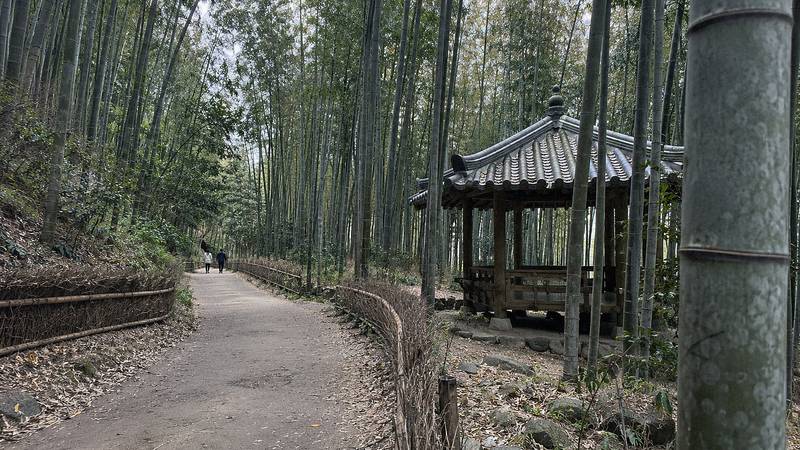
The bamboo trails. About 2.4 km of paths run through the grove, divided into eight themed trails with names such as the Path of Good Fortune, the Path of Old Friends and the Path of Unchanging Love. The first trail, the Path of Good Fortune, is 420 m and takes about 15 minutes; it passes a filming location from the drama Iljimae. A separate path leads to a spot where the KBS variety show 2 Days & 1 Night filmed.
The observatory. Korea Tourism data says the trails start at an observatory that looks over Damyang Stream, the old trees of Gwanbangjerim and the Metasequoia-lined Road.
Siga Culture Village. On the far side of the hill, the county has rebuilt copies of famous Damyang pavilions such as Myeonangjeong, Songgangjeong and Gwangpunggak (the main pavilion of the Soswaewon garden), in a park of lawns and poetry stones. Damyang was a centre of gasa poetry in the Joseon period, and these pavilions are where its poets met. The area also has a pansori practice hall, a tea house serving jungnocha (tea grown under bamboo), a memorial hall to the 1592 righteous army and a hanok guesthouse.
Hanok stays. The park runs a small hanok guesthouse inside Siga Culture Village, about seven minutes’ walk from the back gate, booked through the park’s website (Korean only). The operator posts dates when it cannot take bookings.
Rules and practical tips
- No food or cooking inside, and no smoking anywhere (fines apply).
- No writing on the bamboo and no picking bamboo shoots.
- Dogs: small dogs only if carried; large dogs are banned.
- No bicycles or electric scooters.
- Shoes: wear something with grip; the trails are earth and stone steps on a slope.
- Timing: in winter the sun sets early and the dense bamboo blocks much of the light, so go in the morning or early afternoon.
Around Juknokwon
Gwanbangjerim, about 400 m from the main gate along Damyang Stream, is a riverside embankment lined with old trees, some more than 300 years old (Korea Tourism data). It makes a natural second walk. About 1.7 km away, the Metasequoia-lined Road charges its own entry fee.
Back in Gwangju, combine Juknokwon with the May 18th National Cemetery, which is also north of the city, or spend the afternoon downtown at the former South Jeolla Provincial Office. For a mountain walk instead of a flat one, see Mudeungsan. The Jeolla region guide covers Damyang’s neighbours, from Jeonju to the Suncheon Bay wetland.
Nearby
May 18th National Cemetery
The national cemetery for those killed in the uprising, with a memorial tower and exhibition hall; open daily, bus 518.
Mudeungsan National Park
The mountain on the city's edge, with the columnar rock pillars of Seoseokdae and Ipseokdae; a UNESCO Global Geopark.
1913 Songjeong Station Market
A market from 1913, revamped with snack stalls and cafés, a short walk from the KTX station; good for a meal between trains.
Frequently asked questions
How much is Juknokwon's entrance fee?
₩3,000 for adults (about US$2), ₩1,500 for middle and high school students and ₩1,000 for primary school children. Children under 6 and over-65s go free on showing ID, but the free categories are written for Korean ID, so foreign seniors should expect to pay the adult fare.
What time does Juknokwon close?
From November to February it is open 09:00–18:00 with last entry at 17:30. From March to October it is open 09:00–19:00 with last entry at 18:00. It opens every day of the year, and the grounds are closed completely outside these hours.
How do you get to Juknokwon from Gwangju?
Take city bus 311. The park's own page says to board at the stop behind Gwangju Station or at the stop in front of U-Square bus terminal. From the KTX at Gwangju Songjeong, first get to Gwangju Station or U-Square. Check the live times and journey length in Naver Map or KakaoMap.
How long do you need at Juknokwon?
Allow about two hours. The bamboo paths total 2.4 km, and the first trail alone (420 m) takes about 15 minutes at a walk. Add an hour if you also stroll along Gwanbangjerim, the line of old trees by the stream outside the main gate.
Can you bring a dog or a pushchair to Juknokwon?
Small dogs are allowed only if carried; large dogs are not allowed. Wheelchairs can be borrowed at the back-gate ticket office. Because the bamboo trails climb a hill, the park suggests wheelchair and pushchair users stay around the flatter Siga Culture Village area.
Sources
Facts on this page were checked against these sources on 10 November 2026. Prices, hours and rules change — confirm with the operator before you go.
- 담양 죽녹원 – 관람안내 (하절기·동절기 개방시간, 입장마감, 휴무일 없음, 요금, 무료 대상, 관람 유의사항) (Korean) · official
- 담양 죽녹원 – 오시는길 (정문·후문 주소, 광주역·유스퀘어 311번 버스, 직행버스) (Korean) · official
- 담양 죽녹원 – 죽녹원 소개 (2003년 조성, 2005년 3월 개원, 310,238㎡, 산책로 8길) (Korean) · official
- 담양 죽녹원 – 죽녹원8길 (산책로 2.4km, 운수대통길 420m 15분) (Korean) · official
- 담양 죽녹원 – 시가문화촌 (정자 재현, 우송당, 죽로차 제다실, 한옥체험장) (Korean) · official
- K-Trip Tips (Korea Tourism data) – Juknokwon (Bamboo Garden): hours, fees, open all year (updated 2026-06-30)
- K-Trip Tips (한국관광공사 데이터) – 죽녹원 (산책로 8가지 주제, 전망대, 관방제림, 2026-09-28 갱신) (Korean)
- MTN – 담양군, 추석 당일 죽녹원 등 주요 관광지 무료 개방 (2026-09-18) (Korean)