Daegu · Palgongsan (north-east)
Donghwasa Temple 동화사
The best-known temple on Palgongsan, with a 33 m stone Medicine Buddha; free to enter, about 45 min from Dongdaegu Station on bus Express 1.
Updated
Essentials
- Hours
- Medicine Buddha statue and plaza: open 24 hours, according to the temple
- Seongbo Museum: 10:00–16:00, winter included
- Beophwa Bogung hall under the Buddha: 10:00–17:00, last entry 16:00
- Closed
- Seongbo Museum: every Monday (the temple says this can change). No closing day is published for the temple itself
- Admission
- Temple: free (heritage fee dropped on 4 May 2023)
- Seongbo Museum: free
- Parking: ₩4,000 per car, ₩10,000 for vehicles of 2.5 t and over
- Getting there
- City bus Express 1 (급행1) from Dongdaegu Station: about 45 min, according to the temple
- From Ayanggyo Station (Daegu Metro Line 1): Express 1, about 35 min
- Express 1 runs about every 13 minutes and ends at the Donghwasa facility area (동화시설집단지구), the stop after Donghwasa Entrance (동화사입구)
- Address
- 1 Donghwasa 1-gil, Dong-gu, Daegu
대구광역시 동구 동화사1길 1 - Website
- donghwasa.net/?c=1/9/49
Book your trip
Donghwasa is worth a half day from Daegu if you want a big working monastery under a forested ridge. Entry is free, and city bus Express 1 reaches it from Dongdaegu Station in about 45 minutes. Its landmark is a 33 m stone Medicine Buddha. Allow about two hours, and come on a day other than Monday if you want the museum.
| Your situation | Do this |
|---|---|
| One night in Daegu, one free morning | Express 1 from Dongdaegu Station, two hours at the temple, back by lunch |
| Want a view as well | Add the Palgongsan cable car on the same side of the mountain; together that is half a day |
| Visiting on a Monday | The grounds and the Buddha are open, but the Seongbo Museum is closed |
| Only time for one temple near Daegu | Donghwasa is the easy one by bus; the Gatbawi Buddha is a steep hour’s climb on another route |
| Arriving after dark | The Medicine Buddha is open 24 hours, but the halls, museum and hermitages are for daylight |
| Driving | Search “동화사” in the navigation app; parking costs ₩4,000 |
Why go
Donghwasa (동화사) sits on the southern slopes of Palgongsan, the granite ridge on the north-east edge of Daegu, which became a national park in December 2023. It is the head temple of the Jogye Order’s 9th district, with temples across Daegu and parts of North Gyeongsang under it.
It is also a chongnim, a full training monastery with a meditation hall, a sutra college and a school of monastic discipline. More than 100 monks live here, so parts of the grounds are closed to visitors.
The temple traces its founding to 493. The usual view, which the temple also gives, dates the real start to 832, when the monk Simji rebuilt it. Paulownia trees (odong) are said to have flowered around the temple in winter, which gave it the name Donghwa, “paulownia flower”. In 1606 the monk Samyeong, who led monk soldiers against the Japanese invasions, rebuilt the temple and used it as a base.
Getting there by bus
City bus Express 1 (급행1) is the way in without a car. It is a long cross-city route, and its north-eastern end is the Donghwasa facility area (동화시설집단지구), just past the stop Donghwasa Entrance (동화사입구).
| From | How | Time (temple’s figure) |
|---|---|---|
| Dongdaegu Station (KTX/SRT) | Express 1 towards Donghwasa | About 45 min |
| Ayanggyo Station (Metro Line 1) | Express 1 towards Donghwasa | About 35 min |
| Bukbu Bus Terminal | Express 1 | About 1 hour |
Donghwasa directions page, checked 13 November 2026.
- How often. Normally every 13 minutes, according to the Daegu city figures reported in October 2026. For the autumn-leaf weekends of 31 October to 15 November 2026 the city added two buses on the Dongdaegu–Donghwasa section, cutting the wait to 10–11 minutes.
- Which stop at Dongdaegu. The temple’s page tells you to walk about 10 minutes to the Fatima Hospital stop. The current route list also shows a stop by the Dongdaegu Station underpass (동대구역지하도), so check the stop in Naver Map or KakaoMap before you set off.
- Paying. Tap a T-money or other transit card when you board, and tap again when you get off so the free transfer works.
- Other buses. Route Palgong 1 (팔공1) also reaches Donghwasa, from the Chilseong Market side of the city. At weekends and on holidays, Palgong 3 (팔공3) links Chilgok Kyungpook National University Hospital Station with Pagyesa, Donghwasa and Gatbawi.
Hours and fees
| Hours | Fee | |
|---|---|---|
| Temple grounds | No hours published; the Medicine Buddha is open 24 hours | Free |
| Seongbo Museum | 10:00–16:00, winter included; closed Mondays | Free |
| Beophwa Bogung (hall under the Buddha) | 10:00–17:00, last entry 16:00 | |
| Parking | ₩4,000 car; ₩10,000 vehicles of 2.5 t and over |
Donghwasa visitor, museum and Beophwa Bogung pages, checked 13 November 2026. The heritage entrance fee was dropped on 4 May 2023, when 65 temples stopped charging, so walking in costs nothing. The temple notes that the museum’s Monday closing can change.
What to see
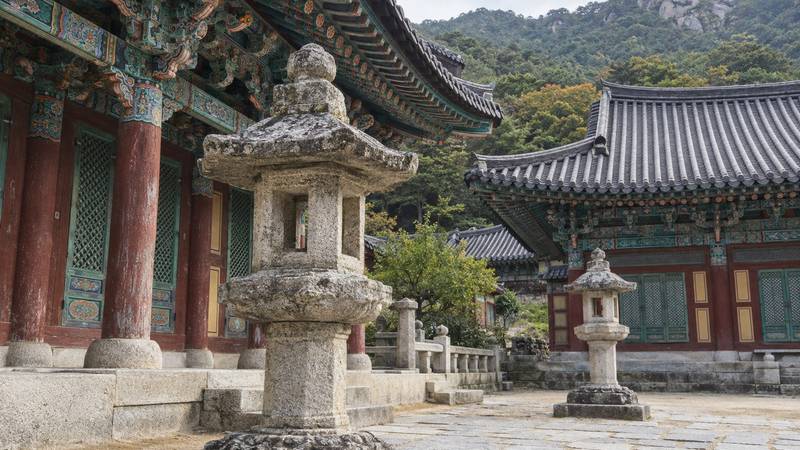
The temple has two parts: the old core around the main hall, and the modern Medicine Buddha plaza beside it.
- The old core. You pass under the Bongseoru pavilion to reach Daeungjeon, the main hall, a Treasure built in the late Joseon period. Its wooden pillars keep the natural curve of the tree trunks. The halls around it face a small courtyard.
- Tongil Yaksa Daebul. The Medicine Buddha statue is 33 m high, including a 13 m pedestal, and the temple calls it the world’s largest stone Buddha. It was carved from 1990 to 1992 as a prayer for Korean reunification. In front stand two stone pagodas 17 m high and two 7.6 m stone lanterns. The hall facing it, Tongil Giwon Daejeon, has no statue of its own; you look through a glass wall at the Buddha.
- Under the Buddha. The Beophwa Bogung hall, under the statue, holds golden panels of the Lotus Sutra. The temple’s Buddhist culture centre there also keeps relics of the Buddha.
- Seongbo Museum (성보박물관). The temple’s collection of Buddhist paintings, portraits of eminent monks, statues and ritual objects, on the ground floor and basement of the hall opposite the Buddha. Free; no photos and no food.
- Geungnakjeon. A late Joseon hall on Silla-period foundations, made a Treasure in 2021. In March 2026 the heritage authorities approved a full dismantling and repair after a safety inspection gave it an E rating. Expect the hall to be under repair or screened off; no dates have been published.
The temple’s grounds hold other heritage too: the twin three-storey pagodas of Geumdangam, next to Geungnakjeon, are a Treasure.
Hermitages above the temple
Several small hermitages sit in the woods above the main temple, and the nearest makes an easy add-on.
- Birobam (비로암), about 300 m south-west of the temple, keeps a seated stone Vairocana Buddha and a three-storey stone pagoda. Both date from the 9th century and are Treasures.
- Budoam (부도암) is about 600 m north and Naewonam (내원암) about 800 m north. Naewonam has a meditation hall for nuns, so do not walk into its practice area.
- Yeombulam (염불암), higher up the valley, sits on the trail towards Palgongsan’s main ridge. It is a mountain walk, not a stroll; get the current trail status from the national park before you set out.
Combining with Palgongsan
The Palgongsan cable car climbs from the Donghwasa side of the mountain to Sillimbong, at 820 m. The 1.2 km ride takes about 8 minutes. Fares, seasonal hours and the walks from the top station are in the Palgongsan cable car guide. Temple plus cable car fills a morning or an afternoon.
The Gatbawi stone Buddha, on a summit at the eastern end of the ridge, is a separate trip. Bus 401 serves it, or Palgong 3 at weekends. The climb takes about an hour each way on steep stone steps. Palgongsan’s leaves turn in late October and early November, when the buses are at their busiest; see autumn leaves in Korea and national parks.
Visiting manners
- Dress. Cover shoulders and knees; this is a monastery as well as a sight.
- Quiet. Speak softly, keep out of signed practice areas and ask before photographing monks.
- Inside halls. Take your shoes off at the door, and do not walk in front of people praying.
- Facilities. A bookshop sits under the Bongseoru pavilion, there is a coffee shop, and shops by both car parks sell snacks and souvenirs. Toilets are near the water fountain and under the Tongil Giwon Daejeon.
To spend a night in a temple, see temple stays in Korea. For more monasteries across the country, see temples in Korea and the Gyeongsang region guide.
Nearby
Palgongsan National Park
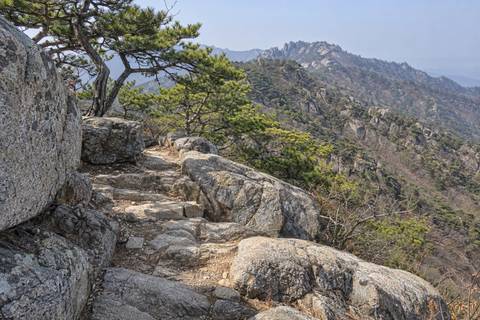
Granite ridge north-east of Daegu, a national park since December 2023; a cable car climbs to 820 m and leaves peak in late October.
Gatbawi Stone Buddha
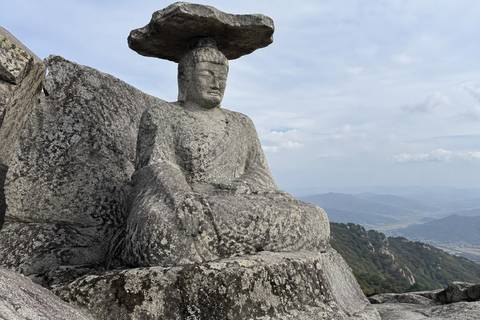
A seated stone Buddha with a flat stone 'hat' on a Palgongsan summit, reached by a 1.6 km climb of about an hour.
Frequently asked questions
Is Donghwasa free to visit?
Yes. Donghwasa was one of 65 temples that stopped charging a heritage entrance fee on 4 May 2023, and its Seongbo Museum has been free since 2012. Only parking is charged: ₩4,000 for a car, ₩10,000 for buses and vehicles of 2.5 t and over.
How do I get to Donghwasa from Dongdaegu Station?
Take city bus Express 1 (급행1), which the temple puts at about 45 minutes from Dongdaegu Station. It runs about every 13 minutes and ends at the Donghwasa facility area. Pay with a T-money card. Confirm the stop at the station in Naver Map or KakaoMap, since the temple's directions are older than the current stop names.
What are Donghwasa's opening hours?
The temple publishes no opening hours for the grounds, but says the 33 m Medicine Buddha is open 24 hours. The Seongbo Museum opens 10:00–16:00 and closes on Mondays. The Beophwa Bogung hall under the statue opens 10:00–17:00, with last entry at 16:00. Come in daylight to see the halls.
How tall is the Buddha at Donghwasa?
The Tongil Yaksa Yeorae Daebul, a stone Medicine Buddha, stands 33 m tall including its 13 m pedestal. The temple calls it the world's largest stone Buddha. It was built from 1990 to 1992 as a prayer for Korean reunification, with two 17 m stone pagodas in front.
Can I combine Donghwasa with the Palgongsan cable car?
Yes, both are on the Donghwasa side of Palgongsan, which makes a half-day trip from central Daegu. The cable car climbs to Sillimbong, at 820 m, in about 8 minutes. Adults pay ₩14,000 return; see the Palgongsan cable car guide for seasonal hours.
Sources
Facts on this page were checked against these sources on 15 November 2026. Prices, hours and rules change — confirm with the operator before you go.
- 동화사 – 관람안내 (주차요금 소형 4,000원 / 2.5톤 이상 및 대형버스 10,000원; 편의시설, 화장실, 주차장) (Korean) · official
- 동화사 – 찾아오시는길 (동대구역 도보 10분 → 파티마병원 → 급행1번 45분; 아양교역 → 급행1번 35분; 북부정류장 → 1시간) (Korean) · official
- 동화사 – 소개 (총림, 선원·율원·강원 100여 명 상주; 약사여래대불 24시간 개방; 불교문화관 진신사리) (Korean) · official
- 동화사 – 창건기 (493년 유가사, 832년 심지왕사 중창 때 겨울 오동나무꽃; 1606년 사명대사 중창, 영남도총섭) (Korean) · official
- 동화사 – 주요문화재 (약사여래대불 전체 33m·좌대 13m, 1990~1992; 삼층석탑 17m 2기, 석등 7.6m; 통일기원대전; 불교문화관) (Korean) · official
- 동화사 – 산내암자 (비로암 남서쪽 300m: 석조비로자나불·삼층석탑 보물; 부도암 600m; 내원암 800m 비구니 선원; 염불암) (Korean) · official
- 동화사 성보박물관 – 관람안내 (10:00~16:00, 동절기 동일; 매주 월요일 휴관; 2012년 5월부터 무료; 촬영 금지) (Korean) · official
- 동화사 법화보궁 – 관람안내 (10:00~17:00, 입장 16:00까지; 약사여래대불 아래) (Korean) · official
- 헤럴드경제 – 대구시, 단풍철 동대구역∼팔공산 동화사 급행버스 증차 운행 (2026-10-28; 20대→22대, 10월 31일~11월 15일 토·일) (Korean)
- 직썰 – 단풍철 팔공산 급행1번 버스 증편…주말 배차간격 10~11분 (2026-10-28; 평소 13분; 동화사 방면 급행1·팔공1, 주말 팔공3) (Korean)
- 매일신문 – 동화사·불국사·운문사 등 사찰 65곳 관람료 면제 (2023-05-04) (Korean)
- 서울신문 서울Pn – '안전 E등급' 대구 동화사 극락전 전면 해체 보수 (2026-03-27; 보물 극락전, 2021년 보물 승격; 금당암 동·서 삼층석탑 보물) (Korean)
- Discover Good Life – 대구 팔공산 8분 케이블카와 동화사 (2026-11-10; 케이블카 1.2km 편도 7~8분, 신림봉 820m; 대웅전 보물) (Korean)
- 위키백과 – 대구광역시의 시내버스 노선 목록 (급행1 동화시설집단지구 ↔ 매곡) (Korean)