Busan · Western coast (Saha, Seo-gu, Yeongdo)
Taejongdae 태종대
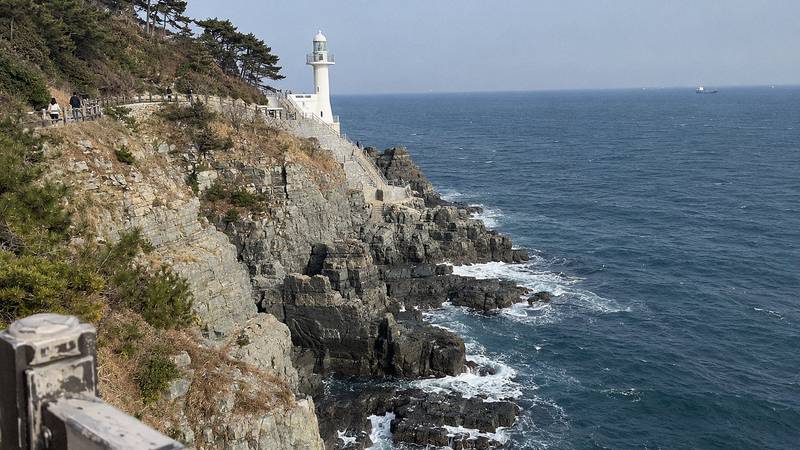
A wooded headland at the tip of Yeongdo with sea cliffs and a lighthouse; a free shuttle replaces the suspended Danubi road train.
Updated
Essentials
- Hours
- Park: 04:00–24:00 from March to October, 05:00–24:00 from November to February
- Shore areas (lighthouse pebble beach and coast): closed to the public from about 20:00 for military operations
- Free loop shuttle bus (replacing the Danubi train): Wednesday–Sunday 09:30–17:30, tickets from 09:10
- Closed
- The park is open every day. The shuttle does not run on Mondays and Tuesdays (may change over holiday periods) or in rain, typhoons and other bad weather
- Admission
- Free admission
- Shuttle bus: free, with a ticket for a specific run from the ticket office (first come, first served)
- Cars on the loop road: ₩2,000 per vehicle (daytime only for drivers with mobility needs)
- Getting there
- Busan Metro Line 1 to Nampo Station, Exit 6, then bus 8, 17, 30, 88 or 186 from the stop opposite Lotte Department Store to the Taejongdae stop, about 30 minutes (Busan Infrastructure Corporation)
- From Busan Station (Exit 7): bus 17, 88 or 101 from opposite the Kyowon Building to Taejongdae, about 40 minutes
- Address
- 24 Jeonmang-ro, Yeongdo-gu, Busan
부산 영도구 전망로 24 - Website
- bisco.or.kr/taejongdae
Book your trip
Taejongdae is a free clifftop park at the southern tip of Yeongdo with a lighthouse, sea cliffs and views toward Tsushima on clear days. The Danubi road train is suspended. A free shuttle bus replaces it Wednesday to Sunday, 09:30–17:30. Take bus 8, 30, 88 or 186 from Nampo Station Exit 6 and allow two to three hours.
Taejongdae (태종대) is a forested headland of about 1.6 km² at the end of Yeongdo, the island across the harbour from Busan’s old centre. A 4.3 km loop road runs through pine forest to the edge of sheer sea cliffs worn by the waves. The park is a national Scenic Site and part of Busan’s National Geopark. It fills the other half of a day spent at Jagalchi Fish Market and the Nampo markets.
Danubi train or shuttle: how you get around now
Most visitors used to ride the Danubi (다누비), a road train that circles the park and stops at the main sights. It has not run since 3 July 2026, when a carriage coupling broke and two passengers were hurt, three months after an April accident. A free shuttle bus now runs the same loop.
| Free shuttle bus (now) | Walking the loop | |
|---|---|---|
| When | Wed–Sun, 09:30–17:30; tickets from 09:10 | Any time the park is open |
| Cost | Free; take a ticket for a specific run at the ticket office | Free |
| Route | Danubi Plaza → Observatory (1.7 km) → Lighthouse (200 m) → Taejongsa (600 m) → Danubi Plaza (1.3 km) | Paved 4.3 km loop road, hilly |
| Hop on and off | Yes, at each stop | — |
| Catch | Tickets are first come, first served; no service Mon/Tue or in rain or typhoons | Two to three hours with stops; steep stairs down to the lighthouse |
Shuttle details from the Busan Tourism Organization, checked 21 October 2026. Three buses (one 30-seat, two 46-seat) run “until the safety inspection ends”. The shuttle leaves from Danubi Plaza, about 200 m uphill from the main-gate tourist information centre.
What could change: in August 2026 the Busan Tourism Organization started a study on whether to restart the train, for example with two carriages instead of three, or to switch to a different vehicle. It said it aims to settle a new plan within 2026 (Newsis, 18 August 2026). The old train timetable and fares on some sites, including Visit Busan’s travel tips, no longer apply. Check the Busan Tourism Organization page before you go.
If you come on a Monday or Tuesday, plan to walk. Following the shuttle route, the observatory is about 1.7 km from the plaza.
What you see on the loop
The shuttle stops follow the order most people walk the park:
- Observatory (전망대). A round viewing building on the cliff top, about halfway round the loop. It looks out to Oryukdo, and on clear days to Tsushima, about 56 km away. This is the main photo stop. The site was once known as “Suicide Rock”; the current building opened in August 1999.
- Yeongdo Lighthouse (영도등대). Down the stairs beside the observatory. Its light has burned since 1906. In 2004 a maritime culture space was added, with a gallery, a natural history exhibition and a lookout. Below it, Sinseon Rock is a broad, flat shelf of rock cut by the waves. Legend says a woman who waited there for her husband to return from the sea was turned to stone.
- Taejongsa (태종사). A Buddhist temple near the end of the loop. The park’s hydrangea festival is held here in early summer.
- Pebble beaches. Taewon Pebble Beach (태원자갈마당) is near the start of the loop, and stairways lead down to the rocks below the lighthouse. Like the rest of the shore, these are closed to the public from about 20:00.
Geologically, the cliffs are layers of sediment laid down in a lake at the end of the Cretaceous and then cut by the sea. You can see sea cliffs, wave-cut platforms and sea caves along the coast. More than 120 tree species grow in the forest, led by black pine.
Getting to Taejongdae
There is no subway on Yeongdo. Take a city bus from Nampo or Busan Station and get off at Taejongdae (태종대; some buses show it as 태종대온천, Taejongdae Spa, the end of the line).
| From | Bus | Time |
|---|---|---|
| Nampo Station Exit 6, stop opposite Lotte Department Store | 8, 17, 30, 88 or 186 | About 30 min |
| Busan Station Exit 7 (KTX), stop opposite the Kyowon Building | 17, 88 or 101 | About 40 min |
| Seomyeon, opposite Judies Taehwa | 88 | About 1 hour |
| Haeundae | Change buses (e.g. 1003 to Jungang-dong, then 88) | About 1 hr 20 min |
Routes and times from the Busan Infrastructure Corporation’s park site, checked 21 October 2026. A T-money card works on every route. Arriving on the KTX? Bus 17, 88 or 101 from Busan Station takes you there without a change.
By taxi, show the address 부산 영도구 전망로 24. Visit Busan lists two paid car parks for cars (Parking Lot 7 and Jayoo Land); the main-gate car park is for buses only. Driving the loop road costs ₩2,000 per car. In the daytime only cars carrying passengers with mobility needs may enter; at night any car may.
Hours and fees
| Park | 04:00–24:00 (March–October), 05:00–24:00 (November–February), every day |
| Shore areas | Closed to the public from about 20:00 (military operations) |
| Shuttle bus | Wed–Sun 09:30–17:30, tickets from 09:10 |
| Admission | Free |
Hours from the Busan Infrastructure Corporation, shuttle from the Busan Tourism Organization, both checked 21 October 2026. Winter hours start on 1 November. The road stays open until midnight, but you can’t go down to the lighthouse rocks after dark.
Tips for visiting
- Go early on weekends. Shuttle tickets are issued per run, and good-weather weekends sell out first. Collect yours from 09:10.
- Check the weather. The shuttle stops in rain and typhoons, and the cliff top is exposed to strong wind.
- Wear proper shoes. The road is paved, but the stairs down to the lighthouse and the rocks are steep, and the rocks are wet near the water.
- Strollers and wheelchairs are lent free at the main-gate tourist information centre, 10:00–17:00, with ID. They are not lent in snow, rain or high winds.
- Clear mornings for Tsushima. The island is only visible in very clear air, so don’t count on it.
- Food: small convenience stores stand near the main square and at Taejongsa. For a proper seafood meal, go back to Jagalchi in Nampo.
A short history
The name means “King Taejong’s terrace”. One legend says King Taejong Muyeol of Silla came here to practise archery. Another says a Joseon king, Taejong, prayed for rain here in a drought in 1419. From the Japanese colonial period, the headland was used as a military fortress and closed to the public. It became a public resort in 1967 and a tourist site in 1969. It was listed as a national Scenic Site (Myeongseung No. 17) on 1 November 2005 and certified as part of Busan’s National Geopark on 6 December 2013.
Around Taejongdae
Taejongdae is on Busan’s western coast. On the same island, Huinnyeoul Culture Village is a cliffside lane of white houses and cafes, reached by bus via Nampo. Across Yeongdo Bridge, Jagalchi Fish Market, Gukje Market and BIFF Square fill the evening. Across the bay to the west, Songdo Beach has a sea cable car, and Gamcheon Culture Village is on the hills behind it. For a two-day plan and where to stay, see the Busan city guide and the Busan region page.
Nearby
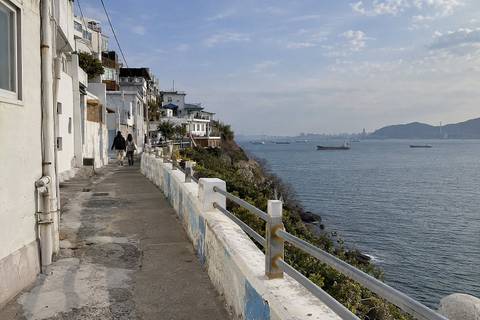
Huinnyeoul Culture Village
A cliffside lane of white houses and cafes on Yeongdo, looking straight out over anchored cargo ships.
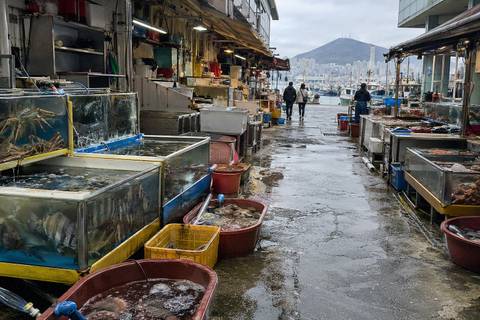
Jagalchi Market
Korea's best-known seafood market, with live tanks downstairs and restaurants upstairs that cook what you pick.
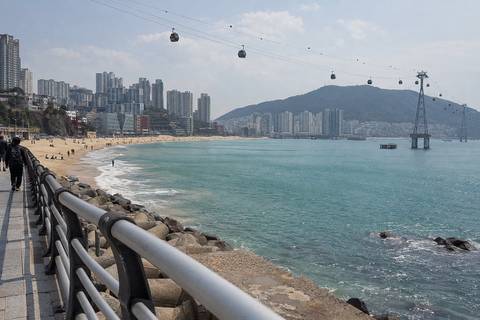
Songdo Beach and Cable Car
Busan's first public beach, crossed by a sea cable car and a curving skywalk over the water.
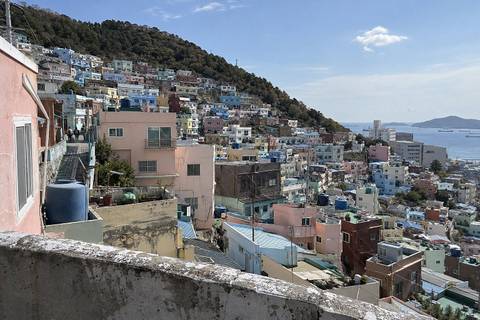
Gamcheon Culture Village
Pastel houses stacked on a steep hillside, linked by stairs and alleys dotted with murals and small galleries.
Frequently asked questions
Is the Danubi train at Taejongdae running?
No. The Danubi road train stopped after an accident on 3 July 2026, its second in four months. A free shuttle bus runs the same loop instead, Wednesday to Sunday, 09:30–17:30. The Busan Tourism Organization is studying whether to restart the train with fewer carriages or replace it. Checked 21 October 2026.
Is Taejongdae free?
Yes. Entry to the park is free, and so is the temporary shuttle bus. You collect a free ticket for a specific run at the ticket office near Danubi Plaza. Tickets are first come, first served and can run out at weekends.
How do I get to Taejongdae from Nampo or Busan Station?
From Nampo Station Exit 6, take bus 8, 17, 30, 88 or 186 from the stop opposite Lotte Department Store, about 30 minutes. From Busan Station Exit 7, take bus 17, 88 or 101, about 40 minutes. Get off at Taejongdae (태종대, also shown as 태종대온천).
Can you walk around Taejongdae without the shuttle?
Yes. The loop road is about 4.3 km and paved, and walking it is the only option on Mondays and Tuesdays, when the shuttle does not run. The road climbs and falls through forest, so wear proper shoes and allow two to three hours with stops.
How long should I spend at Taejongdae?
Allow two to three hours: the observatory, the lighthouse and the steps down to the rocks, and Taejongsa temple. Add the bus time from Nampo, about 30 minutes each way. Huinnyeoul Culture Village, also on Yeongdo, fits on the same half-day.
Sources
Facts on this page were checked against these sources on 21 October 2026. Prices, hours and rules change — confirm with the operator before you go.
- 부산관광공사 – 태종대유원지 (다누비열차 안전점검으로 미운행, 무료 순환버스 운행 안내: 수–일 9:30~17:30, 매표 9:10~, 월·화 휴무, 3.8km 순환) (Korean) · official
- 부산시설공단 태종대유원지 – 개방시간 (하절기 04:00~24:00, 동절기 05:00~24:00, 해안가 20:00경 이후 통제) (Korean) · official
- 부산시설공단 태종대유원지 – 찾아오시는 길 (남포역 6번 출구 8·17·30·88·186번, 부산역 7번 출구 17·88·101번) (Korean) · official
- 부산시설공단 태종대유원지 – 태종대유원지 소개 (명승, 국가지질공원, 연혁, 지명 유래) (Korean) · official
- 부산시설공단 태종대유원지 – 차량개방 (순환도로 4.3km, 차량 1대당 2,000원) (Korean) · official
- 부산시설공단 태종대유원지 – 편의 및 휴게시설 (유모차·휠체어 무료 대여 10:00~17:00, 전망대) (Korean) · official
- 비짓부산 – 태종대 유원지 (이용요금 무료, 교통정보, 주차, 영도등대) (Korean) · official
- Visit Busan – Taejongdae Park (overview, free admission, buses, parking) · official
- 뉴시스(네이트) – 잇단 사고 났던 태종대 다누비열차…운영 전면 재검토 (2026-08-18) (Korean)
- 아던트뉴스 – 무료 순환버스 타고 떠나는 해안 절벽 산책 코스 (태종대, 2026-09-15) (Korean)
- OpenStreetMap – 태종대유원지 (park area, coordinates)