Busan · Nampo and Jung-gu
Gukje Market 국제시장
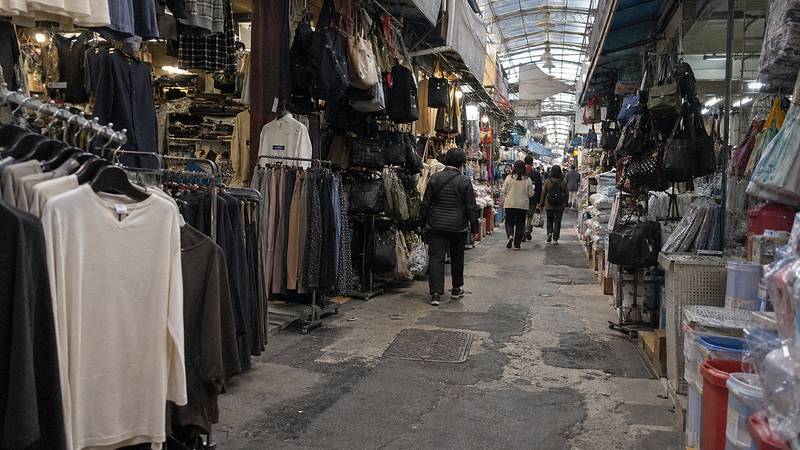
A sprawling postwar market of covered alleys selling clothes, kitchenware and street snacks.
Updated
Essentials
- Hours
- About 09:00–20:00; each shop sets its own hours (Visit Busan and the Jung-gu district office)
- Closed
- Sundays — the two official listings differ: the Jung-gu district office gives the 1st and 3rd Sunday of each month, while Busan's official tourism site lists every Sunday. Plan your visit for Monday to Saturday.
- Admission
- No entry fee. Shops and food stalls set their own prices
- Getting there
- Busan Metro Line 1, Jagalchi Station Exit 7, about 7 minutes on foot
- City buses 15, 40, 86, 126 or 186 to the Gukje Market stop, then about 4 minutes on foot
- From Busan Station (KTX) take Line 1 toward Sinpyeong to Jagalchi, about 10 minutes
- Address
- 32 Junggu-ro, Jung-gu, Busan
부산 중구 중구로 32
Book your trip
Gukje Market is free to wander and open about 09:00–20:00, but it is largely shut on Sundays, so go Monday to Saturday. It is a maze of covered alleys selling hanbok, bedding, kitchenware and street snacks, about 7 minutes on foot from Jagalchi Station Exit 7 on Line 1. Allow about an hour.
Gukje Market (국제시장, “International Market”) is the biggest of the old markets in Busan’s harbour district of Nampo. It is not one building but a grid of two-storey market blocks and the alleys between them, joined by numbered footbridges overhead. Most visitors come for the atmosphere and the snacks rather than to shop, and pair it with Jagalchi Fish Market and the evening night market at Kkangtong next door.
Gukje, Jagalchi or Kkangtong: which market when?
The three markets sit within a few minutes’ walk of each other, so the real question is the order and the day.
| Market | Hours | Closed | Best for | Nearest exit |
|---|---|---|---|---|
| Gukje Market | about 09:00–20:00 | Sundays (see below) | Wandering the alleys, cheap snacks, film location | Jagalchi Exit 7, ~7 min |
| Jagalchi Market | about 05:00–22:00 | 1st, 3rd and 5th Tuesday | Live seafood and raw-fish meals | Jagalchi Exit 10, ~6 min |
| Bupyeong Kkangtong night market | 19:30–24:00 | Open every day | Evening street food | Jagalchi Exit 3, ~9 min |
Hours from Visit Busan and the Jung-gu district office, checked 20 October 2026. Individual shops keep their own hours. The simplest plan is Gukje in the afternoon, an early dinner at Jagalchi, then the Kkangtong night market from 19:30 — on any day except Sunday (Gukje) or a closing Tuesday (Jagalchi).
Hours and the Sunday question
Both official listings give 09:00–20:00, with hours differing from shop to shop. Because each shop keeps its own hours, arrive by mid-afternoon to find most of them open.
The rest day is less clear-cut. The Jung-gu district office, which administers the area, lists the 1st and 3rd Sunday of each month as closed; Visit Busan, the city’s official tourism site, lists Sunday as the closing day. Because the two official sources disagree, do not make Sunday your only Nampo day. The next 1st and 3rd Sundays are 1 and 15 November and 6 and 20 December 2026.
What you find inside
The district office describes the market by section (gonggu), each with its own trades. It is a wholesale and retail market, so anyone can buy.
| Section | Mainly sells |
|---|---|
| 1 | Bags, stationery, crafts |
| 2 | Kitchenware, ironware, glasses shops |
| 3 | Bedding and clothing |
| 4 | Fabrics, silk and kitchenware |
| 5–6 | Home appliances, tools and fabrics |
From the Jung-gu district office’s market guide, checked 20 October 2026. If you want one souvenir errand here, the hanbok and bedding alleys are the most distinctive; for the rest, simply walk and look.
- The footbridges. Climb onto the bridges that link the market buildings; the numbers painted on them tell you where you are, and they give the best view down the alleys.
- Street food. Visit Busan points to stall snacks eaten on low stools: chungmu gimbap (plain rice rolls with spicy squid and radish), bibim dangmyeon (glass noodles in a spicy sauce), fish cakes, tteokbokki, fritters and sundae (blood sausage).
- The film. The 2014 hit Ode to My Father takes its Korean title (국제시장) from the market and is centred on it. Kkotbunine (꽃분이네), a shop featured in the film, is a popular photo stop and a good starting point.
- Payment. Korea Tourism Organization data says credit cards are accepted; carry some cash for the food stalls.
Getting there
Take Busan Metro Line 1 to Jagalchi Station and leave by Exit 7; the market is about 7 minutes on foot. From Busan Station, where the KTX from Seoul arrives, Line 1 toward Sinpyeong reaches Jagalchi in about 10 minutes. City buses 15, 40, 86, 126 and 186 stop at Gukje Market, about 4 minutes from the alleys. A T-money card works on Busan’s metro and buses.
The address for taxis is 부산 중구 중구로 32. Visit Busan notes ramps, a lift, accessible toilets and accessible parking. The district office lists a 72-space car park, but Nampo’s narrow streets are slow and the metro is easier.
Tips for visiting
- Weekday afternoons work best. All shops are open and you can finish at the Kkangtong night market when it starts at 19:30.
- Use the bridge numbers to navigate. The alleys look alike; note the number of the bridge nearest to where you entered.
- Ask before photographing a stall up close. These are working shops, and the alleys are narrow, so step aside for delivery carts.
- Combine it with the neighbours. BIFF Square and its sweet seed pancakes (ssiat hotteok) are next door, and Bosu-dong’s secondhand-book alley is a short walk away.
A short history
Trading here began with liberation in 1945, when departing Japanese residents sold off goods and the empty lot filled with stalls. People called it the dottegi market, a Busan word for a heaving, anything-goes bazaar that still means “packed and chaotic”. During the Korean War, when Busan was the refugee capital, refugees opened shops here and US military goods and imported products passed through on their way to markets across the country. The name “International Market” reflects that trade in foreign goods, and the district office calls it the symbol of the years when Busan was Korea’s biggest trading city.
Around the market
Gukje sits in the old harbour district of Nampo and Jung-gu. Jagalchi Market is a short walk south on the waterfront, and Yongdusan Park with Busan Tower is a short walk east. Gamcheon Culture Village is a short bus or taxi ride west, an easy morning before a Nampo afternoon. For how Gukje compares with Seoul’s Namdaemun and Gwangjang, see markets in Korea; for day trips and other cities, see the Busan region page.
Nearby
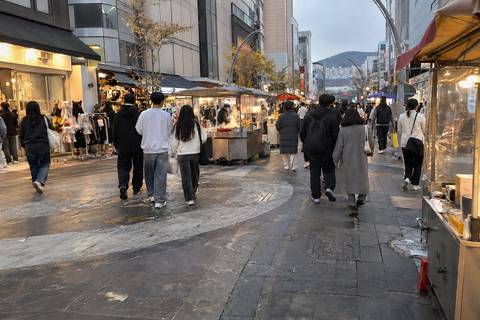
BIFF Square
Pedestrian street tied to the Busan International Film Festival, now best known for its street-food carts.
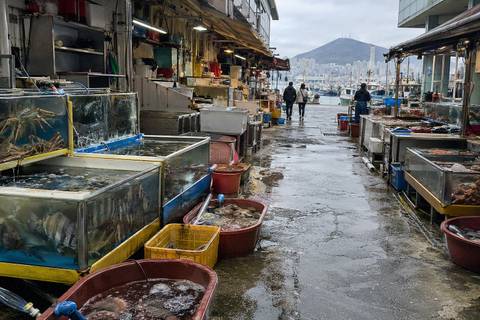
Jagalchi Market
Korea's best-known seafood market, with live tanks downstairs and restaurants upstairs that cook what you pick.
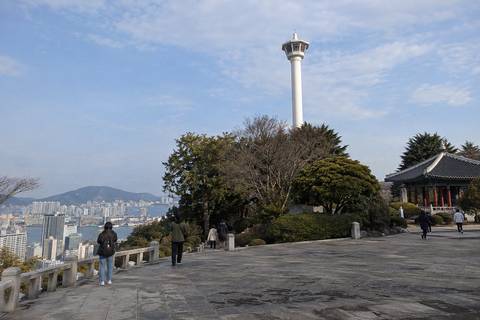
Yongdusan Park and Busan Tower
A hilltop park reached by outdoor escalators, topped by a tower with views over the port and Nampo.
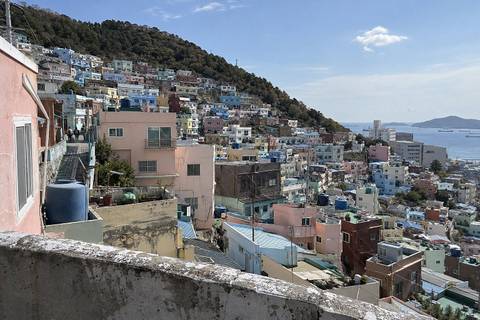
Gamcheon Culture Village
Pastel houses stacked on a steep hillside, linked by stairs and alleys dotted with murals and small galleries.
Frequently asked questions
Is Gukje Market open on Sundays?
Mostly not. The Jung-gu district office lists the 1st and 3rd Sunday of each month as rest days, and Busan's official tourism site lists Sunday as the closing day. Because the official sources differ, plan your visit for Monday to Saturday.
What are Gukje Market's opening hours?
About 09:00 to 20:00, according to both Visit Busan and the Jung-gu district office. Each shop keeps its own hours, so late afternoon is a safer limit than 20:00 if you want to see the alleys busy.
How do I get to Gukje Market?
Take Busan Metro Line 1 to Jagalchi Station and leave by Exit 7; the market is about 7 minutes on foot. From Busan Station the ride on Line 1 takes about 10 minutes. Buses 15, 40, 86, 126 and 186 stop at Gukje Market.
Is Gukje Market worth visiting?
Yes, as part of a Nampo afternoon. It is less about buying than about walking a maze of specialist alleys, eating cheap market snacks and seeing the setting of the film Ode to My Father. Allow about an hour, then walk on to Jagalchi or the Kkangtong night market.
What is the difference between Gukje Market and Kkangtong Market?
They are neighbours in Nampo. Gukje is a daytime market of clothes, bedding, kitchenware and electronics, open about 09:00–20:00. Bupyeong Kkangtong Market next door is known for fish cakes and imported goods, and its night market runs every evening from 19:30 to 24:00.
Sources
Facts on this page were checked against these sources on 20 October 2026. Prices, hours and rules change — confirm with the operator before you go.
- Visit Busan – Gukje Market (hours, closing day, transport, accessibility) · official
- 비짓부산 – 국제시장 이용안내 (주소·휴무일·운영시간·교통정보) (Korean) · official
- 부산 중구청 – 중구명소: 국제시장 (이용시간 09:00~20:00, 1·3주 일요일 휴무, 주차 72대, 역사·공구 안내; 최종수정 2026-08-27) (Korean) · official
- 부산 중구청 – 중구명소: 부평깡통야시장 (야시장 19:30~24:00, 2013년 10월 개장) (Korean) · official
- Visit Busan – Bupyeong Kkangtong Market (night market hours, transport) · official
- 비짓부산 – 부평깡통시장 이용안내 (Korean) · official
- K-Trip Tips (Korea Tourism Organization data) – 국제시장 (영업시간·휴일·신용카드; 수정 2025-04-17) (Korean)
- 서울신문 – 영화 '국제시장' 흥행 바람… 부산 관광상품으로 만든다 (2015-01-03) (Korean)
- OpenStreetMap – 국제시장 (coordinates)